Chapter	3		
Media	And	Representa1on	of	
Femininity	&	Masculinity		
Ms.	Jagri1	Shankar	
Course:	Gender	and	Media	
Dept.	of	Women’s	Studies,	Goa	University
Objec1ve	
In	the	previous	session	we	understood	that	media	plays	
a	major	roles	in	condi0oning	our	brains	to	gender	
norms.		
	
In	this	session	we	will	discuss	how	media	portrays	
femininity	and	masculinity.	What	roles,	behavior,	and	
gender	rela0ons	of	women	and	men	are	repeatedly	
shown	in	the	mass	media.	How	does	it	differ	from	the	
‘real	women	and	men’?
Outline	
•  Traits	of	Femininity	and	masculinity	
•  PaOerns	of	portrayal	of	women’s	roles	in	
media	
•  PaOerns	of	portrayal	of	men’s	roles	in	media	
•  PaOerns	of	gender	rela1ons	
•  How	different	is	reality	from	media	portrayal
Media	Creates	New	‘Normal’	
•  Creates	a	Life-Like	scenario/experiences/
characters	where	we	relate	ourselves	
•  AVer	iden1fying/rela1ng	with	them	we	start	
to	imitate	them	
•  The	process	creates	myths	and	stereotypes,	
and	the	environment	(circula1ng	endless	
1mes)	to	sustain	them	
•  Creates	defini1on	of	NORMAL
Social	construc0on	of	Gender	
INSTITUTIONS	
	
• 	Family	
• 	Religion	
• 	Caste/class	
• 	State	
• 	Market	
• 	Media	
Define	
Roles	
Behavior	
Valua0on	
CONTROLS	
	
• Resources	
• Mobility	
• Sexuality	
• Fer1lity	
Media	defines	roles,	behavior	through	defining	masculinity/femininity
Father	
Husband	
Brother	(in	law)	
Son	(in	law)	
Ac1ve/	Aggressive/	Daring	
Strong/	In-Charge	
Take	control	of	situa1on/	
Lead	Others/	Have	liberty	to	
break	rules,	find	new	path	
High	Importance/	Respect	
Media	portrayal	of	Masculinity	
Quali1es	
Behaviour	
Value
Mother	
Wife	
Sister	(in	law)	
Daughter	(in	law)	
Passive/Submissive	
Domes1cated/	caring	
Delicate/Beau1ful	
Agree	with	societal	norms/	
behave	under	standard	
expecta1ons	of	society/	not	
expected	to	stretch	their	limits	
and	remain	in	boundary	
Work	they	do	in	house	
is	not	of	much	value/no	
monetary	importnace		
Media	Portrayal	of	Femininity	
Role	
Quali1es	
Behaviour	
Value
Discussion	on	Third	Gender/LGBT	is	
purposely	missed	out	to	create	the	
impression	that	they	don’t	exist	
Or,	these	roles	are	ridiculed
Life	Cycle	of	a	Girl/Women	on	TV?
What	Works	Women	do	in	Reel	Life?
Our	role	models	on	TV	
What	do	these	women	do	other	than	being	good	wife/
mother/bahu?
Women’s	Roles	in	Real	Life	(opp	reel	
life)	
•  Novelists	
•  Journalists	
•  Writers	
•  Directors	
•  Producers	
•  Financers	
•  Painters	
•  Sculpture	ar1sts	
•  Event	managers	
•  Poets	
•  Singers	
•  Dancers	
•  Actresses	
•  Folk	Ar1sts	
•  Presenters	
•  Anchors	
•  Photographers	
•  And	many	
more……	
•  Sports	persons	
•  Doctors	
•  Nurses	
•  Entrepreneurs	
•  Interior	
decorators	
•  Teachers	
•  Cook	
•  IT	coders	
•  Developers	
•  Fashion	
Designers
•  Even	if	story	says	that	women	are	scien1st/
professors,	it	never	shows	women	in	their	
professional	sebngs/uniforms/doing	
professional	tasks	
•  Their	sebngs	are	at	home,	par1cularly	
kitchens	or	bedrooms	or	serving	food
Media	Creates	Norms	for	Women	
•  What	women	should	wear?	
•  How	should	women	behave?	
•  When	and	where	women	can	go	and	
how?
PaTerns	of	Women’s	Portrayal		
•  3	Projected	Roles:-		
–  Biological	
–  Domes1c		
–  Decora1ve	
•  Most	successful	female	leads	are	in	roles	of	
wife/mother	
•  Women	are	there	to	support	the	patriarchy/	
family	system	as	obedient	wife/daughter	(law)		
•  Women	add	glamour	to	products/movie/
serial
•  Women’s	first	priority	is	‘Home/Family/Children’	
•  They	are	happy	&	fulfilled	in	serving	men/family	
•  Women	can	not	survive	without	men	
•  When	women	say	‘NO’,	it	is	‘Yes’	(‘PINK’)	
•  The	value	girls/women	care	most	is	looking	‘thin’	&	
‘beau1ful’.	
•  Girls	are	dying	to	get	boys’	aOen1on	
•  Women	are	sacrificing/	submissive/	passive	
Think	of	TV	Serials/	Movies	which	promote	these	
messages		
Other	Norms	Set	for	Women
Symbols	
1.  Maa	
Mere	paas	maa	hai
Symbols	
2.  Pa1vrata	&	Mangalsutra
Symbols	
3.  Karva	Chauth
Symbols	
4.  White	clad	widow
Reel	to	Real	
•  Women	do	not	have	the	luxury	to	be	decorated	
all	the	1mes	(triple	roles)	
•  Women	are	far	more	intelligent	than	shown	on	
screens	
•  Women	are	not	safe	on	streets,	homes,	offices	
•  Women	have	to	put	double	efforts	to	get	the	
approval	of	the	work	than	a	man		
•  Widowed	women	carry	on	their	lives	with	hard	
work	and	grace	
•  Female	fe1cide,	child	marriages	s1ll	exist	and		
child	pornography	is	on	the	rise
“A	maOer	of	grave	concern	is	that,	when	it	comes	to	
films,	women	are	shown	to	be	completely	dormant,	
totally	subservient	persons.	It	reinforces	the	no1on	
that	Indian	women	are	supposed	to	be	that.		
	
I	think	the	only	way	in	which	we	can	counter	these	
images	is	to	portray	a	woman	not	just	as	a	body	but	
also	an	intelligent	being”	–	Shabana	Azmi
Media	Portrayal	of	Masculinity
Father	
Husband	
Brother	(in	law)	
Son	(in	law)	
Ac1ve/	Aggressive/	Daring	
Strong/	In-Charge	
Take	control	of	situa1on/	
Lead	Others/	Have	liberty	to	
break	rules,	find	new	path	
High	Importance/	Respect	
Media	portrayal	of	Masculinity	
Quali1es	
Behaviour	
Value
Masculine	Characteris1cs	
Stereotypic	Characteris/cs	
•  heterosexual	
•  logical	thinkers		
•  think	rather	than	feel		
•  take	charge	of	situa1ons		
•  loners		
•  protect	women	and	children		
•  aggressive		
•  adventurers,	take	risks		
•  worldly	wise		
Non-Tradi/onal	Characteris/cs	
•  sensi1ve	to	feelings		
•  work	with	others		
•  accept	help		
•  emo1onally	expressive		
•  caring	for	children		
•  having	harmonious	rela1onships		
•  engaging	in	home-related	
ac1vi1es		
•  having	non-sexual	friendships	with	
women
Masculinity	stereotypes	
•  Stereotypes	define	what	men	can	be	and	do.	
•  Men	in	key	"posi1ve"	and	“Lead”	roles	are	portrayed	
chiefly	with	narrow	masculine	traits	
•  Media	stereotypes	affect-	
– Society’s	expecta0ons	of	men’s	behaviour	
– Women’s	expecta0ons	of	men	in	rela1onships	
– Men’s	expecta0ons	of	other	men	in	social	or	
professional	sebngs	(controlling,	coopera1ng)	
– Media	tells	us	what	a	successful	man	is
Masculinity		
•  Sexual	stereotyping	begins	early	in	men's	lives.	Boys	
learn	what	it	means	to	be	a	man	from	family	and	
peers.		
•  Bravery,	adventurousness,	being	able	to	think	
ra1onally,	strong	and	effec1ve-	"manly"	traits	are	
encouraged.	
•  Being	emo1onal,	understanding,	soV,	caring	is	usually	
mocked	upon.	
•  Narrow	masculine	standards	discourage	men	to	
coopera0vely	without	controlling,	to	love	in	a	
nonsexual	way,	or	to	solve	conflicts	without	violence.
Less	than	a	real	man	
•  "Less	manly"	characteris1cs	are	usually	
displayed	by	suppor1ng	characters	
•  The	flaws	in	the	personality	of	the	suppor1ng	
character	jus1fies	that	he	is	not	‘real’	or	
‘complete	man’,	and	thus	not	a	hero.
Elderly	Men	Vs.	Women	
•  Older	men	are	seen	as	dis1nguished	while	
older	women	are	seen	as	worn	out.	Their	life	
experiences	do	not	maOer	much.	
•  Older	women	are	seen	as	mere	watchdogs	of	
culture	and	patriarchal	values.
Does	Media	set	these	Norms	for	Men?	
•  Men	should	be	metro-sexual/heterosexual	
•  Men	are	the	authority,	they	set	the	rules	
•  Men	should	control	women	
•  Man	is	the	head	of	household	
•  Men	should	teach	women	a	lesson	if	they	are	not	
behaving	(promotes	domes1c	violence)	
•  A	real	man	should	be	aggressive	
Think	of	TV	Serials/	Movies	which	promote	these	
messages
Discussion	
Have	you	seen	women	with	masculine	traits,	or	
men	with	feminine	traits?	How	does	society	
reacts	to	it,	and	why?
Take	each	other’s	role	
•  When	men	do	any	work	
in	house	they	are	obliging	
women,	bcoz	house	work	
is	women’s	responsibility	
•  When	women	is	working	
professionl,	independent,	
and	career	oriented	
–  she	is	ignoring	family	
–  she	is	characterless	
–  she	cannt	be	a	good	
mother/wife	(self-oriented)
Many	masculini1es/feminini1es	
•  Not	one	single	representa1on	of	femininity/
masculinity	in	the	media.	
•  Depending	on	the	genre	(movie,	television,	
news,	documentary),	the	historical	period,	
there	may	be	a	mul1tude	and	range	of	
representa1ons.	
•  They	stretch	gender	roles	&	rela1ons,	but	
upper	limit	is	set	
Can	you	give	examples?
Shall	we	ask	these	ques0ons?	
•  How	come	mother-in-law	and	daughter-in-law	
always	fight?	Why	not	Father	–Son,	Father-in-
law-Son-in-law?	
•  Why	women	can’t	be	friends	to	each	other?	
Think	about	the	friends	you	or	your	mother	has	
in	real	life.	
•  How	come	one	daughter/daughter-in-law	is	
always	scheming?	how	many	such	people	u	see	
in	real	life?	
•  Why	children	are	always	mother’s	
responsibility?	Aren’t	they	joint	responsibility?
Result	of	portrayal	of	gender	
stereotypes	on	women?		
•  A	crude	defini1on	of	‘Normal’	is	set	
•  Marginalisa1on	of	women’s	work	
•  Provides	public	sanc1on	to	men	for	abuse	
•  Ignorance	and	a	blind	eye	towards	and	
women’s	real	issues
Result	of	portrayal	of	gender	
stereotypes	on	men?		
•  A	crude	defini1on	of	‘Normal’	is	set	
•  They	do	not	have	liberty	to	being	human	
•  It	limits	their	personal	growth	
•  Limits	the	professional	growth	too	
•  Being	‘Less	manly’	hurts		
•  Unable	to	live	up	to	expecta1ons	of	society,	
peers,	women	of	their	life
How	should	the	Portrayal	be?	
•  Women	and	men	as	‘normal’	human	being	(not	
in	super	human	roles)	
•  Women	having	her	own	life	aspira1ons	and	
needs	
•  Women	as	equal	member	of	civiliza1on	
•  Women	respected	for	‘what	she	is’	rather	than	
‘what	she	should	be’	
•  Society	having	men	and	women	as	equal	partners		
•  Changing	not	only	the	media	but	also	the	‘minds’
More	on	Gender	Rela1ons	and	Story	
lines..
Patriarchy	
•  Patriarchal	male	figure	
•  Patriarchal	values	
•  Women	as	bearer	of	
patriarchy
Hero-centric	
•  Male	audience’s	point	of	
view.		
•  Heroine	is	secondary	to	
the	hero,	devoid	of	any	
independent	existence.		
•  Controlling	figure	is	hero,	
villain,	father,	boss.	
•  Essence	of	movie	is	
hero’s	experiences,	
dreams,	stories,	revenge,	
angst,	ambi0ons	etc.
Adultery		
•  Adultery	&	extra-
marital	affairs	are	Okay	
for	men	but	not	for	
women	
•  Women	are	blamed	for	
men’s	adultery	
•  Men’s	adultery	are	
taken	in	lighter	way	but	
not	women’s.
Damsel	in	distress		
•  The		Man	is	the	savior	and	the	
woman	is	the	vic1m	and		
needs	to	be	rescued,	are	
popular	theme	of	Hindi	
cinema	discourse.	
•  Woman	of	substance	is	
missing	from	such	portrayals,	
the	women	who	can	lead	her	
life	independently	and	take	
decisions	without	relying	on	
any	male.		
•  In	such	a	scenario,	women	are	
seen	to	be	not	just	physically	
inferior	to	men	but	also	
intellectually	inferior.
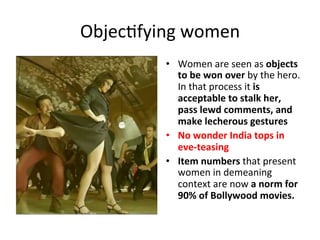
Objec1fying	women	
•  Women	are	seen	as	objects	
to	be	won	over	by	the	hero.	
In	that	process	it	is	
acceptable	to	stalk	her,	
pass	lewd	comments,	and	
make	lecherous	gestures	
•  No	wonder	India	tops	in	
eve-teasing		
•  Item	numbers	that	present	
women	in	demeaning	
context	are	now	a	norm	for	
90%	of	Bollywood	movies.
•  Objec1fica1on	more	broadly	means	trea1ng	a	
person	as	a	commodity	or	an	object	without	
regard	to	their	personality	or	dignity.	
•  Sexual	objec0fica0on	is	the	act	of	trea1ng	a	
person	as	an	instrument	of	sexual	pleasure.
References-1	
•  Masculinity	and	Popular	Hindi	Cinema:	An	Interpreta1ve	Explora1on.	Source:	
hOp://shodhganga.inflibnet.ac.in/bitstream/10603/16425/8/08_chapter%203.pdf	
•  Perumpally,	Leela	(2010).	“Mediated	Images	of	Women	and	their	Gender	Status	in	
Contemporary	Society”,	in	Kiran	Prasad	(Ed)	Women	and	Media:	Challenging	
Feminist	Discourse	
•  Kaptan,	S.	“Women	and	Media”	in	“Women	in	Adver1sing”	
•  Representa1on	of	Women’s	Iden1ty	in	Bollywood”	,	Source:	
hOp://shodhganga.inflibnet.ac.in/bitstream/10603/22634/10/10_chapter_4.pdf	
•  Bagchi,	Amitabha	(1996),	Women	in	Indian	Cinema.	Online	at:	
hOp://www.cs.jhu.edu/~bagchi/women.html	
•  Sarkar,	Srijita	(2012),	"An	analysis	of	Hindi	women-centric	films	in	India”	Electronic	
eses	and	Disserta/ons.		
•  Tere	S.	Nidhi	(2012),	“Gender	reflec1ons	in	mainstream	hindi	cinema”,	Global	
Media	Journal	–	Indian	Edi1on	Vol.	3/No.1		
•  Ahmed,	S.	Akbar	(1992).	‘Bombay	Films:	The	Cinema	as	Metaphor	for	Indian	
Society	and	Poli1cs’.	Modern	Asian	Studies	26,	2	(I992)	
•  Laura	Mulvey	(1988),	‘Visual	Pleasure	and	Narra1ve	Cinema’.	In	Constance	Penley	
(ed),	Feminism	and	Film	Theory,	New	York:	Routledge
References-2	
•  Canada’s	Centre	for	Digital	and	Media	Literacy,	Training	Manual	on	
Gender	Stereotypes	and	Body	Image,	online	at:	hOp://
mediasmarts.ca/lessonplan/gender-stereotypes-and-body-image-
lesson	
•  Sob1	Sukri1	(2013),	“From	Macho	to	Metrosexual:	Change	in	Image	
of	the	Hindi	Film	Hero”,	online	at:	hOp://literophile.org/?p=272	
•  Femiano	S	and	Nickerson	Mark,	“How	do	Media	Images	of	Men	
Affect	Our	Lives?”,	Center	for	Media	Literacy,	online	at:	
hOp://www.medialit.org/reading-room/how-do-media-images-
men-affect-our-lives	
•  The	Cri1cal	Media	Project,	online	at:	www.cri1calmediaproject.org/
cml/topicbackground/gender/femininity
Thank	you!
Chapter	4		
Gender	in	Indian	Movie	DDLJ
Watch	movie	with	a	gender	lens	and	
discuss			
1.  Patriarchal	Indian	family	
2.  Different	gender	condi1oning	messages	to	
son	&	daughter	
3.  Holding	Na1onal	Iden1ty	&	values	when	
overseas	
4.  Value	to	sanc1ty/chas1ty	of	girls	
5.  Male	as	the	agents	of	change

Ch3-4-Masculinity_Femininity_Norms_in_Media