www.avijeetsuryavanshi.blogspot.com
Avijeet PSuryavanshi | Consultant |
www.avijeetsuryavanshi.blogspot.com
All rights reserved with respect to all dispositions.
Qualified Bachelor of Engineering in Mechanical Engineering from
Institute of Engineering and Technology, University of Agra, Agra
India, under taking Gov. of India, and MBA in Operations and
Supply chain Management from Pondicherry University,
Pondicherry India. Member of Indian Value Engineering
Society(NIMA2003) India, Writer.
Have significant understanding of Automotive, Computer Aided Design and Engineering
(CAD/CAE), Design Consulting and Product Engineering as well as managerial and analytical
skills. Therefore, have keen interest in Automotive, PLM Software Services, Engineering Services,
and Manufacturing.
www.avijeetsuryavanshi.blogspot.com
TRAINING OBJETIVES
Tolerancing1
2 Size Tolerancing
3 Geometric Tolerancing
4 Benefits of GD&T
5 GD&T Background
To
Understand
GD&T
www.avijeetsuryavanshi.blogspot.com
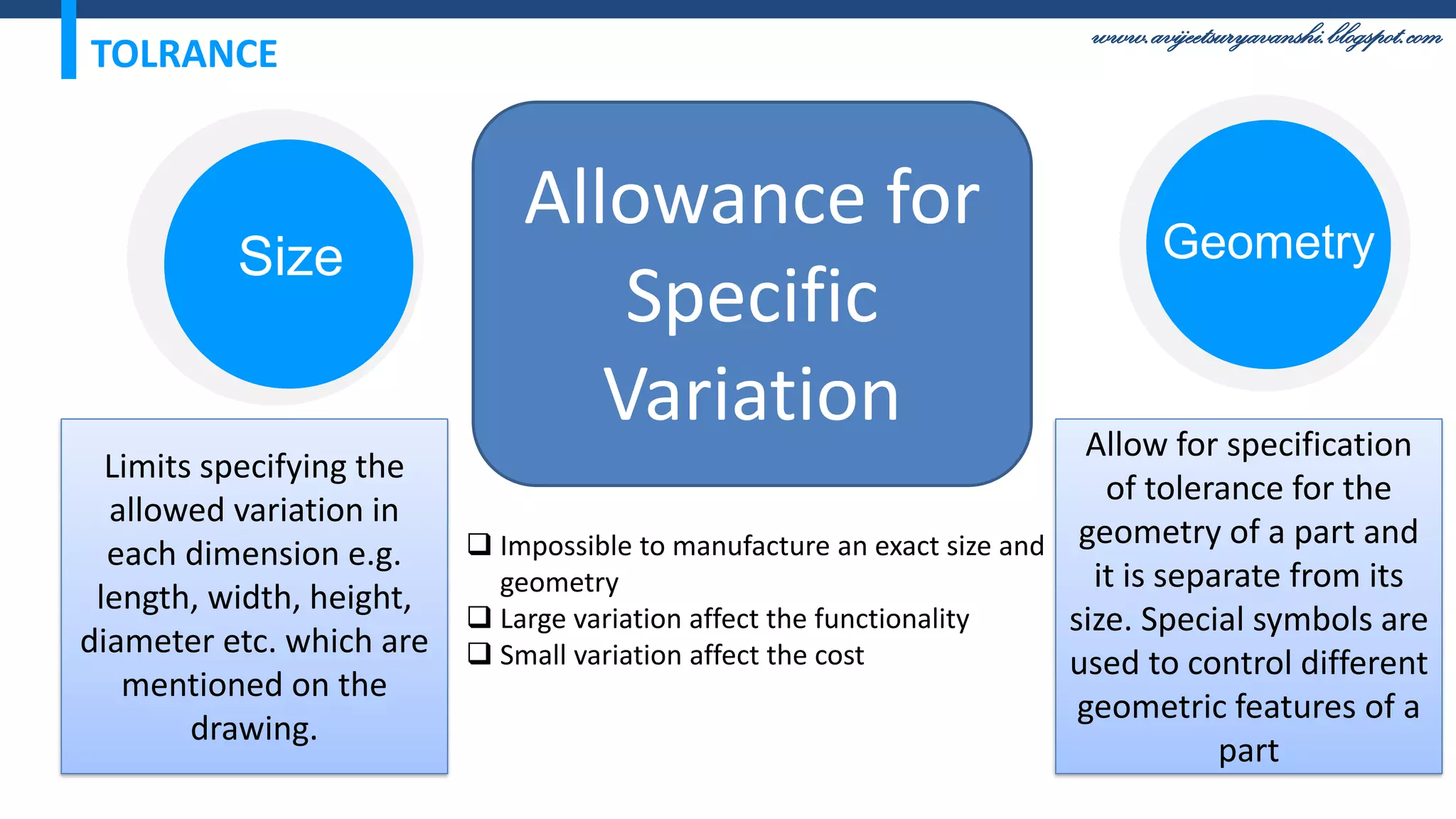
TOLRANCE
Size Geometry
Allowance for
Specific
Variation
 Impossible to manufacture an exact size and
geometry
 Large variation affect the functionality
 Small variation affect the cost
Limits specifying the
allowed variation in
each dimension e.g.
length, width, height,
diameter etc. which are
mentioned on the
drawing.
Allow for specification
of tolerance for the
geometry of a part and
it is separate from its
size. Special symbols are
used to control different
geometric features of a
part
www.avijeetsuryavanshi.blogspot.com
Identify Need
Requirements
Design
Manufacturing
1
2
3
4
WHAT IS GEOMETRIC DIMENSIONING & TOLERANCING?
Verification5
Pin must fit into a hole with a Ø.260 inch mating envelope 6 Need Satisfied
Product Development Cycle
www.avijeetsuryavanshi.blogspot.com
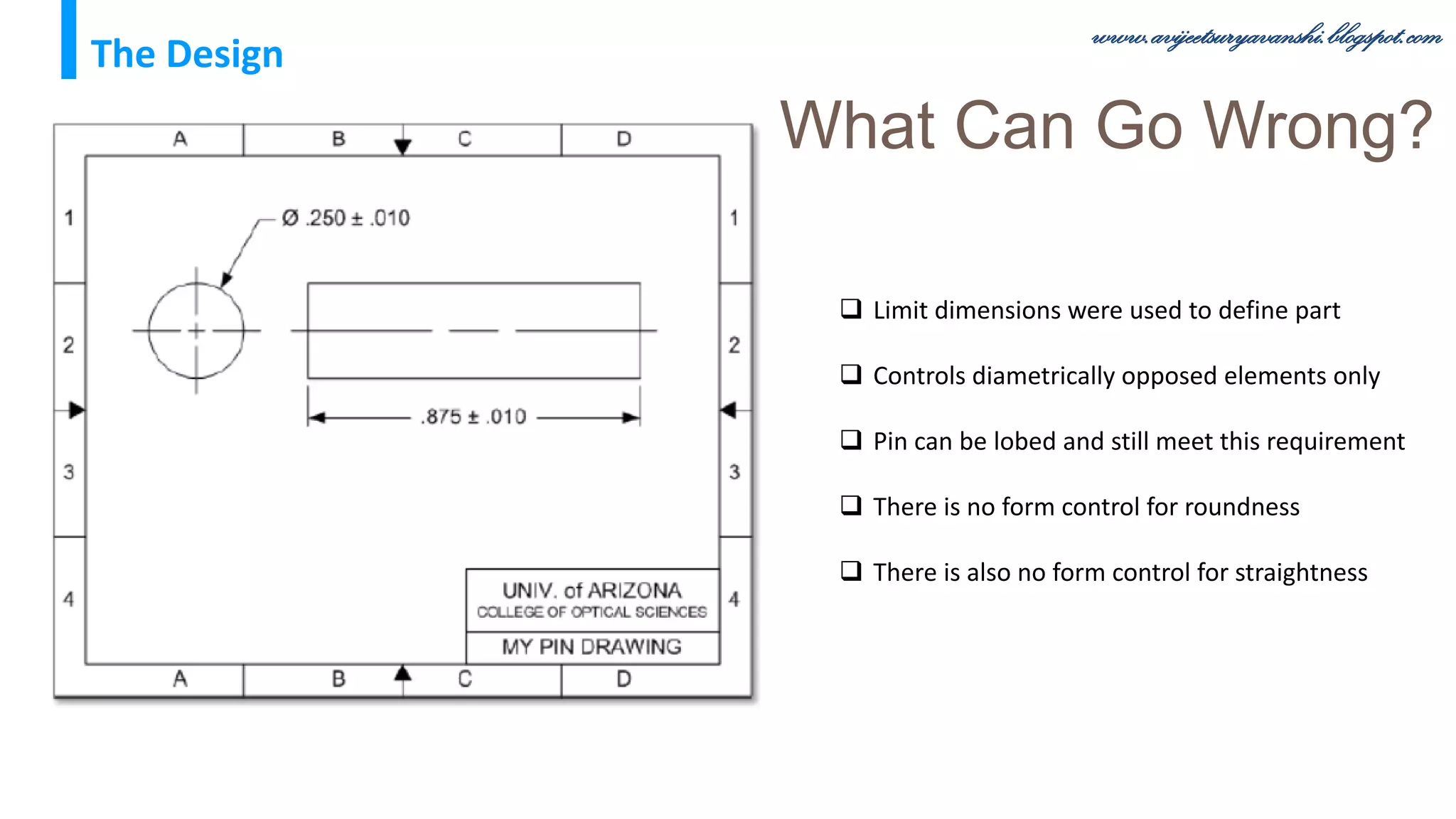
The Design
What Can Go Wrong?
 Limit dimensions were used to define part
 Controls diametrically opposed elements only
 Pin can be lobed and still meet this requirement
 There is no form control for roundness
 There is also no form control for straightness
www.avijeetsuryavanshi.blogspot.com
“The purpose of GD&T is to describe the engineering intent of parts and assemblies” –ASME Y14.5-2009
GD&T is covered by several standards
 ASME Y14.5 -2009 Dimensioning and Tolerancing
 ASME Y14.5M-1994 Dimensioning and Tolerancing
 ASME Y14.5.1M-1994 Mathematical Definition of Dimensioning and Tolerancing Principles
 ISO 286-1:1988 ISO system of limits and fits —Part 1: Bases of tolerances, deviations and fits
 ISO 286-2:1988 ISO system of limits and fits —Part 2: Tables of standard tolerance grades and limit deviations for holes
and shafts
 ISO 1101:2005 Geometrical Product Specifications (GPS) —Geometrical tolerancing—Tolerancing of form, orientation,
location and run-out
 ISO 5458:1998 Geometric Product Specifications (GPS) —Geometrical tolerancing—Positional tolerancing
 ISO 5459:1981 Technical drawings —Geometrical tolerancing—Datumsand datum-systems for geometrical tolerances
WHAT IS GEOMETRIC DIMENSIONING & TOLERANCING (GD&T)?
www.avijeetsuryavanshi.blogspot.com
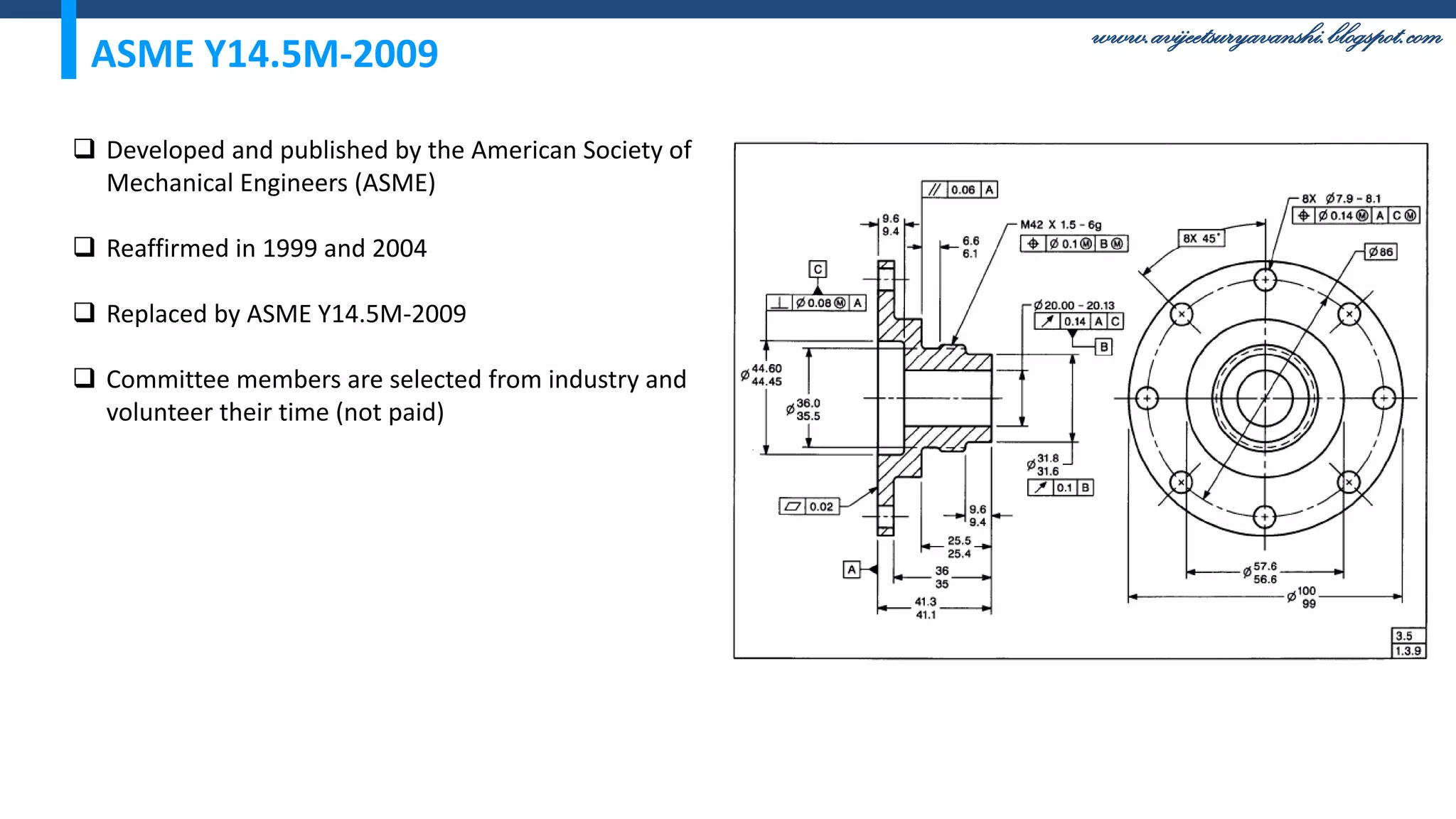
ASME Y14.5M-2009
 Developed and published by the American Society of
Mechanical Engineers (ASME)
 Reaffirmed in 1999 and 2004
 Replaced by ASME Y14.5M-2009
 Committee members are selected from industry and
volunteer their time (not paid)
www.avijeetsuryavanshi.blogspot.com
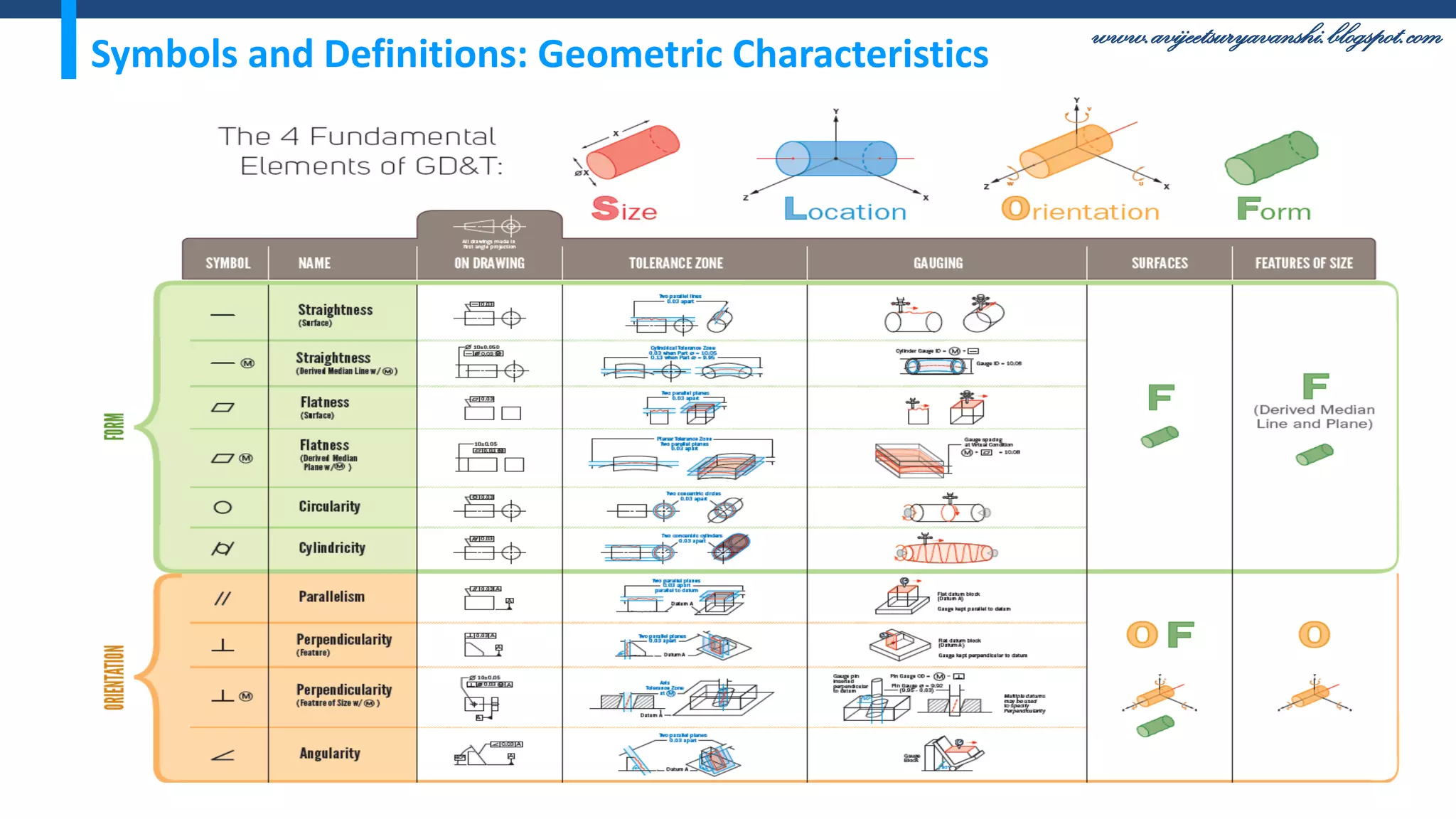
Symbols and Definitions: Geometric Characteristics
www.avijeetsuryavanshi.blogspot.com
Symbols and Definitions: Geometric Characteristics
www.avijeetsuryavanshi.blogspot.com
Symbols and Definitions: Geometric Characteristics
www.avijeetsuryavanshi.blogspot.com
Additional Symbols used in Drawing
www.avijeetsuryavanshi.blogspot.com
Additional Symbols used in Drawing
www.avijeetsuryavanshi.blogspot.com
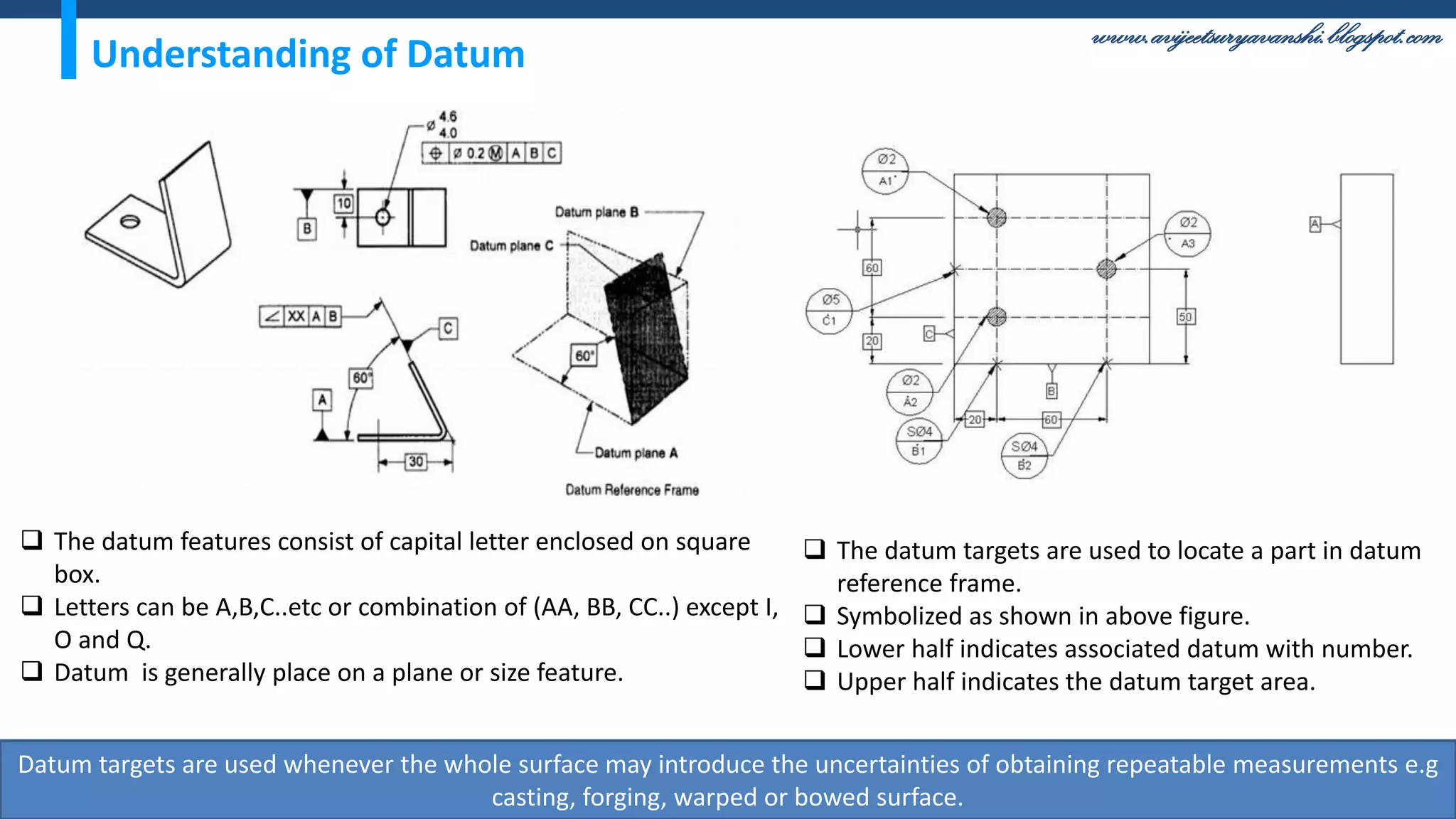
Understanding of Datum
 The datum features consist of capital letter enclosed on square
box.
 Letters can be A,B,C..etc or combination of (AA, BB, CC..) except I,
O and Q.
 Datum is generally place on a plane or size feature.
 The datum targets are used to locate a part in datum
reference frame.
 Symbolized as shown in above figure.
 Lower half indicates associated datum with number.
 Upper half indicates the datum target area.
Datum targets are used whenever the whole surface may introduce the uncertainties of obtaining repeatable measurements e.g
casting, forging, warped or bowed surface.
www.avijeetsuryavanshi.blogspot.com
Feature Control Frame
The position of the feature must be within .014 Diametrical
tolerance zone at maximum material condition and relative to
datum A,B and C.
 FCF is attached to the side view of the surface
by using the leader line in surface.
 For Axis, it is attached to below or closely
adjacent to the dimension or note patterning to
that feature.
www.avijeetsuryavanshi.blogspot.com
Material Conditions
 This is when part weight will be the most
 MMC for shaft is the largest allowable size
 MMC for hole is the smallest allowable size
 Also known as MODIFIER
Maximum Material Condition(MMC) M
Least Material Condition(LMC) L
 In this case the weight of the part is least
 LMC for shaft is the smallest allowable size
 LMC for hole is the largest allowable size
Regardless of Feature Size (RFS)
 Material Conditions are not to be considered
 The Size feature (dimension) does not affect the specified geometric tolerance
 It is applicable when geometric tolerance applied to axis or center plane
www.avijeetsuryavanshi.blogspot.com
Material Conditions
ASME Rule 1- Individual Feature of size (Taylor Principle)
 Where only a tolerance of size is specified, the limits of size of an individual feature prescribe the extent to which
variations in its form – as well as in its size- are allowed
 Limits of the Size for an individual feature will also control the allowable variation in Form of that feature
 Does not apply to the parts which are not rigid
 Where only tolerance of size is specified
www.avijeetsuryavanshi.blogspot.com
Material Conditions
ASME Rule 2- Apply to Axis
 The regardless of feature of size concept (RFS) is implied for geometric tolerance and any datum feature of size
 Where no MMC (M) or LMC (L) symbol is specified in the Feature Control Frame
www.avijeetsuryavanshi.blogspot.com
Bonus Tolerance
 Bonus tolerance is an additional tolerance for a
geometric control
 When the actual mating size of feature’s departs
from MMC towards LMC
 An increase in the stated tolerance— equal to the
amount of the departure — is permitted. This
increase or extra tolerance is called the bonus
tolerance
www.avijeetsuryavanshi.blogspot.com
Virtual Condition
www.avijeetsuryavanshi.blogspot.com
Virtual Condition
www.avijeetsuryavanshi.blogspot.com
Position Tolerance
Position Tolerance
Calculator
Stack-up Calculator
www.avijeetsuryavanshi.blogspot.com
Surface Profile Tolerance
www.avijeetsuryavanshi.blogspot.com
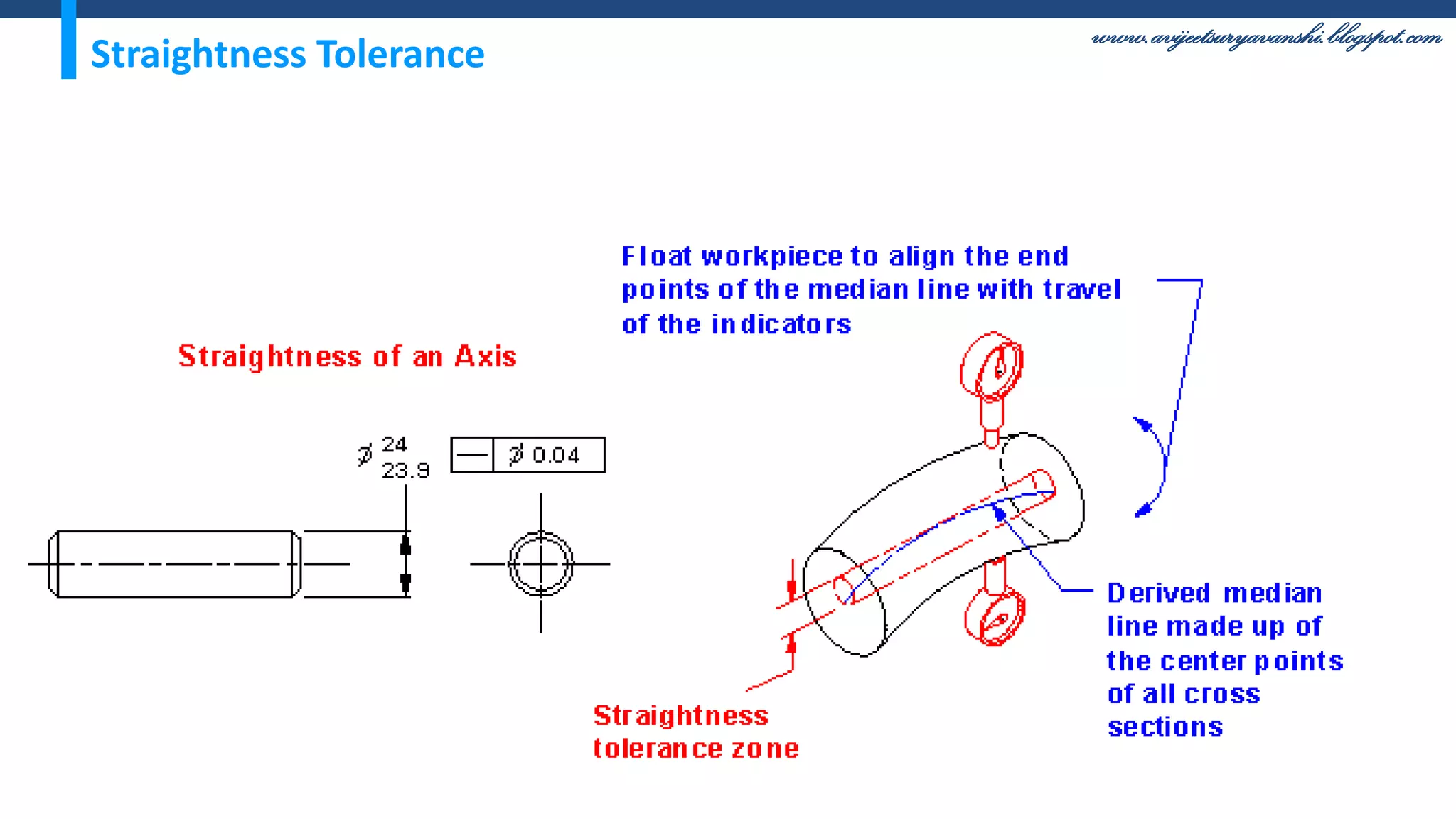
Straightness Tolerance
www.avijeetsuryavanshi.blogspot.com
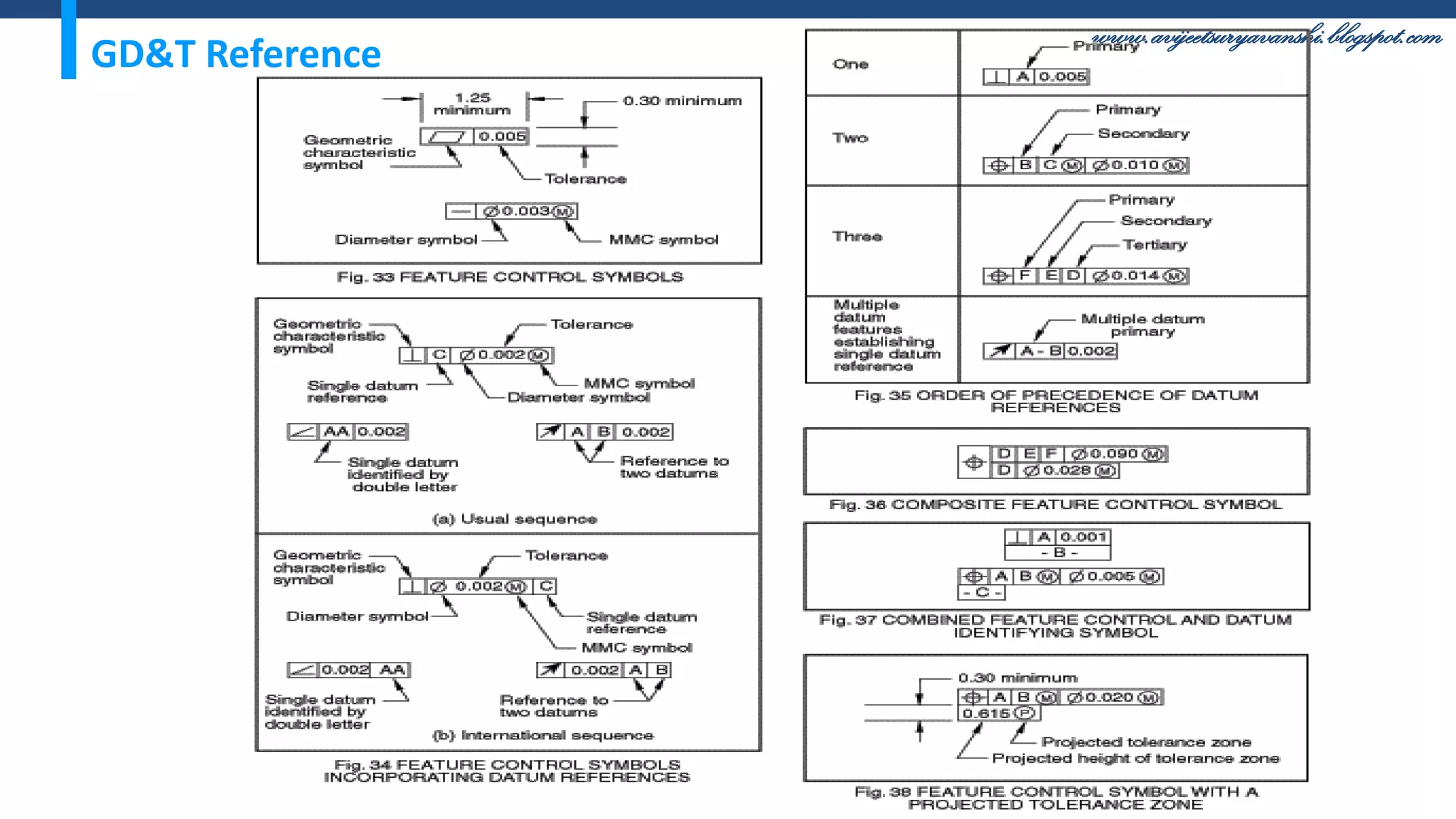
GD&T Reference
www.avijeetsuryavanshi.blogspot.com
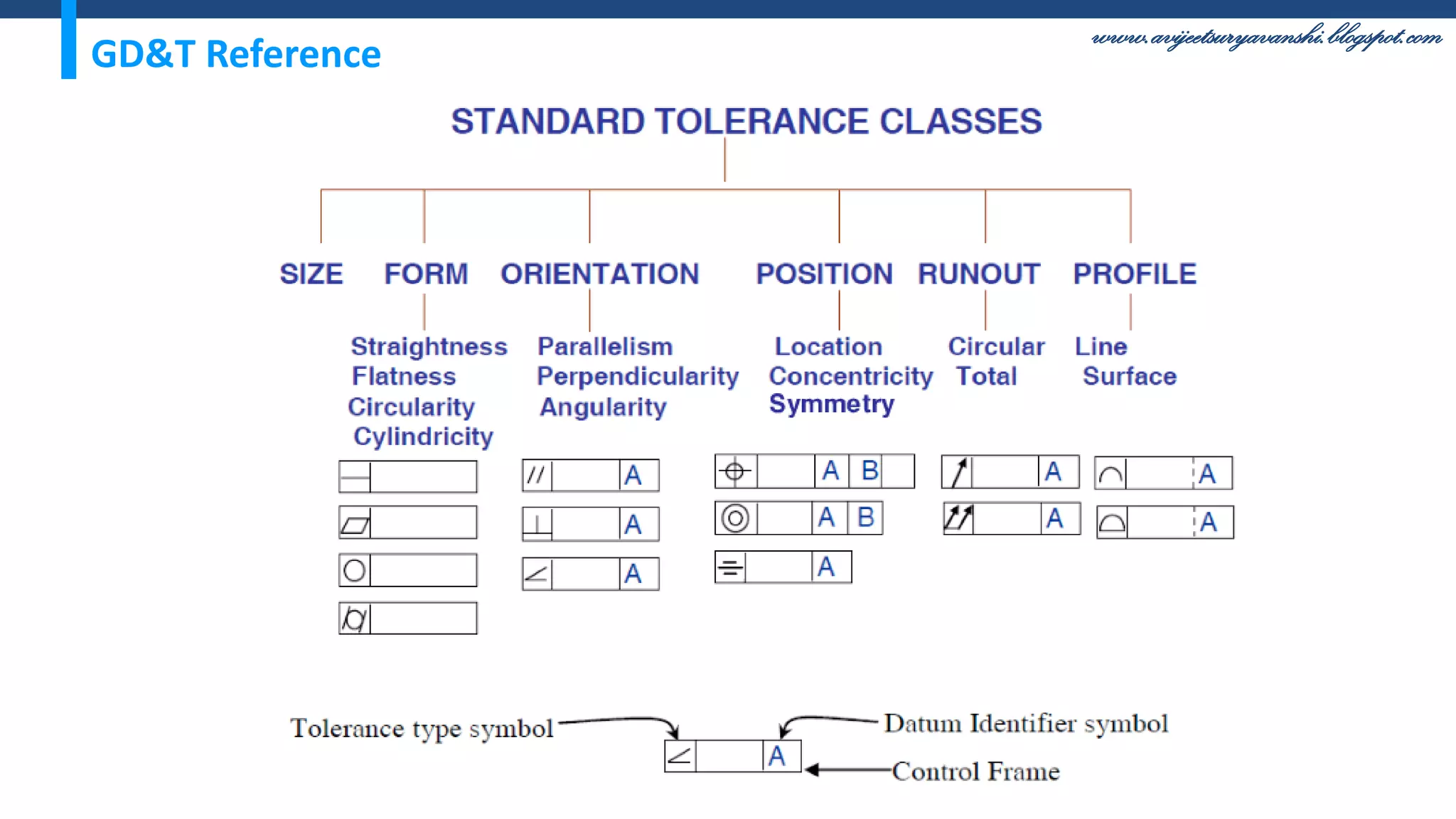
GD&T Reference
www.avijeetsuryavanshi.blogspot.com
Queries ?

GD&T