GEOMETRICAL DIMENSIONING AND
TOLERENCE
1. Geometric dimensioning and tolerancing is an international
language used on drawings to accurately describe a part. The
language consists of a well-defined set of symbols, rules,
definitions, and conventions that can be used to describe the size,
form, orientation, and location tolerances of part features.
2. Geometric Dimensioning and Tolerancing (GD&T) is a language
used on mechanical engineering drawings composed of symbols
that are used to efficiently and accurately communicate geometry
requirements for associated features on components and
assemblies.
3. GD&T is, and has been, successfully used for many years in the
automotive, aerospace, electronic and the commercial design and
manufacturing industries.In today's modern and technically
advanced design, engineering and manufacturing world, effective
and accurate communication is required to ensure successful end
products.
Geometric Dimensioning and Tolerancing symbols have been in
use since at least the turn of the century. GDT was especially
important during the Second World War in relation to extremely
high volume production of Liberty Ships, aircraft, and ground
vehicles. The automotive industry, with its high volumes, has
also benefited from GDT. The computer industry, in particular
mass storage manufacturers, have used GDT extensively to
increase their yields of high-volume and low-margin hard disk
drives. However, as with most engineering and scientific
methodologies, GDT was not rigorously established and
documented until later in the twentieth century. The American
National Standards Institute publication in 1982 of ANSI
Y14.5M-1982 was a turning point in the rigorous, unambiguous
standardization of the methodology.
1. Standardized, international system.
2. Provides a clear and concise technique for defining a
reference coordinate system (datum's) on a component or
assembly to be used throughout the manufacturing and
inspection processes.
3. Geometric dimensioning dramatically reduces the need for
drawing notes to describe complex geometry requirements
on a component or assembly by the use of standard
symbology that accurately and quickly defines design,
manufacturing and inspection requirements.
4. More flexibility, particularly for complex shapes.
5. Eliminates the need for many notes.
6. Based on the fit and function of a part or assembly.
 Allowance for a specific variation in the size
and geometry of part.
 It is the variation, positive or negative, by
which a size is permitted to depart from the
design size.
Types of tolerance:
1.Limit tolerance
2.Plus/Minus Toleraces
a. Unilateral Tolerances
b. Bilateral Tolerances
• Assemblies: Parts will often not fit together if
their dimensions do not fall with in a certain range
of values.
• Interchangeability: If a replacement part is used
it must be a duplicate of the original part within
certain limits of deviation.
 It is the tolerance in which variation is
permitted in on direction only from the design
size.
 It is the tolerance in which variation is
permitted in both directions from the design
size.
Never dimension hidden lines
Maximum Material Condition (MMC) a condition
in which the feature contains the maximum amount of
material relative to the associated tolerances. Examples
are
maximum shaft diameter and minimum hole
diameter.
Examples,
 Largest pin diameter
 Smallest hole size.
M
Least Material Condition (LMC).
A condition of af e a t u re in which it contains the
least amount of materiarelative to the associated
tolerances. Examples are maximum hole diameter and
minimum shaft diameter.
Examples,
 Smallest pin diameter
 Largest hole size
L
Allowance is defined as an intentional
difference between the maximum material
limits of mating parts. Allowance is the
minimum clearance (positive allowance), or
maximum interference (negative allowance)
between mating
parts.
Calculation formula is
ALLOWANCE = MMC HOLE – MMC SHAFT.
Clearance is defined as the loosest fit or
maximum intended difference between mating
parts.
The calculation formula for clearance is:
CLEARANCE = LMC HOLE – LMC SHAFT
 Fit is generally term used to signify the range
of tightness or looseness which may result from
the application of a specific combination of
allowance and tolerance in the design of
mating part features.
 Fits are of generally three types
a.Clearance fit
b.Interference fit
c.Transition fit
 The parts are toleranced such that the largest
shaft is smaller than the smallest hole.
 The allowance is positive and greater than
zero.
 In here allowance>0
 Ex-Clutches,Bearing covers,Oil seals with metal
housing.
 Considerable pressure is required to assemble
these fits and the parts are considered more or
less permenently assembled.
 In here allowance=0
 Examples-gear wheels,couplings,valve seats.
 The parts are toleranced such that the
allowance is negative and the max.
 In here allowance<0
 Examples-belt pulleys,bushes,fit bolts.
Given:
MMC of hole=dia 1.2500
MMC of shaft=dia 1.2509
LMC of hole=dia 1.2506
LMC of shaft=dia 1.2503
Allowance=MMC hole-MMC shaft
1.2500-1.2509= -0.0009
Clearance=LMC hole-LMC shaft
1.2506-1.2503= 0.0003
Allowance= -0.0009
Clearance= 0.0003
Type of fit= Transition fit
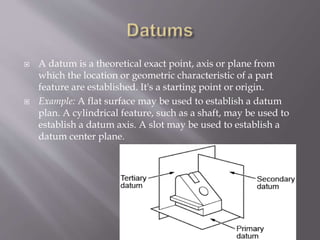
 A datum is a theoretical exact point, axis or plane from
which the location or geometric characteristic of a part
feature are established. It's a starting point or origin.
 Example: A flat surface may be used to establish a datum
plan. A cylindrical feature, such as a shaft, may be used to
establish a datum axis. A slot may be used to establish a
datum center plane.
Datum features are selected to meet design
requirements.
When selecting datum features, the designer
should consider the following characteristics:
 Functional surfaces
 Mating surfaces
 Readily accessible surfaces
 Surfaces of sufficient size to allow repeatable
measurements
 Figure shows a part with four holes. The designer
selected the back of the part as the primary datum,
datum A, because the back of the part mates with
another part, and the parts are bolted together
with four bolts. Datum A makes a good primary
datum for the four holes because the primary
datum controls orientation, and it is desirable to
have bolt holes perpendicular to mating surfaces.
The hole locations are dimensioned from the
bottom and left edges of the part. Datum B is
specified as the secondary datum, and datum C is
specified as the tertiary datum in the feature
control frame. Datum surfaces for location are
selected because of their relative importance to the
controlled features. The bottom edge of the part
was selected as the secondary datum because it is
larger than the left edge. The left edge might have
been selected as the secondary datum if it were a
mating surface.
THANK YOU
Prepared by
VASUDEVAN

Geometric Dimensioning and Tolerancing.pptx

  • 1.
  • 2.
    1. Geometric dimensioningand tolerancing is an international language used on drawings to accurately describe a part. The language consists of a well-defined set of symbols, rules, definitions, and conventions that can be used to describe the size, form, orientation, and location tolerances of part features. 2. Geometric Dimensioning and Tolerancing (GD&T) is a language used on mechanical engineering drawings composed of symbols that are used to efficiently and accurately communicate geometry requirements for associated features on components and assemblies. 3. GD&T is, and has been, successfully used for many years in the automotive, aerospace, electronic and the commercial design and manufacturing industries.In today's modern and technically advanced design, engineering and manufacturing world, effective and accurate communication is required to ensure successful end products.
  • 3.
    Geometric Dimensioning andTolerancing symbols have been in use since at least the turn of the century. GDT was especially important during the Second World War in relation to extremely high volume production of Liberty Ships, aircraft, and ground vehicles. The automotive industry, with its high volumes, has also benefited from GDT. The computer industry, in particular mass storage manufacturers, have used GDT extensively to increase their yields of high-volume and low-margin hard disk drives. However, as with most engineering and scientific methodologies, GDT was not rigorously established and documented until later in the twentieth century. The American National Standards Institute publication in 1982 of ANSI Y14.5M-1982 was a turning point in the rigorous, unambiguous standardization of the methodology.
  • 4.
    1. Standardized, internationalsystem. 2. Provides a clear and concise technique for defining a reference coordinate system (datum's) on a component or assembly to be used throughout the manufacturing and inspection processes. 3. Geometric dimensioning dramatically reduces the need for drawing notes to describe complex geometry requirements on a component or assembly by the use of standard symbology that accurately and quickly defines design, manufacturing and inspection requirements. 4. More flexibility, particularly for complex shapes. 5. Eliminates the need for many notes. 6. Based on the fit and function of a part or assembly.
  • 5.
     Allowance fora specific variation in the size and geometry of part.  It is the variation, positive or negative, by which a size is permitted to depart from the design size. Types of tolerance: 1.Limit tolerance 2.Plus/Minus Toleraces a. Unilateral Tolerances b. Bilateral Tolerances
  • 6.
    • Assemblies: Partswill often not fit together if their dimensions do not fall with in a certain range of values. • Interchangeability: If a replacement part is used it must be a duplicate of the original part within certain limits of deviation.
  • 9.
     It isthe tolerance in which variation is permitted in on direction only from the design size.
  • 10.
     It isthe tolerance in which variation is permitted in both directions from the design size.
  • 15.
  • 31.
    Maximum Material Condition(MMC) a condition in which the feature contains the maximum amount of material relative to the associated tolerances. Examples are maximum shaft diameter and minimum hole diameter. Examples,  Largest pin diameter  Smallest hole size. M
  • 32.
    Least Material Condition(LMC). A condition of af e a t u re in which it contains the least amount of materiarelative to the associated tolerances. Examples are maximum hole diameter and minimum shaft diameter. Examples,  Smallest pin diameter  Largest hole size L
  • 33.
    Allowance is definedas an intentional difference between the maximum material limits of mating parts. Allowance is the minimum clearance (positive allowance), or maximum interference (negative allowance) between mating parts. Calculation formula is ALLOWANCE = MMC HOLE – MMC SHAFT.
  • 34.
    Clearance is definedas the loosest fit or maximum intended difference between mating parts. The calculation formula for clearance is: CLEARANCE = LMC HOLE – LMC SHAFT
  • 35.
     Fit isgenerally term used to signify the range of tightness or looseness which may result from the application of a specific combination of allowance and tolerance in the design of mating part features.  Fits are of generally three types a.Clearance fit b.Interference fit c.Transition fit
  • 36.
     The partsare toleranced such that the largest shaft is smaller than the smallest hole.  The allowance is positive and greater than zero.  In here allowance>0  Ex-Clutches,Bearing covers,Oil seals with metal housing.
  • 37.
     Considerable pressureis required to assemble these fits and the parts are considered more or less permenently assembled.  In here allowance=0  Examples-gear wheels,couplings,valve seats.
  • 38.
     The partsare toleranced such that the allowance is negative and the max.  In here allowance<0  Examples-belt pulleys,bushes,fit bolts.
  • 40.
    Given: MMC of hole=dia1.2500 MMC of shaft=dia 1.2509 LMC of hole=dia 1.2506 LMC of shaft=dia 1.2503 Allowance=MMC hole-MMC shaft 1.2500-1.2509= -0.0009 Clearance=LMC hole-LMC shaft 1.2506-1.2503= 0.0003 Allowance= -0.0009 Clearance= 0.0003 Type of fit= Transition fit
  • 42.
     A datumis a theoretical exact point, axis or plane from which the location or geometric characteristic of a part feature are established. It's a starting point or origin.  Example: A flat surface may be used to establish a datum plan. A cylindrical feature, such as a shaft, may be used to establish a datum axis. A slot may be used to establish a datum center plane.
  • 43.
    Datum features areselected to meet design requirements. When selecting datum features, the designer should consider the following characteristics:  Functional surfaces  Mating surfaces  Readily accessible surfaces  Surfaces of sufficient size to allow repeatable measurements
  • 45.
     Figure showsa part with four holes. The designer selected the back of the part as the primary datum, datum A, because the back of the part mates with another part, and the parts are bolted together with four bolts. Datum A makes a good primary datum for the four holes because the primary datum controls orientation, and it is desirable to have bolt holes perpendicular to mating surfaces. The hole locations are dimensioned from the bottom and left edges of the part. Datum B is specified as the secondary datum, and datum C is specified as the tertiary datum in the feature control frame. Datum surfaces for location are selected because of their relative importance to the controlled features. The bottom edge of the part was selected as the secondary datum because it is larger than the left edge. The left edge might have been selected as the secondary datum if it were a mating surface.
  • 61.