MACRO-ECONOMICS
PRESENTATION
BY GROUP 3-:
Nitasha Kohli
Nivedita Dixit
Paras Thukral
Omesh Sharma
Omender Sharma
GDP[GROSS DOMESTIC PRODUCT]
AS AN INDICATOR OF WELFARE
&
PQLI
[PHYSICAL QUALITY OF LIFE INDEX]
GDP & WELFARE
 What is GDP ?
The market value of all the goods and
services produced or provided within a
country at a given moment in time.
 GDP is used as an indicator of a standard of
living.
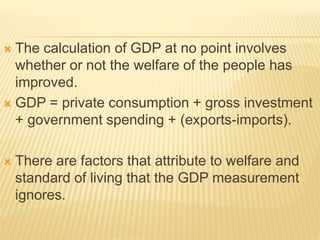
 The calculation of GDP at no point involves
whether or not the welfare of the people has
improved.
 GDP = private consumption + gross investment
+ government spending + (exports-imports).
 There are factors that attribute to welfare and
standard of living that the GDP measurement
ignores.
1) Wealth distribution-:
GDP does not describe whether or not the
people are truly benefitting from economic
growth.
For eg-: This can be seen in countries such
as Qatar where an insignificant percentage
of the population holds all the wealth of the
country, but the wealth is significant due to oil
trade. Due to the manners in which GDP can
be calculated it does not show whether or not
growth is actually improving the welfare of
the people.
2. Non-market transactions-:
Examples of non-market transaction can be
noted as volunteer work, where work is
done by the good will of people. There is
also the example of open software
programmes such as Linux which has
developed our approach to coding and
programming even though Linux is run as a
volunteer programme. Factors such as
volunteer work greatly benefit society and
improve the general standard of living and
GDP fails to recognise this because it is
based on wholly economic activity.
3. Non-monetary & black markets-:
These are not identified as a part of the economic
activity in a country that would attribute to GDP.
Many undeveloped economies rely on non-
monetary economies, this means that trade is
done through swapping goods, rather than the
employment of debt instruments and banknotes.
This means that the economic activity and possible
welfare of people in undeveloped countries may be
underestimated if based around GDP. There is also
the existence of black markets, which consists of
trade of illegal goods or the ability to evade tax,
and as a result there is the underestimation of
GDP.
4. The issue of what is being produced-:
For example if many people were getting sick
and required healthcare there would be a boost
in GDP as this would account for economic
activity, however; this obviously does not
concern welfare as it would be better if the
people did not become ill in the first place. This
can be summarised as uneconomic growth
where economic growth brings about a
decrease in the quality of life. This can be
applied to the issue of using fossil fuels for
energy; even though increased energy
consumption usually corresponds with growth it
may mean more pollution and adverse and
5. Sustainable economic growth.
There are many historic examples where there
was a boost in GDP due to the discovery of
new resources or the re-utilization of land or
capital. However this growth would not be
sustainable due to the scarcity of those
resources. This would incur the miscalculation
of GDP, and again fail to represent the welfare
of the economy.
 The use of gross domestic product can be
useful to give a holistic view of a countries
economy, however when looking at the
welfare of an economy it fails to be an
effective indicator because it does not involve
factors such as happiness, and non-
monetary activity within that country which
directly attribute to peoples standard of
living.
PQLI
PHYSICAL QUALITY OF LIFE INDEX
 The Physical Quality of Life Index (PQLI) is
an attempt to measure the quality of life or well-
being of a country.
 It shares the general problems of measuring
quality of life in a quantitative way.
 The value is the average of three statistics:
1. basic literacy rate,
2. infant mortality, and
3. life expectancy at age one, all equally
weighted on a 0 to 100 scale.
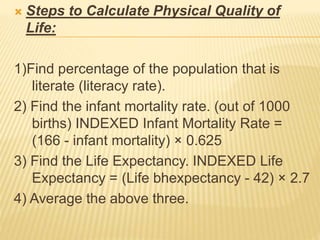
 Steps to Calculate Physical Quality of
Life:
1)Find percentage of the population that is
literate (literacy rate).
2) Find the infant mortality rate. (out of 1000
births) INDEXED Infant Mortality Rate =
(166 - infant mortality) × 0.625
3) Find the Life Expectancy. INDEXED Life
Expectancy = (Life bhexpectancy - 42) × 2.7
4) Average the above three.
THANKYOU

Gdp & welfare; pqli

  • 1.
    MACRO-ECONOMICS PRESENTATION BY GROUP 3-: NitashaKohli Nivedita Dixit Paras Thukral Omesh Sharma Omender Sharma
  • 2.
    GDP[GROSS DOMESTIC PRODUCT] ASAN INDICATOR OF WELFARE & PQLI [PHYSICAL QUALITY OF LIFE INDEX]
  • 3.
    GDP & WELFARE What is GDP ? The market value of all the goods and services produced or provided within a country at a given moment in time.  GDP is used as an indicator of a standard of living.
  • 4.
     The calculationof GDP at no point involves whether or not the welfare of the people has improved.  GDP = private consumption + gross investment + government spending + (exports-imports).  There are factors that attribute to welfare and standard of living that the GDP measurement ignores.
  • 5.
    1) Wealth distribution-: GDPdoes not describe whether or not the people are truly benefitting from economic growth. For eg-: This can be seen in countries such as Qatar where an insignificant percentage of the population holds all the wealth of the country, but the wealth is significant due to oil trade. Due to the manners in which GDP can be calculated it does not show whether or not growth is actually improving the welfare of the people.
  • 6.
    2. Non-market transactions-: Examplesof non-market transaction can be noted as volunteer work, where work is done by the good will of people. There is also the example of open software programmes such as Linux which has developed our approach to coding and programming even though Linux is run as a volunteer programme. Factors such as volunteer work greatly benefit society and improve the general standard of living and GDP fails to recognise this because it is based on wholly economic activity.
  • 7.
    3. Non-monetary &black markets-: These are not identified as a part of the economic activity in a country that would attribute to GDP. Many undeveloped economies rely on non- monetary economies, this means that trade is done through swapping goods, rather than the employment of debt instruments and banknotes. This means that the economic activity and possible welfare of people in undeveloped countries may be underestimated if based around GDP. There is also the existence of black markets, which consists of trade of illegal goods or the ability to evade tax, and as a result there is the underestimation of GDP.
  • 8.
    4. The issueof what is being produced-: For example if many people were getting sick and required healthcare there would be a boost in GDP as this would account for economic activity, however; this obviously does not concern welfare as it would be better if the people did not become ill in the first place. This can be summarised as uneconomic growth where economic growth brings about a decrease in the quality of life. This can be applied to the issue of using fossil fuels for energy; even though increased energy consumption usually corresponds with growth it may mean more pollution and adverse and
  • 9.
    5. Sustainable economicgrowth. There are many historic examples where there was a boost in GDP due to the discovery of new resources or the re-utilization of land or capital. However this growth would not be sustainable due to the scarcity of those resources. This would incur the miscalculation of GDP, and again fail to represent the welfare of the economy.
  • 10.
     The useof gross domestic product can be useful to give a holistic view of a countries economy, however when looking at the welfare of an economy it fails to be an effective indicator because it does not involve factors such as happiness, and non- monetary activity within that country which directly attribute to peoples standard of living.
  • 11.
    PQLI PHYSICAL QUALITY OFLIFE INDEX  The Physical Quality of Life Index (PQLI) is an attempt to measure the quality of life or well- being of a country.  It shares the general problems of measuring quality of life in a quantitative way.  The value is the average of three statistics: 1. basic literacy rate, 2. infant mortality, and 3. life expectancy at age one, all equally weighted on a 0 to 100 scale.
  • 12.
     Steps toCalculate Physical Quality of Life: 1)Find percentage of the population that is literate (literacy rate). 2) Find the infant mortality rate. (out of 1000 births) INDEXED Infant Mortality Rate = (166 - infant mortality) × 0.625 3) Find the Life Expectancy. INDEXED Life Expectancy = (Life bhexpectancy - 42) × 2.7 4) Average the above three.
  • 13.