Development
• Development is a sustained effort.
• Development is a long process
involving changes and requiring
effort.
- there is no such thing as "instant
development."
• Economic growth and economic development
are often used interchangeably. However,
there are two distinctions between two
concepts.
ECONOMIC GROWTH AND
ECONOMIC DEVELOPMENT
• Economic growth means increase in output or
production.
• Economic development means both more
output or production and changes in the
technical and institutional arrangements by
which factors of production are produced and
distributed.
ECONOMIC GROWTH AND
ECONOMIC DEVELOPMENT
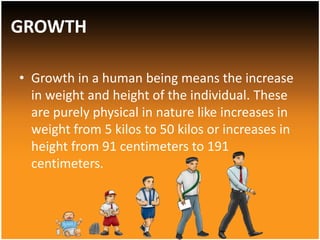
• Growth in a human being means the increase
in weight and height of the individual. These
are purely physical in nature like increases in
weight from 5 kilos to 50 kilos or increases in
height from 91 centimeters to 191
centimeters.
GROWTH
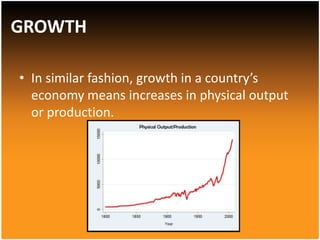
• In similar fashion, growth in a country’s
economy means increases in physical output
or production.
GROWTH
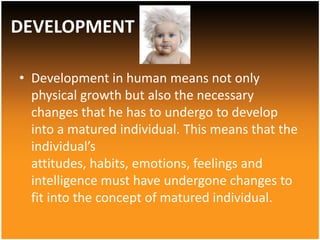
• Development in human means not only
physical growth but also the necessary
changes that he has to undergo to develop
into a matured individual. This means that the
individual’s attitudes, habits, emotions,
feelings and intelligence must have undergone
changes to fit into the concept of matured
individual.
DEVELOPMENT
DEVELOPMENT
Example:
Growth
Development
• In similar fashion, development in a country’s
economy means both increases in output or
production and changes in the technical and
institutional arrangements by which the
factors of production are produced and
distributed.
ECONOMIC DEVELOPMENT
• Economic development of any nation can be
characterized by the following:
1. Increases in output or production has to be sustained
over a long period of time.
2. Changes in economic structure would spread out in the
entire economy.
3. Growth has to be accompanied by an increase in
efficiency.
ECONOMIC DEVELOPMENT
• Economic development is shaped not only by
economic factors but also by non-economic
factors like environmental, social, and cultural
conditions of the economy.
ECONOMIC DEVELOPMENT
• One can get the economic growth of a country
by comparing its GDP at present with the GDP
last year. However, it is not so easy to measure
development as it is based upon many
parameters such as health, education, literacy
levels, and life expectancy and so on.
ECONOMIC GROWTH VS.
ECONOMIC DEVELOPMENT
• Examples of countries like China and India that
have huge GDP but not labeled developed
because of their lowly ranks on other
parameters such as health, education and life
expectancy is enough to demonstrate the
difference between economic growth and
development.
ECONOMIC GROWTH VS.
ECONOMIC DEVELOPMENT
• In the study of economics, economic growth is
taken as a quantitative measure while
development is both a quantitative as well as
a qualitative measure which makes it difficult
to quantify.
ECONOMIC GROWTH VS.
ECONOMIC DEVELOPMENT

Economic Growth and Development

  • 2.
    Development • Development isa sustained effort. • Development is a long process involving changes and requiring effort. - there is no such thing as "instant development."
  • 3.
    • Economic growthand economic development are often used interchangeably. However, there are two distinctions between two concepts. ECONOMIC GROWTH AND ECONOMIC DEVELOPMENT
  • 4.
    • Economic growthmeans increase in output or production. • Economic development means both more output or production and changes in the technical and institutional arrangements by which factors of production are produced and distributed. ECONOMIC GROWTH AND ECONOMIC DEVELOPMENT
  • 5.
    • Growth ina human being means the increase in weight and height of the individual. These are purely physical in nature like increases in weight from 5 kilos to 50 kilos or increases in height from 91 centimeters to 191 centimeters. GROWTH
  • 6.
    • In similarfashion, growth in a country’s economy means increases in physical output or production. GROWTH
  • 7.
    • Development inhuman means not only physical growth but also the necessary changes that he has to undergo to develop into a matured individual. This means that the individual’s attitudes, habits, emotions, feelings and intelligence must have undergone changes to fit into the concept of matured individual. DEVELOPMENT
  • 8.
  • 9.
    • In similarfashion, development in a country’s economy means both increases in output or production and changes in the technical and institutional arrangements by which the factors of production are produced and distributed. ECONOMIC DEVELOPMENT
  • 10.
    • Economic developmentof any nation can be characterized by the following: 1. Increases in output or production has to be sustained over a long period of time. 2. Changes in economic structure would spread out in the entire economy. 3. Growth has to be accompanied by an increase in efficiency. ECONOMIC DEVELOPMENT
  • 11.
    • Economic developmentis shaped not only by economic factors but also by non-economic factors like environmental, social, and cultural conditions of the economy. ECONOMIC DEVELOPMENT
  • 12.
    • One canget the economic growth of a country by comparing its GDP at present with the GDP last year. However, it is not so easy to measure development as it is based upon many parameters such as health, education, literacy levels, and life expectancy and so on. ECONOMIC GROWTH VS. ECONOMIC DEVELOPMENT
  • 13.
    • Examples ofcountries like China and India that have huge GDP but not labeled developed because of their lowly ranks on other parameters such as health, education and life expectancy is enough to demonstrate the difference between economic growth and development. ECONOMIC GROWTH VS. ECONOMIC DEVELOPMENT
  • 14.
    • In thestudy of economics, economic growth is taken as a quantitative measure while development is both a quantitative as well as a qualitative measure which makes it difficult to quantify. ECONOMIC GROWTH VS. ECONOMIC DEVELOPMENT