A rough outline PHYSICS
Contents
SPARKS AND ELECTROSTATICS Charging Isolators, Electric Sparks, Uses of Electrostatics, Dangers of Electrostatics
Charging Insulators Rubbing can charge insulators like wool, plastic and rubber There two types of charges: Positive Negative Charged insulators can attract dust, fibres and small pieces of paper An insulator losing electrons will have a positive charge An insulator gaining electrons will have a negative charge Like charges repel and opposite charges attract A polythene rod rubbed with a duster acquires a negative charge and the duster acquires an equal but opposite positive charge The force between two charged objects are equal in size and act in opposite direction
Electric Sparks You will get an electrostatic shock when: You touch something that is charged You become charged by walking on a carpet/vinyl floor and become earthed by touching a water pop or metal door handle Static charges are a nuisance as they cause synthetic clothes to ‘cling’ The transfer of charges between two objects creates an electric spark Electric sparks can generate high temperatures and therefore are dangerous near inflammable gases and vapours (e.g. Refuelling aircraft) The chance of receiving an electric shock can be reduced by correct earthing, using insulating mats or wearing shoes with insulating soles The risk of electric sparks can be reduced by securing a metal strap between the object and the ground The body acts as a good conductor of small amount of charge An electric shock is safe through the body and long as it doesn’t go across the heart and cause a heart attack. If it goes through the hand down the leg it is unlikely to effect you but if it goes through one hand to the other hand as both are connected to earth then it can cause heart failure
Static Shocks Example The existence of repulsive forces between similar charges explains why you experience a shock if you touch an earthed conductor such as the screw on a light switch after walking across a synthetic carpet: Synthetic carpets, for example those made of nylon, are good insulators Charge builds up on the body when walking across the carpet due to the friction forces between shoes and the carpet The similar charges repel each other but they cannot leave the body through the carpet which is a very good insulator When the body is placed in electrical contact with the earth, electrons move between the body and the earth to discharge the body, creating a current which causes a shock The direction of electron movement depends on whether the body is positively or negatively charged
Uses of Electrostatics Some uses of static electricity include: Defibrillators Photocopiers Laser printers Removing dust/soot from smoke chimneys Spray painting A defibrillator has two charged paddles. These are used to pass a charge through the patient to make the heart contract. The operator has to be careful not to be shocked. Good electrical contact is necessary between the patient and the paddles Electrostatic dust precipitators are used in the chimneys of coal-burning power stations. They have metal plates/grids connected to high voltage. Dust particles are attracted to the plates/grids. When the dust particles are large enough, they fall down the chimneys In spray painting the gun charged. The paint particles are repelled to produce a fine spray. The object to be painted is charged opposite to the paint. Attraction between the object and the paint ensures an even coat of paint. There is less waste in spray painting
Dangers of Static Charge Electrostatic charge is dangerous when it causes lightning and sparks that can ignite fuel When an aircraft is being refuelled with kerosene (paraffin) and when a car is being refuelled with petrol friction forces cause charge separation Charge separation result in the metal frame of an aircraft gaining an opposite charge to the fuel This could result in a build-up of static charge on the metal frame of the aircraft or metal sleeve of the car refuelling pipe]if the voltage became high enough to cause a spark to earth, it could ignite the fuel To prevent this, the framework of an aircraft is connected to earth before refuelling and the pipe leading to the petrol tank in a car is connected to the body of the car so that the charge can spread out, preventing the build-up of charge in a small area
SAFE ELECTRICS Circuits and Symbols, Resistance, Circuit Components, Safety
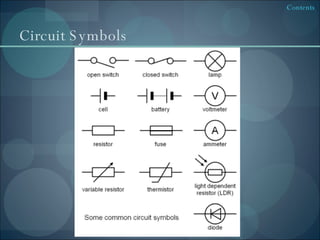
Circuits A complete loop is required for an electrical circuit to work A resistor can be used in a circuit to change the current Electric current is the rate of flow of charge In a circuit, electric current is due to the movement of electrons The size of the current for a given circuit depends on the resistance. Less resistance in a circuit means greater current and vice-versa A variable resistor can be used to change the resistance in a circuit and hence the current
Circuit Symbols
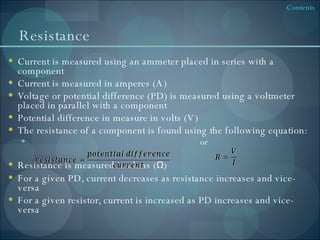
Resistance Current is measured using an ammeter placed in series with a component Current is measured in amperes (A) Voltage or potential difference (PD) is measured using a voltmeter placed in parallel with a component Potential difference in measure in volts (V) The resistance of a component is found using the following equation: or Resistance is measured in ohms ( Ω ) For a given PD, current decreases as resistance increases and vice-versa For a given resistor, current is increased as PD increases and vice-versa
Circuit Components Common circuit components include resistors, lamps and diodes: The resistance of a resistor such as a metal wire does not change provided that there is no significant change in its temperature; a graph of current against voltage shows that the current is proportional to the voltage The wire in a filament lamp becomes hotter  as the current in the filament increases, causing an increase in its resistance A diode only allows current to pass in one direction (shown by the direction of the arrow on its symbol) The direction of the current is always shown as being from positive to negative The resistance of some circuits depend on their surroundings; these components are often found in electronic circuits used for switches and maintaining constant environmental conditions in, for example, greenhouses and incubators: The resistance of a light-dependent resistor (LDR) decreases with increasing light level The resistance of a thermistor decreases with increasing temperature
Safety A mains cable has three coloured wires: Brown – the live wire Blue – the neural wire Yellow/green – the earth wire Charges can safely flow to the ground if a conductor is earthed Metal appliances are earthed in order to protect you from accidental shocks An earthed conductor cannot become live Double-insulated appliances have plastic casing and do not need to be earthed The fuse is a safety device. A large current will melt the fuse and cut off the supply A fuse prevents large currents from starting a fire Circuit breakers are safety devices and can be described as ‘re-settable fuses’ A fuse has to be replaced after a fault whereas circuit breakers just have to be reset
ULTRASOUND AND RADIATION Ultrasound, X-rays and Gamma Rays, Treatment
Ultrasound
X-Rays and Gamma Rays
Treatment Some radioactive nuclei of atoms emit nuclear radiation Alpha particles, beta particles and gamma rays Gamma rays and X-rays are both used in medicine for treatment (therapy) and for finding out what is wrong (diagnosis) In radiotherapy, several gamma ray sources producing wide beams are directed towards cancerous tissues to destroy the cancer cells A radioactive tracer is a radioactive substance that is drunk or injected into the body Only beta particles and gamma rays can pass through the skin. Hence a tracer is either a beta or gamma emitter The function of some vital organs can be diagnosed using a radioactive tracer
NUCLEAR PHYSICS Radioactivity, Uses of Radioisotopes, Fission, Nuclear Waste
Radioactivity
Uses of Radioisotopes Background radiation is always present and is due to radioactive substances in rocks, soil, air and cosmic rays Sound background radiation comes from man-made sources E.g. Nuclear and hospital waste Radioisotopes are used as tracers in industry and hospitals Gamma-emitting tracers are used to find leaks or blockages in underground pipes Smoke detectors contain an alpha emitter Carbon dating is used to date bone, cloth, wood and paper. It relies on the radioactivity isotope of carbon-14
Nuclear Fission Nuclear power stations use uranium as a fuel. Most of the waste is radioactive for thousands of years Reactions produce the heat to produce steam to turn the turbines, which turn the generators to produce electricity In a fission reaction, a neutron is captured by a uranium-235 nucleus and splits into two smaller (daughter) nuclei and either two or three neutrons Energy is released when a uranium nucleus splits Materials become radioactive when they capture neutrons in a nuclear reactor In a chain reaction, the neutrons can cause further fission reactions One destructive use of fission is the atomic bomb. One peaceful use if electricity production
The Process of Nuclear Fission In the process of the fission of uranium-235: A uranium-235 absorbs a neutron, making it unstable It splits into two daughter nuclei, which are also unstable, and two or three spare neutrons The fission products have a lot of kinetic energy, which is removed by a coolant The coolant generates steam that turns a turbine The spare neutrons can cause further fission of other nuclei in a chain reaction If each spare neutron were allowed to cause another fission, the result would be a chain reaction which would be out of control. To maintain the reaction at a steady rate, on average just one of the neutrons released by each fission is allowed to go on and cause further fission In the core of a nuclear reactor, control rods absorb the spare neutrons to control the rate of reaction. It is also a safety feature
Nuclear Waste Nuclear power has one major disadvantage which is how to dispose of the nuclear waste. There are three main categories: Low-level waste such as laboratory clothing and packaging materials; these are either buried either underground or at sea Intermediate-level waste such as the casing used for nuclear fuel and reactor parts that have been replaced; these are kept in stores with thick concrete walls or buried in deep trenches with concrete linings High-level waste such as spent fuel rods; these present a long-term disposal problem since they remain significantly radioactive for thousand of years; much of this waste is in temporary storage in tank of water until the problem of what to do with it can be solved

GCSE Physics Revision

  • 1.
  • 2.
  • 3.
    SPARKS AND ELECTROSTATICSCharging Isolators, Electric Sparks, Uses of Electrostatics, Dangers of Electrostatics
  • 4.
    Charging Insulators Rubbingcan charge insulators like wool, plastic and rubber There two types of charges: Positive Negative Charged insulators can attract dust, fibres and small pieces of paper An insulator losing electrons will have a positive charge An insulator gaining electrons will have a negative charge Like charges repel and opposite charges attract A polythene rod rubbed with a duster acquires a negative charge and the duster acquires an equal but opposite positive charge The force between two charged objects are equal in size and act in opposite direction
  • 5.
    Electric Sparks Youwill get an electrostatic shock when: You touch something that is charged You become charged by walking on a carpet/vinyl floor and become earthed by touching a water pop or metal door handle Static charges are a nuisance as they cause synthetic clothes to ‘cling’ The transfer of charges between two objects creates an electric spark Electric sparks can generate high temperatures and therefore are dangerous near inflammable gases and vapours (e.g. Refuelling aircraft) The chance of receiving an electric shock can be reduced by correct earthing, using insulating mats or wearing shoes with insulating soles The risk of electric sparks can be reduced by securing a metal strap between the object and the ground The body acts as a good conductor of small amount of charge An electric shock is safe through the body and long as it doesn’t go across the heart and cause a heart attack. If it goes through the hand down the leg it is unlikely to effect you but if it goes through one hand to the other hand as both are connected to earth then it can cause heart failure
  • 6.
    Static Shocks ExampleThe existence of repulsive forces between similar charges explains why you experience a shock if you touch an earthed conductor such as the screw on a light switch after walking across a synthetic carpet: Synthetic carpets, for example those made of nylon, are good insulators Charge builds up on the body when walking across the carpet due to the friction forces between shoes and the carpet The similar charges repel each other but they cannot leave the body through the carpet which is a very good insulator When the body is placed in electrical contact with the earth, electrons move between the body and the earth to discharge the body, creating a current which causes a shock The direction of electron movement depends on whether the body is positively or negatively charged
  • 7.
    Uses of ElectrostaticsSome uses of static electricity include: Defibrillators Photocopiers Laser printers Removing dust/soot from smoke chimneys Spray painting A defibrillator has two charged paddles. These are used to pass a charge through the patient to make the heart contract. The operator has to be careful not to be shocked. Good electrical contact is necessary between the patient and the paddles Electrostatic dust precipitators are used in the chimneys of coal-burning power stations. They have metal plates/grids connected to high voltage. Dust particles are attracted to the plates/grids. When the dust particles are large enough, they fall down the chimneys In spray painting the gun charged. The paint particles are repelled to produce a fine spray. The object to be painted is charged opposite to the paint. Attraction between the object and the paint ensures an even coat of paint. There is less waste in spray painting
  • 8.
    Dangers of StaticCharge Electrostatic charge is dangerous when it causes lightning and sparks that can ignite fuel When an aircraft is being refuelled with kerosene (paraffin) and when a car is being refuelled with petrol friction forces cause charge separation Charge separation result in the metal frame of an aircraft gaining an opposite charge to the fuel This could result in a build-up of static charge on the metal frame of the aircraft or metal sleeve of the car refuelling pipe]if the voltage became high enough to cause a spark to earth, it could ignite the fuel To prevent this, the framework of an aircraft is connected to earth before refuelling and the pipe leading to the petrol tank in a car is connected to the body of the car so that the charge can spread out, preventing the build-up of charge in a small area
  • 9.
    SAFE ELECTRICS Circuitsand Symbols, Resistance, Circuit Components, Safety
  • 10.
    Circuits A completeloop is required for an electrical circuit to work A resistor can be used in a circuit to change the current Electric current is the rate of flow of charge In a circuit, electric current is due to the movement of electrons The size of the current for a given circuit depends on the resistance. Less resistance in a circuit means greater current and vice-versa A variable resistor can be used to change the resistance in a circuit and hence the current
  • 11.
  • 12.
    Resistance Current ismeasured using an ammeter placed in series with a component Current is measured in amperes (A) Voltage or potential difference (PD) is measured using a voltmeter placed in parallel with a component Potential difference in measure in volts (V) The resistance of a component is found using the following equation: or Resistance is measured in ohms ( Ω ) For a given PD, current decreases as resistance increases and vice-versa For a given resistor, current is increased as PD increases and vice-versa
  • 13.
    Circuit Components Commoncircuit components include resistors, lamps and diodes: The resistance of a resistor such as a metal wire does not change provided that there is no significant change in its temperature; a graph of current against voltage shows that the current is proportional to the voltage The wire in a filament lamp becomes hotter as the current in the filament increases, causing an increase in its resistance A diode only allows current to pass in one direction (shown by the direction of the arrow on its symbol) The direction of the current is always shown as being from positive to negative The resistance of some circuits depend on their surroundings; these components are often found in electronic circuits used for switches and maintaining constant environmental conditions in, for example, greenhouses and incubators: The resistance of a light-dependent resistor (LDR) decreases with increasing light level The resistance of a thermistor decreases with increasing temperature
  • 14.
    Safety A mainscable has three coloured wires: Brown – the live wire Blue – the neural wire Yellow/green – the earth wire Charges can safely flow to the ground if a conductor is earthed Metal appliances are earthed in order to protect you from accidental shocks An earthed conductor cannot become live Double-insulated appliances have plastic casing and do not need to be earthed The fuse is a safety device. A large current will melt the fuse and cut off the supply A fuse prevents large currents from starting a fire Circuit breakers are safety devices and can be described as ‘re-settable fuses’ A fuse has to be replaced after a fault whereas circuit breakers just have to be reset
  • 15.
    ULTRASOUND AND RADIATIONUltrasound, X-rays and Gamma Rays, Treatment
  • 16.
  • 17.
  • 18.
    Treatment Some radioactivenuclei of atoms emit nuclear radiation Alpha particles, beta particles and gamma rays Gamma rays and X-rays are both used in medicine for treatment (therapy) and for finding out what is wrong (diagnosis) In radiotherapy, several gamma ray sources producing wide beams are directed towards cancerous tissues to destroy the cancer cells A radioactive tracer is a radioactive substance that is drunk or injected into the body Only beta particles and gamma rays can pass through the skin. Hence a tracer is either a beta or gamma emitter The function of some vital organs can be diagnosed using a radioactive tracer
  • 19.
    NUCLEAR PHYSICS Radioactivity,Uses of Radioisotopes, Fission, Nuclear Waste
  • 20.
  • 21.
    Uses of RadioisotopesBackground radiation is always present and is due to radioactive substances in rocks, soil, air and cosmic rays Sound background radiation comes from man-made sources E.g. Nuclear and hospital waste Radioisotopes are used as tracers in industry and hospitals Gamma-emitting tracers are used to find leaks or blockages in underground pipes Smoke detectors contain an alpha emitter Carbon dating is used to date bone, cloth, wood and paper. It relies on the radioactivity isotope of carbon-14
  • 22.
    Nuclear Fission Nuclearpower stations use uranium as a fuel. Most of the waste is radioactive for thousands of years Reactions produce the heat to produce steam to turn the turbines, which turn the generators to produce electricity In a fission reaction, a neutron is captured by a uranium-235 nucleus and splits into two smaller (daughter) nuclei and either two or three neutrons Energy is released when a uranium nucleus splits Materials become radioactive when they capture neutrons in a nuclear reactor In a chain reaction, the neutrons can cause further fission reactions One destructive use of fission is the atomic bomb. One peaceful use if electricity production
  • 23.
    The Process ofNuclear Fission In the process of the fission of uranium-235: A uranium-235 absorbs a neutron, making it unstable It splits into two daughter nuclei, which are also unstable, and two or three spare neutrons The fission products have a lot of kinetic energy, which is removed by a coolant The coolant generates steam that turns a turbine The spare neutrons can cause further fission of other nuclei in a chain reaction If each spare neutron were allowed to cause another fission, the result would be a chain reaction which would be out of control. To maintain the reaction at a steady rate, on average just one of the neutrons released by each fission is allowed to go on and cause further fission In the core of a nuclear reactor, control rods absorb the spare neutrons to control the rate of reaction. It is also a safety feature
  • 24.
    Nuclear Waste Nuclearpower has one major disadvantage which is how to dispose of the nuclear waste. There are three main categories: Low-level waste such as laboratory clothing and packaging materials; these are either buried either underground or at sea Intermediate-level waste such as the casing used for nuclear fuel and reactor parts that have been replaced; these are kept in stores with thick concrete walls or buried in deep trenches with concrete linings High-level waste such as spent fuel rods; these present a long-term disposal problem since they remain significantly radioactive for thousand of years; much of this waste is in temporary storage in tank of water until the problem of what to do with it can be solved