Think →Pair → Share
Has my
understanding of
the themes linked
to ‘Saw it in the
Papers’
increased?
C1 Devising Portfolio
Be a collector of good ideas, but
don't trust your memory, write it
down
C1 Devising Portfolio
C1 Devising
Learning Intention
A04 Analyse and evaluate their own work and the work of others.
Success Criteria By the end of the lesson I will be able to:
• Understand my areas of success and my areas for personal development
• Identify how you need to improve next time
• Complete a written portfolio response to the practical work.
SBS: How will you use these skills to help you achieve the success criteria?
SBS: Resourceful (Questioning, Making Links, Imagining)
SBS: Reciprocal (Collaboration, Empathy & Listening, Imitation)
SBS: Reflective (Planning, Revising, Distilling)
SBS: Resilient (Absorption, Managing Distractions, Noticing, Perseverance)C1 Devising Portfolio
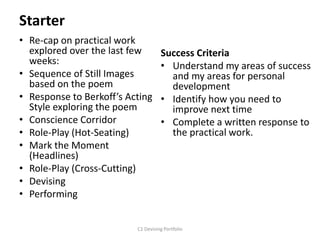
Starter
• Re-cap on practical work
explored over the last few
weeks:
• Sequence of Still Images
based on the poem
• Response to Berkoff’s Acting
Style exploring the poem
• Conscience Corridor
• Role-Play (Hot-Seating)
• Mark the Moment
(Headlines)
• Role-Play (Cross-Cutting)
• Devising
• Performing
Success Criteria
• Understand my areas of success
and my areas for personal
development
• Identify how you need to
improve next time
• Complete a written response to
the practical work.
C1 Devising Portfolio
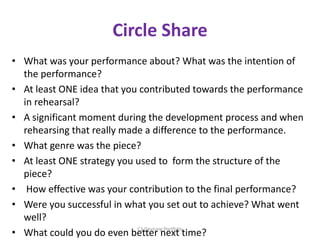
Circle Share
• What was your performance about? What was the intention of
the performance?
• At least ONE idea that you contributed towards the performance
in rehearsal?
• A significant moment during the development process and when
rehearsing that really made a difference to the performance.
• What genre was the piece?
• At least ONE strategy you used to form the structure of the
piece?
• How effective was your contribution to the final performance?
• Were you successful in what you set out to achieve? What went
well?
• What could you do even better next time?C1 Devising Portfolio
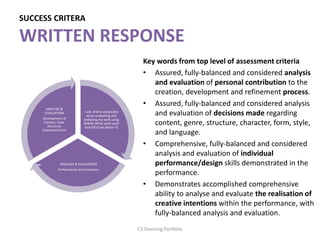
SUCCESS CRITERA
WRITTEN RESPONSE
I use drama vocabulary
when evaluating and
analysing my work using
WWW (What went well)
and EBI (Even Better If)
ANALYSIS & EVALUATION
Performance and Intentions
ANALYSIS &
EVALUATION
Development of
Content, Style,
Structure,
Characterisation
Key words from top level of assessment criteria
• Assured, fully-balanced and considered analysis
and evaluation of personal contribution to the
creation, development and refinement process.
• Assured, fully-balanced and considered analysis
and evaluation of decisions made regarding
content, genre, structure, character, form, style,
and language.
• Comprehensive, fully-balanced and considered
analysis and evaluation of individual
performance/design skills demonstrated in the
performance.
• Demonstrates accomplished comprehensive
ability to analyse and evaluate the realisation of
creative intentions within the performance, with
fully-balanced analysis and evaluation.
C1 Devising Portfolio
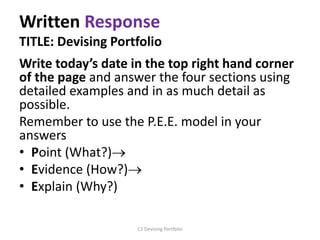
Written Response
TITLE: Devising Portfolio
Write today’s date in the top right hand corner
of the page and answer the four sections using
detailed examples and in as much detail as
possible.
Remember to use the P.E.E. model in your
answers
• Point (What?)
• Evidence (How?)
• Explain (Why?)
C1 Devising Portfolio
GCSE - Each student must include a
response to the following questions.
1. What was your initial response to the stimuli and what were the
intentions of the piece?
2. What work did your group do in order to explore the stimuli and
start to create ideas for performance?
3. What were some of the significant moments during the
development process and when rehearsing and refining your
work?
4. How did you consider genre, structure, character, form, style, and
language throughout the process?
5. How effective was your contribution to the final performance?
6. Were you successful in what you set out to achieve?
Word Count: 1500-2000
C1 Devising Portfolio
Keywords for Written Response
Rehearsal
Strategies
Devising Strategies Medium of Drama Elements of Drama
Hot-Seating Role-Play Props Plot/Content
Role-on-the-Wall Narration Set Protagonist
Forum Theatre Mark the Moment Sound Form
Spontaneous
Improvisation
Still Image Music Climax/Anti-climax
Conscience Corridor Monologue Costume Characterisation
Cross-Cutting Masks Symbolism
Thought-Tracking Spoken Language Contrast
Soliloquy Movement
Sound Scaping Mime
Abstract Drama Gesture
Cliff Hanger Physical Theatre
C1 Devising Portfolio
Written Response
TITLE: Devising Portfolio
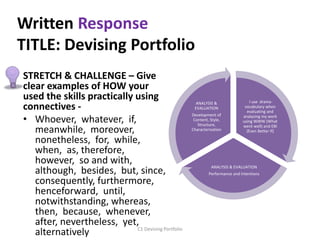
STRETCH & CHALLENGE – Give
clear examples of HOW your
used the skills practically using
connectives -
• Whoever, whatever, if,
meanwhile, moreover,
nonetheless, for, while,
when, as, therefore,
however, so and with,
although, besides, but, since,
consequently, furthermore,
henceforward, until,
notwithstanding, whereas,
then, because, whenever,
after, nevertheless, yet,
alternatively
I use drama
vocabulary when
evaluating and
analysing my work
using WWW (What
went well) and EBI
(Even Better If)
ANALYSIS & EVALUATION
Performance and Intentions
ANALYSIS &
EVALUATION
Development of
Content, Style,
Structure,
Characterisation
C1 Devising Portfolio
1. What was your initial response to the stimuli and
what were the intentions of the piece?
2. What work did your group do in order to explore
the stimuli and start to create ideas for performance?
• Focus on the practical application of your
research and stimulus material. How did
the stimulus material influence your
piece in terms of plot outline, style of
presentation, images or themes?
C1 Devising Portfolio
3. What were some of the significant moments during the
development process and when rehearsing and refining your work?
• When looking at ‘significant moments’ look at
your logbooks. What rehearsals stood out
where significant progress was made or a
break through occurred? Write about ideas
that were both accepted and rejected as a
result of exploration, giving full reasons to
justify the choices that you made. Be specific.
• Identify significant moments in rehearsal when
practical advances were made in the
development of your material and your piece.
C1 Devising Portfolio
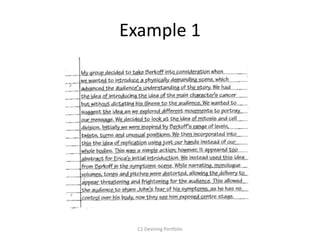
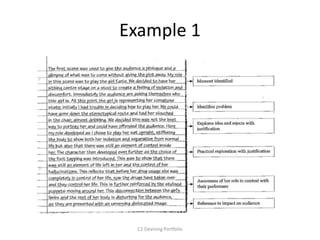
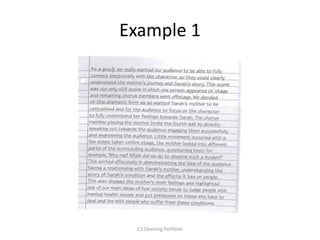
Example 1
C1 Devising Portfolio
4. How did you consider genre, structure, character,
form, style, and language throughout the process?
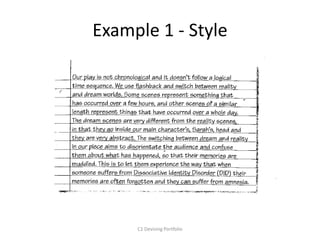
• GENRE/STYLE – The style should define the piece and be
evident to your audience from the opening scene. Did
you use a range of styles and approaches?
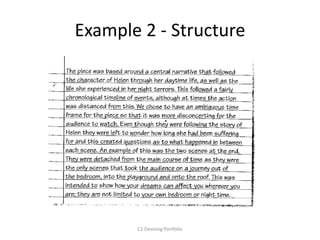
• FORM/STRUCTURE – This refers to the whole range of
drama strategies that you used, from monologue to still
images. You must give the audience the opportunity to go
on a journey with the characters. Which forms of theatre
were most appropriate for the impact that you intended
to make and remember to continually justify why
decisions were made throughout the process.
C1 Devising Portfolio
Example 1 - Style
C1 Devising Portfolio
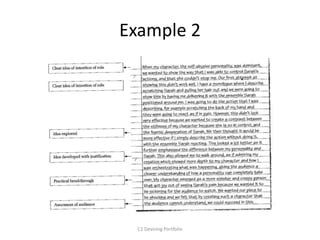
Example 2 - Structure
C1 Devising Portfolio
4. How did you consider genre, structure, character,
form, style, and language throughout the process?
This is a personal response about you and your role(s) and, as
with all the written evidence, it needs to be written in the first
person.
There are three stages to this question.
i. To identify early research into your character
ii. How your piece practically developed for you through
individual research and through 1/2 breakthrough moments
in the rehearsal process
iii. To recognise your role as part of the whole piece and not to
see it in isolation. Consider how your role(s) complemented
those of others and why it might have been necessary to
contrast with other characters for the purpose of emphasis
for the audience.
C1 Devising Portfolio
Example 1
C1 Devising Portfolio
Example 2
C1 Devising Portfolio
5. How effective was your contribution to the final
performance?
6. Were you successful in what you set out to achieve?
• You need to self-analyse as this evaluation requires you to be balanced
and honest in your view of ‘success’.
• The first thing you need to so is BE CLEAR about what your AIMS and
INTENTIONS for your piece actually were.
• Avoid generalisations that mean little. Instead root your answer in the
actual performance. Select two/three central scenes to your piece.
• As a performer you know instinctively how the audience received a certain
scene. It may be nothing like what you expected or intended. Remember
that their reactions are vital.
• It might be worth noting your beginning and ending. How did you grab
your audience from the word go and how did you leave them feeling when
they left?
• What more might you have done in terms of scene order, editing, adding
new scenes, the way the story was told, changing the staging or the
music? Was your central message clear? If not, how would you clarify for
future performances? C1 Devising Portfolio
Example 1
C1 Devising Portfolio
Devising Portfolio
• Look closely at the wording of the questions
• Be open and honest in your appraisal of your
work
• Distinct and specific practical examples linked
to research material
• Focus on the key words from the assessment
criteria – research, explore, develop and
evaluate
C1 Devising Portfolio
Marking for Improvement
DIRT
• Dedicated
• Improvement
&
• Reflection
• Time
FAR
• Feedback
• Action
• Response
How can I improve in Drama?
In GREEN pen complete
your ACTIONS with your
RESPONSE to improve your
written work.
C1 Devising Portfolio

GCSE Drama C1 Devising - portfolio guidelines

  • 1.
    Think →Pair →Share Has my understanding of the themes linked to ‘Saw it in the Papers’ increased? C1 Devising Portfolio
  • 2.
    Be a collectorof good ideas, but don't trust your memory, write it down C1 Devising Portfolio
  • 3.
    C1 Devising Learning Intention A04Analyse and evaluate their own work and the work of others. Success Criteria By the end of the lesson I will be able to: • Understand my areas of success and my areas for personal development • Identify how you need to improve next time • Complete a written portfolio response to the practical work. SBS: How will you use these skills to help you achieve the success criteria? SBS: Resourceful (Questioning, Making Links, Imagining) SBS: Reciprocal (Collaboration, Empathy & Listening, Imitation) SBS: Reflective (Planning, Revising, Distilling) SBS: Resilient (Absorption, Managing Distractions, Noticing, Perseverance)C1 Devising Portfolio
  • 4.
    Starter • Re-cap onpractical work explored over the last few weeks: • Sequence of Still Images based on the poem • Response to Berkoff’s Acting Style exploring the poem • Conscience Corridor • Role-Play (Hot-Seating) • Mark the Moment (Headlines) • Role-Play (Cross-Cutting) • Devising • Performing Success Criteria • Understand my areas of success and my areas for personal development • Identify how you need to improve next time • Complete a written response to the practical work. C1 Devising Portfolio
  • 5.
    Circle Share • Whatwas your performance about? What was the intention of the performance? • At least ONE idea that you contributed towards the performance in rehearsal? • A significant moment during the development process and when rehearsing that really made a difference to the performance. • What genre was the piece? • At least ONE strategy you used to form the structure of the piece? • How effective was your contribution to the final performance? • Were you successful in what you set out to achieve? What went well? • What could you do even better next time?C1 Devising Portfolio
  • 6.
    SUCCESS CRITERA WRITTEN RESPONSE Iuse drama vocabulary when evaluating and analysing my work using WWW (What went well) and EBI (Even Better If) ANALYSIS & EVALUATION Performance and Intentions ANALYSIS & EVALUATION Development of Content, Style, Structure, Characterisation Key words from top level of assessment criteria • Assured, fully-balanced and considered analysis and evaluation of personal contribution to the creation, development and refinement process. • Assured, fully-balanced and considered analysis and evaluation of decisions made regarding content, genre, structure, character, form, style, and language. • Comprehensive, fully-balanced and considered analysis and evaluation of individual performance/design skills demonstrated in the performance. • Demonstrates accomplished comprehensive ability to analyse and evaluate the realisation of creative intentions within the performance, with fully-balanced analysis and evaluation. C1 Devising Portfolio
  • 7.
    Written Response TITLE: DevisingPortfolio Write today’s date in the top right hand corner of the page and answer the four sections using detailed examples and in as much detail as possible. Remember to use the P.E.E. model in your answers • Point (What?) • Evidence (How?) • Explain (Why?) C1 Devising Portfolio
  • 8.
    GCSE - Eachstudent must include a response to the following questions. 1. What was your initial response to the stimuli and what were the intentions of the piece? 2. What work did your group do in order to explore the stimuli and start to create ideas for performance? 3. What were some of the significant moments during the development process and when rehearsing and refining your work? 4. How did you consider genre, structure, character, form, style, and language throughout the process? 5. How effective was your contribution to the final performance? 6. Were you successful in what you set out to achieve? Word Count: 1500-2000 C1 Devising Portfolio
  • 9.
    Keywords for WrittenResponse Rehearsal Strategies Devising Strategies Medium of Drama Elements of Drama Hot-Seating Role-Play Props Plot/Content Role-on-the-Wall Narration Set Protagonist Forum Theatre Mark the Moment Sound Form Spontaneous Improvisation Still Image Music Climax/Anti-climax Conscience Corridor Monologue Costume Characterisation Cross-Cutting Masks Symbolism Thought-Tracking Spoken Language Contrast Soliloquy Movement Sound Scaping Mime Abstract Drama Gesture Cliff Hanger Physical Theatre C1 Devising Portfolio
  • 10.
    Written Response TITLE: DevisingPortfolio STRETCH & CHALLENGE – Give clear examples of HOW your used the skills practically using connectives - • Whoever, whatever, if, meanwhile, moreover, nonetheless, for, while, when, as, therefore, however, so and with, although, besides, but, since, consequently, furthermore, henceforward, until, notwithstanding, whereas, then, because, whenever, after, nevertheless, yet, alternatively I use drama vocabulary when evaluating and analysing my work using WWW (What went well) and EBI (Even Better If) ANALYSIS & EVALUATION Performance and Intentions ANALYSIS & EVALUATION Development of Content, Style, Structure, Characterisation C1 Devising Portfolio
  • 11.
    1. What wasyour initial response to the stimuli and what were the intentions of the piece? 2. What work did your group do in order to explore the stimuli and start to create ideas for performance? • Focus on the practical application of your research and stimulus material. How did the stimulus material influence your piece in terms of plot outline, style of presentation, images or themes? C1 Devising Portfolio
  • 12.
    3. What weresome of the significant moments during the development process and when rehearsing and refining your work? • When looking at ‘significant moments’ look at your logbooks. What rehearsals stood out where significant progress was made or a break through occurred? Write about ideas that were both accepted and rejected as a result of exploration, giving full reasons to justify the choices that you made. Be specific. • Identify significant moments in rehearsal when practical advances were made in the development of your material and your piece. C1 Devising Portfolio
  • 13.
  • 14.
    4. How didyou consider genre, structure, character, form, style, and language throughout the process? • GENRE/STYLE – The style should define the piece and be evident to your audience from the opening scene. Did you use a range of styles and approaches? • FORM/STRUCTURE – This refers to the whole range of drama strategies that you used, from monologue to still images. You must give the audience the opportunity to go on a journey with the characters. Which forms of theatre were most appropriate for the impact that you intended to make and remember to continually justify why decisions were made throughout the process. C1 Devising Portfolio
  • 15.
    Example 1 -Style C1 Devising Portfolio
  • 16.
    Example 2 -Structure C1 Devising Portfolio
  • 17.
    4. How didyou consider genre, structure, character, form, style, and language throughout the process? This is a personal response about you and your role(s) and, as with all the written evidence, it needs to be written in the first person. There are three stages to this question. i. To identify early research into your character ii. How your piece practically developed for you through individual research and through 1/2 breakthrough moments in the rehearsal process iii. To recognise your role as part of the whole piece and not to see it in isolation. Consider how your role(s) complemented those of others and why it might have been necessary to contrast with other characters for the purpose of emphasis for the audience. C1 Devising Portfolio
  • 18.
  • 19.
  • 20.
    5. How effectivewas your contribution to the final performance? 6. Were you successful in what you set out to achieve? • You need to self-analyse as this evaluation requires you to be balanced and honest in your view of ‘success’. • The first thing you need to so is BE CLEAR about what your AIMS and INTENTIONS for your piece actually were. • Avoid generalisations that mean little. Instead root your answer in the actual performance. Select two/three central scenes to your piece. • As a performer you know instinctively how the audience received a certain scene. It may be nothing like what you expected or intended. Remember that their reactions are vital. • It might be worth noting your beginning and ending. How did you grab your audience from the word go and how did you leave them feeling when they left? • What more might you have done in terms of scene order, editing, adding new scenes, the way the story was told, changing the staging or the music? Was your central message clear? If not, how would you clarify for future performances? C1 Devising Portfolio
  • 21.
  • 22.
    Devising Portfolio • Lookclosely at the wording of the questions • Be open and honest in your appraisal of your work • Distinct and specific practical examples linked to research material • Focus on the key words from the assessment criteria – research, explore, develop and evaluate C1 Devising Portfolio
  • 23.
    Marking for Improvement DIRT •Dedicated • Improvement & • Reflection • Time FAR • Feedback • Action • Response How can I improve in Drama? In GREEN pen complete your ACTIONS with your RESPONSE to improve your written work. C1 Devising Portfolio