Stanislavski
Konstantin Stanislavski (1863-1938) Father of modern acting techniquesWriter of the most influential acting lessons in modern timesTogether with Vladimir Nemirovich-Danchenko, he created the Moscow Art Theater (MAT) In 1898
Stanislavski’s BackgroundBorn Konstantin SergeyevichAlekseyev, into an affluent and cultured Russian family (his father was a wealthy merchant)From a very early age he began putting on small plays and musical pieces with his brothers and sisters, for family guests at his family’s estate
The Alekseyev Circle, a group of amateur players largely recruited from Stanislavski’s immediate family provided the young Stanislavski with his first school of dramatic theoryVisiting actors from Moscow and from foreign companies visited the country estate and participated in the productionsStanislavski was able to learn from these actors, finding more ways to create and sustain characters
Although his aristocratic background prevented him from going professional,  he did play important roles in major professional productions in his early life, assuming a stage name to avoid embarrassment for his familyTwo personal traits helped him as he worked to create his method style of acting:His focused study of other actors, and ability to assimilate their styles;His ability to honestly review his own imperfections and adapt himself
In 1890, Stanislavski saw a production by the Meiningen players (a German acting company)From this experience, he learned:The power of crowd scenesImportance of overall moodValue of a rigid acting discipline
Moscow Art TheatreThe partnership  between Stanislavski and with Vladimir Nemirovich-Danchenko began on June 22, 1897, after a now-famous eighteen-hour marathon discussion of the principles of the ideal theater.They determined that the Moscow Art theatre would be created, and they chose their playwright – a successful author of short stories: Anton ChekhovFrom this point onward, Chekhov’s name was forever linked with the Moscow Art Theatre
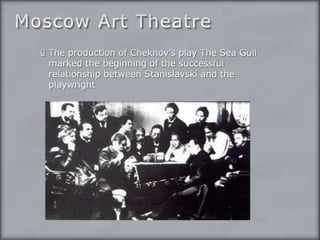
Moscow Art TheatreThe production of Chekhov’s play The Sea Gull marked the beginning of the successful relationship between Stanislavski and the playwright
Stanisklavski TechniqueStanislavski studied how people acted in everyday life, then found a way to bring this genuineness onstage . He developed a series of exercises and techniques for the actor to follow. These included the following:Relaxation: Involved removal of all tension; performer must attain a state of physical and vocal relaxationConcentration and Observation: Focus that should be placed on one object, person or eventSpecificity: Concrete details, rather than generalities in acting are key
TechniquesInner Truth: it is a way for characters to express, possibly non-verbally, their inner feelings. Using the “Magic If”, they can imagine how they would feel in certain situationsWhat? Why? How?: An actor’s physical actions must link to these three questionsThrough Line of a Role: Continuity, or superobjective of a character; involved dividing scenes into beats; the objectives of each beat should link to develop a through line for a characterEnsemble playing: the interaction of all cast members
Stanislavski Quote:"Bring yourself to the part of taking hold of a role, as if it were your own life. Speak for your character in your own person. When you sense this real kinship to your part, your newly created being will become soul of your soul, flesh of your flesh."

Stanislavsky

  • 1.
  • 2.
    Konstantin Stanislavski (1863-1938)Father of modern acting techniquesWriter of the most influential acting lessons in modern timesTogether with Vladimir Nemirovich-Danchenko, he created the Moscow Art Theater (MAT) In 1898
  • 3.
    Stanislavski’s BackgroundBorn KonstantinSergeyevichAlekseyev, into an affluent and cultured Russian family (his father was a wealthy merchant)From a very early age he began putting on small plays and musical pieces with his brothers and sisters, for family guests at his family’s estate
  • 4.
    The Alekseyev Circle,a group of amateur players largely recruited from Stanislavski’s immediate family provided the young Stanislavski with his first school of dramatic theoryVisiting actors from Moscow and from foreign companies visited the country estate and participated in the productionsStanislavski was able to learn from these actors, finding more ways to create and sustain characters
  • 5.
    Although his aristocraticbackground prevented him from going professional, he did play important roles in major professional productions in his early life, assuming a stage name to avoid embarrassment for his familyTwo personal traits helped him as he worked to create his method style of acting:His focused study of other actors, and ability to assimilate their styles;His ability to honestly review his own imperfections and adapt himself
  • 6.
    In 1890, Stanislavskisaw a production by the Meiningen players (a German acting company)From this experience, he learned:The power of crowd scenesImportance of overall moodValue of a rigid acting discipline
  • 7.
    Moscow Art TheatreThepartnership between Stanislavski and with Vladimir Nemirovich-Danchenko began on June 22, 1897, after a now-famous eighteen-hour marathon discussion of the principles of the ideal theater.They determined that the Moscow Art theatre would be created, and they chose their playwright – a successful author of short stories: Anton ChekhovFrom this point onward, Chekhov’s name was forever linked with the Moscow Art Theatre
  • 8.
    Moscow Art TheatreTheproduction of Chekhov’s play The Sea Gull marked the beginning of the successful relationship between Stanislavski and the playwright
  • 9.
    Stanisklavski TechniqueStanislavski studiedhow people acted in everyday life, then found a way to bring this genuineness onstage . He developed a series of exercises and techniques for the actor to follow. These included the following:Relaxation: Involved removal of all tension; performer must attain a state of physical and vocal relaxationConcentration and Observation: Focus that should be placed on one object, person or eventSpecificity: Concrete details, rather than generalities in acting are key
  • 10.
    TechniquesInner Truth: itis a way for characters to express, possibly non-verbally, their inner feelings. Using the “Magic If”, they can imagine how they would feel in certain situationsWhat? Why? How?: An actor’s physical actions must link to these three questionsThrough Line of a Role: Continuity, or superobjective of a character; involved dividing scenes into beats; the objectives of each beat should link to develop a through line for a characterEnsemble playing: the interaction of all cast members
  • 11.
    Stanislavski Quote:"Bring yourselfto the part of taking hold of a role, as if it were your own life. Speak for your character in your own person. When you sense this real kinship to your part, your newly created being will become soul of your soul, flesh of your flesh."

Editor's Notes

  • #6 Stanislavsky’s first experiments with acting styles, as well as the forming and running of his first acting companies, have been well documented, especially in his own autobiography, My Life in Art (1924),.