Component 2: Performance from Text
YEAR 9
Home
Learning
Activities
Week commencing 18-05
How do I Learn Lines?
Learning Aims
• To explore a series of
activities linked to your
chosen text extract
• To develop your skills in
retaining information
• To develop your
performing skills –
voice and movement
What you will need
• See the plays here
• You will need access to the
script, and later your exercise
book, a pen or pencil and
some space to work
practically.
How do I learn my
lines?
1. Writing out
2. Improvising
3. Blocking
4. Mime
5. Experiment
6. Record and Playback
How do I learn my lines?
1. Write your lines out 5x for each line. Cover them up and see if
you can re-write it without looking. REPEAT. REPEAT. REPEAT.
2. Improvise the section of the scene, then look at the lines.
REPEAT. REPEAT. REPEAT. Try to get it as close to the original
as possible.
3. Start BLOCKING the scene – adding movement to the scene.
Muscle memory is powerful and will help you remember.
How do I learn my lines?
4. Perform the monologue using MIME only. You could tap out the
rhythm of the lines using your foot, or your hands tapping your
knees.
5. Experiment/Explore your range of vocal techniques such as
Volume, Tone, and Expression. How does a line sound when I
say it in a different emotion – experiment with opposites.
6. Record your monologue and listen back to it when out for a
walk
You can develop this by leaving gaps for you to speak, or simply
pausing playback and trying to say the next section, then
check you are right – all designed to get the script out of your
hand.
Personal Learning Checklist (PLC)
• Only a few of you are regularly sending work for me to see, so I want
to do a ‘round up’ of what we have been doing and make it easy for
you to track your own progress.
• To do this with any multi-stage task, we can use a PLC.
• I have placed one on the next slide, and then included all the
activities after that so you can keep referring back to them.
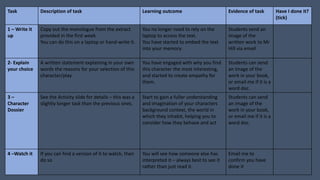
Task Description of task Learning outcome Evidence of task Have I done it?
(tick)
1 – Write it
up
Copy out the monologue from the extract
provided in the first week.
You can do this on a laptop or hand-write it.
You no longer need to rely on the
laptop to access the text.
You have started to embed the text
into your memory.
Students send an
image of the
written work to Mr
Hill via email
2- Explain
your choice
A written statement explaining in your own
words the reasons for your selection of this
character/play
You have engaged with why you find
this character the most interesting,
and started to create empathy for
them.
Students can send
an image of the
work in your book,
or email me if it is a
word doc.
3 –
Character
Dossier
See the Activity slide for details – this was a
slightly longer task than the previous ones.
Start to gain a fuller understanding
and imagination of your characters
background context, the world in
which they inhabit, helping you to
consider how they behave and act
Students can send
an image of the
work in your book,
or email me if it is a
word doc.
4 –Watch it If you can find a version of it to watch, then
do so
You will see how someone else has
interpreted it – always best to see it
rather than just read it.
Email me to
confirm you have
done it
Task Description of task Learning outcome Evidence of task Have I done it?
(tick)
5 –
Condense it
Condensing – making into the essence of
what happens in your extract using a 5-5-1
system
You have a better understanding of
the themes and reason why the
monologue exists in the play at that
point. What is it the audience have
understood because of it?
Email your
response
6 –
Storyboard
it
See Activity slide for full details You start to visualise the events
taking place, and also begin to
consider where your character might
be on stage
Students can send
an image of the
work in your book,
or email me if it is a
word doc.
So – please review all of these tasks and start sending me your work.
I keep a spreadsheet recording who has sent me the work for each tasks but this only works if everyone
communicates.
If you have any difficulties understanding the work remember – three before me – have you read it, have
you asked a family member if they understand it, then email me if you are still stuck.
Next week I will set more tasks; if you have completed all of these and emailed me with evidence, then
either use Digital Theatre or the National Theatre collection to watch some plays – this is a great
opportunity to do so in the time that you have.
Best wishes.

C2.3.1 home learning tasks week 7

  • 1.
    Component 2: Performancefrom Text YEAR 9 Home Learning Activities Week commencing 18-05
  • 2.
    How do ILearn Lines? Learning Aims • To explore a series of activities linked to your chosen text extract • To develop your skills in retaining information • To develop your performing skills – voice and movement What you will need • See the plays here • You will need access to the script, and later your exercise book, a pen or pencil and some space to work practically.
  • 3.
    How do Ilearn my lines? 1. Writing out 2. Improvising 3. Blocking 4. Mime 5. Experiment 6. Record and Playback
  • 4.
    How do Ilearn my lines? 1. Write your lines out 5x for each line. Cover them up and see if you can re-write it without looking. REPEAT. REPEAT. REPEAT. 2. Improvise the section of the scene, then look at the lines. REPEAT. REPEAT. REPEAT. Try to get it as close to the original as possible. 3. Start BLOCKING the scene – adding movement to the scene. Muscle memory is powerful and will help you remember.
  • 5.
    How do Ilearn my lines? 4. Perform the monologue using MIME only. You could tap out the rhythm of the lines using your foot, or your hands tapping your knees. 5. Experiment/Explore your range of vocal techniques such as Volume, Tone, and Expression. How does a line sound when I say it in a different emotion – experiment with opposites. 6. Record your monologue and listen back to it when out for a walk You can develop this by leaving gaps for you to speak, or simply pausing playback and trying to say the next section, then check you are right – all designed to get the script out of your hand.
  • 6.
    Personal Learning Checklist(PLC) • Only a few of you are regularly sending work for me to see, so I want to do a ‘round up’ of what we have been doing and make it easy for you to track your own progress. • To do this with any multi-stage task, we can use a PLC. • I have placed one on the next slide, and then included all the activities after that so you can keep referring back to them.
  • 7.
    Task Description oftask Learning outcome Evidence of task Have I done it? (tick) 1 – Write it up Copy out the monologue from the extract provided in the first week. You can do this on a laptop or hand-write it. You no longer need to rely on the laptop to access the text. You have started to embed the text into your memory. Students send an image of the written work to Mr Hill via email 2- Explain your choice A written statement explaining in your own words the reasons for your selection of this character/play You have engaged with why you find this character the most interesting, and started to create empathy for them. Students can send an image of the work in your book, or email me if it is a word doc. 3 – Character Dossier See the Activity slide for details – this was a slightly longer task than the previous ones. Start to gain a fuller understanding and imagination of your characters background context, the world in which they inhabit, helping you to consider how they behave and act Students can send an image of the work in your book, or email me if it is a word doc. 4 –Watch it If you can find a version of it to watch, then do so You will see how someone else has interpreted it – always best to see it rather than just read it. Email me to confirm you have done it
  • 8.
    Task Description oftask Learning outcome Evidence of task Have I done it? (tick) 5 – Condense it Condensing – making into the essence of what happens in your extract using a 5-5-1 system You have a better understanding of the themes and reason why the monologue exists in the play at that point. What is it the audience have understood because of it? Email your response 6 – Storyboard it See Activity slide for full details You start to visualise the events taking place, and also begin to consider where your character might be on stage Students can send an image of the work in your book, or email me if it is a word doc. So – please review all of these tasks and start sending me your work. I keep a spreadsheet recording who has sent me the work for each tasks but this only works if everyone communicates. If you have any difficulties understanding the work remember – three before me – have you read it, have you asked a family member if they understand it, then email me if you are still stuck. Next week I will set more tasks; if you have completed all of these and emailed me with evidence, then either use Digital Theatre or the National Theatre collection to watch some plays – this is a great opportunity to do so in the time that you have. Best wishes.