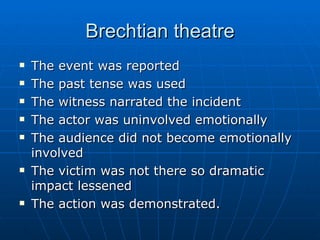
Brechtian theatre The event was reported The past tense was used The witness narrated the incident The actor was uninvolved emotionally The audience did not become emotionally involved The victim was not there so dramatic impact lessened The action was demonstrated.
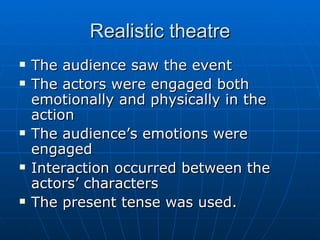
Realistic theatre The audience saw the event The actors were engaged both emotionally and physically in the action The audience’s emotions were engaged Interaction occurred between the actors’ characters The present tense was used.
Role play Strong focus on an issue Narrator presented one point of view Didacticism is strong in Brechtian drama. Use of a narrator to observe action and report events Use of actors taking dual roles – narrator/police officer Objective characterisation Use of ritualised or formal setting/movement
DRAMATIC THEATRE EPIC THEATRE Brings an event to life Relates the event Involves the audience and wears down its capacity for action Makes the audience an observer but arouses its capacity for action Helps it to feel Compels it to make Decisions Communicates experiences Communicates insights The audience is projected into an event The audience is confronted with an event Suggestion is used Arguments are used The character is a known quantity The character is subject to investigation Man is unchangeable Man can change and make changes Eyes on the finish Eyes on the course Events move in a straight line Events move in irregular episodes One event follows another Events jump The world as it is The world as it is becoming or might be
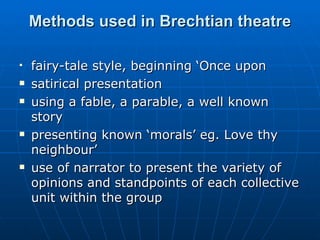
Methods used in Brechtian theatre fairy-tale style, beginning ‘Once upon satirical presentation using a fable, a parable, a well known story presenting known ‘morals’ eg. Love thy neighbour’ use of narrator to present the variety of opinions and standpoints of each collective unit within the group
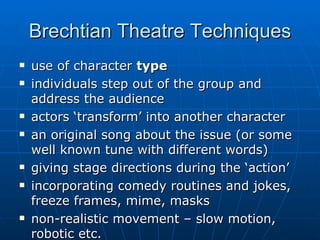
Brechtian Theatre Techniques use of character  type individuals step out of the group and address the audience actors ‘transform’ into another character an original song about the issue (or some well known tune with different words) giving stage directions during the ‘action’ incorporating comedy routines and jokes, freeze frames, mime, masks non-realistic movement – slow motion, robotic etc.
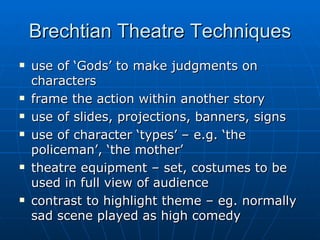
Brechtian Theatre Techniques use of ‘Gods’ to make judgments on characters frame the action within another story use of slides, projections, banners, signs use of character ‘types’ – e.g. ‘the policeman’, ‘the mother’ theatre equipment – set, costumes to be used in full view of audience contrast to highlight theme – eg. normally sad scene played as high comedy

Brechtian Theatre

  • 1.
    Brechtian theatre Theevent was reported The past tense was used The witness narrated the incident The actor was uninvolved emotionally The audience did not become emotionally involved The victim was not there so dramatic impact lessened The action was demonstrated.
  • 2.
    Realistic theatre Theaudience saw the event The actors were engaged both emotionally and physically in the action The audience’s emotions were engaged Interaction occurred between the actors’ characters The present tense was used.
  • 3.
    Role play Strongfocus on an issue Narrator presented one point of view Didacticism is strong in Brechtian drama. Use of a narrator to observe action and report events Use of actors taking dual roles – narrator/police officer Objective characterisation Use of ritualised or formal setting/movement
  • 4.
    DRAMATIC THEATRE EPICTHEATRE Brings an event to life Relates the event Involves the audience and wears down its capacity for action Makes the audience an observer but arouses its capacity for action Helps it to feel Compels it to make Decisions Communicates experiences Communicates insights The audience is projected into an event The audience is confronted with an event Suggestion is used Arguments are used The character is a known quantity The character is subject to investigation Man is unchangeable Man can change and make changes Eyes on the finish Eyes on the course Events move in a straight line Events move in irregular episodes One event follows another Events jump The world as it is The world as it is becoming or might be
  • 5.
    Methods used inBrechtian theatre fairy-tale style, beginning ‘Once upon satirical presentation using a fable, a parable, a well known story presenting known ‘morals’ eg. Love thy neighbour’ use of narrator to present the variety of opinions and standpoints of each collective unit within the group
  • 6.
    Brechtian Theatre Techniquesuse of character type individuals step out of the group and address the audience actors ‘transform’ into another character an original song about the issue (or some well known tune with different words) giving stage directions during the ‘action’ incorporating comedy routines and jokes, freeze frames, mime, masks non-realistic movement – slow motion, robotic etc.
  • 7.
    Brechtian Theatre Techniquesuse of ‘Gods’ to make judgments on characters frame the action within another story use of slides, projections, banners, signs use of character ‘types’ – e.g. ‘the policeman’, ‘the mother’ theatre equipment – set, costumes to be used in full view of audience contrast to highlight theme – eg. normally sad scene played as high comedy