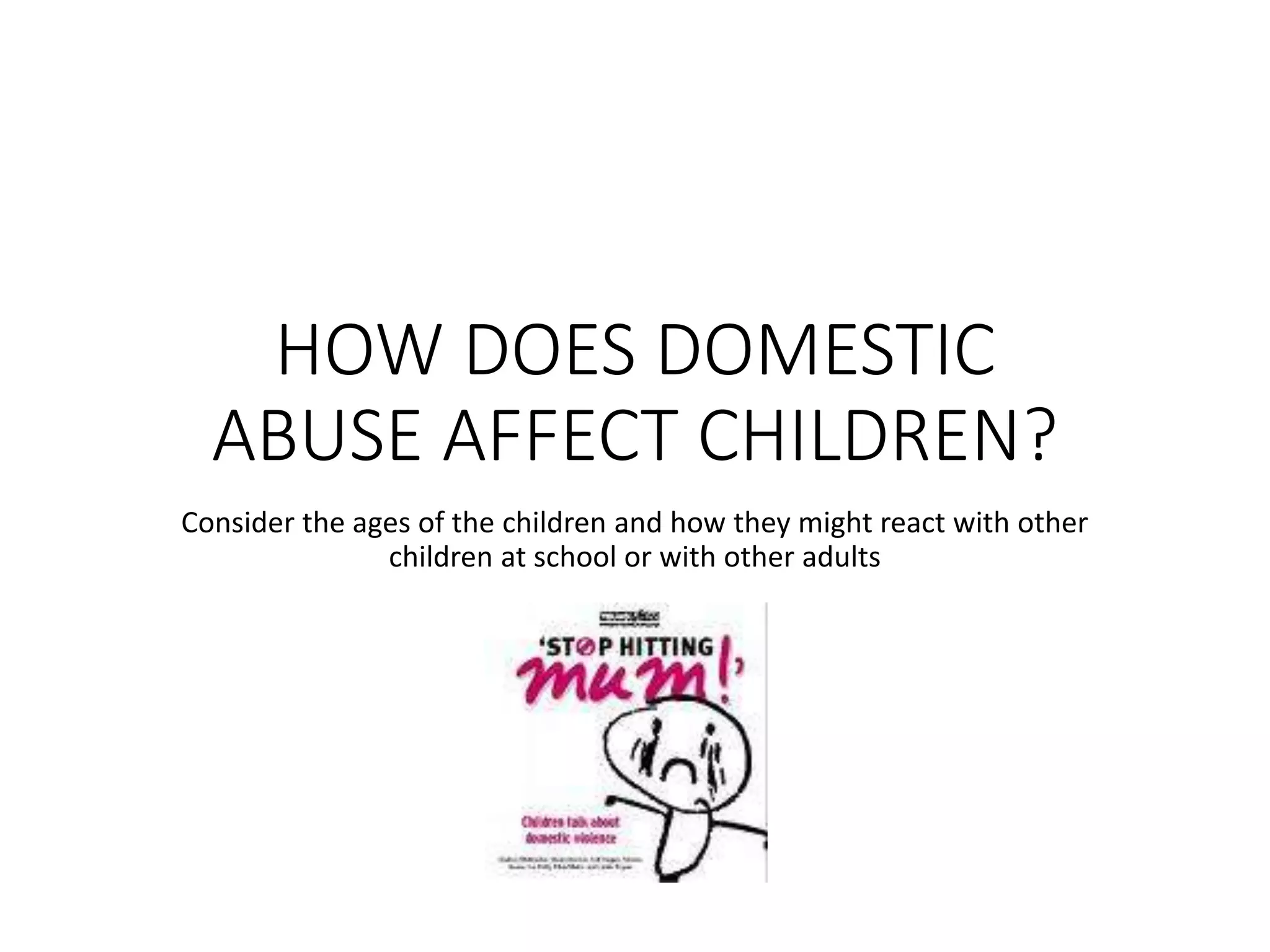
HOW DOES DOMESTIC
ABUSE AFFECT CHILDREN?
Consider the ages of the children and how they might react with other
children at school or with other adults
Unit 1 Drama Exploration
Learning Intention
A01 Recall, select, use and communicate your knowledge and understanding
of drama in an effective manner to generate, explore and develop ideas.
A03 Analyse and evaluate your own work and that of others using appropriate
terminology
Success Criteria By the end of the lesson I will:
Apply cross-cutting creatively to explore how domestic abuse affects children
Explore the use of music and lighting in a ROLE-PLAY
Analyse and evaluate your own practical work and the work of others
SBS: How will you use these skills to help you achieve the success criteria?
SBS: Resourceful (Questioning, Making Links, Imagining)
SBS: Reciprocal (Collaboration, Empathy & Listening, Imitation)
SBS: Reflective (Planning, Revising, Distilling)
SBS: Resilient (Absorption, Managing Distractions, Noticing, Perseverance)
Unit 1 Drama Exploration 30% – EXPLORING RESPONDING
Practical Exploration
Contribute to ideas and work within
the group
Communicate through space and
movement as well as words
Explore issues, ideas and feelings
Understand how Drama
communicates
Choose the appropriate form of
Drama for communication.
Respond to ideas and issues in
different contexts
WRITTEN PORTFOLIO
Reflect on your
exploration process
and analyse and
evaluate:
Your own work and
the work of others
Learning Intentions
• A01 Recall, select,
use and
communicate
their knowledge
and
understanding of
drama in an
effective manner
to generate,
explore and
develop ideas.
20%
• A03 Analyse and
evaluate their
own work and
that of others
using appropriate
terminology 10%
SUCCESS CRITERA
I can . . .
How are
you
developing
these skills
in Drama?
Reciprocal
Collaboration
Empathy &
Listening
Imitation
Resilient
Absorption
Noticing
Perseverance
Managing
Distractions
Resourceful
Questioning
Making Links
Imagining
Reflective
Planning
Revising
Distilling
Unit 1: Drama Exploration:
Image Theatre
Success Criteria
• Apply cross-cutting creatively to
explore how domestic abuse affects
children
• Analyse and evaluate your own
practical work and the work of others
• Whole class: Read extract
‘Once in a House on Fire’
• Image Theatre -Create a class
image that reflects how they
would feel if they were the
child caught up in a violent
situation outlined in the
novel – add music.
• Add spoken language
STRETCH & CHALLENGE –
Volunteer to share your
work first.
Unit 1: Drama Exploration
DISCUSSION
• Feelings
• Who might they talk to?
• How might they behave with their
siblings?
• How might they behave with their
friends?
• How might they behave with
other adults?
• How do they feel towards their
parents?
Success Criteria
• Analyse the use of props, music
and lighting
• Apply cross-cutting creatively to
explore how domestic abuse
affects children
• Explore the use of props, music
and lighting in a ROLE-PLAY
• Analyse and evaluate your own
practical work and the work of
others
Unit 1: Drama Exploration: Cross-Cutting
What is cross-cutting?
CROSS-CUTTING is creating
scenes and then re-ordering
the action by ‘cutting’
forwards and backwards to
different times.
You could start with a middle
scene, then flashback to the
first scene and then continue
with the final scenes.
You could also use a SPLIT –
STAGE and CROSS-CUT
between the different scenes.
Success Criteria
Apply cross-cutting creatively to explore
how domestic abuse affects children
Analyse and evaluate your own practical
work and the work of others
Stretch and Challenge
• STILL IMAGE
• PHYSICAL THEATRE
• TRANSITION
• MARK THE MOMENT
• MONOLOGUE
Drama
Strategies
•Use of Sound
•Use of Music
•Use of Space
•Use of Levels
•Use of Spoken language
•Use of Movement
•Use of Mime
•Use of Gesture
Drama
Medium •Symbols
•Contrasts
•Climax/anti-climax
•Rhythm/pace/tempo
•Action/plot/content
•Characterisation
•Choreography
Drama Elements
Group work: Using CROSS-CUTTING create a performance that explores the impact of Domestic
Abuse on the children over time.
Explore the impact at home, at school and at a friend’s house.
How has cross-cutting enhanced your understanding of the theme of domestic abuse?
Written Response - How did you use CROSS-CUTTING to explore
the impact of Domestic Abuse on children over time?
Answer the question giving examples and linking to your practical work
Point
What?
Evidence
How?
Evaluate
Why?
POINT – How did the stimulus
inspire you in your role-play?
EVIDENCE – How did you use CROSS-
CUTTING to explore the impact of
Domestic Abuse on children over
time?
Evaluate –Explain how your practical
exploration enabled you to develop
your knowledge and understanding
of the impact on children over time
CROSS-CUTTING Significant moments
Climax/Anti-Climax
Space/Levels
Movement
Mime and Gestures
Expressions
Eye Contact
Use of Voice
Use of Spoken Language
Narrative /Plot/Content
Themes of the play (Unit 2)
Themes/Topic/Issues (Unit 1)
Character relationships
Status
Dramatic Potential
Collaboration with others
Contrasts
Characterisation
Symbolism

W6 once in a house on fire cross cutting.1

  • 1.
    HOW DOES DOMESTIC ABUSEAFFECT CHILDREN? Consider the ages of the children and how they might react with other children at school or with other adults
  • 2.
    Unit 1 DramaExploration Learning Intention A01 Recall, select, use and communicate your knowledge and understanding of drama in an effective manner to generate, explore and develop ideas. A03 Analyse and evaluate your own work and that of others using appropriate terminology Success Criteria By the end of the lesson I will: Apply cross-cutting creatively to explore how domestic abuse affects children Explore the use of music and lighting in a ROLE-PLAY Analyse and evaluate your own practical work and the work of others SBS: How will you use these skills to help you achieve the success criteria? SBS: Resourceful (Questioning, Making Links, Imagining) SBS: Reciprocal (Collaboration, Empathy & Listening, Imitation) SBS: Reflective (Planning, Revising, Distilling) SBS: Resilient (Absorption, Managing Distractions, Noticing, Perseverance)
  • 3.
    Unit 1 DramaExploration 30% – EXPLORING RESPONDING Practical Exploration Contribute to ideas and work within the group Communicate through space and movement as well as words Explore issues, ideas and feelings Understand how Drama communicates Choose the appropriate form of Drama for communication. Respond to ideas and issues in different contexts WRITTEN PORTFOLIO Reflect on your exploration process and analyse and evaluate: Your own work and the work of others Learning Intentions • A01 Recall, select, use and communicate their knowledge and understanding of drama in an effective manner to generate, explore and develop ideas. 20% • A03 Analyse and evaluate their own work and that of others using appropriate terminology 10%
  • 4.
    SUCCESS CRITERA I can. . . How are you developing these skills in Drama? Reciprocal Collaboration Empathy & Listening Imitation Resilient Absorption Noticing Perseverance Managing Distractions Resourceful Questioning Making Links Imagining Reflective Planning Revising Distilling
  • 5.
    Unit 1: DramaExploration: Image Theatre Success Criteria • Apply cross-cutting creatively to explore how domestic abuse affects children • Analyse and evaluate your own practical work and the work of others • Whole class: Read extract ‘Once in a House on Fire’ • Image Theatre -Create a class image that reflects how they would feel if they were the child caught up in a violent situation outlined in the novel – add music. • Add spoken language STRETCH & CHALLENGE – Volunteer to share your work first.
  • 6.
    Unit 1: DramaExploration DISCUSSION • Feelings • Who might they talk to? • How might they behave with their siblings? • How might they behave with their friends? • How might they behave with other adults? • How do they feel towards their parents? Success Criteria • Analyse the use of props, music and lighting • Apply cross-cutting creatively to explore how domestic abuse affects children • Explore the use of props, music and lighting in a ROLE-PLAY • Analyse and evaluate your own practical work and the work of others
  • 7.
    Unit 1: DramaExploration: Cross-Cutting What is cross-cutting? CROSS-CUTTING is creating scenes and then re-ordering the action by ‘cutting’ forwards and backwards to different times. You could start with a middle scene, then flashback to the first scene and then continue with the final scenes. You could also use a SPLIT – STAGE and CROSS-CUT between the different scenes. Success Criteria Apply cross-cutting creatively to explore how domestic abuse affects children Analyse and evaluate your own practical work and the work of others
  • 8.
    Stretch and Challenge •STILL IMAGE • PHYSICAL THEATRE • TRANSITION • MARK THE MOMENT • MONOLOGUE Drama Strategies •Use of Sound •Use of Music •Use of Space •Use of Levels •Use of Spoken language •Use of Movement •Use of Mime •Use of Gesture Drama Medium •Symbols •Contrasts •Climax/anti-climax •Rhythm/pace/tempo •Action/plot/content •Characterisation •Choreography Drama Elements Group work: Using CROSS-CUTTING create a performance that explores the impact of Domestic Abuse on the children over time. Explore the impact at home, at school and at a friend’s house. How has cross-cutting enhanced your understanding of the theme of domestic abuse?
  • 9.
    Written Response -How did you use CROSS-CUTTING to explore the impact of Domestic Abuse on children over time? Answer the question giving examples and linking to your practical work Point What? Evidence How? Evaluate Why? POINT – How did the stimulus inspire you in your role-play? EVIDENCE – How did you use CROSS- CUTTING to explore the impact of Domestic Abuse on children over time? Evaluate –Explain how your practical exploration enabled you to develop your knowledge and understanding of the impact on children over time CROSS-CUTTING Significant moments Climax/Anti-Climax Space/Levels Movement Mime and Gestures Expressions Eye Contact Use of Voice Use of Spoken Language Narrative /Plot/Content Themes of the play (Unit 2) Themes/Topic/Issues (Unit 1) Character relationships Status Dramatic Potential Collaboration with others Contrasts Characterisation Symbolism