From Page to Stage
What is the Focus of the unit
• The Focus of the unit is
how a published script is
brought to life for an
audience.
• The emphasis is on
the original intention
of the playwrite.
NOT DEVISING
You will need to
• Establish The
Playwright’s intention
• Establish the key features
of the genre and related
performance style
• Identify the historical and
cultural context and how
that might impact on any
performance.
• Identify the design
elements indicated in
the script and adopt or
add to these in a way
that supports the
interpretation decided
upon
• Develop and practice
the necessary
performance skills
needed to deliver an
effective performance
of the interpretation of
a chosen extract
• Rehearse the
developed piece for
final performance.
Areas of Study
You must show an understanding
and appreciation of Areas of Study
• Character, context and
plot
• Structure
• Audience and Defining
performance space
• Improvisation
• Genre, performance style
and convention
• The semiotics of Drama
and Theatre
To Bring the Script to
life
• You must explore the
roles of
– Designer
– Director
– Performer
You must develop and
demonstrate an ability to:
• Apply performance and
production skills
• Acquire reflective and
evaluative skills in
response to the Script
• Work collaboratively and
creatively to achieve
shared dramatic
intentions
Workshop sessions
• We will be taking
part in workshop
sessions to
introduce you to the
script and its main
themes.
• It is up to you to the
take these ideas and
develop them further
Assessment
Assessment is in Controlled Conditions Again
• You will be assessed on
your working Record
– These are all your ideas
and workings leading up to
your final performance.
• Final performance of
Extract
– This is the culmination of
your ideas based on the
intention of the script and
you ideas in your working
record.
• 20 marks
• 40 marks
• Total 60 Marks
The working process
• The working process is
designed to reflect the
work of proffesionals and
covers 5 stages needed
to create a performance.
The 5 Stages
• Preparation
• Exploration
• Rehearsal
• Performance
• Review
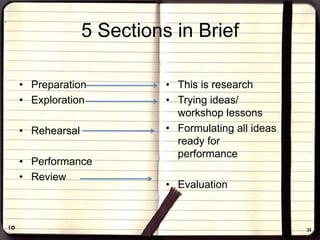
5 Sections in Brief
• Preparation
• Exploration
• Rehearsal
• Performance
• Review
• This is research
• Trying ideas/
workshop lessons
• Formulating all ideas
ready for
performance
• Evaluation
Preparation and Exploration
Preparation - Research
• Examine the Social,
Cultural and Historical
context of the play
• Identify the genre,
performance style and
Audience
• Investigate the intention
of the playwright
• Areas of Study
Exploration – Based
on the script as written
• Take part as a
Performer and
director in workshops
of the script
• Consider the Design
Implications of the
script and within the
time constraints apply
elements of design
where possible
Rehearsal and Performance
Rehearsal
• Start of Controlled
Conditions
• Direct Sections of the script
applying ideas generated
from previous workshops or
creating a new
interpretation.
• Prepare for performance as
a Performer
• Complete Second Section
of Working Record Charting
Rehearsals
Performance
• Perform the
rehearsed section of
Script
Review
• Review of intention of
Areas of study
• Reflection on
Performances
• If I had more time
• Review of another group
How to set out Working Record
• There are many different
ways to set out your
working Record.
• Outlined is just an
example of how to do it.
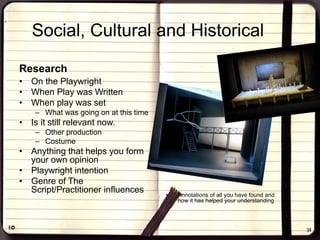
Social, Cultural and Historical
Research
• On the Playwright
• When Play was Written
• When play was set
– What was going on at this time
• Is it still relevant now.
– Other production
– Costume
• Anything that helps you form
your own opinion
• Playwright intention
• Genre of The
Script/Practitioner influences • Annotations of all you have found and
how it has helped your understanding
During the read through
Initial thoughts whilst
reading through
• This could be elements
that highlight the
playwrights original
intention
– This could be anything that
highlights the theme
– Enhances Character
– Develops plot
– Relates directly to historical
event
• Look for use of
language
– As it was written by
the playwright
– Crime and
Punishment
– Redemption
– Societies views
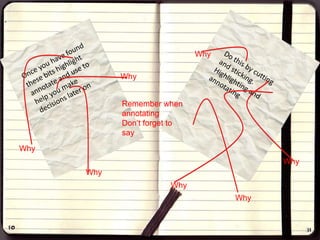
Remember when
annotating
Don’t forget to
say
Why
Why
Why
Why
Why
Why
Why
Workshop session
Keep a record of the
workshop sessions
• This could be exercises
we have done
• Character development
exercises
• Set
• Props
• Character relationship
Reflect on the
session
• This is what you
have personally
found out from doing
the sessions and
should spark ideas
of what section/
character you would
like to work on.
Idea for development
• Idea for a monologue
piece and Why?
• Idea for a duologue Piece
and Why?
• Idea for a group piece
and why?
Final Idea
• What you are doing
and how that fits
with the playwrights
intention
Areas of Study
This is directly linked to
your final Idea
• Character, context and
plot
• Structure
• Audience and Defining
performance space
• Improvisation
• Genre, performance style
and convention
• The semiotics of Drama
and Theatre
Throughout the Rehearsal
• Description of Character
in context must be
coherent and justified
• Ideas for use of
performance space
• Capture important
essence of the script for
performance
• Semiotics combine
sound, lighting,
projection to combine
in a unified way.
• Practitioner
influences on your
work.
• Subject vocab
throughout.
Rehearsal
This is what you are doing to get
you piece ready for rehearsal
• You can split this into
sections if you want.
• Script – Annotated
• Costume
• Set Design
• Semiotics
• Lighting
• Staging
And WHY!!!!!!
• Or you can work
through it session by
session.
• This is spread out
not just on one
page.
• It is as long as it has
to be.
Performance
What I am looking for
• Use and selection of
stage space.
– Integrated with the theme
• Good Command of the
demands placed on the
performer by the script.
• Use of Voice and
gesture
– Well crafted
Characterisation
– Works productively
with others
• Semiotics –
costume/properties/te
chnical aspects/
symbolism works with
the theme of the text.
• Gives insight into
character, creates
mood, adds layers
and meaning for
audience
Review
Your own piece
• Areas of study
• Evaluate
– Directing, Acting, Design
• Context of text extract
• All analysed with
perception
• If I had more time.
Work of others
• The practitioner
influences
• Ideas of others
• How they brought
the section to life.
Unit 1 from page to stage

Unit 1 from page to stage

  • 2.
    From Page toStage What is the Focus of the unit • The Focus of the unit is how a published script is brought to life for an audience. • The emphasis is on the original intention of the playwrite. NOT DEVISING
  • 3.
    You will needto • Establish The Playwright’s intention • Establish the key features of the genre and related performance style • Identify the historical and cultural context and how that might impact on any performance. • Identify the design elements indicated in the script and adopt or add to these in a way that supports the interpretation decided upon • Develop and practice the necessary performance skills needed to deliver an effective performance of the interpretation of a chosen extract • Rehearse the developed piece for final performance.
  • 4.
    Areas of Study Youmust show an understanding and appreciation of Areas of Study • Character, context and plot • Structure • Audience and Defining performance space • Improvisation • Genre, performance style and convention • The semiotics of Drama and Theatre To Bring the Script to life • You must explore the roles of – Designer – Director – Performer
  • 5.
    You must developand demonstrate an ability to: • Apply performance and production skills • Acquire reflective and evaluative skills in response to the Script • Work collaboratively and creatively to achieve shared dramatic intentions Workshop sessions • We will be taking part in workshop sessions to introduce you to the script and its main themes. • It is up to you to the take these ideas and develop them further
  • 6.
    Assessment Assessment is inControlled Conditions Again • You will be assessed on your working Record – These are all your ideas and workings leading up to your final performance. • Final performance of Extract – This is the culmination of your ideas based on the intention of the script and you ideas in your working record. • 20 marks • 40 marks • Total 60 Marks
  • 7.
    The working process •The working process is designed to reflect the work of proffesionals and covers 5 stages needed to create a performance. The 5 Stages • Preparation • Exploration • Rehearsal • Performance • Review
  • 8.
    5 Sections inBrief • Preparation • Exploration • Rehearsal • Performance • Review • This is research • Trying ideas/ workshop lessons • Formulating all ideas ready for performance • Evaluation
  • 9.
    Preparation and Exploration Preparation- Research • Examine the Social, Cultural and Historical context of the play • Identify the genre, performance style and Audience • Investigate the intention of the playwright • Areas of Study Exploration – Based on the script as written • Take part as a Performer and director in workshops of the script • Consider the Design Implications of the script and within the time constraints apply elements of design where possible
  • 10.
    Rehearsal and Performance Rehearsal •Start of Controlled Conditions • Direct Sections of the script applying ideas generated from previous workshops or creating a new interpretation. • Prepare for performance as a Performer • Complete Second Section of Working Record Charting Rehearsals Performance • Perform the rehearsed section of Script
  • 11.
    Review • Review ofintention of Areas of study • Reflection on Performances • If I had more time • Review of another group
  • 12.
    How to setout Working Record • There are many different ways to set out your working Record. • Outlined is just an example of how to do it.
  • 14.
    Social, Cultural andHistorical Research • On the Playwright • When Play was Written • When play was set – What was going on at this time • Is it still relevant now. – Other production – Costume • Anything that helps you form your own opinion • Playwright intention • Genre of The Script/Practitioner influences • Annotations of all you have found and how it has helped your understanding
  • 16.
    During the readthrough Initial thoughts whilst reading through • This could be elements that highlight the playwrights original intention – This could be anything that highlights the theme – Enhances Character – Develops plot – Relates directly to historical event • Look for use of language – As it was written by the playwright – Crime and Punishment – Redemption – Societies views
  • 17.
    Remember when annotating Don’t forgetto say Why Why Why Why Why Why Why
  • 18.
    Workshop session Keep arecord of the workshop sessions • This could be exercises we have done • Character development exercises • Set • Props • Character relationship Reflect on the session • This is what you have personally found out from doing the sessions and should spark ideas of what section/ character you would like to work on.
  • 19.
    Idea for development •Idea for a monologue piece and Why? • Idea for a duologue Piece and Why? • Idea for a group piece and why? Final Idea • What you are doing and how that fits with the playwrights intention
  • 20.
    Areas of Study Thisis directly linked to your final Idea • Character, context and plot • Structure • Audience and Defining performance space • Improvisation • Genre, performance style and convention • The semiotics of Drama and Theatre
  • 22.
    Throughout the Rehearsal •Description of Character in context must be coherent and justified • Ideas for use of performance space • Capture important essence of the script for performance • Semiotics combine sound, lighting, projection to combine in a unified way. • Practitioner influences on your work. • Subject vocab throughout.
  • 23.
    Rehearsal This is whatyou are doing to get you piece ready for rehearsal • You can split this into sections if you want. • Script – Annotated • Costume • Set Design • Semiotics • Lighting • Staging And WHY!!!!!! • Or you can work through it session by session. • This is spread out not just on one page. • It is as long as it has to be.
  • 24.
    Performance What I amlooking for • Use and selection of stage space. – Integrated with the theme • Good Command of the demands placed on the performer by the script. • Use of Voice and gesture – Well crafted Characterisation – Works productively with others • Semiotics – costume/properties/te chnical aspects/ symbolism works with the theme of the text. • Gives insight into character, creates mood, adds layers and meaning for audience
  • 26.
    Review Your own piece •Areas of study • Evaluate – Directing, Acting, Design • Context of text extract • All analysed with perception • If I had more time. Work of others • The practitioner influences • Ideas of others • How they brought the section to life.