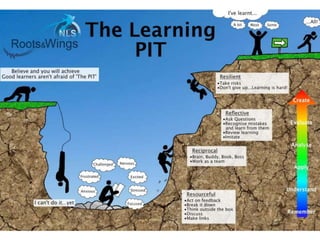
SUCCESS CRITERA
I can develop the following skills:
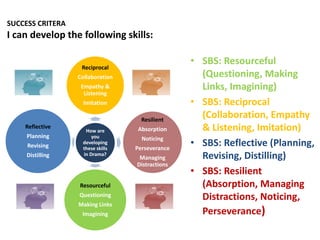
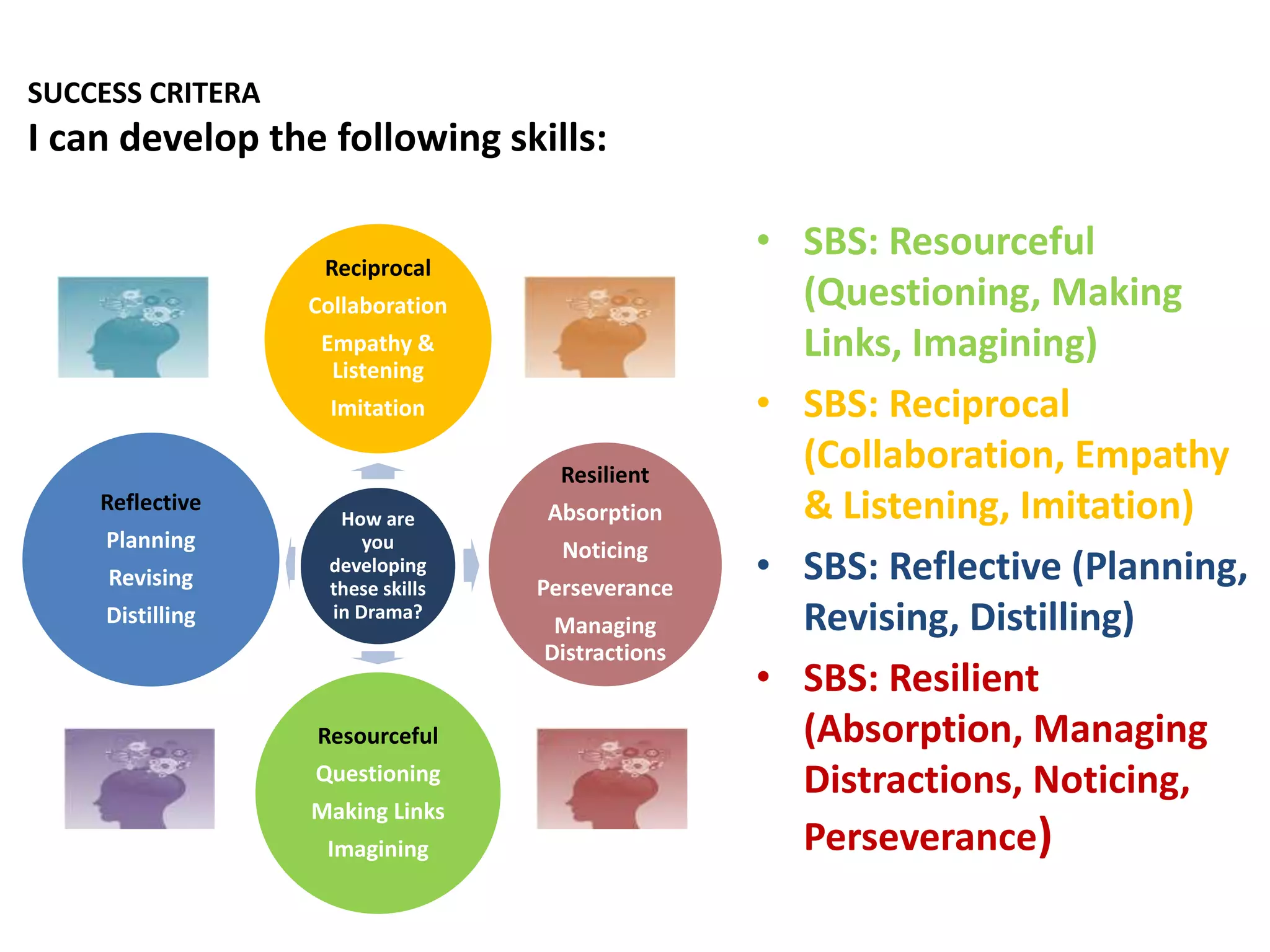
How are
you
developing
these skills
in Drama?
Reciprocal
Collaboration
Empathy &
Listening
Imitation
Resilient
Absorption
Noticing
Perseverance
Managing
Distractions
Resourceful
Questioning
Making Links
Imagining
Reflective
Planning
Revising
Distilling
• SBS: Resourceful
(Questioning, Making
Links, Imagining)
• SBS: Reciprocal
(Collaboration, Empathy
& Listening, Imitation)
• SBS: Reflective (Planning,
Revising, Distilling)
• SBS: Resilient
(Absorption, Managing
Distractions, Noticing,
Perseverance)
C1 Devising
Learning Intentions
A01 Create and develop ideas to communicate meaning for theatrical
performance.
A02 Apply theatrical skills to realise artistic intentions in live performance.
A04 Analyse and evaluate their own work and the work of others.
Success Criteria By the end of the lesson I will be able to:
• Know the expectations of a Drama lesson and the Drama Rules.
• Understand the THREE components of the course
• Establish relationships within the group to create an effective group dynamic.
SBS: How will you use these skills to help you achieve the success criteria?
SBS: Resourceful (Questioning, Making Links, Imagining)
SBS: Reciprocal (Collaboration, Empathy & Listening, Imitation)
SBS: Reflective (Planning, Revising, Distilling)
SBS: Resilient (Absorption, Managing Distractions, Noticing, Perseverance)
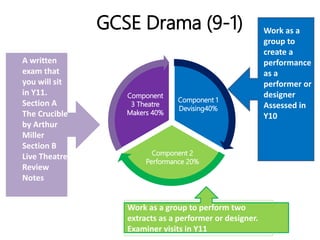
GCSE Drama (9-1)
Component 1
Devising40%
Component 2
Performance 20%
Component
3 Theatre
Makers 40%
Work as a
group to
create a
performance
as a
performer or
designer
Assessed in
Y10
Work as a group to perform two
extracts as a performer or designer.
Examiner visits in Y11
A written
exam that
you will sit
in Y11.
Section A
The Crucible
by Arthur
Miller
Section B
Live Theatre
Review
Notes
Resources are to found at:
• http://soadrama.blogspot.com
• Shared Drive on the Student Common area –
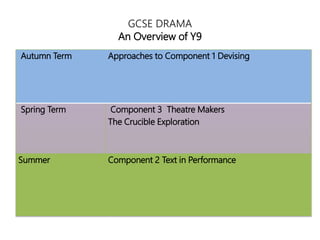
GCSE DRAMA
An Overview of Y9
Autumn Term Approaches to Component 1 Devising
Spring Term Component 3 Theatre Makers
The Crucible Exploration
Summer Component 2 Text in Performance
Roles in the Theatre
In pairs …
List as many job roles as you can think of in
professional theatre.
Include onstage, backstage and front of house
roles.
Join up with another pair to see if you can add to
your list.
Key Roles in Theatre
PERFORMER
• Often referred to as actors, performers use a
range of physical and vocal skills to convey
narrative and plot to the audience.
• Performers make decisions about how a
character might be interpreted and then
shown on stage. They use facial expressions,
body language, proxemics and voice to bring
their ideas to life for the audience.
Key Roles in Theatre
DIRECTOR
• The director has overall creative control of the
piece and brings together all of the different
dramatic elements.
• A director will consider what approach to the
text the production will take and will also take
control of the overall vision. It is the role of
the director to make decisions about the style
and genre of the production and to work
alongside performers and designers to create
a consistent and creative production.
Key Roles in Theatre
DESIGNER
• Designers tend to specialise in specific aspects
of the production. They will have experience in
different elements of design, such as lighting,
sound, costume or set design. They work
closely with the director to ensure the overall
concept of the production is consistent as well
as providing creative solutions to different
problems. Each design skill is vital in helping
communicate ideas to the audience, using
components such as colours and materials to
convey different ideas.
Written Response
Home-Learning Task
Key Roles in the theatre
• As part of the GCSE Drama course you
will need to consider how theatre is
made from three different
perspectives:
• PERFORMER
• DIRECTOR
• DESIGNER
• Each role brings different elements to
life which, when combined, can
produce a powerful and entertaining
production.
• Create a Key roles
in Theatre
Poster/Mindmap
that you will stick
into your book for
the THREE key
roles.
• Use the worksheet
on the shared drive
to support you.
Component 1 Devising
What is Devising? Devising is a group collaboration in
response to a stimulus leading to the creation of an original
performance.
Groups must work together
collaboratively as an
ensemble to generate the
devised performance and to
challenge each other to
develop creative ways of
using voice, movement and
space.
Collaborative Ensemble
Co-operation
Trust
Imagination
Empathy
Rapport
Altruism
Compassion
Tolerance
Forgiveness
Humility
Magnamity
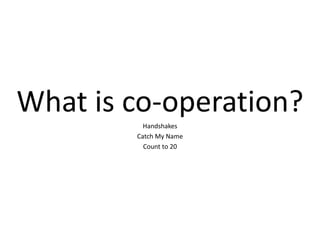
What is co-operation?
Handshakes
Catch My Name
Count to 20
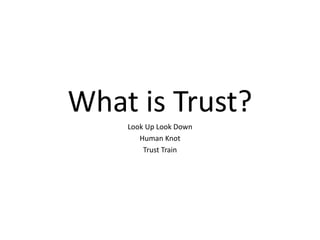
What is Trust?
Look Up Look Down
Human Knot
Trust Train
What is Imagination?
The Sun Shines On . . .
Yes Let’s
What are you doing?
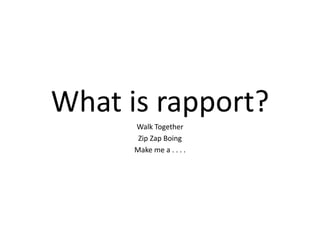
What is rapport?
Walk Together
Zip Zap Boing
Make me a . . . .
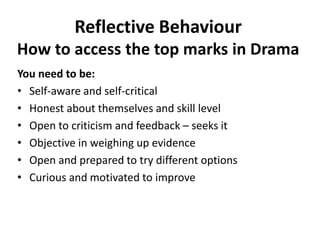
Reflective Behaviour
How to access the top marks in Drama
You need to be:
• Self-aware and self-critical
• Honest about themselves and skill level
• Open to criticism and feedback – seeks it
• Objective in weighing up evidence
• Open and prepared to try different options
• Curious and motivated to improve
L1 induction devising

L1 induction devising

  • 1.
    SUCCESS CRITERA I candevelop the following skills: How are you developing these skills in Drama? Reciprocal Collaboration Empathy & Listening Imitation Resilient Absorption Noticing Perseverance Managing Distractions Resourceful Questioning Making Links Imagining Reflective Planning Revising Distilling • SBS: Resourceful (Questioning, Making Links, Imagining) • SBS: Reciprocal (Collaboration, Empathy & Listening, Imitation) • SBS: Reflective (Planning, Revising, Distilling) • SBS: Resilient (Absorption, Managing Distractions, Noticing, Perseverance)
  • 2.
    C1 Devising Learning Intentions A01Create and develop ideas to communicate meaning for theatrical performance. A02 Apply theatrical skills to realise artistic intentions in live performance. A04 Analyse and evaluate their own work and the work of others. Success Criteria By the end of the lesson I will be able to: • Know the expectations of a Drama lesson and the Drama Rules. • Understand the THREE components of the course • Establish relationships within the group to create an effective group dynamic. SBS: How will you use these skills to help you achieve the success criteria? SBS: Resourceful (Questioning, Making Links, Imagining) SBS: Reciprocal (Collaboration, Empathy & Listening, Imitation) SBS: Reflective (Planning, Revising, Distilling) SBS: Resilient (Absorption, Managing Distractions, Noticing, Perseverance)
  • 3.
    GCSE Drama (9-1) Component1 Devising40% Component 2 Performance 20% Component 3 Theatre Makers 40% Work as a group to create a performance as a performer or designer Assessed in Y10 Work as a group to perform two extracts as a performer or designer. Examiner visits in Y11 A written exam that you will sit in Y11. Section A The Crucible by Arthur Miller Section B Live Theatre Review Notes
  • 4.
    Resources are tofound at: • http://soadrama.blogspot.com • Shared Drive on the Student Common area –
  • 5.
    GCSE DRAMA An Overviewof Y9 Autumn Term Approaches to Component 1 Devising Spring Term Component 3 Theatre Makers The Crucible Exploration Summer Component 2 Text in Performance
  • 6.
    Roles in theTheatre In pairs … List as many job roles as you can think of in professional theatre. Include onstage, backstage and front of house roles. Join up with another pair to see if you can add to your list.
  • 7.
    Key Roles inTheatre PERFORMER • Often referred to as actors, performers use a range of physical and vocal skills to convey narrative and plot to the audience. • Performers make decisions about how a character might be interpreted and then shown on stage. They use facial expressions, body language, proxemics and voice to bring their ideas to life for the audience.
  • 8.
    Key Roles inTheatre DIRECTOR • The director has overall creative control of the piece and brings together all of the different dramatic elements. • A director will consider what approach to the text the production will take and will also take control of the overall vision. It is the role of the director to make decisions about the style and genre of the production and to work alongside performers and designers to create a consistent and creative production.
  • 9.
    Key Roles inTheatre DESIGNER • Designers tend to specialise in specific aspects of the production. They will have experience in different elements of design, such as lighting, sound, costume or set design. They work closely with the director to ensure the overall concept of the production is consistent as well as providing creative solutions to different problems. Each design skill is vital in helping communicate ideas to the audience, using components such as colours and materials to convey different ideas.
  • 10.
    Written Response Home-Learning Task KeyRoles in the theatre • As part of the GCSE Drama course you will need to consider how theatre is made from three different perspectives: • PERFORMER • DIRECTOR • DESIGNER • Each role brings different elements to life which, when combined, can produce a powerful and entertaining production. • Create a Key roles in Theatre Poster/Mindmap that you will stick into your book for the THREE key roles. • Use the worksheet on the shared drive to support you.
  • 11.
    Component 1 Devising Whatis Devising? Devising is a group collaboration in response to a stimulus leading to the creation of an original performance. Groups must work together collaboratively as an ensemble to generate the devised performance and to challenge each other to develop creative ways of using voice, movement and space. Collaborative Ensemble Co-operation Trust Imagination Empathy Rapport Altruism Compassion Tolerance Forgiveness Humility Magnamity
  • 12.
  • 13.
    What is Trust? LookUp Look Down Human Knot Trust Train
  • 14.
    What is Imagination? TheSun Shines On . . . Yes Let’s What are you doing?
  • 15.
    What is rapport? WalkTogether Zip Zap Boing Make me a . . . .
  • 16.
    Reflective Behaviour How toaccess the top marks in Drama You need to be: • Self-aware and self-critical • Honest about themselves and skill level • Open to criticism and feedback – seeks it • Objective in weighing up evidence • Open and prepared to try different options • Curious and motivated to improve