Holt Geometry
6-3 Conditions for Parallelograms6-3 Conditions for Parallelograms
Holt Geometry
Warm UpWarm Up
Lesson PresentationLesson Presentation
Lesson QuizLesson Quiz
Holt Geometry
6-3 Conditions for Parallelograms
Warm Up
Justify each statement.
1.
2.
Evaluate each expression for x = 12 and
y = 8.5.
3. 2x + 7
4. 16x – 9
5. (8y + 5)°
Reflex Prop. of ≅
Conv. of Alt. Int. ∠s Thm.
31
183
73°
Holt Geometry
6-3 Conditions for Parallelograms
Prove that a given quadrilateral is a
parallelogram.
Objective
Holt Geometry
6-3 Conditions for Parallelograms
You have learned to identify the properties of a
parallelogram. Now you will be given the properties
of a quadrilateral and will have to tell if the
quadrilateral is a parallelogram. To do this, you can
use the definition of a parallelogram or the
conditions below.
Holt Geometry
6-3 Conditions for Parallelograms
Holt Geometry
6-3 Conditions for Parallelograms
The two theorems below can also be used to show that
a given quadrilateral is a parallelogram.
Holt Geometry
6-3 Conditions for Parallelograms
Example 1A: Verifying Figures are Parallelograms
Show that JKLM is
a parallelogram for
a = 3 and b = 9.
Step 1 Find JK and LM.
Given
Substitute
and simplify.
JK = 15a – 11
JK = 15(3) – 11 = 34
LM = 10a + 4
LM = 10(3)+ 4 = 34
Holt Geometry
6-3 Conditions for Parallelograms
Example 1A Continued
Since JK = LM and KL = JM, JKLM is a parallelogram
by Theorem 6-3-2.
Step 2 Find KL and JM.
Given
Substitute
and simplify.
KL = 5b + 6
KL = 5(9) + 6 = 51
JM = 8b – 21
JM = 8(9) – 21 = 51
Holt Geometry
6-3 Conditions for Parallelograms
Example 1B: Verifying Figures are Parallelograms
Show that PQRS is a
parallelogram for x = 10
and y = 6.5.
Given
Substitute 6.5 for y
and simplify.
Given
Substitute 6.5 for y
and simplify.
m∠Q = (6y + 7)°
m∠Q = [(6(6.5) + 7)]° = 46°
m∠S = (8y – 6)°
m∠S = [(8(6.5) – 6)]° = 46°
m∠R = (15x – 16)°
m∠R = [(15(10) – 16)]° = 134°
Given
Substitute 10 for x
and simplify.
Holt Geometry
6-3 Conditions for Parallelograms
Example 1B Continued
Since 46° + 134° = 180°, ∠R is supplementary to
both ∠Q and ∠S. PQRS is a parallelogram by
Theorem 6-3-4.
Holt Geometry
6-3 Conditions for Parallelograms
Check It Out! Example 1
Show that PQRS is a
parallelogram for a = 2.4
and b = 9.
By Theorem 6-3-1, PQRS is a parallelogram.
PQ = RS = 16.8, so
m∠Q = 74°, and m∠R = 106°, so ∠Q and ∠R
are supplementary.
So one pair of opposite sides of PQRS are || and ≅.
Therefore,
Holt Geometry
6-3 Conditions for Parallelograms
Example 2A: Applying Conditions for Parallelograms
Determine if the quadrilateral must be a
parallelogram. Justify your answer.
Yes. The 73° angle is
supplementary to both
its corresponding angles.
By Theorem 6-3-4, the
quadrilateral is a
parallelogram.
Holt Geometry
6-3 Conditions for Parallelograms
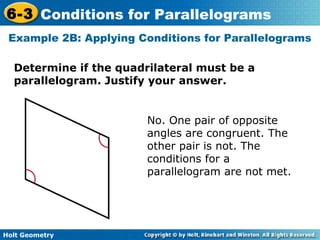
Example 2B: Applying Conditions for Parallelograms
Determine if the quadrilateral must be a
parallelogram. Justify your answer.
No. One pair of opposite
angles are congruent. The
other pair is not. The
conditions for a
parallelogram are not met.
Holt Geometry
6-3 Conditions for Parallelograms
Check It Out! Example 2a
Determine if the
quadrilateral must be a
parallelogram. Justify your
answer.
The diagonal of the quadrilateral forms 2 triangles.
Yes
Two angles of one triangle are congruent to two
angles of the other triangle, so the third pair of
angles are congruent by the Third Angles Theorem.
So both pairs of opposite angles of the quadrilateral
are congruent .
By Theorem 6-3-3, the quadrilateral is a parallelogram.
Holt Geometry
6-3 Conditions for Parallelograms
Check It Out! Example 2b
Determine if each
quadrilateral must be a
parallelogram. Justify
your answer.
No. Two pairs of consective sides
are congruent.
None of the sets of conditions for a
parallelogram are met.
Holt Geometry
6-3 Conditions for Parallelograms
To say that a quadrilateral is a parallelogram by
definition, you must show that both pairs of
opposite sides are parallel.
Helpful Hint
Holt Geometry
6-3 Conditions for Parallelograms
Example 3A: Proving Parallelograms in the
Coordinate Plane
Show that quadrilateral JKLM is a parallelogram by
using the definition of parallelogram. J(–1, –6),
K(–4, –1), L(4, 5), M(7, 0).
Find the slopes of both pairs of opposite sides.
Since both pairs of opposite sides are parallel,
JKLM is a parallelogram by definition.
Holt Geometry
6-3 Conditions for Parallelograms
Example 3B: Proving Parallelograms in the
Coordinate Plane
Show that quadrilateral ABCD is a parallelogram
by using Theorem 6-3-1. A(2, 3), B(6, 2), C(5, 0),
D(1, 1).
Find the slopes and lengths of one pair of opposite
sides.
AB and CD have the same slope, so . Since
AB = CD, . So by Theorem 6-3-1, ABCD is a
parallelogram.
Holt Geometry
6-3 Conditions for Parallelograms
Check It Out! Example 3
Use the definition of a parallelogram to show that
the quadrilateral with vertices K(–3, 0), L(–5, 7),
M(3, 5), and N(5, –2) is a parallelogram.
Both pairs of opposite sides have the same
slope so and by definition,
KLMN is a parallelogram.
Holt Geometry
6-3 Conditions for Parallelograms
You have learned several ways to determine whether a
quadrilateral is a parallelogram. You can use the given
information about a figure to decide which condition is
best to apply.
Holt Geometry
6-3 Conditions for Parallelograms
To show that a quadrilateral is a parallelogram,
you only have to show that it satisfies one of
these sets of conditions.
Helpful Hint
Holt Geometry
6-3 Conditions for Parallelograms
Example 4: Application
The legs of a keyboard tray are
connected by a bolt at their
midpoints, which allows the tray to
be raised or lowered. Why is PQRS
always a parallelogram?
Since the bolt is at the midpoint of both legs, PE = ER
and SE = EQ. So the diagonals of PQRS bisect each
other, and by Theorem 6-3-5, PQRS is always a
parallelogram.
Holt Geometry
6-3 Conditions for Parallelograms
Check It Out! Example 4
The frame is attached to the tripod at points A
and B such that AB = RS and BR = SA. So ABRS
is also a parallelogram. How does this ensure
that the angle of the binoculars stays the same?
Since AB stays vertical, RS also remains vertical no
matter how the frame is adjusted.
Therefore the viewing ∠ never changes.
Since ABRS is a parallelogram, it is always true
that .
Holt Geometry
6-3 Conditions for Parallelograms
No; One pair of consecutive ∠s are ≅, and one
pair of opposite sides are ||. The conditions for a
parallelogram are not met.
Lesson Quiz: Part I
1. Show that JKLM is a parallelogram
for a = 4 and b = 5.
2. Determine if QWRT must be a
parallelogram. Justify your
answer.
JN = LN = 22; KN = MN = 10; so
JKLM is a parallelogram by
Theorem 6-3-5.
Holt Geometry
6-3 Conditions for Parallelograms
Lesson Quiz: Part II
3. Show that the quadrilateral with vertices E(–1, 5),
F(2, 4), G(0, –3), and H(–3, –2) is a parallelogram.
Since one pair of opposite sides are || and ≅, EFGH
is a parallelogram by Theorem 6-3-1.

Gch6 l3

  • 1.
    Holt Geometry 6-3 Conditionsfor Parallelograms6-3 Conditions for Parallelograms Holt Geometry Warm UpWarm Up Lesson PresentationLesson Presentation Lesson QuizLesson Quiz
  • 2.
    Holt Geometry 6-3 Conditionsfor Parallelograms Warm Up Justify each statement. 1. 2. Evaluate each expression for x = 12 and y = 8.5. 3. 2x + 7 4. 16x – 9 5. (8y + 5)° Reflex Prop. of ≅ Conv. of Alt. Int. ∠s Thm. 31 183 73°
  • 3.
    Holt Geometry 6-3 Conditionsfor Parallelograms Prove that a given quadrilateral is a parallelogram. Objective
  • 4.
    Holt Geometry 6-3 Conditionsfor Parallelograms You have learned to identify the properties of a parallelogram. Now you will be given the properties of a quadrilateral and will have to tell if the quadrilateral is a parallelogram. To do this, you can use the definition of a parallelogram or the conditions below.
  • 5.
    Holt Geometry 6-3 Conditionsfor Parallelograms
  • 6.
    Holt Geometry 6-3 Conditionsfor Parallelograms The two theorems below can also be used to show that a given quadrilateral is a parallelogram.
  • 7.
    Holt Geometry 6-3 Conditionsfor Parallelograms Example 1A: Verifying Figures are Parallelograms Show that JKLM is a parallelogram for a = 3 and b = 9. Step 1 Find JK and LM. Given Substitute and simplify. JK = 15a – 11 JK = 15(3) – 11 = 34 LM = 10a + 4 LM = 10(3)+ 4 = 34
  • 8.
    Holt Geometry 6-3 Conditionsfor Parallelograms Example 1A Continued Since JK = LM and KL = JM, JKLM is a parallelogram by Theorem 6-3-2. Step 2 Find KL and JM. Given Substitute and simplify. KL = 5b + 6 KL = 5(9) + 6 = 51 JM = 8b – 21 JM = 8(9) – 21 = 51
  • 9.
    Holt Geometry 6-3 Conditionsfor Parallelograms Example 1B: Verifying Figures are Parallelograms Show that PQRS is a parallelogram for x = 10 and y = 6.5. Given Substitute 6.5 for y and simplify. Given Substitute 6.5 for y and simplify. m∠Q = (6y + 7)° m∠Q = [(6(6.5) + 7)]° = 46° m∠S = (8y – 6)° m∠S = [(8(6.5) – 6)]° = 46° m∠R = (15x – 16)° m∠R = [(15(10) – 16)]° = 134° Given Substitute 10 for x and simplify.
  • 10.
    Holt Geometry 6-3 Conditionsfor Parallelograms Example 1B Continued Since 46° + 134° = 180°, ∠R is supplementary to both ∠Q and ∠S. PQRS is a parallelogram by Theorem 6-3-4.
  • 11.
    Holt Geometry 6-3 Conditionsfor Parallelograms Check It Out! Example 1 Show that PQRS is a parallelogram for a = 2.4 and b = 9. By Theorem 6-3-1, PQRS is a parallelogram. PQ = RS = 16.8, so m∠Q = 74°, and m∠R = 106°, so ∠Q and ∠R are supplementary. So one pair of opposite sides of PQRS are || and ≅. Therefore,
  • 12.
    Holt Geometry 6-3 Conditionsfor Parallelograms Example 2A: Applying Conditions for Parallelograms Determine if the quadrilateral must be a parallelogram. Justify your answer. Yes. The 73° angle is supplementary to both its corresponding angles. By Theorem 6-3-4, the quadrilateral is a parallelogram.
  • 13.
    Holt Geometry 6-3 Conditionsfor Parallelograms Example 2B: Applying Conditions for Parallelograms Determine if the quadrilateral must be a parallelogram. Justify your answer. No. One pair of opposite angles are congruent. The other pair is not. The conditions for a parallelogram are not met.
  • 14.
    Holt Geometry 6-3 Conditionsfor Parallelograms Check It Out! Example 2a Determine if the quadrilateral must be a parallelogram. Justify your answer. The diagonal of the quadrilateral forms 2 triangles. Yes Two angles of one triangle are congruent to two angles of the other triangle, so the third pair of angles are congruent by the Third Angles Theorem. So both pairs of opposite angles of the quadrilateral are congruent . By Theorem 6-3-3, the quadrilateral is a parallelogram.
  • 15.
    Holt Geometry 6-3 Conditionsfor Parallelograms Check It Out! Example 2b Determine if each quadrilateral must be a parallelogram. Justify your answer. No. Two pairs of consective sides are congruent. None of the sets of conditions for a parallelogram are met.
  • 16.
    Holt Geometry 6-3 Conditionsfor Parallelograms To say that a quadrilateral is a parallelogram by definition, you must show that both pairs of opposite sides are parallel. Helpful Hint
  • 17.
    Holt Geometry 6-3 Conditionsfor Parallelograms Example 3A: Proving Parallelograms in the Coordinate Plane Show that quadrilateral JKLM is a parallelogram by using the definition of parallelogram. J(–1, –6), K(–4, –1), L(4, 5), M(7, 0). Find the slopes of both pairs of opposite sides. Since both pairs of opposite sides are parallel, JKLM is a parallelogram by definition.
  • 18.
    Holt Geometry 6-3 Conditionsfor Parallelograms Example 3B: Proving Parallelograms in the Coordinate Plane Show that quadrilateral ABCD is a parallelogram by using Theorem 6-3-1. A(2, 3), B(6, 2), C(5, 0), D(1, 1). Find the slopes and lengths of one pair of opposite sides. AB and CD have the same slope, so . Since AB = CD, . So by Theorem 6-3-1, ABCD is a parallelogram.
  • 19.
    Holt Geometry 6-3 Conditionsfor Parallelograms Check It Out! Example 3 Use the definition of a parallelogram to show that the quadrilateral with vertices K(–3, 0), L(–5, 7), M(3, 5), and N(5, –2) is a parallelogram. Both pairs of opposite sides have the same slope so and by definition, KLMN is a parallelogram.
  • 20.
    Holt Geometry 6-3 Conditionsfor Parallelograms You have learned several ways to determine whether a quadrilateral is a parallelogram. You can use the given information about a figure to decide which condition is best to apply.
  • 21.
    Holt Geometry 6-3 Conditionsfor Parallelograms To show that a quadrilateral is a parallelogram, you only have to show that it satisfies one of these sets of conditions. Helpful Hint
  • 22.
    Holt Geometry 6-3 Conditionsfor Parallelograms Example 4: Application The legs of a keyboard tray are connected by a bolt at their midpoints, which allows the tray to be raised or lowered. Why is PQRS always a parallelogram? Since the bolt is at the midpoint of both legs, PE = ER and SE = EQ. So the diagonals of PQRS bisect each other, and by Theorem 6-3-5, PQRS is always a parallelogram.
  • 23.
    Holt Geometry 6-3 Conditionsfor Parallelograms Check It Out! Example 4 The frame is attached to the tripod at points A and B such that AB = RS and BR = SA. So ABRS is also a parallelogram. How does this ensure that the angle of the binoculars stays the same? Since AB stays vertical, RS also remains vertical no matter how the frame is adjusted. Therefore the viewing ∠ never changes. Since ABRS is a parallelogram, it is always true that .
  • 24.
    Holt Geometry 6-3 Conditionsfor Parallelograms No; One pair of consecutive ∠s are ≅, and one pair of opposite sides are ||. The conditions for a parallelogram are not met. Lesson Quiz: Part I 1. Show that JKLM is a parallelogram for a = 4 and b = 5. 2. Determine if QWRT must be a parallelogram. Justify your answer. JN = LN = 22; KN = MN = 10; so JKLM is a parallelogram by Theorem 6-3-5.
  • 25.
    Holt Geometry 6-3 Conditionsfor Parallelograms Lesson Quiz: Part II 3. Show that the quadrilateral with vertices E(–1, 5), F(2, 4), G(0, –3), and H(–3, –2) is a parallelogram. Since one pair of opposite sides are || and ≅, EFGH is a parallelogram by Theorem 6-3-1.