GASTRULATION,
NOTOCHORD AND
NEURULATION
COURSETITLE: General Embryology
LECTURER: Dr Sabiu B. SOJA
UNIT: Epigenetics/ Developmental Anatomy
DATE : 27TH
October 2024
GASTRULATION
2
• Is the process that establishes 3 germ cell layers:
Trilaminar germ disc at the 3rd week of embryonic
development
• Begins with formation of primitive streak on
surface of epiblast
• Which has an orientation with the cephalic end
marked by the primitive node and pit
GASTRULATION (CONT’D)
3
• Epiblast cells migrate to the primitive streak, detach
and slip underneath,
• Displacing the hypoblast and becoming the endoderm
• Subsequent layer of cells develops between this
endoderm and the epiblast- these form the
mesoderm
• The remaining epiblast now is referred to as the
ectoderm.
GASTRULATION (CONT’D)
4
GASTRULATION (CONT’D)
5
• Following gastrulation,
• The bilaminar disc of
blastula is transformed into
Trilamina disc,
• Which consists of three
primary germ layers;
• the ectoderm, mesoderm
and endodermal layers
NOTOCHORDAL FORMATION
6
• Invagination cells that migrate cephalad form the
prechodal plate, that is significant in induction of
the forebrain
• It is situated close to the buccopharnyngeal
membrane
• Also , the migrating cells form the notochord
• That extends from the prechordal plate cranially
to the primitive pit caudally.
NOTOCHORDAL FORMATION
7
• The Cloacal
membrane is
formed at the
caudal end of
the embryonic
disk- formed
NEURULATION
8
• Is the formation of the
neural tube
• Notochord induces the
overlying ectoderm to
thicken and form the neural
plate
• At the end of 3rd week,
neural folds and neural
groove are established.
NEURULATION (CONT’D)
9
NEURULATION (CONT’D)
10
• Neural folds fuse in
the midline, from the
cervical region and
extending cranially
and caudally.
NEURULATION (CONT’D)
11
NEURULATION (CONT’D)
12
• Neural tube is formed and invade into the
embryo body
NEURULATION
13
• The broader
cephalic portion
of the neural tube
transforms into
primary brain
vesicles
• The narrower
part develops
into the spinal
cord
NEURULATION (CONT’D)
14
Primary and Secondary Vesicle Stages of Development The embryonic brain develops
complexity through enlargements of the neural tube called vesicles; (a) The primary
vesicle stage has three regions, and (b) the secondary vesicle stage has five regions.
Credit: OpenStax.
SOMITES
15
• Mesodermal cells on each side of the neural tube
begin to form a row of regular, compact
structures called somites
SOMITES (CONT’D)
16
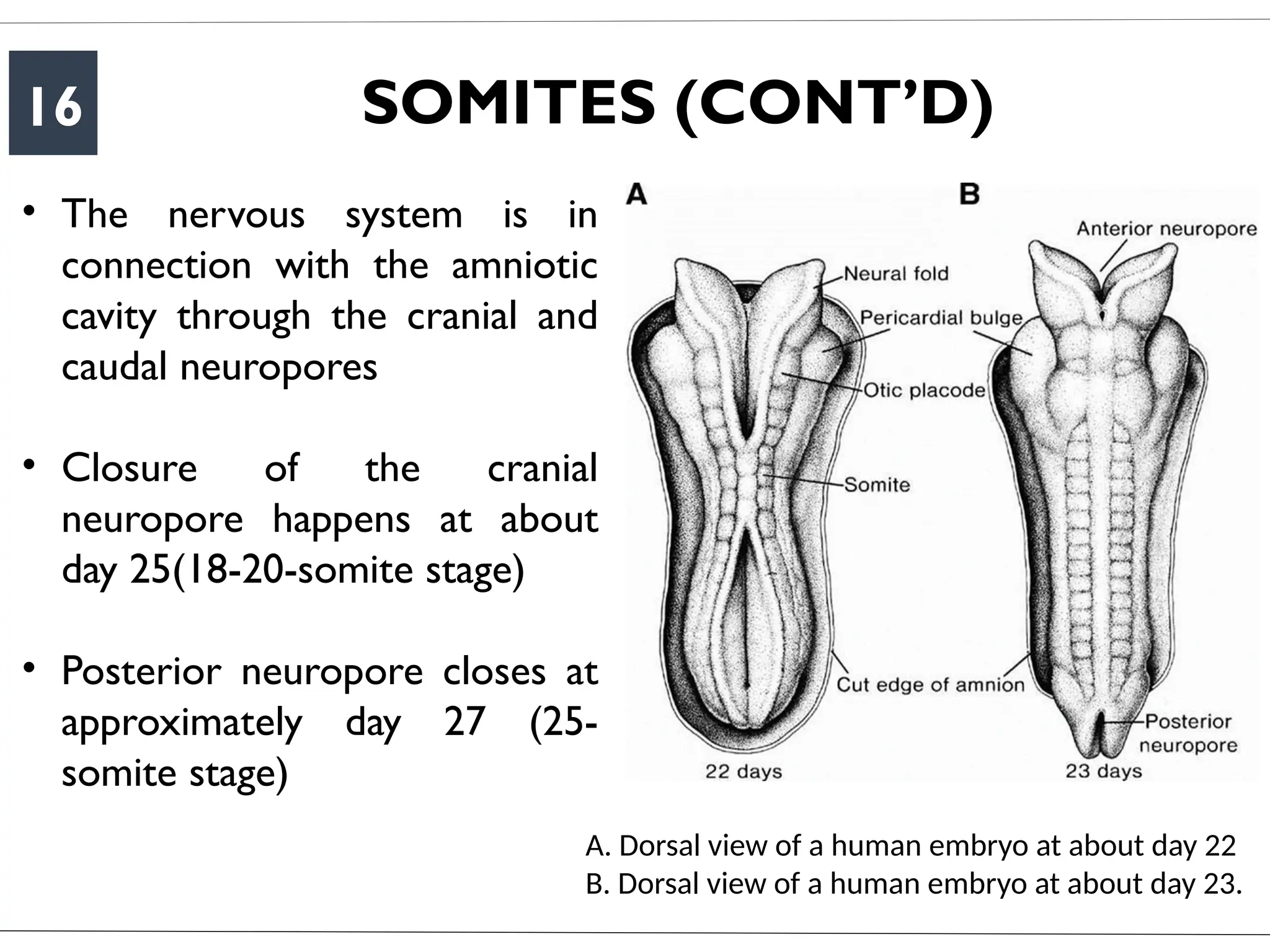
A. Dorsal view of a human embryo at about day 22
B. Dorsal view of a human embryo at about day 23.
• The nervous system is in
connection with the amniotic
cavity through the cranial and
caudal neuropores
• Closure of the cranial
neuropore happens at about
day 25(18-20-somite stage)
• Posterior neuropore closes at
approximately day 27 (25-
somite stage)
NEURAL CREST CELLS
17
• Along the line of fusion of
the neural folds, some of the
cells break free and become
migratory within the
mesodermal layer.
• These are the neural crest
cells, and are shown here as
tan-coloured clusters of cells
resembling 'teardrops'
alongside the neural tube
Neural
crest cell
NEURAL CREST CELLS (CONT’D)
18
19
CLINICAL CONSIDERATION
20
• NTD’s occur due to defect in the midline fusion
of neural tube
• Resulting in cranial or spinal dysraphism, and may
involve nerve roots, spinal cord, or bony
vertebrae.
• They can be open or closed types
NEURALTUBE DEFECTS(NTD’s)
CLINICAL CONSIDERATION
21
• The causes are mostly
multifactorial, including
both genetic and
environmental causes.
• Mutations in several
genes, especially genes
involved in folic acid
metabolism, have been
found
CLINICAL CONSIDERATION
22
• Failure of cranial
neuropore results to
anencephalic child or
meningocele.
• Failure of posterior
neuropore results in
rachischisis or
meningomyelocele.
CLINICAL CONSIDERATION
23
CLINICAL CONSIDERATION
24
CLINICAL CONSIDERATION
26
CLINICAL CONSIDERATION
27
CLINICAL CONSIDERATION
28
THANKYOU
FOR
LISTENING

GASTRULATION, NOTOCHORD AND NEURULATION.pptx