Fourth to Eighth Weeks
of
Human Development
• All major external and internal structures are established during the fourth to
eighth weeks.
• By the end of this embryonic period, the main organ systems have started to
develop.
• As the tissues and organs form, the shape of the embryo changes, and by the
end of this period, the embryo has a distinctly human appearance.
• Because the tissues and organs are differentiating rapidly, exposure of
embryos to teratogens during this period may cause major birth defects.
•Teratogens are agents (such as some drugs and viruses) that produce or
increase the incidence of major birth defects.
Embryonic folding from IV week
• https://www.youtube.com/watch?
v=yXUv4MPuNTA
Embryonic folding from IV week.mp4
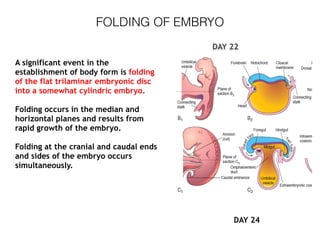
FOLDING OF EMBRYO
A significant event in the
establishment of body form is folding
of the flat trilaminar embryonic disc
into a somewhat cylindric embryo.
Folding occurs in the median and
horizontal planes and results from
rapid growth of the embryo.
Folding at the cranial and caudal ends
and sides of the embryo occurs
simultaneously.
DAY 22
DAY 24
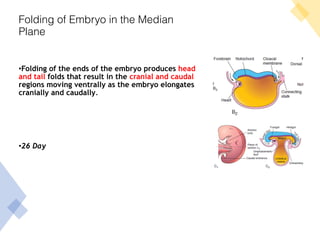
Folding of Embryo in the Median
Plane
•Folding of the ends of the embryo produces head
and tail folds that result in the cranial and caudal
regions moving ventrally as the embryo elongates
cranially and caudally.
•26 Day
Head Fold
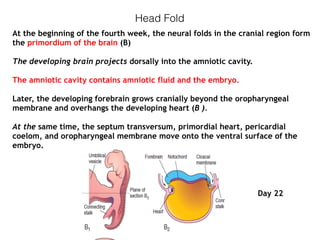
At the beginning of the fourth week, the neural folds in the cranial region form
the primordium of the brain (B)
The developing brain projects dorsally into the amniotic cavity.
The amniotic cavity contains amniotic fluid and the embryo.
Later, the developing forebrain grows cranially beyond the oropharyngeal
membrane and overhangs the developing heart (B ).
At the same time, the septum transversum, primordial heart, pericardial
coelom, and oropharyngeal membrane move onto the ventral surface of the
embryo.
Day 22
Head Fold
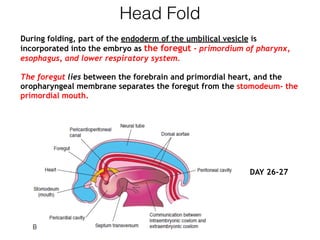
During folding, part of the endoderm of the umbilical vesicle is
incorporated into the embryo as the foregut - primordium of pharynx,
esophagus, and lower respiratory system.
The foregut lies between the forebrain and primordial heart, and the
oropharyngeal membrane separates the foregut from the stomodeum- the
primordial mouth.
DAY 26-27
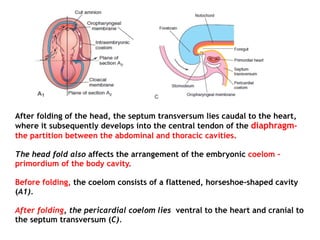
After folding of the head, the septum transversum lies caudal to the heart,
where it subsequently develops into the central tendon of the diaphragm-
the partition between the abdominal and thoracic cavities.
The head fold also affects the arrangement of the embryonic coelom -
primordium of the body cavity.
Before folding, the coelom consists of a flattened, horseshoe-shaped cavity
(A1).
After folding, the pericardial coelom lies ventral to the heart and cranial to
the septum transversum (C).
Tail Fold
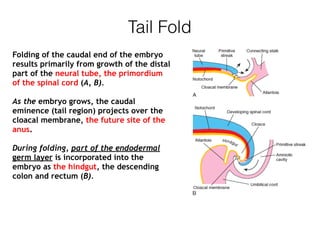
Folding of the caudal end of the embryo
results primarily from growth of the distal
part of the neural tube, the primordium
of the spinal cord (A, B).
As the embryo grows, the caudal
eminence (tail region) projects over the
cloacal membrane, the future site of the
anus.
During folding, part of the endodermal
germ layer is incorporated into the
embryo as the hindgut, the descending
colon and rectum (B).
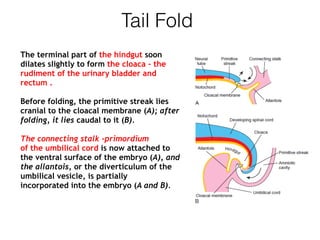
Tail Fold
The terminal part of the hindgut soon
dilates slightly to form the cloaca - the
rudiment of the urinary bladder and
rectum .
Before folding, the primitive streak lies
cranial to the cloacal membrane (A); after
folding, it lies caudal to it (B).
The connecting stalk -primordium
of the umbilical cord is now attached to
the ventral surface of the embryo (A), and
the allantois, or the diverticulum of the
umbilical vesicle, is partially
incorporated into the embryo (A and B).
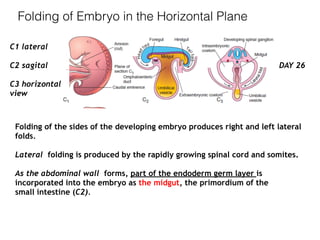
Folding of Embryo in the Horizontal Plane
Folding of the sides of the developing embryo produces right and left lateral
folds.
Lateral folding is produced by the rapidly growing spinal cord and somites.
As the abdominal wall forms, part of the endoderm germ layer is
incorporated into the embryo as the midgut, the primordium of the
small intestine (C2).
DAY 26
C1 lateral
C2 sagital
C3 horizontal
view
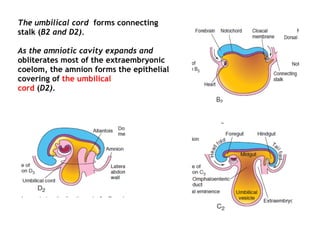
The umbilical cord forms connecting
stalk (B2 and D2).
As the amniotic cavity expands and
obliterates most of the extraembryonic
coelom, the amnion forms the epithelial
covering of the umbilical
cord (D2).
Folding of embryo
• https://www.youtube.com/watch?
v=qMnpxP6EeIY
GERM LAYER DERIVATIVES
•The three germ layers
•1. ectoderm
•2. mesoderm, and
•3. Endoderm
•formed during gastrulation , give rise to the primordia of all tissues and organs.
•The cells of each germ layer divide, migrate, aggregate, and differentiate in
patterns as they form the various organ systems.
The main germ
layer derivatives
are as follows:
•● Ectoderm gives rise to the
• central nervous system;
• peripheral nervous system;
• sensory epithelia of the eyes, ears, and nose;
• epidermis and its appendages (hair and nails);
• mammary glands, pituitary gland;
• subcutaneous glands and enamel of the teeth
Neural crest cells give rise to
Neural crest cells, derived from neuroectoderm, the central
region of early ectoderm, eventually give rise to or participate in the formation
of many cells types and organs, including:
➢ cells of the spinal cord,
➢ cranial nerves (V, VII, IX, and X), and neurons for cranial ganglia
➢ sensory ganglia and autonomic ganglia; sympathetic and enteric neurons
➢ ensheathing cells of the peripheral nervous system;
➢ melanocytes in the skin and hair follicles, pigment cells of the dermis,
➢ muscles and connective tissues,
➢ bones of pharyngeal arch origin;
➢ suprarenal medulla and cells of the adrenal medulla
➢ meninges of the brain and spinal cord.
➢ glial cells-Schwann cells
•● Mesoderm gives rise to
• connective tissue,
• cartilage and bone
• striated and smooth muscles,
• heart, blood, and lymphatic vessels;
• kidneys;
• ovaries;
• testes;
• genital ducts;
• serous membranes lining the body cavities
•(pericardial, pleural and peritoneal membranes);
• spleen;
• cortex of the suprarenal glands.
● Endoderm gives rise to
• the epithelial lining of the digestive and respiratory tracts;
• parenchyma (connective tissue framework) of the tonsils;
•thyroid and parathyroid glands;
• thymus,
• liver
• pancreas;
• epithelial lining of the urinary bladder and
• most of the urethra;
• epithelial lining of the tympanic cavity, tympanic
•antrum, and pharyngotympanic tube.
HIGHLIGHTS OF
FOURTH TO EIGHTH
WEEKS
Fourth Week
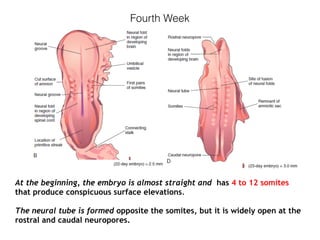
At the beginning, the embryo is almost straight and has 4 to 12 somites
that produce conspicuous surface elevations.
The neural tube is formed opposite the somites, but it is widely open at the
rostral and caudal neuropores.
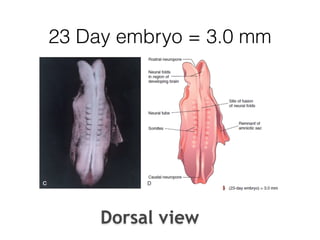
23 Day embryo = 3.0 mm
Dorsal view
Fourth Week
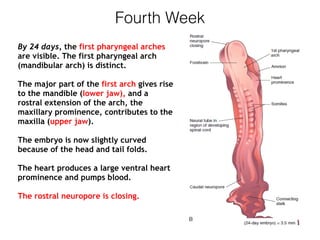
By 24 days, the first pharyngeal arches
are visible. The first pharyngeal arch
(mandibular arch) is distinct.
The major part of the first arch gives rise
to the mandible (lower jaw), and a
rostral extension of the arch, the
maxillary prominence, contributes to the
maxilla (upper jaw).
The embryo is now slightly curved
because of the head and tail folds.
The heart produces a large ventral heart
prominence and pumps blood.
The rostral neuropore is closing.
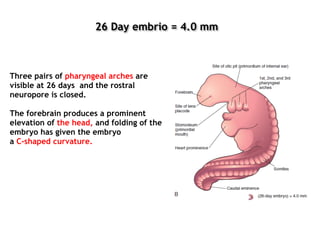
Three pairs of pharyngeal arches are
visible at 26 days and the rostral
neuropore is closed.
The forebrain produces a prominent
elevation of the head, and folding of the
embryo has given the embryo
a C-shaped curvature.
26 Day embrio = 4.0 mm
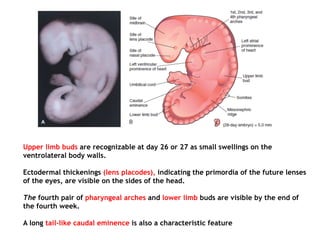
Upper limb buds are recognizable at day 26 or 27 as small swellings on the
ventrolateral body walls.
Ectodermal thickenings (lens placodes), indicating the primordia of the future lenses
of the eyes, are visible on the sides of the head.
The fourth pair of pharyngeal arches and lower limb buds are visible by the end of
the fourth week.
A long tail-like caudal eminence is also a characteristic feature
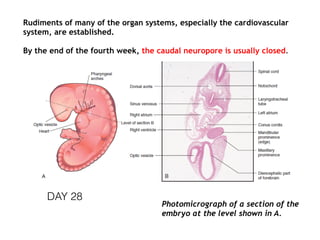
DAY 28
Rudiments of many of the organ systems, especially the cardiovascular
system, are established.
By the end of the fourth week, the caudal neuropore is usually closed.
Photomicrograph of a section of the
embryo at the level shown in A.
Fifth Week
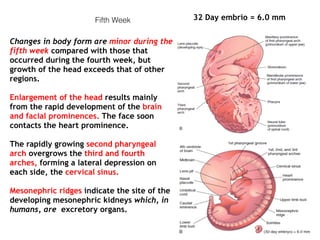
Changes in body form are minor during the
fifth week compared with those that
occurred during the fourth week, but
growth of the head exceeds that of other
regions.
Enlargement of the head results mainly
from the rapid development of the brain
and facial prominences. The face soon
contacts the heart prominence.
The rapidly growing second pharyngeal
arch overgrows the third and fourth
arches, forming a lateral depression on
each side, the cervical sinus.
Mesonephric ridges indicate the site of the
developing mesonephric kidneys which, in
humans, are excretory organs.
32 Day embrio = 6.0 mm
Sixth Week
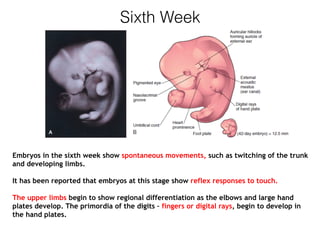
Embryos in the sixth week show spontaneous movements, such as twitching of the trunk
and developing limbs.
It has been reported that embryos at this stage show reflex responses to touch.
The upper limbs begin to show regional differentiation as the elbows and large hand
plates develop. The primordia of the digits – fingers or digital rays, begin to develop in
the hand plates.
Sixth Week
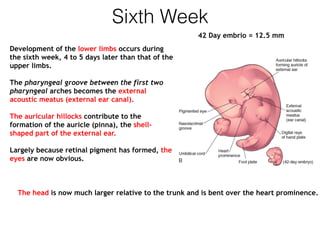
Development of the lower limbs occurs during
the sixth week, 4 to 5 days later than that of the
upper limbs.
The pharyngeal groove between the first two
pharyngeal arches becomes the external
acoustic meatus (external ear canal).
The auricular hillocks contribute to the
formation of the auricle (pinna), the shell-
shaped part of the external ear.
Largely because retinal pigment has formed, the
eyes are now obvious.
42 Day embrio = 12.5 mm
The head is now much larger relative to the trunk and is bent over the heart prominence.
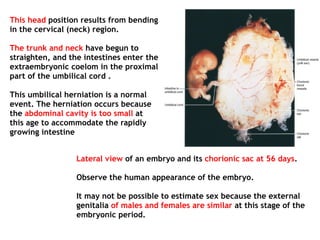
This head position results from bending
in the cervical (neck) region.
The trunk and neck have begun to
straighten, and the intestines enter the
extraembryonic coelom in the proximal
part of the umbilical cord .
This umbilical herniation is a normal
event. The herniation occurs because
the abdominal cavity is too small at
this age to accommodate the rapidly
growing intestine
Lateral view of an embryo and its chorionic sac at 56 days.
Observe the human appearance of the embryo.
It may not be possible to estimate sex because the external
genitalia of males and females are similar at this stage of the
embryonic period.
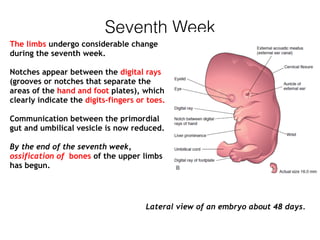
Seventh Week
The limbs undergo considerable change
during the seventh week.
Notches appear between the digital rays
(grooves or notches that separate the
areas of the hand and foot plates), which
clearly indicate the digits-fingers or toes.
Communication between the primordial
gut and umbilical vesicle is now reduced.
By the end of the seventh week,
ossification of bones of the upper limbs
has begun.
Lateral view of an embryo about 48 days.
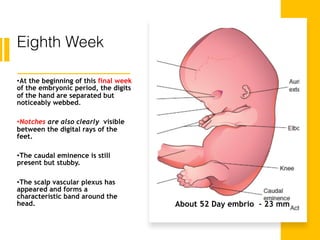
Eighth Week
•At the beginning of this final week
of the embryonic period, the digits
of the hand are separated but
noticeably webbed.
•Notches are also clearly visible
between the digital rays of the
feet.
•The caudal eminence is still
present but stubby.
•The scalp vascular plexus has
appeared and forms a
characteristic band around the
head. About 52 Day embrio - 23 mm
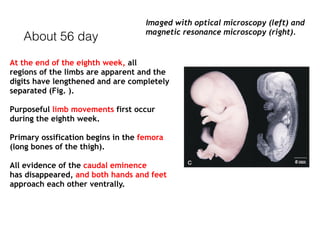
About 56 day
At the end of the eighth week, all
regions of the limbs are apparent and the
digits have lengthened and are completely
separated (Fig. ).
Purposeful limb movements first occur
during the eighth week.
Primary ossification begins in the femora
(long bones of the thigh).
All evidence of the caudal eminence
has disappeared, and both hands and feet
approach each other ventrally.
Imaged with optical microscopy (left) and
magnetic resonance microscopy (right).
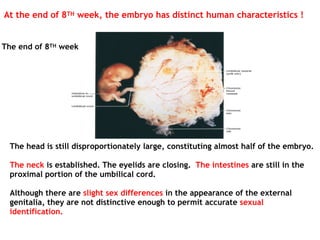
The head is still disproportionately large, constituting almost half of the embryo.
The neck is established. The eyelids are closing. The intestines are still in the
proximal portion of the umbilical cord.
Although there are slight sex differences in the appearance of the external
genitalia, they are not distinctive enough to permit accurate sexual
identification.
The end of 8TH week
At the end of 8TH week, the embryo has distinct human characteristics !
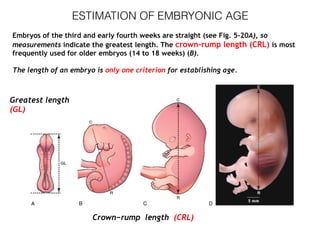
ESTIMATION OF EMBRYONIC AGE
Embryos of the third and early fourth weeks are straight (see Fig. 5-20A), so
measurements indicate the greatest length. The crown–rump length (CRL) is most
frequently used for older embryos (14 to 18 weeks) (B).
The length of an embryo is only one criterion for establishing age.
Greatest length
(GL)
Crown−rump length (CRL)
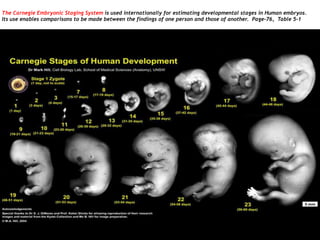
The Carnegie Embryonic Staging System is used internationally for estimating developmental stages in Human embryos.
Its use enables comparisons to be made between the findings of one person and those of another. Page-76, Table 5-1
The Gut Tube
and The Body
Cavities
https://www.youtube.com/watch?v=EtWACeVEmKw
Langman
Chapter 7
The gut tube and body cavities
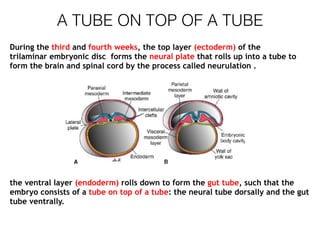
A TUBE ON TOP OF A TUBE
During the third and fourth weeks, the top layer (ectoderm) of the
trilaminar embryonic disc forms the neural plate that rolls up into a tube to
form the brain and spinal cord by the process called neurulation .
the ventral layer (endoderm) rolls down to form the gut tube, such that the
embryo consists of a tube on top of a tube: the neural tube dorsally and the gut
tube ventrally.
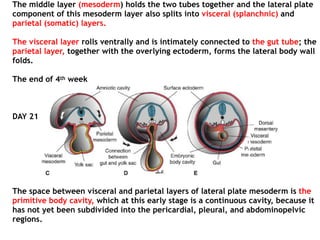
The middle layer (mesoderm) holds the two tubes together and the lateral plate
component of this mesoderm layer also splits into visceral (splanchnic) and
parietal (somatic) layers.
The visceral layer rolls ventrally and is intimately connected to the gut tube; the
parietal layer, together with the overlying ectoderm, forms the lateral body wall
folds.
The end of 4th week
DAY 21
The space between visceral and parietal layers of lateral plate mesoderm is the
primitive body cavity, which at this early stage is a continuous cavity, because it
has not yet been subdivided into the pericardial, pleural, and abdominopelvic
regions.
FORMATION OF THE BODY CAVITY
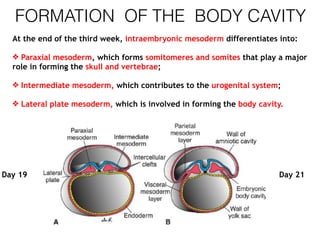
At the end of the third week, intraembryonic mesoderm differentiates into:
❖ Paraxial mesoderm, which forms somitomeres and somites that play a major
role in forming the skull and vertebrae;
❖ Intermediate mesoderm, which contributes to the urogenital system;
❖ Lateral plate mesoderm, which is involved in forming the body cavity.
Day 19 Day 21
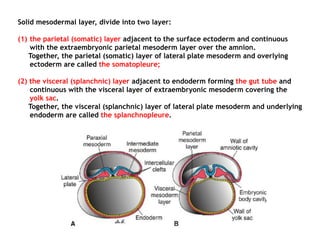
Solid mesodermal layer, divide into two layer:
(1) the parietal (somatic) layer adjacent to the surface ectoderm and continuous
with the extraembryonic parietal mesoderm layer over the amnion.
Together, the parietal (somatic) layer of lateral plate mesoderm and overlying
ectoderm are called the somatopleure;
(2) the visceral (splanchnic) layer adjacent to endoderm forming the gut tube and
continuous with the visceral layer of extraembryonic mesoderm covering the
yolk sac.
Together, the visceral (splanchnic) layer of lateral plate mesoderm and underlying
endoderm are called the splanchnopleure.
FORMATION OF THE BODY CAVITY
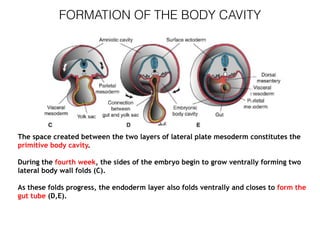
The space created between the two layers of lateral plate mesoderm constitutes the
primitive body cavity.
During the fourth week, the sides of the embryo begin to grow ventrally forming two
lateral body wall folds (C).
As these folds progress, the endoderm layer also folds ventrally and closes to form the
gut tube (D,E).
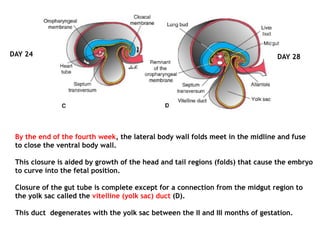
By the end of the fourth week, the lateral body wall folds meet in the midline and fuse
to close the ventral body wall.
This closure is aided by growth of the head and tail regions (folds) that cause the embryo
to curve into the fetal position.
Closure of the gut tube is complete except for a connection from the midgut region to
the yolk sac called the vitelline (yolk sac) duct (D).
This duct degenerates with the yolk sac between the II and III months of gestation.
DAY 24 DAY 28
SEROUS MEMBRANES
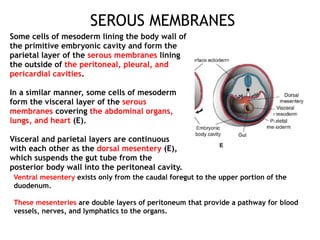
Some cells of mesoderm lining the body wall of
the primitive embryonic cavity and form the
parietal layer of the serous membranes lining
the outside of the peritoneal, pleural, and
pericardial cavities.
In a similar manner, some cells of mesoderm
form the visceral layer of the serous
membranes covering the abdominal organs,
lungs, and heart (E).
Visceral and parietal layers are continuous
with each other as the dorsal mesentery (E),
which suspends the gut tube from the
posterior body wall into the peritoneal cavity.
Ventral mesentery exists only from the caudal foregut to the upper portion of the
duodenum.
These mesenteries are double layers of peritoneum that provide a pathway for blood
vessels, nerves, and lymphatics to the organs.
DIAPHRAGM AND THORACIC CAVITY
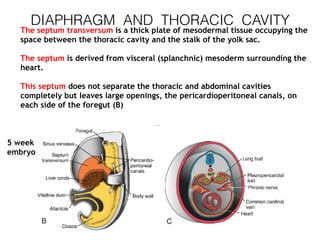
The septum transversum is a thick plate of mesodermal tissue occupying the
space between the thoracic cavity and the stalk of the yolk sac.
The septum is derived from visceral (splanchnic) mesoderm surrounding the
heart.
This septum does not separate the thoracic and abdominal cavities
completely but leaves large openings, the pericardioperitoneal canals, on
each side of the foregut (B)
5 week
embryo
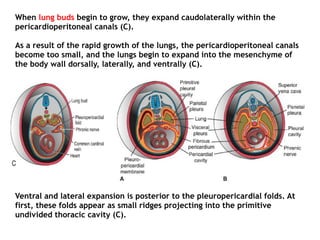
Ventral and lateral expansion is posterior to the pleuropericardial folds. At
first, these folds appear as small ridges projecting into the primitive
undivided thoracic cavity (C).
When lung buds begin to grow, they expand caudolaterally within the
pericardioperitoneal canals (C).
As a result of the rapid growth of the lungs, the pericardioperitoneal canals
become too small, and the lungs begin to expand into the mesenchyme of
the body wall dorsally, laterally, and ventrally (C).
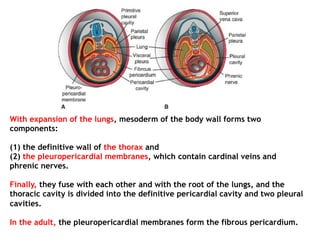
With expansion of the lungs, mesoderm of the body wall forms two
components:
(1) the definitive wall of the thorax and
(2) the pleuropericardial membranes, which contain cardinal veins and
phrenic nerves.
Finally, they fuse with each other and with the root of the lungs, and the
thoracic cavity is divided into the definitive pericardial cavity and two pleural
cavities.
In the adult, the pleuropericardial membranes form the fibrous pericardium.
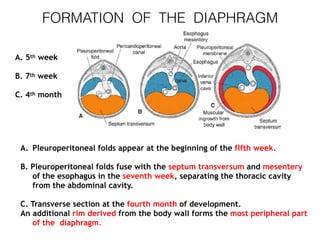
FORMATION OF THE DIAPHRAGM
A. Pleuroperitoneal folds appear at the beginning of the flfth week.
B. Pleuroperitoneal folds fuse with the septum transversum and mesentery
of the esophagus in the seventh week, separating the thoracic cavity
from the abdominal cavity.
C. Transverse section at the fourth month of development.
An additional rim derived from the body wall forms the most peripheral part
of the diaphragm.
A. 5th week
B. 7th week
C. 4th month
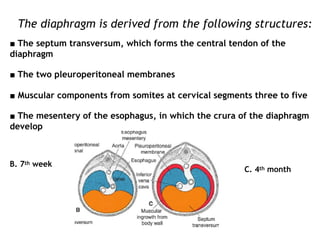
The diaphragm is derived from the following structures:
■ The septum transversum, which forms the central tendon of the
diaphragm
■ The two pleuroperitoneal membranes
■ Muscular components from somites at cervical segments three to five
■ The mesentery of the esophagus, in which the crura of the diaphragm
develop
B. 7th week
C. 4th month

lec 5- week 4-8 weeks of development.pdf

  • 1.
    Fourth to EighthWeeks of Human Development
  • 2.
    • All majorexternal and internal structures are established during the fourth to eighth weeks. • By the end of this embryonic period, the main organ systems have started to develop. • As the tissues and organs form, the shape of the embryo changes, and by the end of this period, the embryo has a distinctly human appearance. • Because the tissues and organs are differentiating rapidly, exposure of embryos to teratogens during this period may cause major birth defects. •Teratogens are agents (such as some drugs and viruses) that produce or increase the incidence of major birth defects.
  • 3.
    Embryonic folding fromIV week • https://www.youtube.com/watch? v=yXUv4MPuNTA Embryonic folding from IV week.mp4
  • 4.
    FOLDING OF EMBRYO Asignificant event in the establishment of body form is folding of the flat trilaminar embryonic disc into a somewhat cylindric embryo. Folding occurs in the median and horizontal planes and results from rapid growth of the embryo. Folding at the cranial and caudal ends and sides of the embryo occurs simultaneously. DAY 22 DAY 24
  • 5.
    Folding of Embryoin the Median Plane •Folding of the ends of the embryo produces head and tail folds that result in the cranial and caudal regions moving ventrally as the embryo elongates cranially and caudally. •26 Day
  • 6.
    Head Fold At thebeginning of the fourth week, the neural folds in the cranial region form the primordium of the brain (B) The developing brain projects dorsally into the amniotic cavity. The amniotic cavity contains amniotic fluid and the embryo. Later, the developing forebrain grows cranially beyond the oropharyngeal membrane and overhangs the developing heart (B ). At the same time, the septum transversum, primordial heart, pericardial coelom, and oropharyngeal membrane move onto the ventral surface of the embryo. Day 22
  • 7.
    Head Fold During folding,part of the endoderm of the umbilical vesicle is incorporated into the embryo as the foregut - primordium of pharynx, esophagus, and lower respiratory system. The foregut lies between the forebrain and primordial heart, and the oropharyngeal membrane separates the foregut from the stomodeum- the primordial mouth. DAY 26-27
  • 8.
    After folding ofthe head, the septum transversum lies caudal to the heart, where it subsequently develops into the central tendon of the diaphragm- the partition between the abdominal and thoracic cavities. The head fold also affects the arrangement of the embryonic coelom - primordium of the body cavity. Before folding, the coelom consists of a flattened, horseshoe-shaped cavity (A1). After folding, the pericardial coelom lies ventral to the heart and cranial to the septum transversum (C).
  • 9.
    Tail Fold Folding ofthe caudal end of the embryo results primarily from growth of the distal part of the neural tube, the primordium of the spinal cord (A, B). As the embryo grows, the caudal eminence (tail region) projects over the cloacal membrane, the future site of the anus. During folding, part of the endodermal germ layer is incorporated into the embryo as the hindgut, the descending colon and rectum (B).
  • 10.
    Tail Fold The terminalpart of the hindgut soon dilates slightly to form the cloaca - the rudiment of the urinary bladder and rectum . Before folding, the primitive streak lies cranial to the cloacal membrane (A); after folding, it lies caudal to it (B). The connecting stalk -primordium of the umbilical cord is now attached to the ventral surface of the embryo (A), and the allantois, or the diverticulum of the umbilical vesicle, is partially incorporated into the embryo (A and B).
  • 11.
    Folding of Embryoin the Horizontal Plane Folding of the sides of the developing embryo produces right and left lateral folds. Lateral folding is produced by the rapidly growing spinal cord and somites. As the abdominal wall forms, part of the endoderm germ layer is incorporated into the embryo as the midgut, the primordium of the small intestine (C2). DAY 26 C1 lateral C2 sagital C3 horizontal view
  • 12.
    The umbilical cordforms connecting stalk (B2 and D2). As the amniotic cavity expands and obliterates most of the extraembryonic coelom, the amnion forms the epithelial covering of the umbilical cord (D2).
  • 13.
    Folding of embryo •https://www.youtube.com/watch? v=qMnpxP6EeIY
  • 15.
    GERM LAYER DERIVATIVES •Thethree germ layers •1. ectoderm •2. mesoderm, and •3. Endoderm •formed during gastrulation , give rise to the primordia of all tissues and organs. •The cells of each germ layer divide, migrate, aggregate, and differentiate in patterns as they form the various organ systems.
  • 16.
    The main germ layerderivatives are as follows: •● Ectoderm gives rise to the • central nervous system; • peripheral nervous system; • sensory epithelia of the eyes, ears, and nose; • epidermis and its appendages (hair and nails); • mammary glands, pituitary gland; • subcutaneous glands and enamel of the teeth
  • 17.
    Neural crest cellsgive rise to Neural crest cells, derived from neuroectoderm, the central region of early ectoderm, eventually give rise to or participate in the formation of many cells types and organs, including: ➢ cells of the spinal cord, ➢ cranial nerves (V, VII, IX, and X), and neurons for cranial ganglia ➢ sensory ganglia and autonomic ganglia; sympathetic and enteric neurons ➢ ensheathing cells of the peripheral nervous system; ➢ melanocytes in the skin and hair follicles, pigment cells of the dermis, ➢ muscles and connective tissues, ➢ bones of pharyngeal arch origin; ➢ suprarenal medulla and cells of the adrenal medulla ➢ meninges of the brain and spinal cord. ➢ glial cells-Schwann cells
  • 18.
    •● Mesoderm givesrise to • connective tissue, • cartilage and bone • striated and smooth muscles, • heart, blood, and lymphatic vessels; • kidneys; • ovaries; • testes; • genital ducts; • serous membranes lining the body cavities •(pericardial, pleural and peritoneal membranes); • spleen; • cortex of the suprarenal glands.
  • 19.
    ● Endoderm givesrise to • the epithelial lining of the digestive and respiratory tracts; • parenchyma (connective tissue framework) of the tonsils; •thyroid and parathyroid glands; • thymus, • liver • pancreas; • epithelial lining of the urinary bladder and • most of the urethra; • epithelial lining of the tympanic cavity, tympanic •antrum, and pharyngotympanic tube.
  • 20.
  • 21.
    Fourth Week At thebeginning, the embryo is almost straight and has 4 to 12 somites that produce conspicuous surface elevations. The neural tube is formed opposite the somites, but it is widely open at the rostral and caudal neuropores.
  • 22.
    23 Day embryo= 3.0 mm Dorsal view
  • 23.
    Fourth Week By 24days, the first pharyngeal arches are visible. The first pharyngeal arch (mandibular arch) is distinct. The major part of the first arch gives rise to the mandible (lower jaw), and a rostral extension of the arch, the maxillary prominence, contributes to the maxilla (upper jaw). The embryo is now slightly curved because of the head and tail folds. The heart produces a large ventral heart prominence and pumps blood. The rostral neuropore is closing.
  • 24.
    Three pairs ofpharyngeal arches are visible at 26 days and the rostral neuropore is closed. The forebrain produces a prominent elevation of the head, and folding of the embryo has given the embryo a C-shaped curvature. 26 Day embrio = 4.0 mm
  • 25.
    Upper limb budsare recognizable at day 26 or 27 as small swellings on the ventrolateral body walls. Ectodermal thickenings (lens placodes), indicating the primordia of the future lenses of the eyes, are visible on the sides of the head. The fourth pair of pharyngeal arches and lower limb buds are visible by the end of the fourth week. A long tail-like caudal eminence is also a characteristic feature
  • 26.
    DAY 28 Rudiments ofmany of the organ systems, especially the cardiovascular system, are established. By the end of the fourth week, the caudal neuropore is usually closed. Photomicrograph of a section of the embryo at the level shown in A.
  • 27.
    Fifth Week Changes inbody form are minor during the fifth week compared with those that occurred during the fourth week, but growth of the head exceeds that of other regions. Enlargement of the head results mainly from the rapid development of the brain and facial prominences. The face soon contacts the heart prominence. The rapidly growing second pharyngeal arch overgrows the third and fourth arches, forming a lateral depression on each side, the cervical sinus. Mesonephric ridges indicate the site of the developing mesonephric kidneys which, in humans, are excretory organs. 32 Day embrio = 6.0 mm
  • 28.
    Sixth Week Embryos inthe sixth week show spontaneous movements, such as twitching of the trunk and developing limbs. It has been reported that embryos at this stage show reflex responses to touch. The upper limbs begin to show regional differentiation as the elbows and large hand plates develop. The primordia of the digits – fingers or digital rays, begin to develop in the hand plates.
  • 29.
    Sixth Week Development ofthe lower limbs occurs during the sixth week, 4 to 5 days later than that of the upper limbs. The pharyngeal groove between the first two pharyngeal arches becomes the external acoustic meatus (external ear canal). The auricular hillocks contribute to the formation of the auricle (pinna), the shell- shaped part of the external ear. Largely because retinal pigment has formed, the eyes are now obvious. 42 Day embrio = 12.5 mm The head is now much larger relative to the trunk and is bent over the heart prominence.
  • 30.
    This head positionresults from bending in the cervical (neck) region. The trunk and neck have begun to straighten, and the intestines enter the extraembryonic coelom in the proximal part of the umbilical cord . This umbilical herniation is a normal event. The herniation occurs because the abdominal cavity is too small at this age to accommodate the rapidly growing intestine Lateral view of an embryo and its chorionic sac at 56 days. Observe the human appearance of the embryo. It may not be possible to estimate sex because the external genitalia of males and females are similar at this stage of the embryonic period.
  • 31.
    Seventh Week The limbsundergo considerable change during the seventh week. Notches appear between the digital rays (grooves or notches that separate the areas of the hand and foot plates), which clearly indicate the digits-fingers or toes. Communication between the primordial gut and umbilical vesicle is now reduced. By the end of the seventh week, ossification of bones of the upper limbs has begun. Lateral view of an embryo about 48 days.
  • 32.
    Eighth Week •At thebeginning of this final week of the embryonic period, the digits of the hand are separated but noticeably webbed. •Notches are also clearly visible between the digital rays of the feet. •The caudal eminence is still present but stubby. •The scalp vascular plexus has appeared and forms a characteristic band around the head. About 52 Day embrio - 23 mm
  • 33.
    About 56 day Atthe end of the eighth week, all regions of the limbs are apparent and the digits have lengthened and are completely separated (Fig. ). Purposeful limb movements first occur during the eighth week. Primary ossification begins in the femora (long bones of the thigh). All evidence of the caudal eminence has disappeared, and both hands and feet approach each other ventrally. Imaged with optical microscopy (left) and magnetic resonance microscopy (right).
  • 34.
    The head isstill disproportionately large, constituting almost half of the embryo. The neck is established. The eyelids are closing. The intestines are still in the proximal portion of the umbilical cord. Although there are slight sex differences in the appearance of the external genitalia, they are not distinctive enough to permit accurate sexual identification. The end of 8TH week At the end of 8TH week, the embryo has distinct human characteristics !
  • 35.
    ESTIMATION OF EMBRYONICAGE Embryos of the third and early fourth weeks are straight (see Fig. 5-20A), so measurements indicate the greatest length. The crown–rump length (CRL) is most frequently used for older embryos (14 to 18 weeks) (B). The length of an embryo is only one criterion for establishing age. Greatest length (GL) Crown−rump length (CRL)
  • 36.
    The Carnegie EmbryonicStaging System is used internationally for estimating developmental stages in Human embryos. Its use enables comparisons to be made between the findings of one person and those of another. Page-76, Table 5-1
  • 37.
    The Gut Tube andThe Body Cavities https://www.youtube.com/watch?v=EtWACeVEmKw Langman Chapter 7 The gut tube and body cavities
  • 38.
    A TUBE ONTOP OF A TUBE During the third and fourth weeks, the top layer (ectoderm) of the trilaminar embryonic disc forms the neural plate that rolls up into a tube to form the brain and spinal cord by the process called neurulation . the ventral layer (endoderm) rolls down to form the gut tube, such that the embryo consists of a tube on top of a tube: the neural tube dorsally and the gut tube ventrally.
  • 39.
    The middle layer(mesoderm) holds the two tubes together and the lateral plate component of this mesoderm layer also splits into visceral (splanchnic) and parietal (somatic) layers. The visceral layer rolls ventrally and is intimately connected to the gut tube; the parietal layer, together with the overlying ectoderm, forms the lateral body wall folds. The end of 4th week DAY 21 The space between visceral and parietal layers of lateral plate mesoderm is the primitive body cavity, which at this early stage is a continuous cavity, because it has not yet been subdivided into the pericardial, pleural, and abdominopelvic regions.
  • 40.
    FORMATION OF THEBODY CAVITY At the end of the third week, intraembryonic mesoderm differentiates into: ❖ Paraxial mesoderm, which forms somitomeres and somites that play a major role in forming the skull and vertebrae; ❖ Intermediate mesoderm, which contributes to the urogenital system; ❖ Lateral plate mesoderm, which is involved in forming the body cavity. Day 19 Day 21
  • 41.
    Solid mesodermal layer,divide into two layer: (1) the parietal (somatic) layer adjacent to the surface ectoderm and continuous with the extraembryonic parietal mesoderm layer over the amnion. Together, the parietal (somatic) layer of lateral plate mesoderm and overlying ectoderm are called the somatopleure; (2) the visceral (splanchnic) layer adjacent to endoderm forming the gut tube and continuous with the visceral layer of extraembryonic mesoderm covering the yolk sac. Together, the visceral (splanchnic) layer of lateral plate mesoderm and underlying endoderm are called the splanchnopleure.
  • 42.
    FORMATION OF THEBODY CAVITY The space created between the two layers of lateral plate mesoderm constitutes the primitive body cavity. During the fourth week, the sides of the embryo begin to grow ventrally forming two lateral body wall folds (C). As these folds progress, the endoderm layer also folds ventrally and closes to form the gut tube (D,E).
  • 43.
    By the endof the fourth week, the lateral body wall folds meet in the midline and fuse to close the ventral body wall. This closure is aided by growth of the head and tail regions (folds) that cause the embryo to curve into the fetal position. Closure of the gut tube is complete except for a connection from the midgut region to the yolk sac called the vitelline (yolk sac) duct (D). This duct degenerates with the yolk sac between the II and III months of gestation. DAY 24 DAY 28
  • 44.
    SEROUS MEMBRANES Some cellsof mesoderm lining the body wall of the primitive embryonic cavity and form the parietal layer of the serous membranes lining the outside of the peritoneal, pleural, and pericardial cavities. In a similar manner, some cells of mesoderm form the visceral layer of the serous membranes covering the abdominal organs, lungs, and heart (E). Visceral and parietal layers are continuous with each other as the dorsal mesentery (E), which suspends the gut tube from the posterior body wall into the peritoneal cavity. Ventral mesentery exists only from the caudal foregut to the upper portion of the duodenum. These mesenteries are double layers of peritoneum that provide a pathway for blood vessels, nerves, and lymphatics to the organs.
  • 45.
    DIAPHRAGM AND THORACICCAVITY The septum transversum is a thick plate of mesodermal tissue occupying the space between the thoracic cavity and the stalk of the yolk sac. The septum is derived from visceral (splanchnic) mesoderm surrounding the heart. This septum does not separate the thoracic and abdominal cavities completely but leaves large openings, the pericardioperitoneal canals, on each side of the foregut (B) 5 week embryo
  • 46.
    Ventral and lateralexpansion is posterior to the pleuropericardial folds. At first, these folds appear as small ridges projecting into the primitive undivided thoracic cavity (C). When lung buds begin to grow, they expand caudolaterally within the pericardioperitoneal canals (C). As a result of the rapid growth of the lungs, the pericardioperitoneal canals become too small, and the lungs begin to expand into the mesenchyme of the body wall dorsally, laterally, and ventrally (C).
  • 47.
    With expansion ofthe lungs, mesoderm of the body wall forms two components: (1) the definitive wall of the thorax and (2) the pleuropericardial membranes, which contain cardinal veins and phrenic nerves. Finally, they fuse with each other and with the root of the lungs, and the thoracic cavity is divided into the definitive pericardial cavity and two pleural cavities. In the adult, the pleuropericardial membranes form the fibrous pericardium.
  • 48.
    FORMATION OF THEDIAPHRAGM A. Pleuroperitoneal folds appear at the beginning of the flfth week. B. Pleuroperitoneal folds fuse with the septum transversum and mesentery of the esophagus in the seventh week, separating the thoracic cavity from the abdominal cavity. C. Transverse section at the fourth month of development. An additional rim derived from the body wall forms the most peripheral part of the diaphragm. A. 5th week B. 7th week C. 4th month
  • 49.
    The diaphragm isderived from the following structures: ■ The septum transversum, which forms the central tendon of the diaphragm ■ The two pleuroperitoneal membranes ■ Muscular components from somites at cervical segments three to five ■ The mesentery of the esophagus, in which the crura of the diaphragm develop B. 7th week C. 4th month