DR IGE OLUFEMI
LECTURER/CONSULTANT
DEPT OF ANAESTHESIA
UNILORIN/UITH
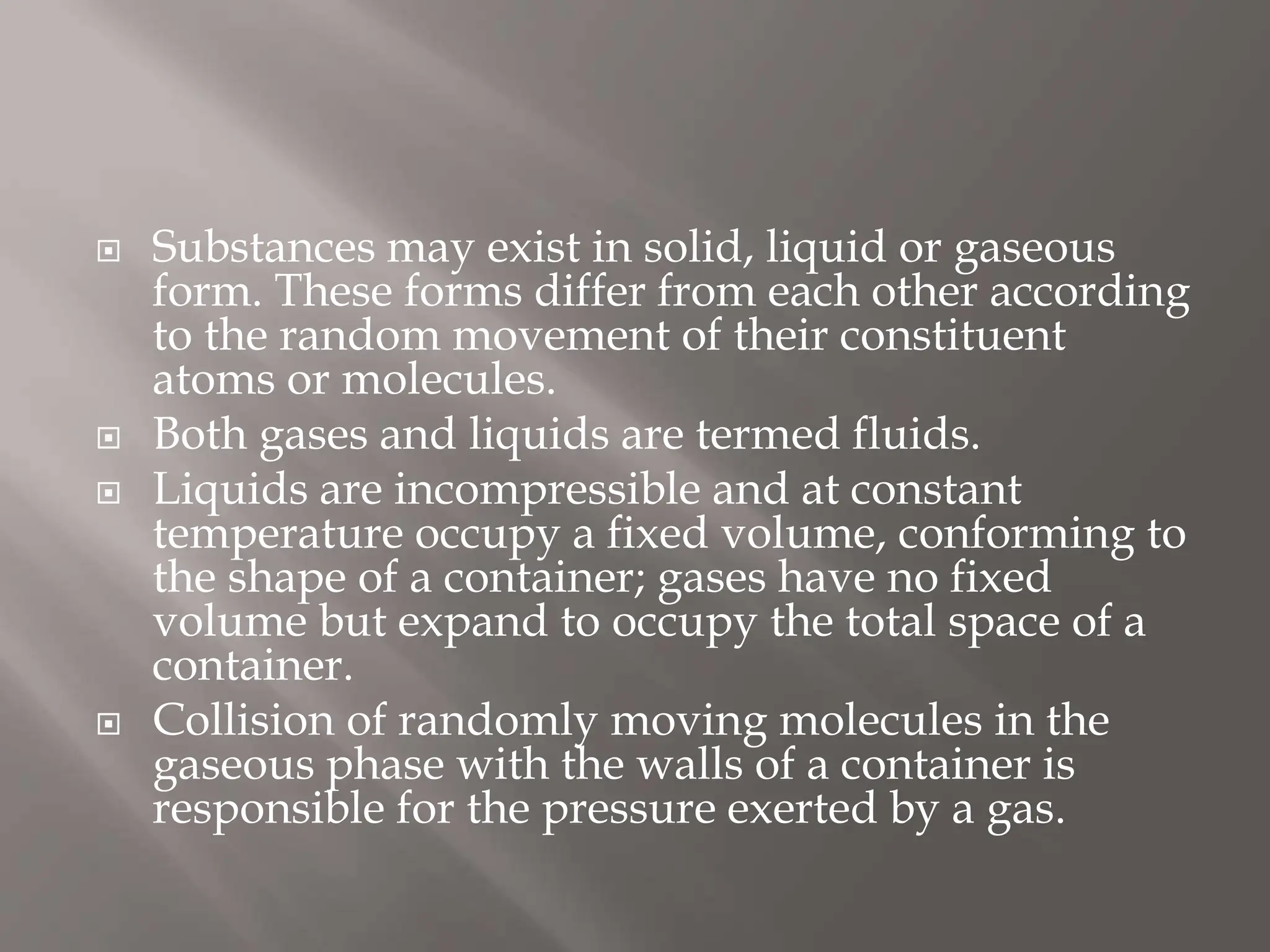
 Substances may exist in solid, liquid or gaseous
form. These forms differ from each other according
to the random movement of their constituent
atoms or molecules.
 Both gases and liquids are termed fluids.
 Liquids are incompressible and at constant
temperature occupy a fixed volume, conforming to
the shape of a container; gases have no fixed
volume but expand to occupy the total space of a
container.
 Collision of randomly moving molecules in the
gaseous phase with the walls of a container is
responsible for the pressure exerted by a gas.
 There are three important laws which determine
the behaviour of gases and which are important to
anaesthetists.
 Boyle's law states that, at constant temperature, the
volume ( V) of a given mass of gas varies inversely
with its absolute pressure (P): PV = k1
 Charles' law states that, at constant pressure, the
volume of a given mass of gas varies directly with
its absolute temperature ( T): V=k2T
 The third gas law states that, at constant volume,
the absolute pressure of a given mass of gas varies
directly with its absolute temperature: P = k3T
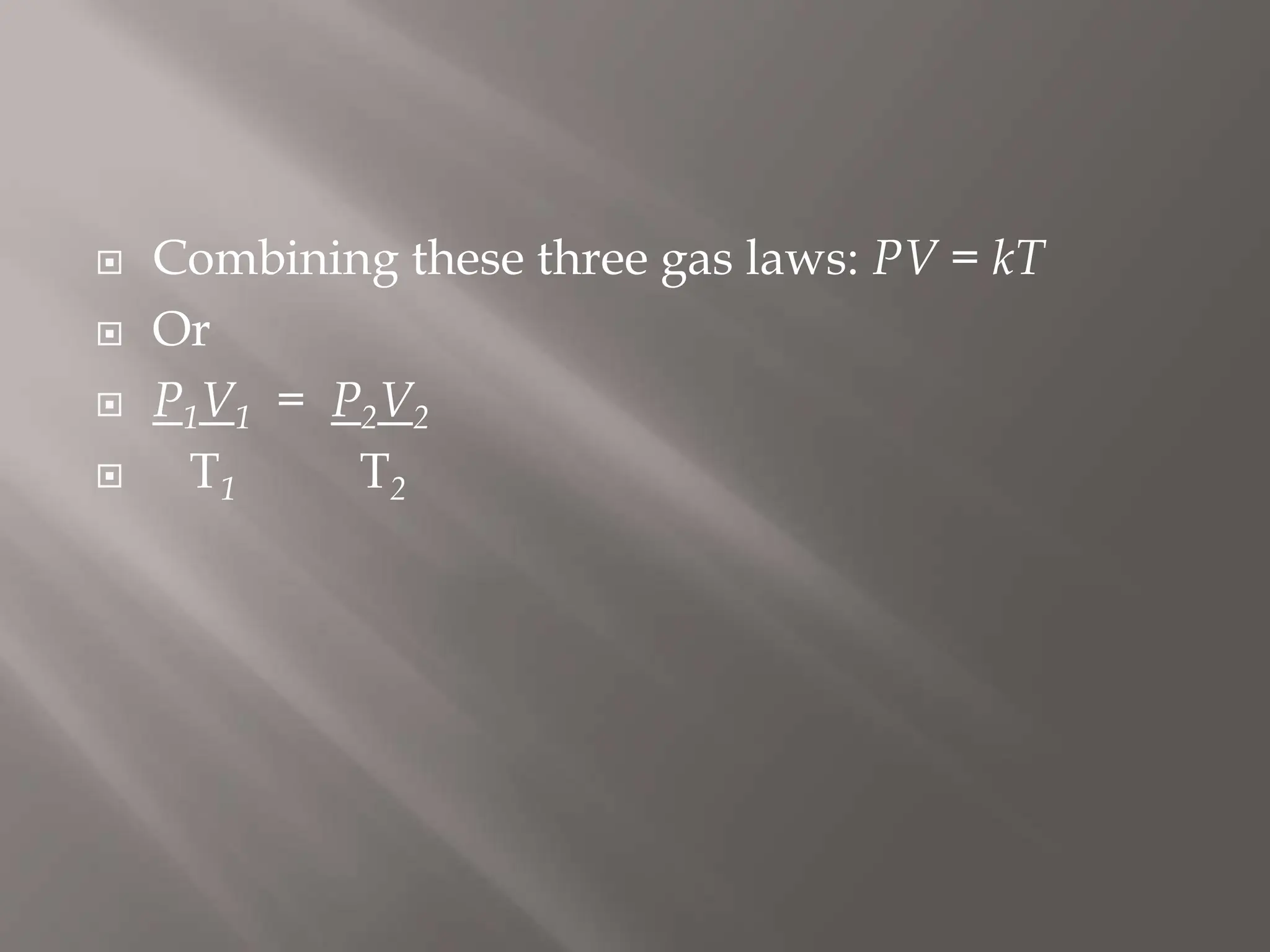
 Combining these three gas laws: PV = kT
 Or
 P1V1 = P2V2
 T1 T2
 The behavior of a mixture of gases in a
container is described by Dalton’s law of
partial pressures. This states that, in a mixture
of gases, the pressure exerted by each gas is the
same as that which it would exert if it alone
occupied the container.
 Thus, in a cylinder of compressed air at a
pressure of 100 bar, the pressure exerted by
nitrogen is equal to 79 bar (as the fractional
concentration of nitrogen is 0.79).
 Avogadro’s hypothesis states that equal volumes
of gases at the same temperature and pressure
contain equal numbers of molecules.
 Since molecular weights are different, the masses
of equal volumes of gases at STP will be
different. Avogadro’s law seeks to express the
quantity of a gas in moles (which is related to the
number of molecules of the gas)
 One mole is the quantity of a substance
containing the same number of particules as
there are atoms in 12g of carbon 12.
 Avogadro’s number is the number of
molecules in 1 g molecular weight of a
substance and is equal to 6.022 x 10²³.
 Under conditions of standard temperature and
pressure, 1 g molecular weight of any gas
occupies a volume of 22.4 litres (L).
 These data are useful in calculating, for
example, the quantity of gas produced from
liquid nitrous oxide. The molecular weight of
nitrous oxide is 44. Thus, 44 g of N2O occupy a
volume of 22.4L at standard temperature and
pressure (STP). If a full cylinder of N2O
contains 3.0 kg of liquid, then vaporization of
all the liquid would yield:
 22.4 x 3.0 x 1000 L
 44
 = 1527 L at STP
 The critical temperature of a substance is the
temperature above which that substance cannot be
liquefied by pressure, irrespective of its
magnitude.
 The critical temperature of oxygen is -118°C, that
of nitrogen is -147°C, and that of air is -141°C.
Thus, at room temperature, cylinders of these
substances contain gases.
 In contrast, the critical temperature of carbon
dioxide is 31°C and that of nitrous oxide is 36.5°C.
The critical pressures are 73.8 and 72.5 bar,
respectively; at higher pressures, cylinders of these
substances contain a mixture of gas and liquid.
 Adiabatic change of state
 The term adiabatic implies a change in the state of a gas
without exchange of heat energy with its surroundings.
 The cryoprobe is a clinical application of adiabatic
change of state.
 Sudden expansion of gas from a capillary tube results
in cooling of the gas because the kinetic energy of the
gas molecules supply the heat needed for expansion as
heat exchange does not take place with the
surroundings.
 It is used for rapid freezing of tissues in dermatology,
ophthalmology, gynaecology and pain management.
 Gauge pressure
 The pressure in a cylinder of nitrous oxide
remains relatively constant as the cylinder
empties until the liquid nitrous oxide has totally
vaporized.
 Subsequently, there is a linear decline in pressure
proportional to the volume of gas remaining
within the cylinder.
 Therefore, the gauge in a nitrous oxide cylinder is
not a true reflection of its contents until all the
liquid within the cylinder has totally vapourized.
 Gauge pressure (contd)
 In considering pressure, it is necessary to indicate
whether or not atmospheric pressure is taken into
account.
 To avoid confusion when discussing compressed
cylinders of gases, the term gauge pressure is
used.
 This refers to the difference between the pressure
of the contents of the cylinder and the ambient
pressure. Thus, a full cylinder of oxygen has a
gauge pressure of 137 bar, but the contents are at a
pressure of 138 bar absolute.
 Filling ratio
 Incomplete filling of a nitrous oxide cylinder is
necessary because thermally induced
expansion of the liquid in a totally full cylinder
may cause an explosion.
 The degree of filling of a nitrous oxide cylinder
is expressed as the mass of nitrous oxide in the
cylinder divided by the mass of water that the
cylinder could hold.
 Normally, a cylinder of nitrous oxide is filled to
a ratio of 0.65.
 Entonox
 Entonox is the trade name for a compressed gas
mixture containing 50% oxygen and 50% nitrous
oxide. The mixture is compressed into cylinders
containing gas at a pressure of 137 bar.
 The nitrous oxide does not liquefy (critical pressure
72.5bars) because the presence of oxygen at high
pressure reduces the critical temperature of nitrous
oxide.
 The critical temperature of the mixture is -7°C.
Cooling of a cylinder of Entonox to a temperature
below -7°C results in separation of liquid nitrous
oxide.
 Entonox (contd)
 Use of such a cylinder results in oxygen-rich
gas being released initially, followed by a
hypoxic nitrous oxide-rich gas.
 Consequently, it is recommended that when an
Entonox cylinder may have been exposed to
low temperatures, it should be stored
horizontally for a period of not less than 24 h at
a temperature of 5°C or above.
 In addition, the cylinder should be inverted
several times before use.
 Pressure notation in anaesthesia
 Atmospheric pressure exerts a pressure sufficient
to support a column of mercury of height 760 mm.
 1 atmospheric pressure
 = 760 mmHg
 = 1.01325 bar
 = 760 torr
 = 1 atmosphere absolute (ata)
 = 14.7 Ib in-2
 = 101.325kPa
 = 10.33mH2O
UPDATES ON GAS LAWS AND CLINICAL APPLICATIONS.pptx

UPDATES ON GAS LAWS AND CLINICAL APPLICATIONS.pptx

  • 1.
    DR IGE OLUFEMI LECTURER/CONSULTANT DEPTOF ANAESTHESIA UNILORIN/UITH
  • 2.
     Substances mayexist in solid, liquid or gaseous form. These forms differ from each other according to the random movement of their constituent atoms or molecules.  Both gases and liquids are termed fluids.  Liquids are incompressible and at constant temperature occupy a fixed volume, conforming to the shape of a container; gases have no fixed volume but expand to occupy the total space of a container.  Collision of randomly moving molecules in the gaseous phase with the walls of a container is responsible for the pressure exerted by a gas.
  • 3.
     There arethree important laws which determine the behaviour of gases and which are important to anaesthetists.  Boyle's law states that, at constant temperature, the volume ( V) of a given mass of gas varies inversely with its absolute pressure (P): PV = k1  Charles' law states that, at constant pressure, the volume of a given mass of gas varies directly with its absolute temperature ( T): V=k2T  The third gas law states that, at constant volume, the absolute pressure of a given mass of gas varies directly with its absolute temperature: P = k3T
  • 4.
     Combining thesethree gas laws: PV = kT  Or  P1V1 = P2V2  T1 T2
  • 5.
     The behaviorof a mixture of gases in a container is described by Dalton’s law of partial pressures. This states that, in a mixture of gases, the pressure exerted by each gas is the same as that which it would exert if it alone occupied the container.  Thus, in a cylinder of compressed air at a pressure of 100 bar, the pressure exerted by nitrogen is equal to 79 bar (as the fractional concentration of nitrogen is 0.79).
  • 6.
     Avogadro’s hypothesisstates that equal volumes of gases at the same temperature and pressure contain equal numbers of molecules.  Since molecular weights are different, the masses of equal volumes of gases at STP will be different. Avogadro’s law seeks to express the quantity of a gas in moles (which is related to the number of molecules of the gas)  One mole is the quantity of a substance containing the same number of particules as there are atoms in 12g of carbon 12.
  • 7.
     Avogadro’s numberis the number of molecules in 1 g molecular weight of a substance and is equal to 6.022 x 10²³.  Under conditions of standard temperature and pressure, 1 g molecular weight of any gas occupies a volume of 22.4 litres (L).
  • 8.
     These dataare useful in calculating, for example, the quantity of gas produced from liquid nitrous oxide. The molecular weight of nitrous oxide is 44. Thus, 44 g of N2O occupy a volume of 22.4L at standard temperature and pressure (STP). If a full cylinder of N2O contains 3.0 kg of liquid, then vaporization of all the liquid would yield:  22.4 x 3.0 x 1000 L  44  = 1527 L at STP
  • 9.
     The criticaltemperature of a substance is the temperature above which that substance cannot be liquefied by pressure, irrespective of its magnitude.  The critical temperature of oxygen is -118°C, that of nitrogen is -147°C, and that of air is -141°C. Thus, at room temperature, cylinders of these substances contain gases.  In contrast, the critical temperature of carbon dioxide is 31°C and that of nitrous oxide is 36.5°C. The critical pressures are 73.8 and 72.5 bar, respectively; at higher pressures, cylinders of these substances contain a mixture of gas and liquid.
  • 10.
     Adiabatic changeof state  The term adiabatic implies a change in the state of a gas without exchange of heat energy with its surroundings.  The cryoprobe is a clinical application of adiabatic change of state.  Sudden expansion of gas from a capillary tube results in cooling of the gas because the kinetic energy of the gas molecules supply the heat needed for expansion as heat exchange does not take place with the surroundings.  It is used for rapid freezing of tissues in dermatology, ophthalmology, gynaecology and pain management.
  • 11.
     Gauge pressure The pressure in a cylinder of nitrous oxide remains relatively constant as the cylinder empties until the liquid nitrous oxide has totally vaporized.  Subsequently, there is a linear decline in pressure proportional to the volume of gas remaining within the cylinder.  Therefore, the gauge in a nitrous oxide cylinder is not a true reflection of its contents until all the liquid within the cylinder has totally vapourized.
  • 12.
     Gauge pressure(contd)  In considering pressure, it is necessary to indicate whether or not atmospheric pressure is taken into account.  To avoid confusion when discussing compressed cylinders of gases, the term gauge pressure is used.  This refers to the difference between the pressure of the contents of the cylinder and the ambient pressure. Thus, a full cylinder of oxygen has a gauge pressure of 137 bar, but the contents are at a pressure of 138 bar absolute.
  • 13.
     Filling ratio Incomplete filling of a nitrous oxide cylinder is necessary because thermally induced expansion of the liquid in a totally full cylinder may cause an explosion.  The degree of filling of a nitrous oxide cylinder is expressed as the mass of nitrous oxide in the cylinder divided by the mass of water that the cylinder could hold.  Normally, a cylinder of nitrous oxide is filled to a ratio of 0.65.
  • 14.
     Entonox  Entonoxis the trade name for a compressed gas mixture containing 50% oxygen and 50% nitrous oxide. The mixture is compressed into cylinders containing gas at a pressure of 137 bar.  The nitrous oxide does not liquefy (critical pressure 72.5bars) because the presence of oxygen at high pressure reduces the critical temperature of nitrous oxide.  The critical temperature of the mixture is -7°C. Cooling of a cylinder of Entonox to a temperature below -7°C results in separation of liquid nitrous oxide.
  • 15.
     Entonox (contd) Use of such a cylinder results in oxygen-rich gas being released initially, followed by a hypoxic nitrous oxide-rich gas.  Consequently, it is recommended that when an Entonox cylinder may have been exposed to low temperatures, it should be stored horizontally for a period of not less than 24 h at a temperature of 5°C or above.  In addition, the cylinder should be inverted several times before use.
  • 16.
     Pressure notationin anaesthesia  Atmospheric pressure exerts a pressure sufficient to support a column of mercury of height 760 mm.  1 atmospheric pressure  = 760 mmHg  = 1.01325 bar  = 760 torr  = 1 atmosphere absolute (ata)  = 14.7 Ib in-2  = 101.325kPa  = 10.33mH2O