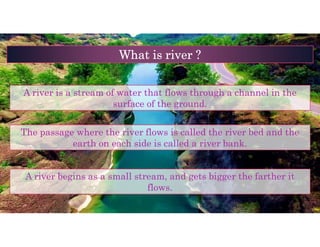
The passage where the river flows is called the river bed and the
earth on each side is called a river bank.
A river is a stream of water that flows through a channel in the
surface of the ground.
A river begins as a small stream, and gets bigger the farther it
flows.
What is river ?
 A natural stream of water of fairly large size flowing in a definite
series of diverging and converging channels.
 A river is the path that water takes as it flows downhill towards
the ocean.
Definition of river-
The start of a river is called the source and the end is called the
mouth.
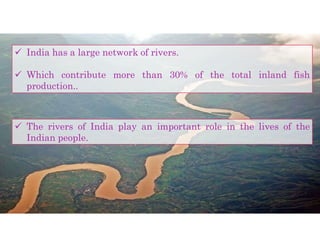
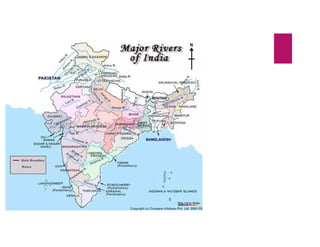
 India has a large network of rivers.
 Which contribute more than 30% of the total inland fish
production..
 The rivers of India play an important role in the lives of the
Indian people.
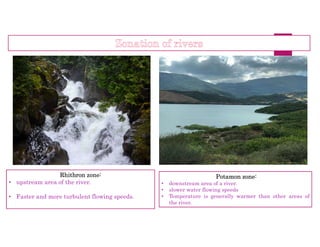
Rhithron zone:
• upstream area of the river.
• Faster and more turbulent flowing speeds.
Potamon zone:
• downstream area of a river.
• slower water flowing speeds
• Temperature is generally warmer than other areas of
the river.
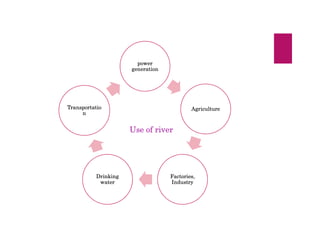
power
generation
Agriculture
Factories,
Industry
Drinking
water
Transportatio
n
Use of river
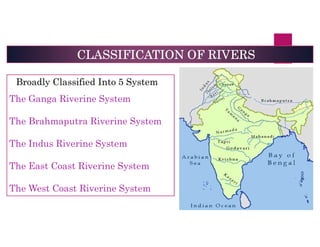
CLASSIFICATION OF RIVERS
Broadly Classified Into 5 System
The Ganga Riverine System
The Brahmaputra Riverine System
The Indus Riverine System
The East Coast Riverine System
The West Coast Riverine System
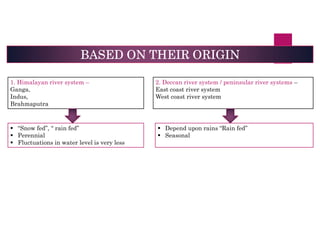
BASED ON THEIR ORIGIN
1. Himalayan river system –
Ganga,
Indus,
Brahmaputra
2. Deccan river system / peninsular river systems –
East coast river system
West coast river system
 “Snow fed”, “ rain fed”
 Perennial
 Fluctuations in water level is very less
 Depend upon rains “Rain fed”
 Seasonal
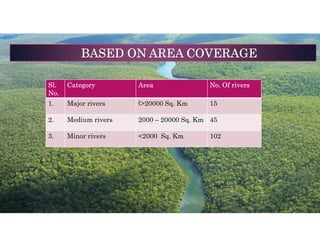
BASED ON AREA COVERAGE
Sl.
No.
Category Area No. Of rivers
1. Major rivers (>20000 Sq. Km 15
2. Medium rivers 2000 – 20000 Sq. Km 45
3. Minor rivers <2000 Sq. Km 102
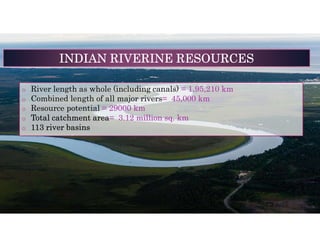
o River length as whole (including canals) = 1,95,210 km
o Combined length of all major rivers= 45,000 km
o Resource potential = 29000 km
o Total catchment area= 3.12 million sq. km
o 113 river basins
INDIAN RIVERINE RESOURCES
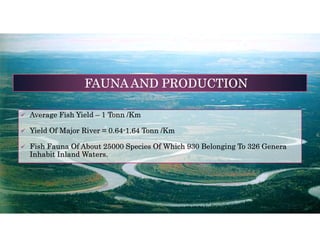
FAUNA AND PRODUCTION
 Average Fish Yield – 1 Tonn /Km
 Yield Of Major River = 0.64-1.64 Tonn /Km
 Fish Fauna Of About 25000 Species Of Which 930 Belonging To 326 Genera
Inhabit Inland Waters.
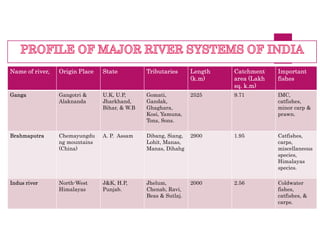
Name of river, Origin Place State Tributaries Length
(k.m)
Catchment
area (Lakh
sq. k.m)
Important
fishes
Ganga Gangotri &
Alaknanda
U.K, U.P,
Jharkhand,
Bihar, & W.B
Gomati,
Gandak,
Ghaghara,
Kosi, Yamuna,
Tons, Sons.
2525 9.71 IMC,
catfishes,
minor carp &
prawn.
Brahmaputra Chemayungdu
ng mountains
(China)
A. P. Assam Dibang, Siang,
Lohit, Manas,
Manas, Dihahg
2900 1.95 Catfishes,
carps,
miscellaneous
species,
Himalayas
species.
Indus river North-West
Himalayas
J&K, H.P,
Punjab.
Jhelum,
Chenab, Ravi,
Beas & Sutlaj.
2000 2.56 Coldwater
fishes,
catfishes, &
carps.
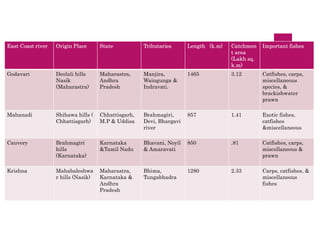
East Coast river Origin Place State Tributaries Length (k.m) Catchmen
t area
(Lakh sq.
k.m)
Important fishes
Godavari Deolali hills
Nasik
(Maharastra)
Maharastra,
Andhra
Pradesh
Manjira,
Waingunga &
Indravati.
1465 3.12 Catfishes, carps,
miscellaneous
species, &
brackishwater
prawn
Mahanadi Shihawa hills (
Chhattisgarh)
Chhattisgarh,
M.P & Uddisa
Brahmagiri,
Devi, Bhargavi
river
857 1.41 Exotic fishes,
catfishes
&miscellaneous
Cauvery Brahmagiri
hills
(Karnataka)
Karnataka
&Tamil Nadu
Bhavani, Noyil
& Amaravati
850 .81 Catfishes, carps,
miscellaneous &
prawn
Krishna Mahabaleshwa
r hills (Nasik)
Maharastra,
Karnataka &
Andhra
Pradesh
Bhima,
Tungabhadra
1280 2.33 Carps, catfishes, &
miscellaneous
fishes
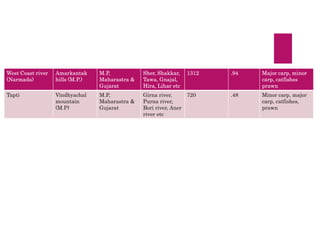
West Coast river
(Narmada)
Amarkantak
hills (M.P.)
M.P,
Maharastra &
Gujarat
Sher, Shakkar,
Tawa, Gnajal,
Hira, Lihar etc
1312 .94 Major carp, minor
carp, catfishes
prawn
Tapti Vindhyachal
mountain
(M.P)
M.P,
Maharastra &
Gujarat
Girna river,
Purna river,
Bori river, Aner
river etc
720 .48 Minor carp, major
carp, catfishes,
prawn
“ The Ganges is a lifeline to millions who
live along its course.”
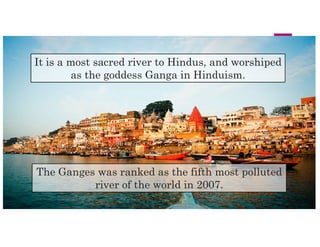
It is a most sacred river to Hindus, and worshiped
as the goddess Ganga in Hinduism.
The Ganges was ranked as the fifth most polluted
river of the world in 2007.
 Ganga most important river system in India and one of the largest in the world.
 Total length about 8,047 km.(in India with tributaries).
 Length of ganga- 2,525 km
 Travels through two countries - India and Bangladesh.
 Originates from Gangotri and Alaknanda at a height 6000 m above m.s.l in the Garwal Himalayas in
Uttarkhand.
 It drain cover states Uttarakhand, U. P., Bihar, Jharkhand, West Bengal & some part of Rajasthan and M.P.
 Ganga has its source in two head water (Gangotri and Alaknanda) at a height of about 6000 m. above sea level.
 It is named as Bhagirathi here. At Devprayag, Alakananda joins Bhagirathi and becomes Ganga.
 In Allahabad it is joined by the Yamuna, the largest tributary of Ganga, rising from Yamunotri glacier.
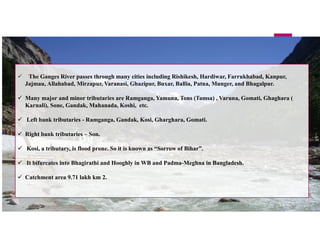
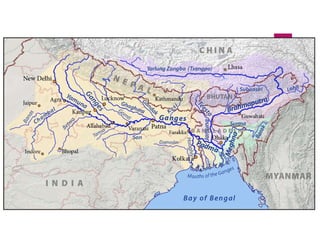
 The Ganges River passes through many cities including Rishikesh, Hardiwar, Farrukhabad, Kanpur,
Jajmau, Allahabad, Mirzapur, Varanasi, Ghazipur, Buxar, Ballia, Patna, Munger, and Bhagalpur.
 Many major and minor tributaries are Ramganga, Yamuna, Tons (Tamsa) , Varuna, Gomati, Ghaghara (
Karnali), Sone, Gandak, Mahanada, Koshi, etc.
 Left bank tributaries - Ramganga, Gandak, Kosi, Gharghara, Gomati.
 Right bank tributaries – Son.
 Kosi, a tributary, is flood prone. So it is known as “Sorrow of Bihar”.
 It bifurcates into Bhagirathi and Hooghly in WB and Padma-Meghna in Bangladesh.
 Catchment area 9.71 lakh km 2.
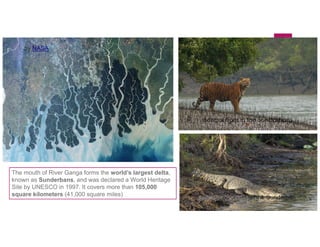
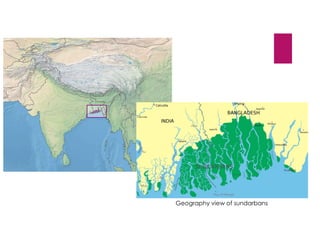
The mouth of River Ganga forms the world’s largest delta,
known as Sunderbans, and was declared a World Heritage
Site by UNESCO in 1997. It covers more than 105,000
square kilometers (41,000 square miles)
by NASA
Bengal tiger in the Sundarbans
saltwater crocodile in the Sundarban
Geography view of sundarbans
 Habitat
Upper reach (Tehri to Kannauj)
Middle reach (Kanpur to Patna)
Lower reach (Sultanpur to Kotwah)
 Zones of Ganga river
(a) Sluggish zone (Kanpur, Allahabad, Varanasi)
(b) Aggresive zone (Balia to Buxar)
(c) Recovery zone (Bhagalpur to Rajamahal)
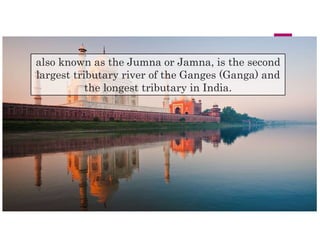
also known as the Jumna or Jamna, is the second
largest tributary river of the Ganges (Ganga) and
the longest tributary in India.
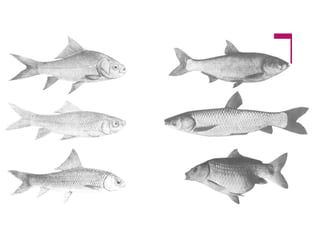
 The Ganga river system supports a large number of commercially important fish species
including major carp.
 Major carp- Labeo rohita, L. calbasu, Catla catla, Cirrhinus mrigala.
 Minor carp:- L. fimriatus, L. bata, L. dero, Cirrhinus reba etc.
 Catfishes:- Wallago attu, Mytus aor, Clarias batrachus, Bagarius bagarius, Rita rita, Ompak
pabda etc.
 Feather back:- Notopterus chitala, N. notopterus.
 Clupeids- Hilsa ilisha, Gadusia chapra, Satipinna phasa.
 Prawns- Macrobrachium malcolmsonii M. gangaticum.
 The dominant fish species in Ganga river system is Cirrhinus mrigala
Fisheries of Ganga river system
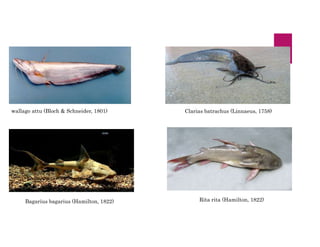
wallago attu (Bloch & Schneider, 1801) Clarias batrachus (Linnaeus, 1758)
Bagarius bagarius (Hamilton, 1822) Rita rita (Hamilton, 1822)
Chanda nama Glass fish
Puntius spp.
M. choparai (Truly freshwater prawn) Macrobrachium rosenbergii
Tenualosa ilisha
FISHING GEARS OF GANGA
 Hook and line is the main gear in the upper most stretch.
 Down stream up to Haridwar fishing is not permitted.
 Use of fishing gears is operative in the middle and low & reaches.
 The variously designed gears are used to suit local conditions such as depth of water, water
velocity and type of fish to be caught.
 Dragnets (major and minor), Gill nets, purse net, scoop net, cast nets, set barriers, traps,
long lines are normally used in fresh water stretches
 In estuaries system, Trawl nets, sine nets, purse nets, drift nets, lift nets, cast nets, bag nets,
set gillnets, set barrier nets and traps are used
Fishing gears of Ganga
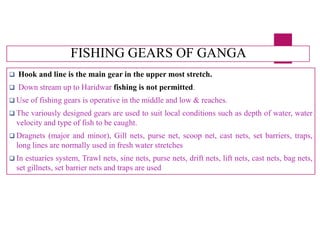
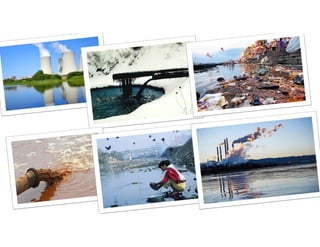
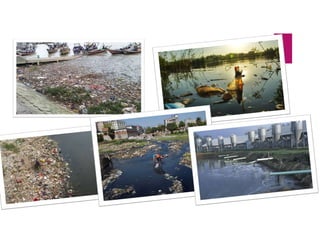
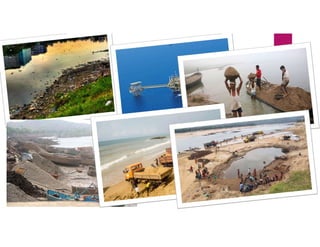
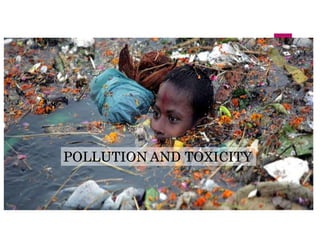
POLLUTION AND TOXICITY
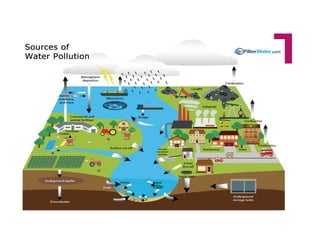
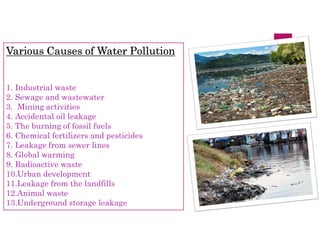
Various Causes of Water Pollution
1. Industrial waste
2. Sewage and wastewater
3. Mining activities
4. Accidental oil leakage
5. The burning of fossil fuels
6. Chemical fertilizers and pesticides
7. Leakage from sewer lines
8. Global warming
9. Radioactive waste
10.Urban development
11.Leakage from the landfills
12.Animal waste
13.Underground storage leakage
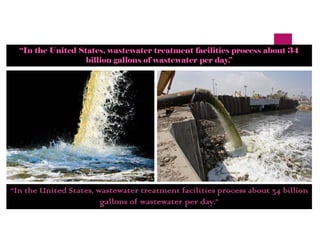
“In the United States, wastewater treatment facilities process about 34 billion
gallons of wastewater per day.”
“In the United States, wastewater treatment facilities process about 34
billion gallons of wastewater per day.”
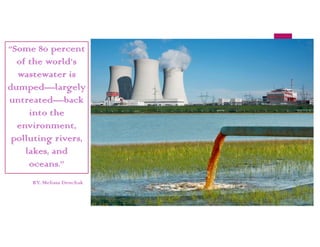
“Some 80 percent
of the world’s
wastewater is
dumped—largely
untreated—back
into the
environment,
polluting rivers,
lakes, and
oceans.”
BY, Melissa Denchak
“Unsafe water kills more people each year than war and all other forms
of violence combined.”
Oil pollution
“Moreover, nearly half of the estimated 1 million tons of oil that makes its way into marine
environments each year comes not from tanker spills but from land-based sources such as factories,
farms, and cities.”
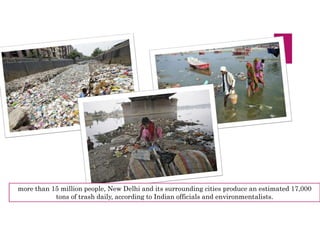
more than 15 million people, New Delhi and its surrounding cities produce an estimated 17,000
tons of trash daily, according to Indian officials and environmentalists.
ENVIRONMENTAL IMPACTS
CLIMATE CHANGE AND FISHERIES:
 Enhanced water temperature………
 Geographic shift of species
 Habitat loss or gain
 Fish breeding alteration or changes
 Decrease in fish and related biota species richness, alteration
compositions
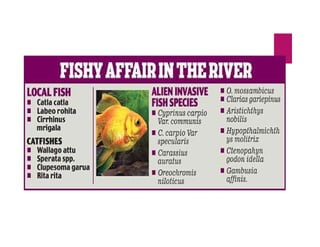
 Exotic species invasion.
 Impact on fish physiology
 Increased growth of plankton
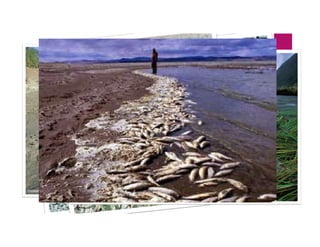
 Low oxygen
 Increased toxicity of pollutants
EXCESSIVE RAINFALL AND DROUGHT
 Geographic shift of species
 Habitat loss and gain
 Fish breeding failure
 Decrease in fish and related biota species distribution.
ALTERATION IN RAINFALL AND WATER AVAILABILITY
 Geographic shift of species.
 Species richness decreases
 Breeding failure
 Habitat loss
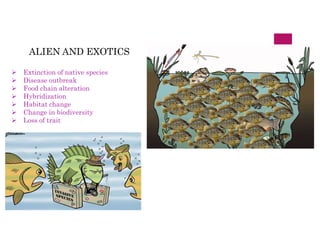
ALIEN AND EXOTICS
 Extinction of native species
 Disease outbreak
 Food chain alteration
 Hybridization
 Habitat change
 Change in biodiversity
 Loss of trait
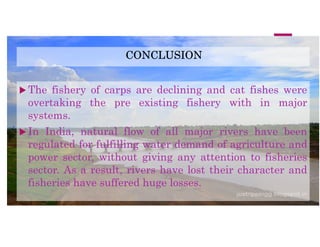
CONCLUSION
 The fishery of carps are declining and cat fishes were
overtaking the pre existing fishery with in major
systems.
 In India, natural flow of all major rivers have been
regulated for fulfilling water demand of agriculture and
power sector, without giving any attention to fisheries
sector. As a result, rivers have lost their character and
fisheries have suffered huge losses.
REFERENCE
•Hand book of aquaculture – Dr.S.ayyappan, Second edition,2011 (Chapter no – 1. Page no. 1 to
31, 302, 169).
•A text book of fish biology and fisheries Dr. S.S. Khanna Corrected edition (Chapter no – 34, 39 .
page no. 351 to 355,403 to 407).
•Fish and fisheries of India – V. G. Jhingran, Second edition, 1985 (Chapter no – 7. Page no.249,
492).
• Google

Ganga River System

  • 3.
    The passage wherethe river flows is called the river bed and the earth on each side is called a river bank. A river is a stream of water that flows through a channel in the surface of the ground. A river begins as a small stream, and gets bigger the farther it flows. What is river ?
  • 4.
     A naturalstream of water of fairly large size flowing in a definite series of diverging and converging channels.  A river is the path that water takes as it flows downhill towards the ocean. Definition of river- The start of a river is called the source and the end is called the mouth.
  • 5.
     India hasa large network of rivers.  Which contribute more than 30% of the total inland fish production..  The rivers of India play an important role in the lives of the Indian people.
  • 6.
    Rhithron zone: • upstreamarea of the river. • Faster and more turbulent flowing speeds. Potamon zone: • downstream area of a river. • slower water flowing speeds • Temperature is generally warmer than other areas of the river.
  • 7.
  • 8.
    CLASSIFICATION OF RIVERS BroadlyClassified Into 5 System The Ganga Riverine System The Brahmaputra Riverine System The Indus Riverine System The East Coast Riverine System The West Coast Riverine System
  • 9.
    BASED ON THEIRORIGIN 1. Himalayan river system – Ganga, Indus, Brahmaputra 2. Deccan river system / peninsular river systems – East coast river system West coast river system  “Snow fed”, “ rain fed”  Perennial  Fluctuations in water level is very less  Depend upon rains “Rain fed”  Seasonal
  • 10.
    BASED ON AREACOVERAGE Sl. No. Category Area No. Of rivers 1. Major rivers (>20000 Sq. Km 15 2. Medium rivers 2000 – 20000 Sq. Km 45 3. Minor rivers <2000 Sq. Km 102
  • 11.
    o River lengthas whole (including canals) = 1,95,210 km o Combined length of all major rivers= 45,000 km o Resource potential = 29000 km o Total catchment area= 3.12 million sq. km o 113 river basins INDIAN RIVERINE RESOURCES
  • 12.
    FAUNA AND PRODUCTION Average Fish Yield – 1 Tonn /Km  Yield Of Major River = 0.64-1.64 Tonn /Km  Fish Fauna Of About 25000 Species Of Which 930 Belonging To 326 Genera Inhabit Inland Waters.
  • 14.
    Name of river,Origin Place State Tributaries Length (k.m) Catchment area (Lakh sq. k.m) Important fishes Ganga Gangotri & Alaknanda U.K, U.P, Jharkhand, Bihar, & W.B Gomati, Gandak, Ghaghara, Kosi, Yamuna, Tons, Sons. 2525 9.71 IMC, catfishes, minor carp & prawn. Brahmaputra Chemayungdu ng mountains (China) A. P. Assam Dibang, Siang, Lohit, Manas, Manas, Dihahg 2900 1.95 Catfishes, carps, miscellaneous species, Himalayas species. Indus river North-West Himalayas J&K, H.P, Punjab. Jhelum, Chenab, Ravi, Beas & Sutlaj. 2000 2.56 Coldwater fishes, catfishes, & carps.
  • 15.
    East Coast riverOrigin Place State Tributaries Length (k.m) Catchmen t area (Lakh sq. k.m) Important fishes Godavari Deolali hills Nasik (Maharastra) Maharastra, Andhra Pradesh Manjira, Waingunga & Indravati. 1465 3.12 Catfishes, carps, miscellaneous species, & brackishwater prawn Mahanadi Shihawa hills ( Chhattisgarh) Chhattisgarh, M.P & Uddisa Brahmagiri, Devi, Bhargavi river 857 1.41 Exotic fishes, catfishes &miscellaneous Cauvery Brahmagiri hills (Karnataka) Karnataka &Tamil Nadu Bhavani, Noyil & Amaravati 850 .81 Catfishes, carps, miscellaneous & prawn Krishna Mahabaleshwa r hills (Nasik) Maharastra, Karnataka & Andhra Pradesh Bhima, Tungabhadra 1280 2.33 Carps, catfishes, & miscellaneous fishes
  • 16.
    West Coast river (Narmada) Amarkantak hills(M.P.) M.P, Maharastra & Gujarat Sher, Shakkar, Tawa, Gnajal, Hira, Lihar etc 1312 .94 Major carp, minor carp, catfishes prawn Tapti Vindhyachal mountain (M.P) M.P, Maharastra & Gujarat Girna river, Purna river, Bori river, Aner river etc 720 .48 Minor carp, major carp, catfishes, prawn
  • 19.
    “ The Gangesis a lifeline to millions who live along its course.”
  • 20.
    It is amost sacred river to Hindus, and worshiped as the goddess Ganga in Hinduism. The Ganges was ranked as the fifth most polluted river of the world in 2007.
  • 21.
     Ganga mostimportant river system in India and one of the largest in the world.  Total length about 8,047 km.(in India with tributaries).  Length of ganga- 2,525 km  Travels through two countries - India and Bangladesh.  Originates from Gangotri and Alaknanda at a height 6000 m above m.s.l in the Garwal Himalayas in Uttarkhand.  It drain cover states Uttarakhand, U. P., Bihar, Jharkhand, West Bengal & some part of Rajasthan and M.P.  Ganga has its source in two head water (Gangotri and Alaknanda) at a height of about 6000 m. above sea level.  It is named as Bhagirathi here. At Devprayag, Alakananda joins Bhagirathi and becomes Ganga.  In Allahabad it is joined by the Yamuna, the largest tributary of Ganga, rising from Yamunotri glacier.
  • 23.
     The GangesRiver passes through many cities including Rishikesh, Hardiwar, Farrukhabad, Kanpur, Jajmau, Allahabad, Mirzapur, Varanasi, Ghazipur, Buxar, Ballia, Patna, Munger, and Bhagalpur.  Many major and minor tributaries are Ramganga, Yamuna, Tons (Tamsa) , Varuna, Gomati, Ghaghara ( Karnali), Sone, Gandak, Mahanada, Koshi, etc.  Left bank tributaries - Ramganga, Gandak, Kosi, Gharghara, Gomati.  Right bank tributaries – Son.  Kosi, a tributary, is flood prone. So it is known as “Sorrow of Bihar”.  It bifurcates into Bhagirathi and Hooghly in WB and Padma-Meghna in Bangladesh.  Catchment area 9.71 lakh km 2.
  • 25.
    The mouth ofRiver Ganga forms the world’s largest delta, known as Sunderbans, and was declared a World Heritage Site by UNESCO in 1997. It covers more than 105,000 square kilometers (41,000 square miles) by NASA Bengal tiger in the Sundarbans saltwater crocodile in the Sundarban
  • 26.
  • 27.
     Habitat Upper reach(Tehri to Kannauj) Middle reach (Kanpur to Patna) Lower reach (Sultanpur to Kotwah)  Zones of Ganga river (a) Sluggish zone (Kanpur, Allahabad, Varanasi) (b) Aggresive zone (Balia to Buxar) (c) Recovery zone (Bhagalpur to Rajamahal)
  • 28.
    also known asthe Jumna or Jamna, is the second largest tributary river of the Ganges (Ganga) and the longest tributary in India.
  • 29.
     The Gangariver system supports a large number of commercially important fish species including major carp.  Major carp- Labeo rohita, L. calbasu, Catla catla, Cirrhinus mrigala.  Minor carp:- L. fimriatus, L. bata, L. dero, Cirrhinus reba etc.  Catfishes:- Wallago attu, Mytus aor, Clarias batrachus, Bagarius bagarius, Rita rita, Ompak pabda etc.  Feather back:- Notopterus chitala, N. notopterus.  Clupeids- Hilsa ilisha, Gadusia chapra, Satipinna phasa.  Prawns- Macrobrachium malcolmsonii M. gangaticum.  The dominant fish species in Ganga river system is Cirrhinus mrigala Fisheries of Ganga river system
  • 31.
    wallago attu (Bloch& Schneider, 1801) Clarias batrachus (Linnaeus, 1758) Bagarius bagarius (Hamilton, 1822) Rita rita (Hamilton, 1822)
  • 32.
    Chanda nama Glassfish Puntius spp. M. choparai (Truly freshwater prawn) Macrobrachium rosenbergii Tenualosa ilisha
  • 33.
    FISHING GEARS OFGANGA  Hook and line is the main gear in the upper most stretch.  Down stream up to Haridwar fishing is not permitted.  Use of fishing gears is operative in the middle and low & reaches.  The variously designed gears are used to suit local conditions such as depth of water, water velocity and type of fish to be caught.  Dragnets (major and minor), Gill nets, purse net, scoop net, cast nets, set barriers, traps, long lines are normally used in fresh water stretches  In estuaries system, Trawl nets, sine nets, purse nets, drift nets, lift nets, cast nets, bag nets, set gillnets, set barrier nets and traps are used
  • 34.
  • 35.
  • 36.
  • 38.
    Various Causes ofWater Pollution 1. Industrial waste 2. Sewage and wastewater 3. Mining activities 4. Accidental oil leakage 5. The burning of fossil fuels 6. Chemical fertilizers and pesticides 7. Leakage from sewer lines 8. Global warming 9. Radioactive waste 10.Urban development 11.Leakage from the landfills 12.Animal waste 13.Underground storage leakage
  • 43.
    “In the UnitedStates, wastewater treatment facilities process about 34 billion gallons of wastewater per day.” “In the United States, wastewater treatment facilities process about 34 billion gallons of wastewater per day.”
  • 44.
    “Some 80 percent ofthe world’s wastewater is dumped—largely untreated—back into the environment, polluting rivers, lakes, and oceans.” BY, Melissa Denchak
  • 45.
    “Unsafe water killsmore people each year than war and all other forms of violence combined.”
  • 46.
  • 47.
    “Moreover, nearly halfof the estimated 1 million tons of oil that makes its way into marine environments each year comes not from tanker spills but from land-based sources such as factories, farms, and cities.”
  • 51.
    more than 15million people, New Delhi and its surrounding cities produce an estimated 17,000 tons of trash daily, according to Indian officials and environmentalists.
  • 52.
    ENVIRONMENTAL IMPACTS CLIMATE CHANGEAND FISHERIES:  Enhanced water temperature………  Geographic shift of species  Habitat loss or gain  Fish breeding alteration or changes  Decrease in fish and related biota species richness, alteration compositions  Exotic species invasion.  Impact on fish physiology  Increased growth of plankton  Low oxygen  Increased toxicity of pollutants
  • 53.
    EXCESSIVE RAINFALL ANDDROUGHT  Geographic shift of species  Habitat loss and gain  Fish breeding failure  Decrease in fish and related biota species distribution. ALTERATION IN RAINFALL AND WATER AVAILABILITY  Geographic shift of species.  Species richness decreases  Breeding failure  Habitat loss
  • 55.
    ALIEN AND EXOTICS Extinction of native species  Disease outbreak  Food chain alteration  Hybridization  Habitat change  Change in biodiversity  Loss of trait
  • 58.
    CONCLUSION  The fisheryof carps are declining and cat fishes were overtaking the pre existing fishery with in major systems.  In India, natural flow of all major rivers have been regulated for fulfilling water demand of agriculture and power sector, without giving any attention to fisheries sector. As a result, rivers have lost their character and fisheries have suffered huge losses.
  • 59.
    REFERENCE •Hand book ofaquaculture – Dr.S.ayyappan, Second edition,2011 (Chapter no – 1. Page no. 1 to 31, 302, 169). •A text book of fish biology and fisheries Dr. S.S. Khanna Corrected edition (Chapter no – 34, 39 . page no. 351 to 355,403 to 407). •Fish and fisheries of India – V. G. Jhingran, Second edition, 1985 (Chapter no – 7. Page no.249, 492). • Google