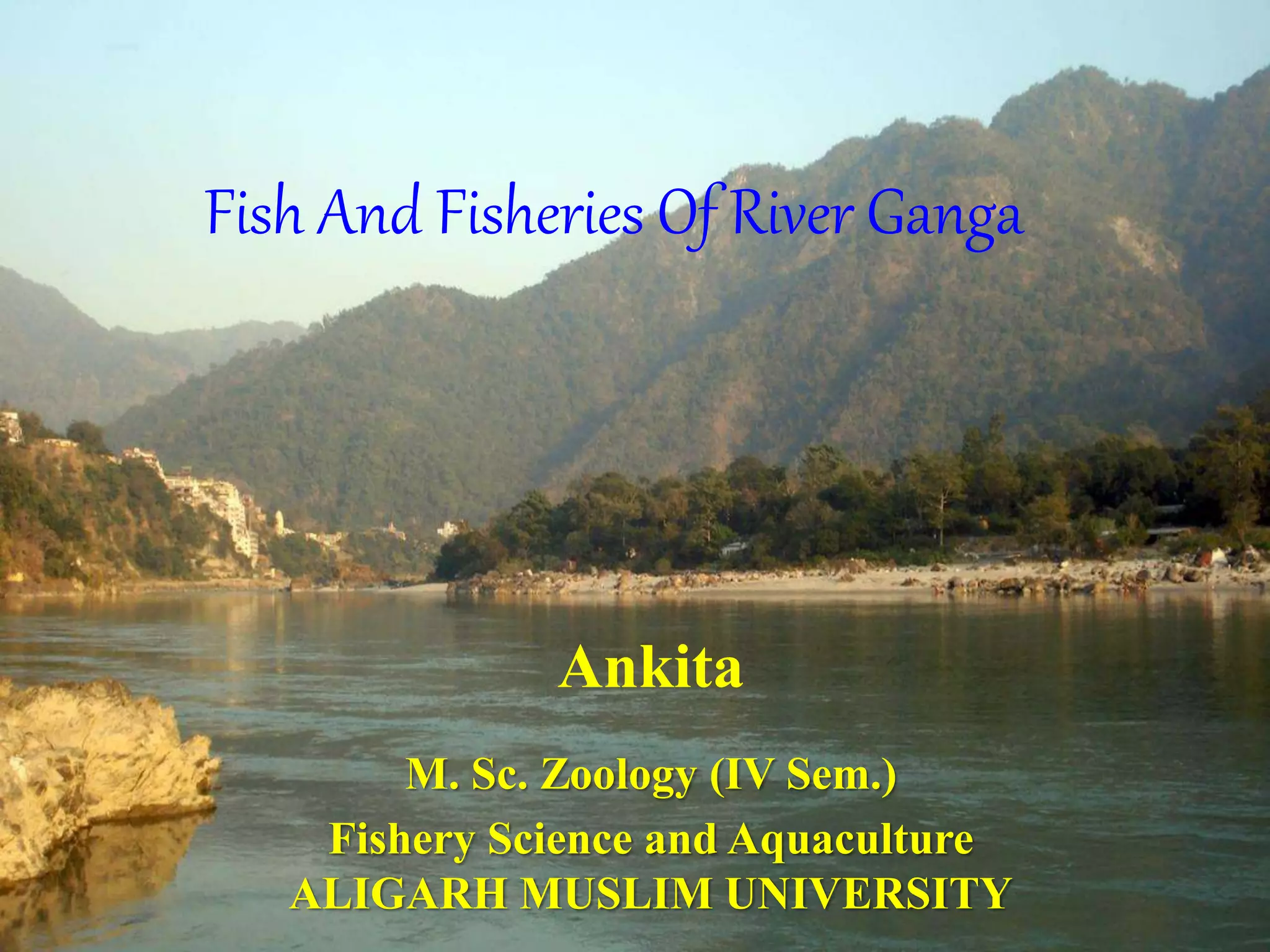
Fish And Fisheries Of River Ganga
Ankita
M. Sc. Zoology (IV Sem.)
Fishery Science and Aquaculture
ALIGARH MUSLIM UNIVERSITY
The Auspicious Ganga
• The river Ganga originates in the Garhwal
Himalayas (30° 55' N; 70° 7' E) at an elevation
of 4100 m above mean sea level from Gangotri
glacier in the western Himalayas in the
Uttrakhand state of India.
• The Ganga river supports a copious flora and
fauna.
Routes of River Ganga
Habitat For The Fishes
 Upper Ganga:
 The river in the upper reach flows on steep bed and narrow terrain
 The substrate is mostly rocks, boulders and stones
 The water is very cold having turbulent flow with high velocities
sometimes up to 2.0-3.0 m/sec
 Middle Ganga:
 River bed is wide with extensive flood plains, meandering streams
on sand and pebbles
 The temperatures of water are moderate and velocities low 20-30
cm/sec
 Lower Ganga:
The river in lower stretch has problems of sediment load, flooding
and silt deposition through a meandering water course
The flows are comparatively more after the confluence of major
tributaries
The substrate is usually of silt over sand and accumulation of
degrading organic matter
FISHES OF THE GANGA RIVER
• Ganga river supports a large number of
endemic and exotic species of fishes. It
harbours approximately 265 fish species,
including the Gangetic major carps, large
catfishes, featherbacks and murrels.
COMMERCIALLY IMPORTANT FISHES
(A). Indian Major carps
Catla catla
Labeo rohita
Cirrhina mrigala
B).Other Carps
Labeo bata
Labeo dero
Cirrhinus reba
(C). Large cat fishes
Sperata aor
Sperata seenghala
Silonia silondia
Wallaga attu
Pangasius pangasius
Bagarius bagarius
Rita rita
(D). Other catfishes
Clupisoma garua
Eutropiichthys vacha
Ailia coila
Ompok bimaculatus
Ompak pabda
(E).Clupeoides
Hilsa ilisha
Setipinna phasa
Gudusia chapra
(F).Feather backs
Notopterus notopterus
Notopterus chitala
(G).Exotic and other fishes
Cyprinus carpio
Oreochromis niloticus
Aristichthys nobilis
Ctenopharyngodon idella
Hypophthalmichthys molitrix
Clarias gariepinus
Puntius sophore
Puntius conchonius
Channa punctata
Channa marulius
Channa striata
Fishes of Upper Ganga
 The sub stretch Gangotri to
Gangnani is no fish zone.
 The river continuum is
disturbed between Gangnani
and Devprayag due to multiple
hydroelectric projects.
 The reach between Gangnani to
Devprayag is inhabited by
fishes. The most typical being
Trouts, Schizothorax (7sp) and
Schizothoraichthys (2sp). Other
fishes reported are Garra (3sp),
Barillius,Nemachilus,
Pseudecheneis, Glyptothorax.
Fishes of Middle Ganga
 138 species belonging
to 69 genus and 26
families have been
reported.
 Cyprinidae is the
largest group.
 This middle Ganga
shows decline of carps
and increase in catfishes
and forage fishes.
Fishes of Lower Ganga
The most important
groups like in middle
Ganga are Cyprinidae
which includes 34
species.
The characteristic group
of fishes in the zone is
the major carps and large
catfishes, clupeiods and
featherbacks.
Fishing Gears
Hook and line is the
main gear in the upper
most stretch.
Use of fishing gears
e.g.gill nets, cast net etc
are operative in the
middle and lower
stretches.
The variously designed
gears are used to suit
local conditions such as
depth of water, water
velocity and type of
fish to be caught.
FISH LANDINGS (TONNES) AT DIFFERENT CENTRES ON GANGA
RIVER
(COMPILED FROM CIFRI ANNUAL REPORTS, 1970, 80, 90, 2000, 2007)
EXOTIC FISHES
FISHERIES AT ALLAHABAD
Fish landing at Allahabad
(CIFRI Annual Reports 1961-2007)
Factors influencing the declining
rate of fishes in River Ganga
1. Climate change
2. Dams, Barrages and Hydropower projects
3. Pollution
4. Invasion of Exotic species
Recommendations for Sustainable
Fisheries in the Ganga River
• Check water diversions into canals to allow natural flow.
Allow fish movements upriver, currently locked by large dams
and barrages.
• Curb destructive practices of fishing.
• Urgent need to reduce the presently excessive river pollution,
specially industrial but also domestic wastes.
• Make sure new proposed dams are built at a site that results in
the least amount of environmental damage.
• Public awareness among people to reduce socio-economic
pressure on the selected fish species.
• Recently integrated Ganga Conservation
Mission called Namami Gange was formed
under National Mission for Clean Ganga, a
registered society of the Ministry of Water
Resources, River Development and Ganga
Rejuvenation to ensure ecological rejuvenation
by conservation of aquatic life and
biodiversity.
Fish And Fisheries Of River Ganga By ANKITA

Fish And Fisheries Of River Ganga By ANKITA

  • 1.
    Fish And FisheriesOf River Ganga Ankita M. Sc. Zoology (IV Sem.) Fishery Science and Aquaculture ALIGARH MUSLIM UNIVERSITY
  • 2.
    The Auspicious Ganga •The river Ganga originates in the Garhwal Himalayas (30° 55' N; 70° 7' E) at an elevation of 4100 m above mean sea level from Gangotri glacier in the western Himalayas in the Uttrakhand state of India. • The Ganga river supports a copious flora and fauna.
  • 3.
  • 4.
    Habitat For TheFishes  Upper Ganga:  The river in the upper reach flows on steep bed and narrow terrain  The substrate is mostly rocks, boulders and stones  The water is very cold having turbulent flow with high velocities sometimes up to 2.0-3.0 m/sec  Middle Ganga:  River bed is wide with extensive flood plains, meandering streams on sand and pebbles  The temperatures of water are moderate and velocities low 20-30 cm/sec  Lower Ganga: The river in lower stretch has problems of sediment load, flooding and silt deposition through a meandering water course The flows are comparatively more after the confluence of major tributaries The substrate is usually of silt over sand and accumulation of degrading organic matter
  • 5.
    FISHES OF THEGANGA RIVER • Ganga river supports a large number of endemic and exotic species of fishes. It harbours approximately 265 fish species, including the Gangetic major carps, large catfishes, featherbacks and murrels.
  • 6.
    COMMERCIALLY IMPORTANT FISHES (A).Indian Major carps Catla catla Labeo rohita Cirrhina mrigala B).Other Carps Labeo bata Labeo dero Cirrhinus reba (C). Large cat fishes Sperata aor Sperata seenghala Silonia silondia Wallaga attu Pangasius pangasius Bagarius bagarius Rita rita (D). Other catfishes Clupisoma garua Eutropiichthys vacha Ailia coila Ompok bimaculatus Ompak pabda (E).Clupeoides Hilsa ilisha Setipinna phasa Gudusia chapra (F).Feather backs Notopterus notopterus Notopterus chitala (G).Exotic and other fishes Cyprinus carpio Oreochromis niloticus Aristichthys nobilis Ctenopharyngodon idella Hypophthalmichthys molitrix Clarias gariepinus Puntius sophore Puntius conchonius Channa punctata Channa marulius Channa striata
  • 7.
    Fishes of UpperGanga  The sub stretch Gangotri to Gangnani is no fish zone.  The river continuum is disturbed between Gangnani and Devprayag due to multiple hydroelectric projects.  The reach between Gangnani to Devprayag is inhabited by fishes. The most typical being Trouts, Schizothorax (7sp) and Schizothoraichthys (2sp). Other fishes reported are Garra (3sp), Barillius,Nemachilus, Pseudecheneis, Glyptothorax.
  • 8.
    Fishes of MiddleGanga  138 species belonging to 69 genus and 26 families have been reported.  Cyprinidae is the largest group.  This middle Ganga shows decline of carps and increase in catfishes and forage fishes.
  • 9.
    Fishes of LowerGanga The most important groups like in middle Ganga are Cyprinidae which includes 34 species. The characteristic group of fishes in the zone is the major carps and large catfishes, clupeiods and featherbacks.
  • 11.
    Fishing Gears Hook andline is the main gear in the upper most stretch. Use of fishing gears e.g.gill nets, cast net etc are operative in the middle and lower stretches. The variously designed gears are used to suit local conditions such as depth of water, water velocity and type of fish to be caught.
  • 12.
    FISH LANDINGS (TONNES)AT DIFFERENT CENTRES ON GANGA RIVER (COMPILED FROM CIFRI ANNUAL REPORTS, 1970, 80, 90, 2000, 2007)
  • 14.
  • 15.
    FISHERIES AT ALLAHABAD Fishlanding at Allahabad (CIFRI Annual Reports 1961-2007)
  • 16.
    Factors influencing thedeclining rate of fishes in River Ganga 1. Climate change 2. Dams, Barrages and Hydropower projects 3. Pollution 4. Invasion of Exotic species
  • 17.
    Recommendations for Sustainable Fisheriesin the Ganga River • Check water diversions into canals to allow natural flow. Allow fish movements upriver, currently locked by large dams and barrages. • Curb destructive practices of fishing. • Urgent need to reduce the presently excessive river pollution, specially industrial but also domestic wastes. • Make sure new proposed dams are built at a site that results in the least amount of environmental damage. • Public awareness among people to reduce socio-economic pressure on the selected fish species.
  • 18.
    • Recently integratedGanga Conservation Mission called Namami Gange was formed under National Mission for Clean Ganga, a registered society of the Ministry of Water Resources, River Development and Ganga Rejuvenation to ensure ecological rejuvenation by conservation of aquatic life and biodiversity.