MOUNT TABOR TRAINING COLLEGE, PATHANAPURAM
EDUCATIONAL CONTRIBUTIONS OF MAHATMA
GANDHI
Submitted to : Dr George Varghese
MEMBERS
 Akhila Prabhakaran
 Akhila M
 Aleena R
 Amitha Raghunathan
 Anjali Chacko
 Arya M S
 Arathy V R
 Athira Anand
 Fathima Shahjahan
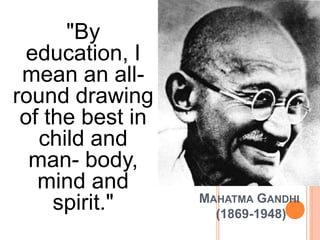
MAHATMA GANDHI
(1869-1948)
"By
education, I
mean an all-
round drawing
of the best in
child and
man- body,
mind and
spirit."
LIFE SKETCH
 Born in 1869 in Gujarat.
 Honoured by the people of India as the father of our
nation.
 A great socio-political reformer.
 Apostle of peace and non-violence.
 Champion of the freedom movement.
 Organized Satyagraha and various other movements.
CONTD…
 He completed his high school in India.
 He studied in a college called Salmdas at Bhavnagar.
 He sailed from Bombay to England to study law.
 Was a lawyer for much of his early life.
 Spent 22 years in South Africa, where he would begin an
Indian revolution.
MAJOR WORKS
 My experiments with truth (1927).
 Satyagraha in South africa (1928).
 Hind swaraj (1909).
 The Bhagavat Gita (1929).
 Non violent Resistance (1951).
 Pathway to God(1971).
 All men are brothers (1995).
BASIC EDUCATION
 Basic education indicates such education which
may help an individual to fulfill his basic needs.
 It is based on the national culture and civilization of
India.
 Its main objective is to make a child self-reliant and
self-sufficient.
 It stands for anew crafts-centered approach full of
spirit and self realization which always seeks truth.
PROPOSALS OF BASIC EDUCATION
 Free, universal and compulsory education should be provided for all boys
and girls between the ages 7-14 years.
 Mother tongue of the child should be the medium of instruction.
 According to the capacity of the children and the needs of the locality
education should be crafts oriented.
 Spinning and weaving, card-board and wood work, leather work, kitchen,
gardening, agriculture and fishery were suggested as suitable crafts.
 The social and scientific implications of the selected crafts must be taught.
 Education should develop human values in the child.
 Health education for physical fitness and insistence for simple life.
 Aimed to achieve the harmonious develpoment of the child's body, mind and
soul.
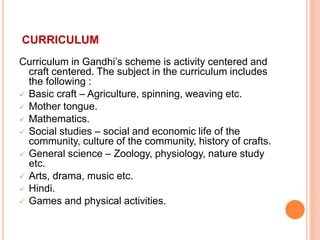
CURRICULUM
Curriculum in Gandhi’s scheme is activity centered and
craft centered. The subject in the curriculum includes
the following :
 Basic craft – Agriculture, spinning, weaving etc.
 Mother tongue.
 Mathematics.
 Social studies – social and economic life of the
community, culture of the community, history of crafts.
 General science – Zoology, physiology, nature study
etc.
 Arts, drama, music etc.
 Hindi.
 Games and physical activities.
REFERENCES
 Philosophical Foundations of Education – DDCE,
Utkal University.
 Philosophical Foundations of Education – Y K
Singh.
 http://assisiaruvithura.blogspot.com

Educational con wps office

  • 1.
    MOUNT TABOR TRAININGCOLLEGE, PATHANAPURAM EDUCATIONAL CONTRIBUTIONS OF MAHATMA GANDHI Submitted to : Dr George Varghese
  • 2.
    MEMBERS  Akhila Prabhakaran Akhila M  Aleena R  Amitha Raghunathan  Anjali Chacko  Arya M S  Arathy V R  Athira Anand  Fathima Shahjahan
  • 3.
    MAHATMA GANDHI (1869-1948) "By education, I meanan all- round drawing of the best in child and man- body, mind and spirit."
  • 4.
    LIFE SKETCH  Bornin 1869 in Gujarat.  Honoured by the people of India as the father of our nation.  A great socio-political reformer.  Apostle of peace and non-violence.  Champion of the freedom movement.  Organized Satyagraha and various other movements.
  • 5.
    CONTD…  He completedhis high school in India.  He studied in a college called Salmdas at Bhavnagar.  He sailed from Bombay to England to study law.  Was a lawyer for much of his early life.  Spent 22 years in South Africa, where he would begin an Indian revolution.
  • 6.
    MAJOR WORKS  Myexperiments with truth (1927).  Satyagraha in South africa (1928).  Hind swaraj (1909).  The Bhagavat Gita (1929).  Non violent Resistance (1951).  Pathway to God(1971).  All men are brothers (1995).
  • 7.
    BASIC EDUCATION  Basiceducation indicates such education which may help an individual to fulfill his basic needs.  It is based on the national culture and civilization of India.  Its main objective is to make a child self-reliant and self-sufficient.  It stands for anew crafts-centered approach full of spirit and self realization which always seeks truth.
  • 8.
    PROPOSALS OF BASICEDUCATION  Free, universal and compulsory education should be provided for all boys and girls between the ages 7-14 years.  Mother tongue of the child should be the medium of instruction.  According to the capacity of the children and the needs of the locality education should be crafts oriented.  Spinning and weaving, card-board and wood work, leather work, kitchen, gardening, agriculture and fishery were suggested as suitable crafts.  The social and scientific implications of the selected crafts must be taught.  Education should develop human values in the child.  Health education for physical fitness and insistence for simple life.  Aimed to achieve the harmonious develpoment of the child's body, mind and soul.
  • 9.
    CURRICULUM Curriculum in Gandhi’sscheme is activity centered and craft centered. The subject in the curriculum includes the following :  Basic craft – Agriculture, spinning, weaving etc.  Mother tongue.  Mathematics.  Social studies – social and economic life of the community, culture of the community, history of crafts.  General science – Zoology, physiology, nature study etc.  Arts, drama, music etc.  Hindi.  Games and physical activities.
  • 10.
    REFERENCES  Philosophical Foundationsof Education – DDCE, Utkal University.  Philosophical Foundations of Education – Y K Singh.  http://assisiaruvithura.blogspot.com