GANDHIJI’S EDUCATIONAL
PHILOSOPHY
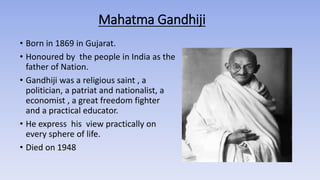
Mahatma Gandhiji
• Born in 1869 in Gujarat.
• Honoured by the people in India as the
father of Nation.
• Gandhiji was a religious saint , a
politician, a patriat and nationalist, a
economist , a great freedom fighter
and a practical educator.
• He express his view practically on
every sphere of life.
• Died on 1948
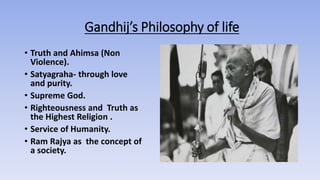
Gandhij’s Philosophy of life
• Truth and Ahimsa (Non
Violence).
• Satyagraha- through love
and purity.
• Supreme God.
• Righteousness and Truth as
the Highest Religion .
• Service of Humanity.
• Ram Rajya as the concept of
a society.
Fundamental principles of Education proposed by
Mahatma Gandhi
• Indian control on Education .
• Fostering of patriotism- it should promote national
consciousness and a love of the motherland.
• No service imitation of the west.
• Domination of English Language.
• Vocational Education to be Emphasized.
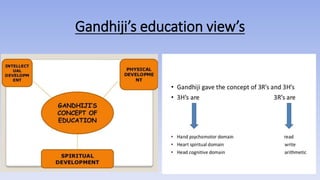
Gandhiji’s education view’s
Aims of Education According to Gandhiji
• All Round development of personality.
• Preparation for Complete Living.
• Training for Citizenship.
• Individual and social aim very important.
• Emphasis on cultural aim.
• The Utilitarian aim- help on self supporting in later life.
• For the preservation of culture.
• Ensure all round development of the child.
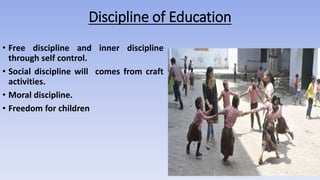
Discipline of Education
• Free discipline and inner discipline
through self control.
• Social discipline will comes from craft
activities.
• Moral discipline.
• Freedom for children
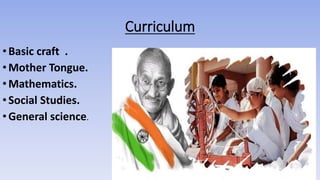
Curriculum
•Basic craft .
•Mother Tongue.
•Mathematics.
•Social Studies.
•General science.
Method of Teaching
• Correlation.
• Learning by doing.
• Learning by Living .
• Lecture questioning and division method.
Role of Teacher
• Should be energetic.
• Should be an example by his attitude and value.
• Should process the qualities he wishes to inculcate in pupils.
• Should be help people to distinguish between true and fals good,
and bad.
• Should provide free and fearless environment.
Basic Education scheme
• Free and compulsory education for all from 7-14 year.
• Craft as the center of Education.
• Self Supporting education.
• Mother Tongue as the medium.
• Ideal of citizenship.
• Co operative living.
• Emphasis on Non Violence.
• No religious education.
Educational implementation of Gandhian
Philosophy
• Free and compulsory education.
• Craft centered Education.
• Self Supporting Elenei.
• Education should be in Mother Tongue.
• Education should be based on Non Violence.
• The basic scheme of Education was practical solution for rural
unemployment.
• Gandhiji succeed in presenting a type of Education which can
provide the necessary economic self sufficiency and self realiance .
Conclusion
Last of all we can said that Gandhiji philosophy of Education still hold a
promise for better tomorrow in the modern scenario of rapid ,
scientific, and technological advancement.
• Reference : Bhatia b.k philosophy of Education.
• Gandhi M.K.Basic education.
• Aggarwal J.c.Education for value,shipra publication.
• Retrieved from “www.mk Gandhi.org.

37

  • 1.
  • 2.
    Mahatma Gandhiji • Bornin 1869 in Gujarat. • Honoured by the people in India as the father of Nation. • Gandhiji was a religious saint , a politician, a patriat and nationalist, a economist , a great freedom fighter and a practical educator. • He express his view practically on every sphere of life. • Died on 1948
  • 3.
    Gandhij’s Philosophy oflife • Truth and Ahimsa (Non Violence). • Satyagraha- through love and purity. • Supreme God. • Righteousness and Truth as the Highest Religion . • Service of Humanity. • Ram Rajya as the concept of a society.
  • 4.
    Fundamental principles ofEducation proposed by Mahatma Gandhi • Indian control on Education . • Fostering of patriotism- it should promote national consciousness and a love of the motherland. • No service imitation of the west. • Domination of English Language. • Vocational Education to be Emphasized.
  • 5.
  • 6.
    Aims of EducationAccording to Gandhiji • All Round development of personality. • Preparation for Complete Living. • Training for Citizenship. • Individual and social aim very important. • Emphasis on cultural aim. • The Utilitarian aim- help on self supporting in later life. • For the preservation of culture. • Ensure all round development of the child.
  • 7.
    Discipline of Education •Free discipline and inner discipline through self control. • Social discipline will comes from craft activities. • Moral discipline. • Freedom for children
  • 8.
    Curriculum •Basic craft . •MotherTongue. •Mathematics. •Social Studies. •General science.
  • 9.
    Method of Teaching •Correlation. • Learning by doing. • Learning by Living . • Lecture questioning and division method.
  • 10.
    Role of Teacher •Should be energetic. • Should be an example by his attitude and value. • Should process the qualities he wishes to inculcate in pupils. • Should be help people to distinguish between true and fals good, and bad. • Should provide free and fearless environment.
  • 11.
    Basic Education scheme •Free and compulsory education for all from 7-14 year. • Craft as the center of Education. • Self Supporting education. • Mother Tongue as the medium. • Ideal of citizenship. • Co operative living. • Emphasis on Non Violence. • No religious education.
  • 12.
    Educational implementation ofGandhian Philosophy • Free and compulsory education. • Craft centered Education. • Self Supporting Elenei. • Education should be in Mother Tongue. • Education should be based on Non Violence. • The basic scheme of Education was practical solution for rural unemployment. • Gandhiji succeed in presenting a type of Education which can provide the necessary economic self sufficiency and self realiance .
  • 13.
    Conclusion Last of allwe can said that Gandhiji philosophy of Education still hold a promise for better tomorrow in the modern scenario of rapid , scientific, and technological advancement. • Reference : Bhatia b.k philosophy of Education. • Gandhi M.K.Basic education. • Aggarwal J.c.Education for value,shipra publication. • Retrieved from “www.mk Gandhi.org.