GAMIFICATION
LET’S PLAY
5 minutes to play the game

Frog Jumping Puzzle

1. http://www.kidsmathgamesonline.com/problemsolving/frogjump.html
or

2. http://www.smart-kit.com/s7284/
GAMIFICATION IN ACTION
Follow the link
http://www.youtube.com/watch?v=2lXh2
n0aPyw
HOW TO WE MOTIVATE PEOPLE TO CHAN GE
THEIR BEHAVIOR
1.Incentives

2.Badges
3.Points
4.Discounts

5.Free Stuff!!
6. Provide things the customers like
Is liking something the same as being motivated by something

Pleasure = Behaviour change
WHAT IS A GAME?
A Game is a system in which players
engage in an abstract challenge
defined by rules interactivity and
feedback, the results in a quantifiable
outcome often eliciting an emotional
reaction.
INTRODUCTION

What is Gamification?
gamification - gam(e) + -ification
applying game-design thinking to non-game
applications to make them more fun and engaging
GAMIFICATION
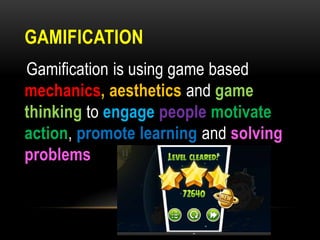
Gamification is using game based
mechanics, aesthetics and game
thinking to engage people motivate
action, promote learning and solving
problems
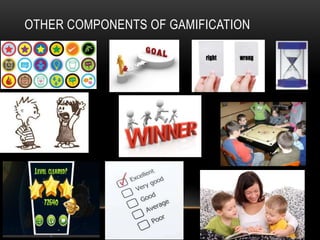
OTHER COMPONENTS OF GAMIFICATION
CURVE OF INTEREST
The interest curve within a game is the flow and the
sequence of events holds and grabs players attention and
extends the concept throughout the entire experience.
Games are designed to take initial interest and rise it to an
other level. When the game is over the learner leaves the
interest with some interest left over and with the knowledge
is gained by the carefully sequenced instruction.
FLOW-BY MIHALY CSIKSZENTMIHALYE
STATE BETWEEN BOREDOM AND ANXIETY
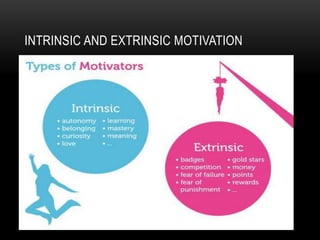
INTRINSIC AND EXTRINSIC MOTIVATION
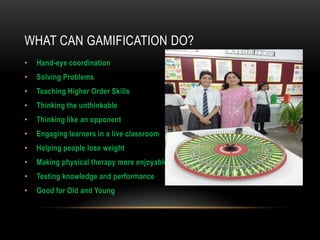
WHAT CAN GAMIFICATION DO?
•

Hand-eye coordination

•

Solving Problems

•

Teaching Higher Order Skills

•

Thinking the unthinkable

•

Thinking like an opponent

•

Engaging learners in a live classroom

•

Helping people lose weight

•

Making physical therapy more enjoyable

•

Testing knowledge and performance

•

Good for Old and Young
APPLYING GAMIFICATION TO LEARNING
DOMAINS
• Declarative Knowledge

• Conceptual Knowledge
• Procedural Knowledge
• Rule-based Knowledge

• Experiencing the concept
• Experience consequences
• Affective Domain

• Psychomotor Domain
GAMIFICATION IN ACTION



53% male and 47% female

women 18 or older represent a greater portion of the gameplaying population (30%) than boys 17 or younger (18%)



average player age is: 30



25% of population is over 50



social games outpace competitive games by 3:1
CONCLUSION

The Mantra

“Have fun while you learn”

Gamification-MTechET by S.P.Vasumathy

  • 1.
  • 2.
    LET’S PLAY 5 minutesto play the game Frog Jumping Puzzle 1. http://www.kidsmathgamesonline.com/problemsolving/frogjump.html or 2. http://www.smart-kit.com/s7284/
  • 3.
    GAMIFICATION IN ACTION Followthe link http://www.youtube.com/watch?v=2lXh2 n0aPyw
  • 4.
    HOW TO WEMOTIVATE PEOPLE TO CHAN GE THEIR BEHAVIOR 1.Incentives 2.Badges 3.Points 4.Discounts 5.Free Stuff!! 6. Provide things the customers like Is liking something the same as being motivated by something Pleasure = Behaviour change
  • 5.
    WHAT IS AGAME? A Game is a system in which players engage in an abstract challenge defined by rules interactivity and feedback, the results in a quantifiable outcome often eliciting an emotional reaction.
  • 6.
    INTRODUCTION What is Gamification? gamification- gam(e) + -ification applying game-design thinking to non-game applications to make them more fun and engaging
  • 7.
    GAMIFICATION Gamification is usinggame based mechanics, aesthetics and game thinking to engage people motivate action, promote learning and solving problems
  • 8.
    OTHER COMPONENTS OFGAMIFICATION
  • 9.
    CURVE OF INTEREST Theinterest curve within a game is the flow and the sequence of events holds and grabs players attention and extends the concept throughout the entire experience. Games are designed to take initial interest and rise it to an other level. When the game is over the learner leaves the interest with some interest left over and with the knowledge is gained by the carefully sequenced instruction.
  • 10.
    FLOW-BY MIHALY CSIKSZENTMIHALYE STATEBETWEEN BOREDOM AND ANXIETY
  • 11.
  • 12.
    WHAT CAN GAMIFICATIONDO? • Hand-eye coordination • Solving Problems • Teaching Higher Order Skills • Thinking the unthinkable • Thinking like an opponent • Engaging learners in a live classroom • Helping people lose weight • Making physical therapy more enjoyable • Testing knowledge and performance • Good for Old and Young
  • 13.
    APPLYING GAMIFICATION TOLEARNING DOMAINS • Declarative Knowledge • Conceptual Knowledge • Procedural Knowledge • Rule-based Knowledge • Experiencing the concept • Experience consequences • Affective Domain • Psychomotor Domain
  • 14.
    GAMIFICATION IN ACTION   53%male and 47% female women 18 or older represent a greater portion of the gameplaying population (30%) than boys 17 or younger (18%)  average player age is: 30  25% of population is over 50  social games outpace competitive games by 3:1
  • 15.