White Paper by Rohan Agnihotry
Today, we see a lot of hullaballoo around Gamification.
Enterprises around the world have realized the power
of gamification and it's widely being adopted to
improve business outcomes at various levels.
According to Forbes-The overall market for
gamification tools, services and applications is
projected to be $5.5 billion by 2018. Gartner reported
that 70 Percent of Global 2000 Organizations will have
at least One Gamified Application by 2014. While
Gamification is certainly a powerful concept the
effective implementation of game elements in a non-
game context is acid test for any organization.
This whitepaper will help readers to understand
gamification, game elements and benefits of
gamification for the Enterprise through use case.
What is Gamification?
The term "gamification" was coined in 2002 by Nick
Pelling, a British-born computer programmer and
inventor. As defined by Gartner “Gamification is the
use of game design and game mechanics to engage a
target audience to change behaviors, learn new skills
or engage in innovation.” The target audience may
be customers, employees or the general public, but
first and foremost, they are people with needs and
desires who will respond to stimuli.
If we simplify this Gamification means use of game
elements and game design techniques in non-game
context. Now let's understand the definition by its
components:-
 Game mechanics describes use of game elements
such as points, badges and leaderboards that are
common to many games.
 Game Design describes the journey players take
with elements such as game play, play space and
story line.
The goal of gamification is to motivate people to
Introduction
change behaviors or develop skills, or to drive
innovation and when organization goals are aligned
with players' goal, the organization achieves
its goals as a consequence of players achieving
their goals.
Is Play vs. Game same or
different?
It is important to distinguish the concept of play &
game as both of them are important for doing
effective gamification.
Play as described by American thinker George
Santayana “Play is whatever done spontaneously
and for its own sake” i.e. Play is freedom and you are
free to do whatever you want under some structure
which is either virtually exists or defined by the rules.
While Game as defined by Tracy Fullerton & his team
“A game is a closed, formal system that engages
players in a structured conflict, and resolves in an
unequal outcomes” i.e. Game is a path where you
are free to choose a path which will lead to a
meaningful outcome.
So, why GAMIFY?
Gamification is near the peak of Gartner hype cycle
but do we really require gamification in some
serious business environment or it's just a fancy
term businesses are adopting as a part of the
branding strategy.
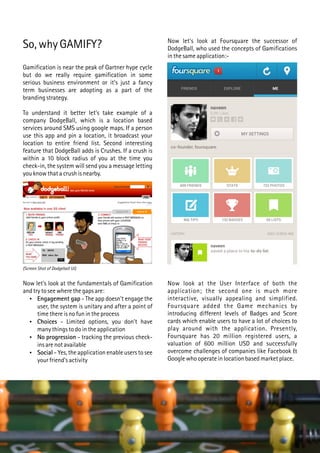
To understand it better let's take example of a
company DodgeBall, which is a location based
services around SMS using google maps. If a person
use this app and pin a location, it broadcast your
location to entire friend list. Second interesting
feature that DodgeBall adds is Crushes. If a crush is
within a 10 block radius of you at the time you
check-in, the system will send you a message letting
you know that a crush is nearby.
Now let's look at the fundamentals of Gamification
and try to see where the gaps are:
 Engagement gap - The app doesn't engage the
user, the system is unitary and after a point of
time there is no fun in the process
 Choices - Limited options, you don't have
many things to do in the application
 No progression - tracking the previous check-
ins are not available
 Social - Yes, the application enable users to see
your friend's activity
(Screen Shot of Dodgeball UI)
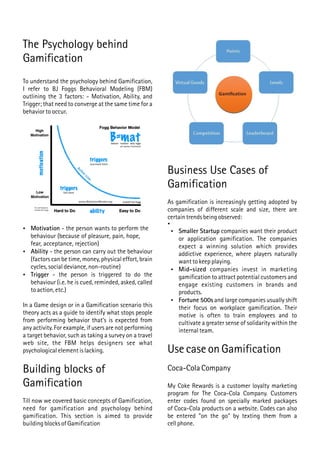
Now let's look at Foursquare the successor of
DodgeBall, who used the concepts of Gamifications
in the same application:-
Now look at the User Interface of both the
application; the second one is much more
interactive, visually appealing and simplified.
Foursquare added the Game mechanics by
introducing different levels of Badges and Score
cards which enable users to have a lot of choices to
play around with the application. Presently,
Foursquare has 20 million registered users, a
valuation of 600 million USD and successfully
overcome challenges of companies like Facebook &
Google who operate in location based market place.
The Psychology behind
Gamification
To understand the psychology behind Gamification,
I refer to BJ Foggs Behavioral Modeling (FBM)
outlining the 3 factors: - Motivation, Ability, and
Trigger; that need to converge at the same time for a
behavior to occur.
 Motivation - the person wants to perform the
behaviour (because of pleasure, pain, hope,
fear, acceptance, rejection)
 Ability - the person can carry out the behaviour
(factors can be time, money, physical effort, brain
cycles, social deviance, non-routine)
 Trigger - the person is triggered to do the
behaviour (i.e. he is cued, reminded, asked, called
to action, etc.)
In a Game design or in a Gamification scenario this
theory acts as a guide to identify what stops people
from performing behavior that's is expected from
any activity. For example, if users are not performing
a target behavior, such as taking a survey on a travel
web site, the FBM helps designers see what
psychological element is lacking.
Building blocks of
Gamification
Till now we covered basic concepts of Gamification,
need for gamification and psychology behind
gamification. This section is aimed to provide
building blocks of Gamification
Business Use Cases of
Gamification
As gamification is increasingly getting adopted by
companies of different scale and size, there are
certain trends being observed:

 Smaller Startup companies want their product
or application gamification. The companies
expect a winning solution which provides
addictive experience, where players naturally
want to keep playing.
 Mid-sized companies invest in marketing
gamification to attract potential customers and
engage existing customers in brands and
products.
 Fortune 500s and large companies usually shift
their focus on workplace gamification. Their
motive is often to train employees and to
cultivate a greater sense of solidarity within the
internal team.
Use case on Gamification
Coca-Cola Company
My Coke Rewards is a customer loyalty marketing
program for The Coca-Cola Company. Customers
enter codes found on specially marked packages
of Coca-Cola products on a website. Codes can also
be entered "on the go" by texting them from a
cell phone.
Coke used gamification as a powerful tool to change
its loyalty program from a transactional activity to
one that was inherently personal, social, and
engaging, and would help the brand connect with
new, younger consumers at scale. Presently
company has 20 million lifetime members in its My
Coke reward point.
Siemens Plantville
Siemens Industry, Inc. recently launched Plantville, a
new online gaming platform that simulates the
experience of being a plant manager. Players are
faced with the challenge of maintaining the
operation of their plant while trying to improve the
productivity, efficiency, sustainability and overall
health of their facility.
Plantville is an innovative, educational and fun way
for Siemens to engage customers, employees,
prospects, students and the general public while
driving awareness of Siemens technologies
and brand.
Gamification is being widely adopted across
organization at different levels and the process is
adding value but now is the time to understand and
evaluate this important trend. According to the
Gartner Inc. “80 percent of current gamified
applications will fail to meet business objectives
primarily because of poor design”.
“The challenge facing project managers and
sponsors responsible for gamification initiatives
is the lack of game design talent to apply to
gamification projects,” said Brian Burke, research
vice president at Gartner. “Poor game design is
one of the key failings of many gamified
applications today.”
It's advisable for the companies to first identify what
exactly is the business problem and then work out
on the game design rather being carried away by the
fun element or engagement.
“Everybody raise your hand. Now raise it a little
higher. Take that same idea and wrap it around a
sales behavior, service behavior, whatever it may be,
and that's the idea [of gamification] right there.” –
Bob Marsh, CEO, LevelEleven
I would like to acknowledge Brunchball, for their
outstanding work in this area and the Coursera
course of Professor Kevin Werbach, University of
Pennsylvania. They lead the game in Gamification.
Sources:-
 Behavior Model.Org
 Coursera Gamification Lecture
 Bunchball.com
 Plantengineering.com
 BunchBall.com - CocaCola
 Forbes.com
The Gamification market is estimated to grow from $
421.3 million in 2013 to $5.502 billion in 2018. This
represents a compound annual growth rate (CAGR) of
67.1% from 2013 to 2018.
In the current scenario, the ‘consumer goods and retail’
vertical continues to be the largest adopter of
gamification solutions. In terms of regions, North
America is expected to be the biggest market, followed
by Europe and Asia-Pacific.
MarketsandMarkets
Office
Bangalore: 389, 2nd Floor, 9th Main, HSR Layout, Sector – 7, Bangalore – 560 102
Phone: +91-80-42102154
US: 1013 Centre Road, ST # 403S, Wilmington, New Castle, DE 19805
Phone: +1 858 312 1075
www.bridgei2i.com enquiries@bridgei2i.com|
Facebook | Twitter | Google+ | LinkedIn: BRIDGEi2i
About BRIDGEi2i
BRIDGEi2i provides Business Analytics Solutions to enterprises globally, enabling them to achieve
accelerated business impact harnessing the power of data. These analytics services and technology solutions
enable business managers to consume more meaningful information from big data, generate actionable
insights from complex business problems and make data driven decisions across pan-enterprise processes to
create sustainable business impact. BRIDGEi2i has featured among the top 10 analytics and big data start-
ups in several coveted publications.

Whitepaper - Understanding Gamification

  • 1.
    White Paper byRohan Agnihotry
  • 2.
    Today, we seea lot of hullaballoo around Gamification. Enterprises around the world have realized the power of gamification and it's widely being adopted to improve business outcomes at various levels. According to Forbes-The overall market for gamification tools, services and applications is projected to be $5.5 billion by 2018. Gartner reported that 70 Percent of Global 2000 Organizations will have at least One Gamified Application by 2014. While Gamification is certainly a powerful concept the effective implementation of game elements in a non- game context is acid test for any organization. This whitepaper will help readers to understand gamification, game elements and benefits of gamification for the Enterprise through use case. What is Gamification? The term "gamification" was coined in 2002 by Nick Pelling, a British-born computer programmer and inventor. As defined by Gartner “Gamification is the use of game design and game mechanics to engage a target audience to change behaviors, learn new skills or engage in innovation.” The target audience may be customers, employees or the general public, but first and foremost, they are people with needs and desires who will respond to stimuli. If we simplify this Gamification means use of game elements and game design techniques in non-game context. Now let's understand the definition by its components:-  Game mechanics describes use of game elements such as points, badges and leaderboards that are common to many games.  Game Design describes the journey players take with elements such as game play, play space and story line. The goal of gamification is to motivate people to Introduction change behaviors or develop skills, or to drive innovation and when organization goals are aligned with players' goal, the organization achieves its goals as a consequence of players achieving their goals. Is Play vs. Game same or different? It is important to distinguish the concept of play & game as both of them are important for doing effective gamification. Play as described by American thinker George Santayana “Play is whatever done spontaneously and for its own sake” i.e. Play is freedom and you are free to do whatever you want under some structure which is either virtually exists or defined by the rules. While Game as defined by Tracy Fullerton & his team “A game is a closed, formal system that engages players in a structured conflict, and resolves in an unequal outcomes” i.e. Game is a path where you are free to choose a path which will lead to a meaningful outcome.
  • 3.
    So, why GAMIFY? Gamificationis near the peak of Gartner hype cycle but do we really require gamification in some serious business environment or it's just a fancy term businesses are adopting as a part of the branding strategy. To understand it better let's take example of a company DodgeBall, which is a location based services around SMS using google maps. If a person use this app and pin a location, it broadcast your location to entire friend list. Second interesting feature that DodgeBall adds is Crushes. If a crush is within a 10 block radius of you at the time you check-in, the system will send you a message letting you know that a crush is nearby. Now let's look at the fundamentals of Gamification and try to see where the gaps are:  Engagement gap - The app doesn't engage the user, the system is unitary and after a point of time there is no fun in the process  Choices - Limited options, you don't have many things to do in the application  No progression - tracking the previous check- ins are not available  Social - Yes, the application enable users to see your friend's activity (Screen Shot of Dodgeball UI) Now let's look at Foursquare the successor of DodgeBall, who used the concepts of Gamifications in the same application:- Now look at the User Interface of both the application; the second one is much more interactive, visually appealing and simplified. Foursquare added the Game mechanics by introducing different levels of Badges and Score cards which enable users to have a lot of choices to play around with the application. Presently, Foursquare has 20 million registered users, a valuation of 600 million USD and successfully overcome challenges of companies like Facebook & Google who operate in location based market place.
  • 4.
    The Psychology behind Gamification Tounderstand the psychology behind Gamification, I refer to BJ Foggs Behavioral Modeling (FBM) outlining the 3 factors: - Motivation, Ability, and Trigger; that need to converge at the same time for a behavior to occur.  Motivation - the person wants to perform the behaviour (because of pleasure, pain, hope, fear, acceptance, rejection)  Ability - the person can carry out the behaviour (factors can be time, money, physical effort, brain cycles, social deviance, non-routine)  Trigger - the person is triggered to do the behaviour (i.e. he is cued, reminded, asked, called to action, etc.) In a Game design or in a Gamification scenario this theory acts as a guide to identify what stops people from performing behavior that's is expected from any activity. For example, if users are not performing a target behavior, such as taking a survey on a travel web site, the FBM helps designers see what psychological element is lacking. Building blocks of Gamification Till now we covered basic concepts of Gamification, need for gamification and psychology behind gamification. This section is aimed to provide building blocks of Gamification Business Use Cases of Gamification As gamification is increasingly getting adopted by companies of different scale and size, there are certain trends being observed:   Smaller Startup companies want their product or application gamification. The companies expect a winning solution which provides addictive experience, where players naturally want to keep playing.  Mid-sized companies invest in marketing gamification to attract potential customers and engage existing customers in brands and products.  Fortune 500s and large companies usually shift their focus on workplace gamification. Their motive is often to train employees and to cultivate a greater sense of solidarity within the internal team. Use case on Gamification Coca-Cola Company My Coke Rewards is a customer loyalty marketing program for The Coca-Cola Company. Customers enter codes found on specially marked packages of Coca-Cola products on a website. Codes can also be entered "on the go" by texting them from a cell phone.
  • 5.
    Coke used gamificationas a powerful tool to change its loyalty program from a transactional activity to one that was inherently personal, social, and engaging, and would help the brand connect with new, younger consumers at scale. Presently company has 20 million lifetime members in its My Coke reward point. Siemens Plantville Siemens Industry, Inc. recently launched Plantville, a new online gaming platform that simulates the experience of being a plant manager. Players are faced with the challenge of maintaining the operation of their plant while trying to improve the productivity, efficiency, sustainability and overall health of their facility. Plantville is an innovative, educational and fun way for Siemens to engage customers, employees, prospects, students and the general public while driving awareness of Siemens technologies and brand. Gamification is being widely adopted across organization at different levels and the process is adding value but now is the time to understand and evaluate this important trend. According to the Gartner Inc. “80 percent of current gamified applications will fail to meet business objectives primarily because of poor design”. “The challenge facing project managers and sponsors responsible for gamification initiatives is the lack of game design talent to apply to gamification projects,” said Brian Burke, research vice president at Gartner. “Poor game design is one of the key failings of many gamified applications today.” It's advisable for the companies to first identify what exactly is the business problem and then work out on the game design rather being carried away by the fun element or engagement. “Everybody raise your hand. Now raise it a little higher. Take that same idea and wrap it around a sales behavior, service behavior, whatever it may be, and that's the idea [of gamification] right there.” – Bob Marsh, CEO, LevelEleven I would like to acknowledge Brunchball, for their outstanding work in this area and the Coursera course of Professor Kevin Werbach, University of Pennsylvania. They lead the game in Gamification. Sources:-  Behavior Model.Org  Coursera Gamification Lecture  Bunchball.com  Plantengineering.com  BunchBall.com - CocaCola  Forbes.com The Gamification market is estimated to grow from $ 421.3 million in 2013 to $5.502 billion in 2018. This represents a compound annual growth rate (CAGR) of 67.1% from 2013 to 2018. In the current scenario, the ‘consumer goods and retail’ vertical continues to be the largest adopter of gamification solutions. In terms of regions, North America is expected to be the biggest market, followed by Europe and Asia-Pacific. MarketsandMarkets
  • 6.
    Office Bangalore: 389, 2ndFloor, 9th Main, HSR Layout, Sector – 7, Bangalore – 560 102 Phone: +91-80-42102154 US: 1013 Centre Road, ST # 403S, Wilmington, New Castle, DE 19805 Phone: +1 858 312 1075 www.bridgei2i.com enquiries@bridgei2i.com| Facebook | Twitter | Google+ | LinkedIn: BRIDGEi2i About BRIDGEi2i BRIDGEi2i provides Business Analytics Solutions to enterprises globally, enabling them to achieve accelerated business impact harnessing the power of data. These analytics services and technology solutions enable business managers to consume more meaningful information from big data, generate actionable insights from complex business problems and make data driven decisions across pan-enterprise processes to create sustainable business impact. BRIDGEi2i has featured among the top 10 analytics and big data start- ups in several coveted publications.