A Case Study in
Demand-Supply
Interlock
The largest Contract Manufacturer in
the world
Quick Context
Objective
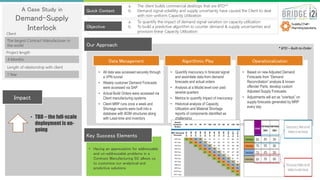
a. The client builds commercial desktops that are BTO**
b. Demand signal volatility and supply uncertainty have caused the Client to deal
with non-uniform Capacity Utilization
• TBD – the full-scale
deployment is on-
going
Impact
• Having an appreciation for addressable
and un-addressable problems in a
Contract Manufacturing SC allows us
to customize our analytical and
predictive solutions
Key Success Elements
Our Approach
4 Months
1 Year
Client
Project length
Length of relationship with client
• All data was accessed securely through
a VPN tunnel
• Weekly customer Demand Forecasts
were accessed via SAP
• Actual Build Orders were accessed via
Client manufacturing systems
• Client MRP runs once a week and
Shortage reports were built into a
database with BOM structures along
with Lead-time and inventory
• Quantify inaccuracy in forecast signal
and assimilate data from demand
forecasts and actual orders
• Analysis at a Model level over past
several quarters
• Metrics to quantify impact of inaccuracy
• Historical analysis of Capacity
Utilization and Material Shortage
reports of components identified as
challenging
• Based on new Adjusted Demand
Forecasts from “Demand
Reconciliation” analysis & known
offender Parts, develop custom
Adjusted Supply Forecasts
• Adjustments will act as “overlays” on
supply forecasts generated by MRP
every day
Data Management Algorithmic Play Operationalization
a. To quantify the impact of demand signal variation on capacity utilization
b. To build a predictive algorithm to counter demand & supply uncertainties and
provision linear Capacity Utilization
* BTO – Built-to-Order

Demand - Supply Interlock (Largest Contract Manufacturer)

  • 1.
    A Case Studyin Demand-Supply Interlock The largest Contract Manufacturer in the world Quick Context Objective a. The client builds commercial desktops that are BTO** b. Demand signal volatility and supply uncertainty have caused the Client to deal with non-uniform Capacity Utilization • TBD – the full-scale deployment is on- going Impact • Having an appreciation for addressable and un-addressable problems in a Contract Manufacturing SC allows us to customize our analytical and predictive solutions Key Success Elements Our Approach 4 Months 1 Year Client Project length Length of relationship with client • All data was accessed securely through a VPN tunnel • Weekly customer Demand Forecasts were accessed via SAP • Actual Build Orders were accessed via Client manufacturing systems • Client MRP runs once a week and Shortage reports were built into a database with BOM structures along with Lead-time and inventory • Quantify inaccuracy in forecast signal and assimilate data from demand forecasts and actual orders • Analysis at a Model level over past several quarters • Metrics to quantify impact of inaccuracy • Historical analysis of Capacity Utilization and Material Shortage reports of components identified as challenging • Based on new Adjusted Demand Forecasts from “Demand Reconciliation” analysis & known offender Parts, develop custom Adjusted Supply Forecasts • Adjustments will act as “overlays” on supply forecasts generated by MRP every day Data Management Algorithmic Play Operationalization a. To quantify the impact of demand signal variation on capacity utilization b. To build a predictive algorithm to counter demand & supply uncertainties and provision linear Capacity Utilization * BTO – Built-to-Order