Jose A. Briones, Ph.D.
C-Level Advisors
Twitter: @Brioneja
AIPMM Webinar
March 28, 2014
Outline
 Many people hear about gamification and think that it
is not applicable to their work since they do not work
in the gaming industry.
 However, companies like Dropbox and other have
proven that gamification is applicable to any
industry, product or service.
 This session will discuss how to use gamification in
your company to generate ideas, improve product
design and increase sales.
 Recent examples of successful gamification
concepts will be shown.
www.Brioneja.com
Twitter: @Brioneja
What is Gamification?
 Gamification, or the use of game elements to
promote desired behaviors among customers and
employees, has been a popular business strategy
for decades.
 The always-on mobile age and integration with
social networks has vastly expanded opportunities
for gamification.
 Gamification is design that places the most
emphasis on human motivation in the process. In
essence, it is Human-Focused Design (as opposed
to “function-focused design”).
www.Brioneja.com
Twitter: @Brioneja
Market Size
 Market research firms MarketandMarkets
and M2, estimate the global market for
gamification apps and services in between
$400 & $500 million by the end of 2013.
 M2 Research projects the market to grow to
$2.8 billion by 2016.
 An assessment by Gartner estimates that more
than 70% of Global 2000 companies will use at
least one gamified application by 2014.
www.Brioneja.com
Twitter: @Brioneja
Market Trends
 IEEE Experts Predict Gaming Will Be
Integrated Into More than 85 Percent of
Daily Tasks by 2020
 Industries like healthcare, business and
education will be integrating gaming
elements into standard tasks and
activities, making us all gamers.
 People will accrue points for regular tasks
and each person’s point cache will
influence their position in society, and
compliment their monetary wealth.
www.Brioneja.com
Twitter: @Brioneja
Market Trends
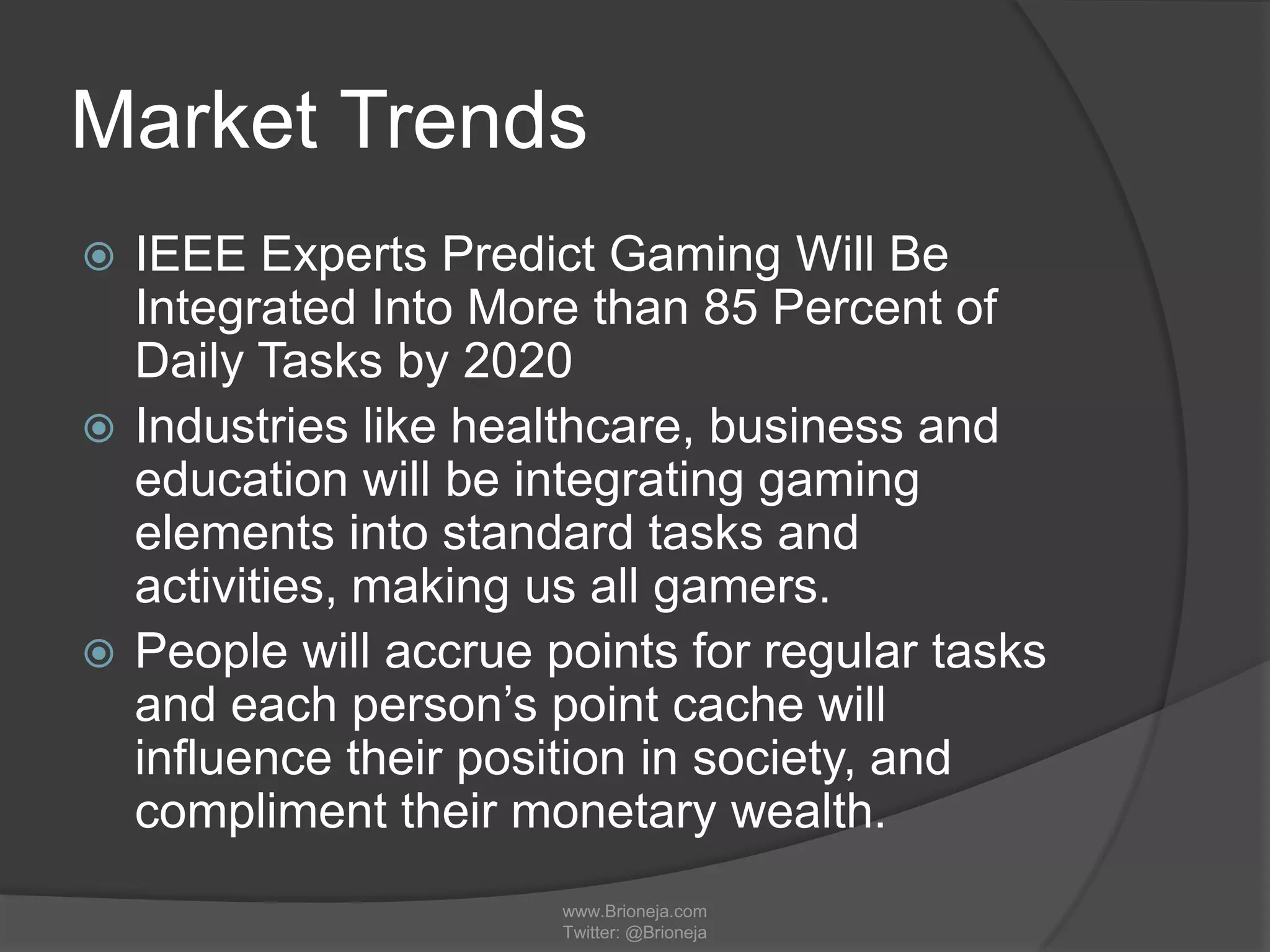
 Gamification represents the intersection of
4 megatrends:
 The explosion of social media usage,
 The mobile revolution,
 The rise of big data
 The emergence of wearable computing.
 Marketers, enterprises & governments are
using gamification to achieve and expand
their goals.
www.Brioneja.com
Twitter: @Brioneja
History
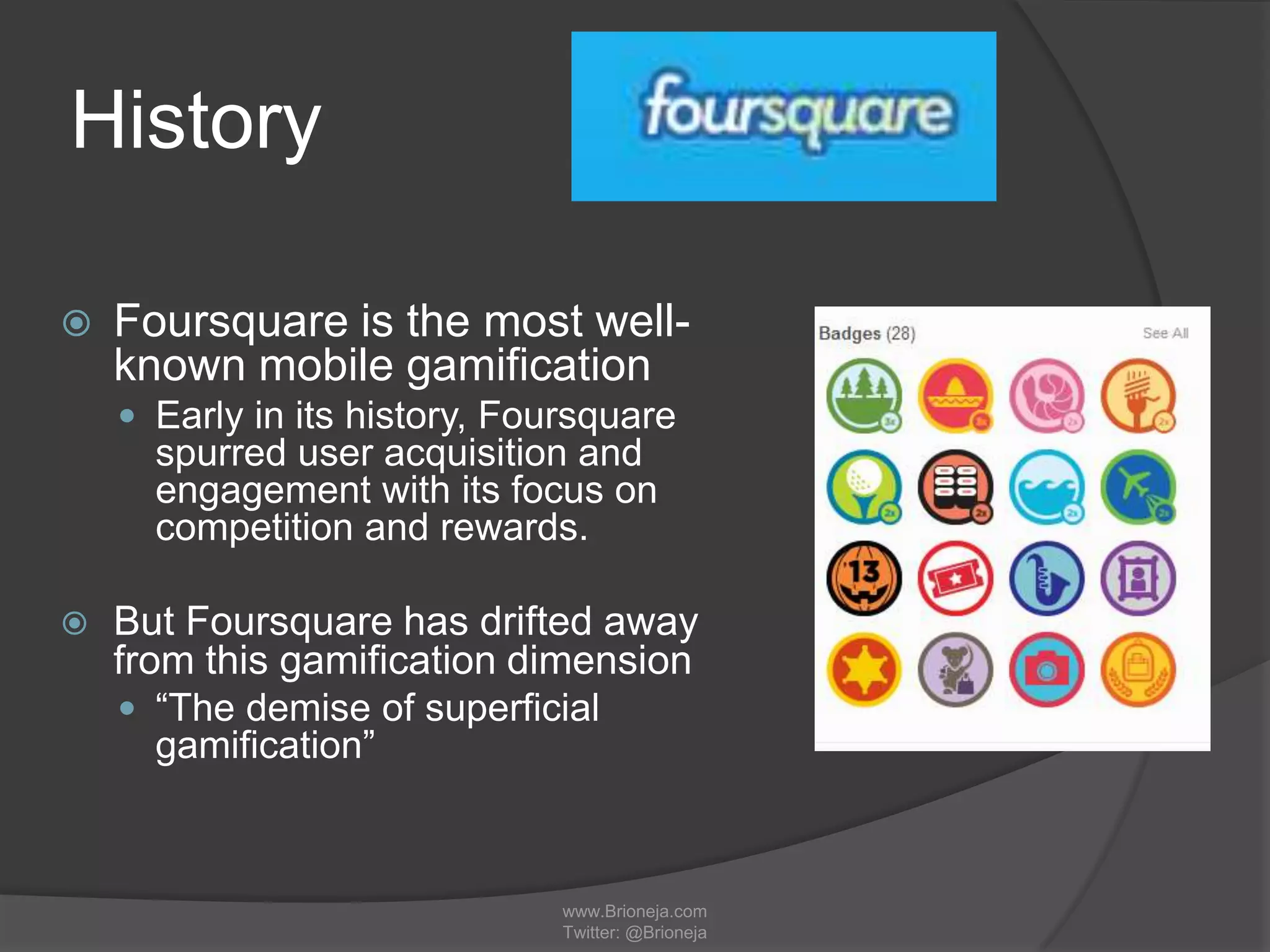
 Foursquare is the most well-
known mobile gamification
 Early in its history, Foursquare
spurred user acquisition and
engagement with its focus on
competition and rewards.
 But Foursquare has drifted away
from this gamification dimension
 “The demise of superficial
gamification”
www.Brioneja.com
Twitter: @Brioneja
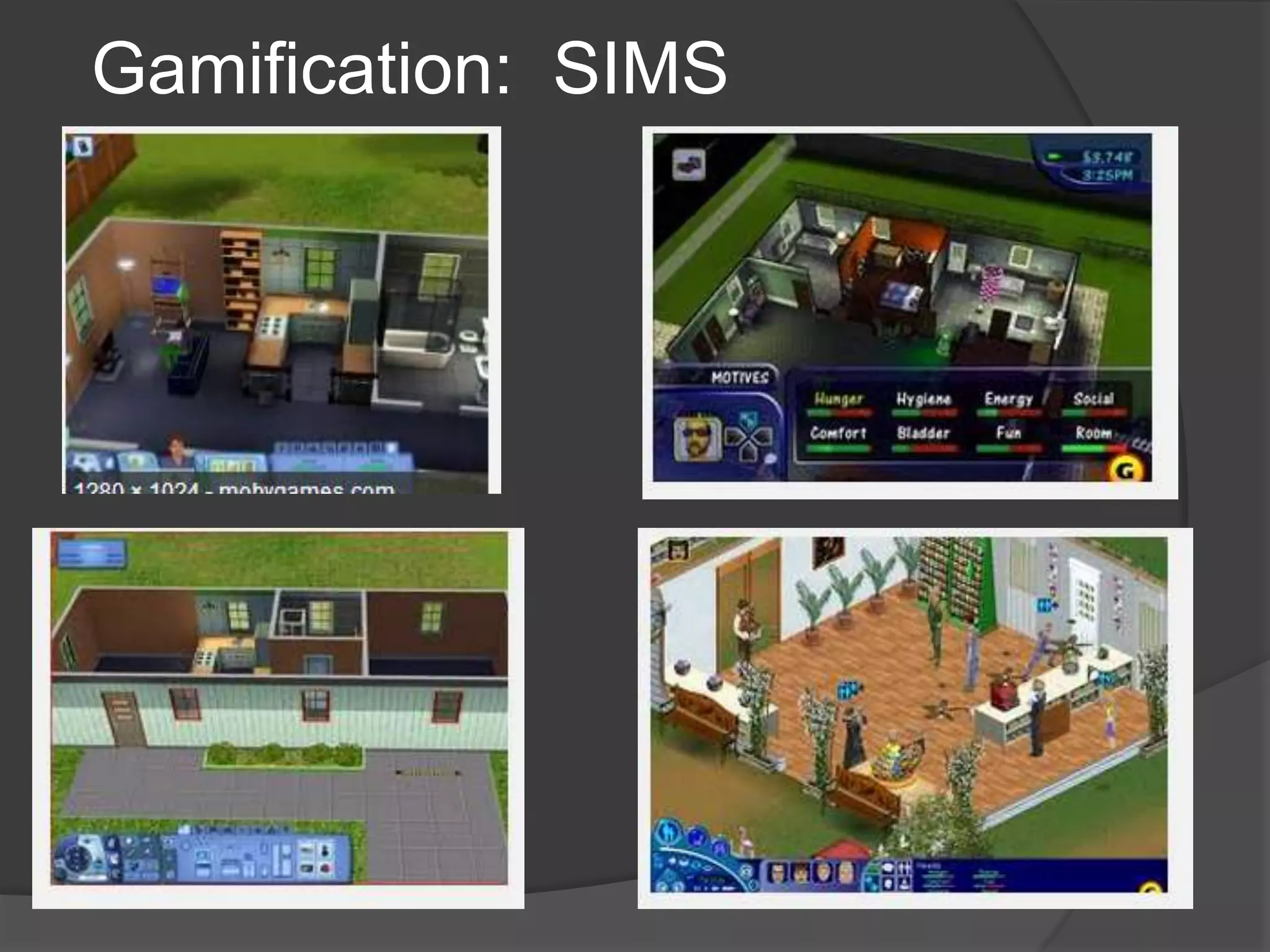
Gamification: SIMS
Dropbox
Dropbox History
 Dropbox was the first to perfect cloud storage for
consumers and reaped the benefits – user numbers
leapt from 5m in 2010 to 25m in 2011, reaching
100m last year and 175m today.
 Over $500 million in revenues
 96% of its customers use the service free
 $125/paid customer/yr.
 A 2012 US survey by Forrester Research found that
14% of online adults had used back-up or storage
services, with Dropbox the most popular claiming
more than 25% of the market, followed closely by
Apple’s iCloud.
 Claims a presence in more than 2 million businesses,
including 95 percent of the Fortune 500.
 Dropbox raised $250 million at a $4 billion valuation from
investors including Index Ventures, Sequoia, Greylock,
Benchmark, and Accel, among others
www.Brioneja.com
Twitter: @Brioneja
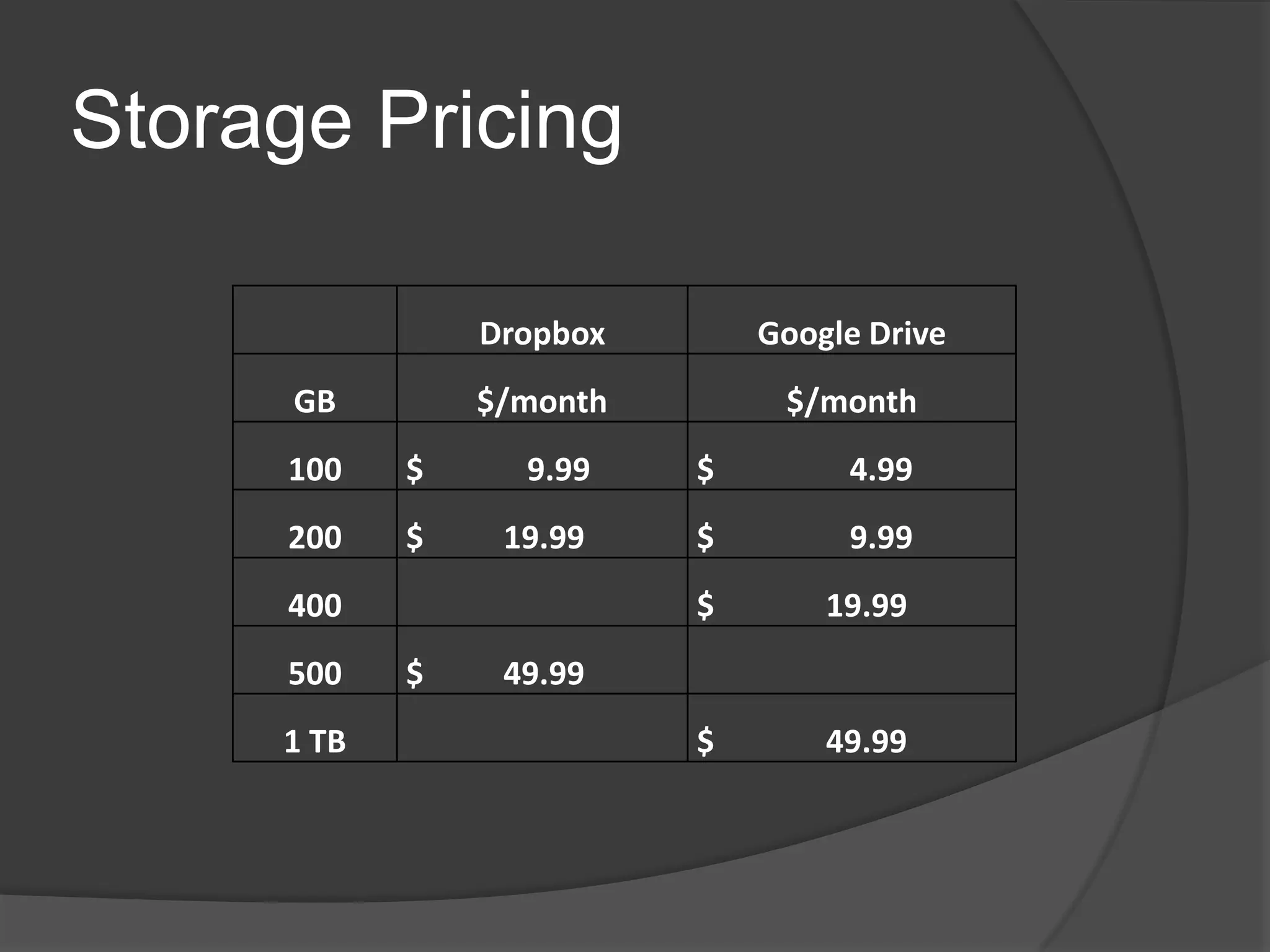
Storage Pricing
Dropbox Google Drive
GB $/month $/month
100 $ 9.99 $ 4.99
200 $ 19.99 $ 9.99
400 $ 19.99
500 $ 49.99
1 TB $ 49.99
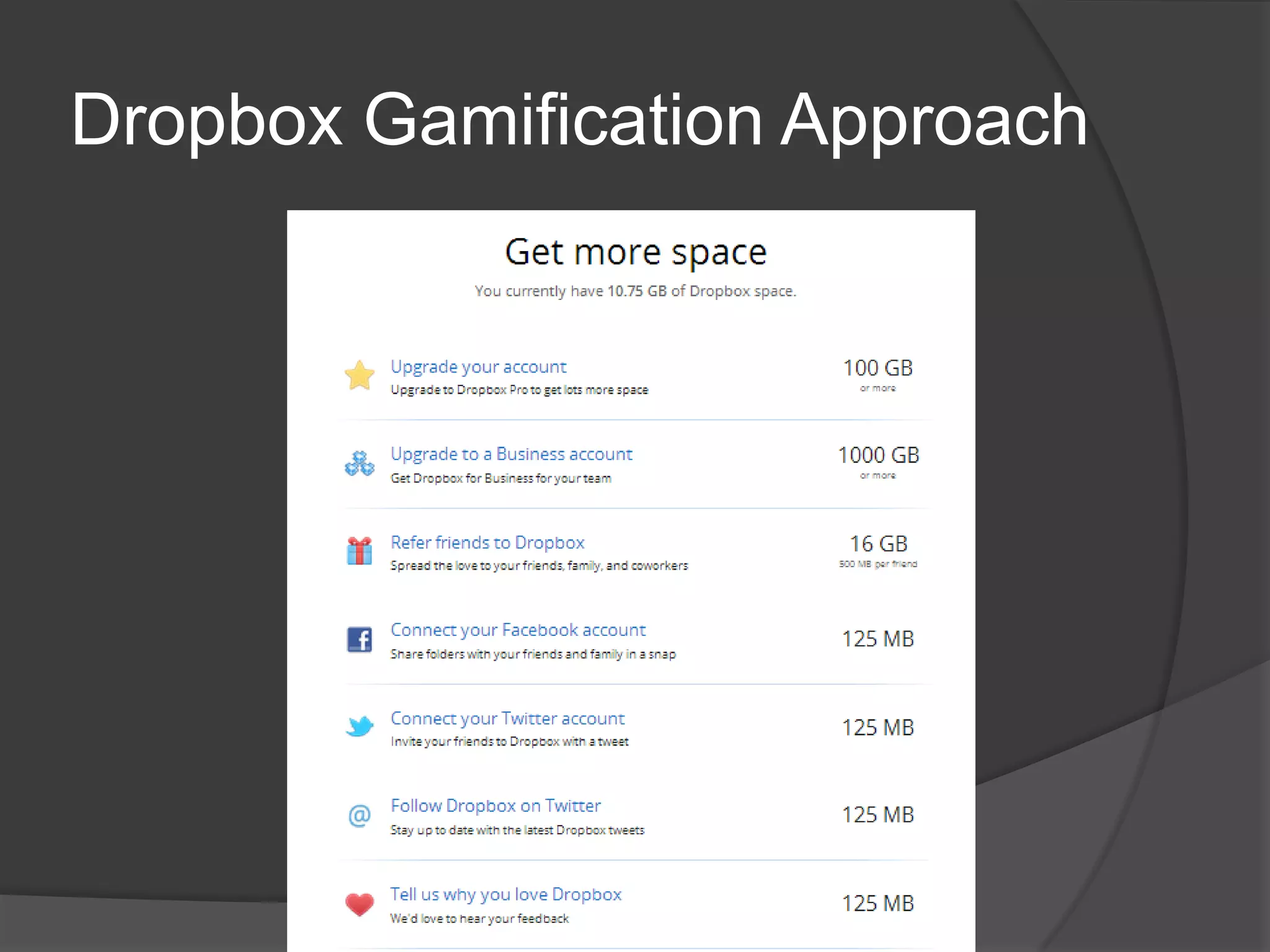
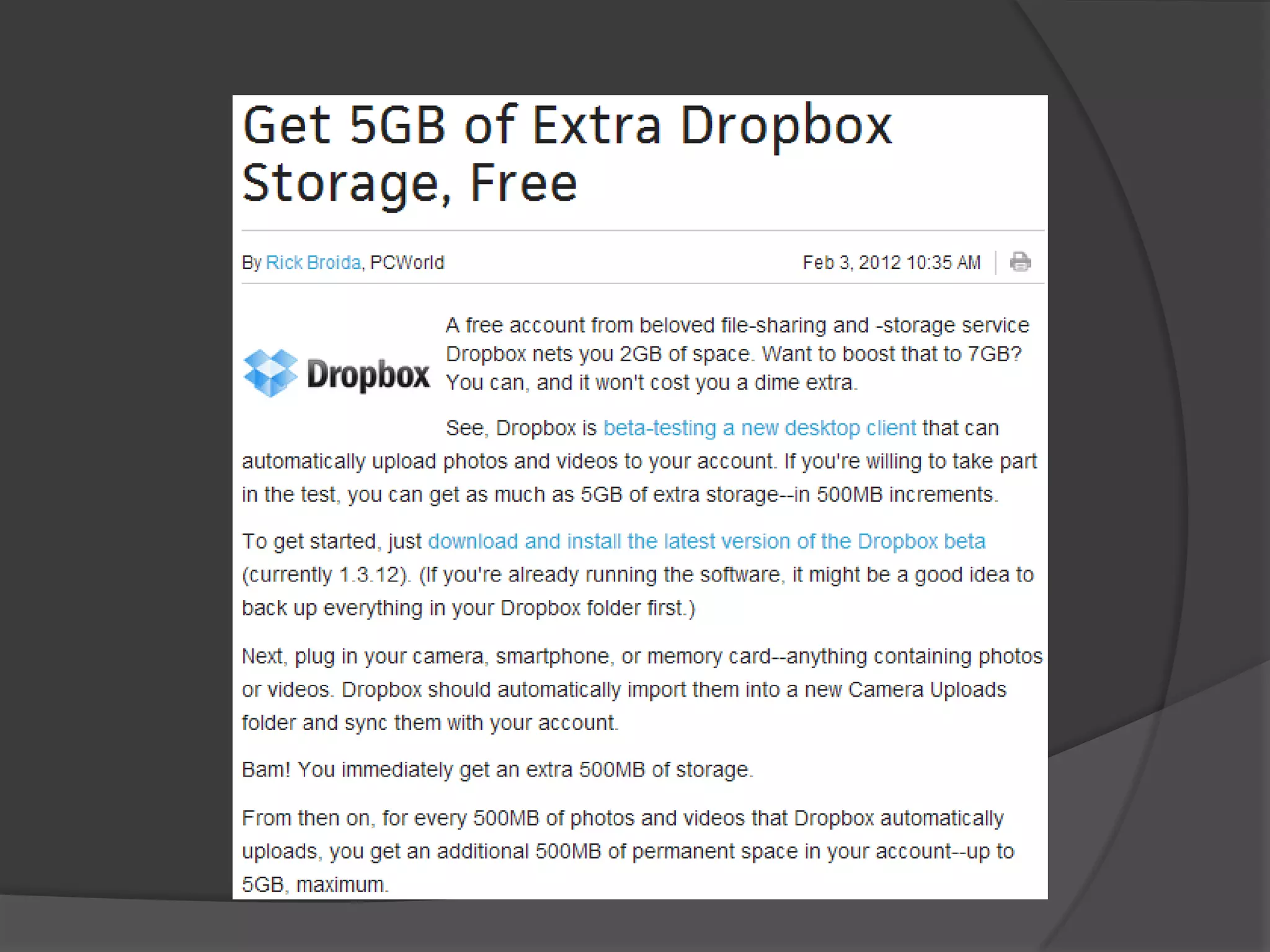
Dropbox Gamification Approach
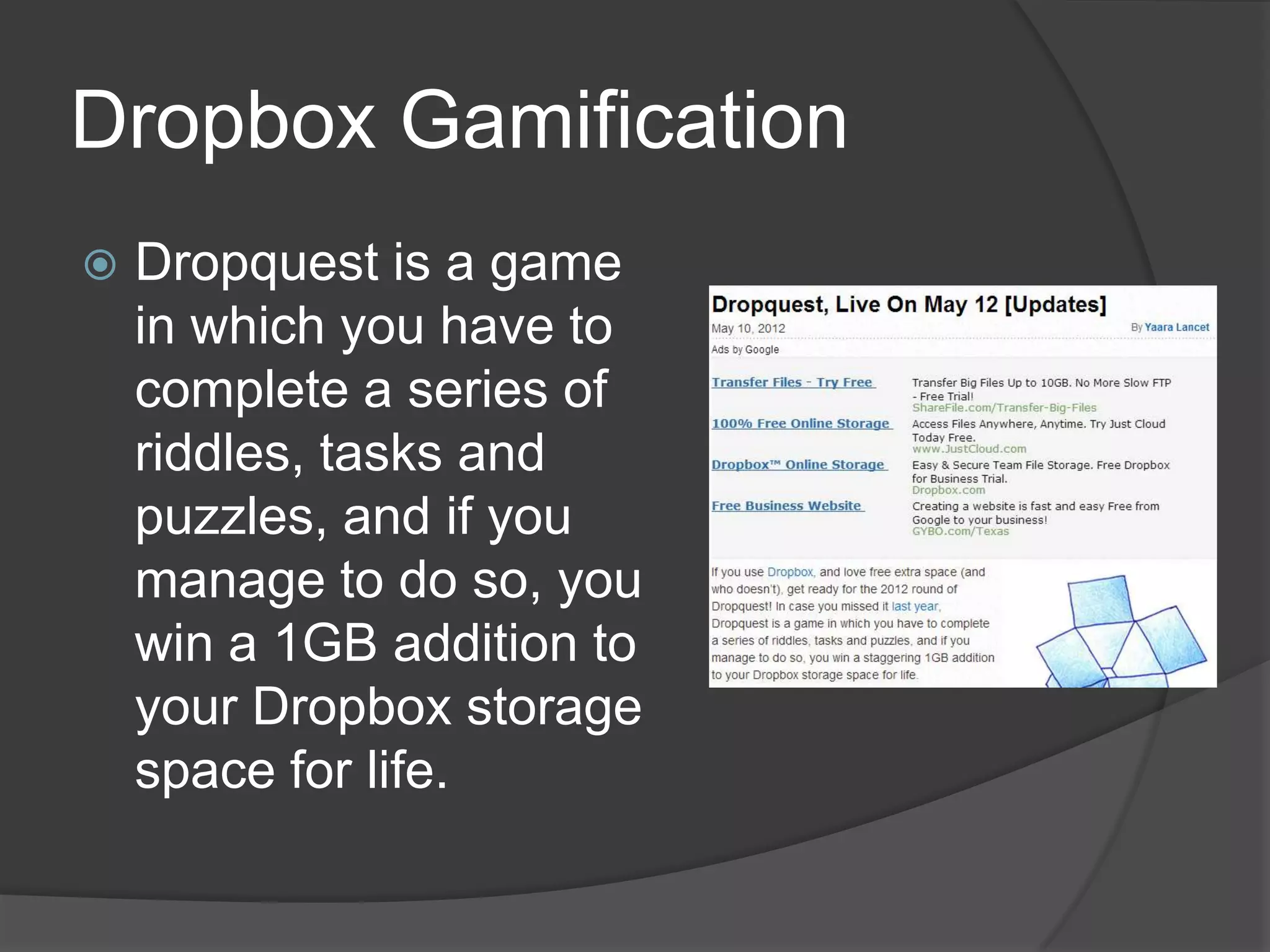
Dropbox Gamification
 Dropquest is a game
in which you have to
complete a series of
riddles, tasks and
puzzles, and if you
manage to do so, you
win a 1GB addition to
your Dropbox storage
space for life.
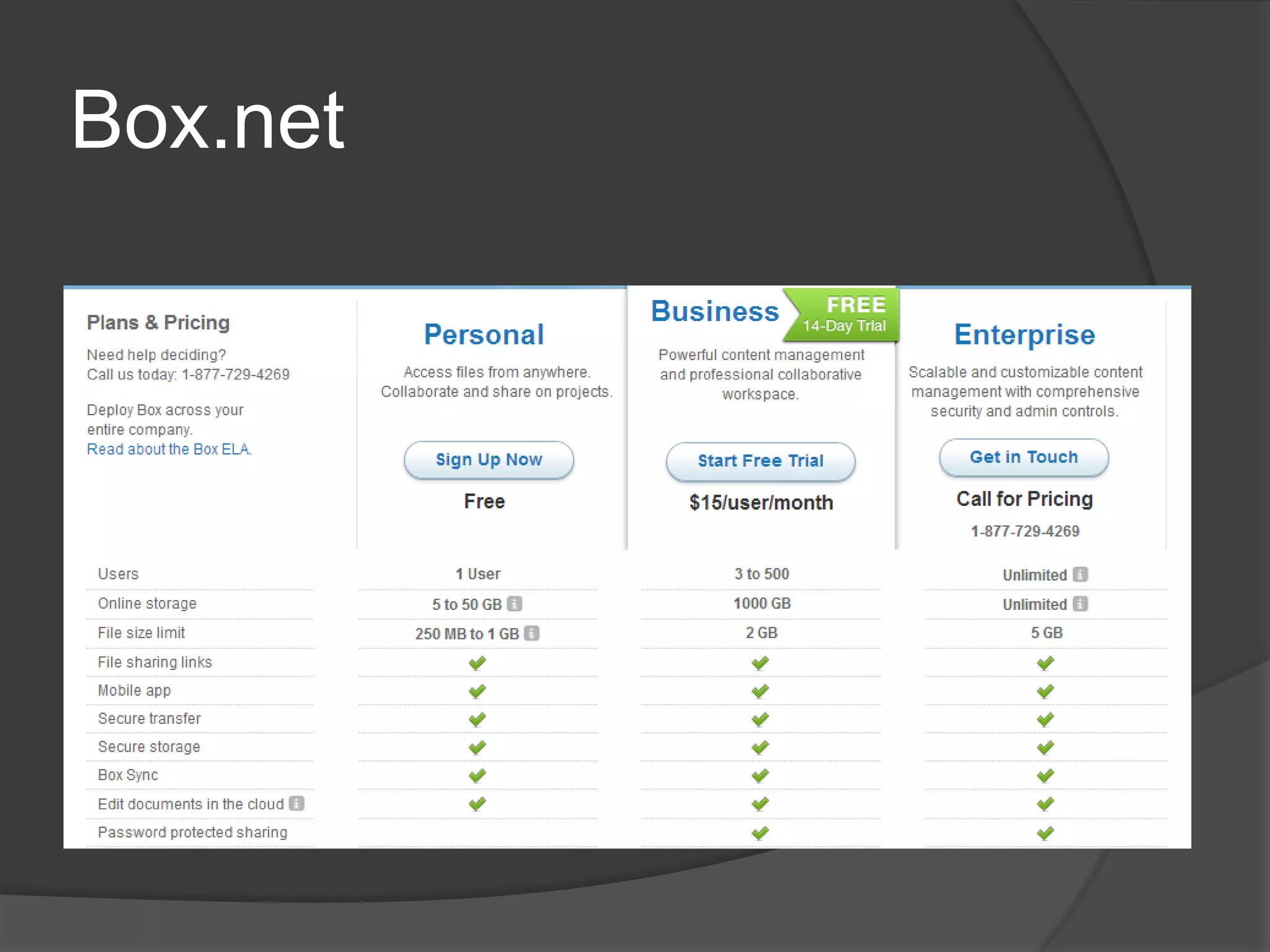
Box.net
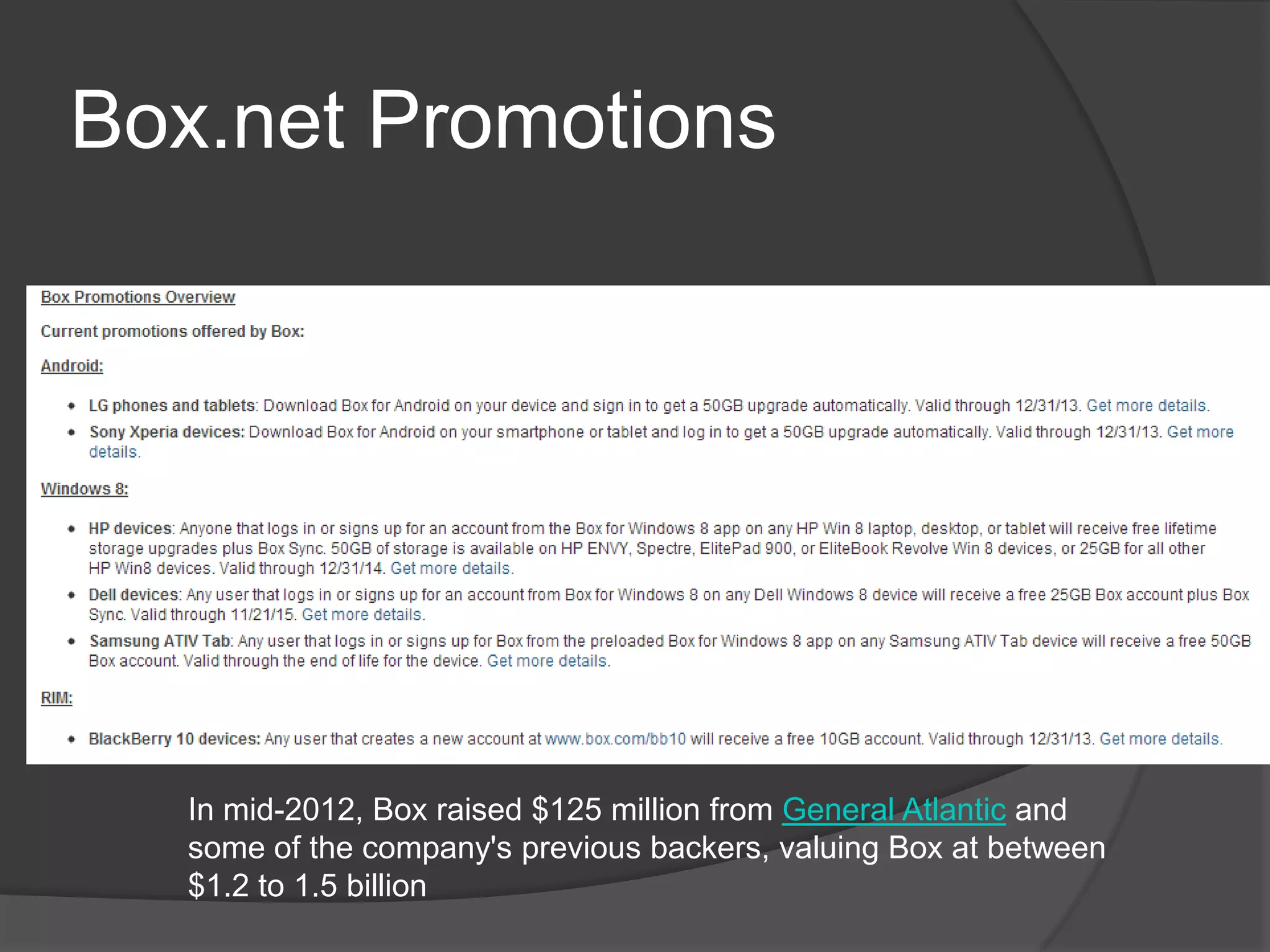
Box.net Promotions
In mid-2012, Box raised $125 million from General Atlantic and
some of the company's previous backers, valuing Box at between
$1.2 to 1.5 billion
Yesware
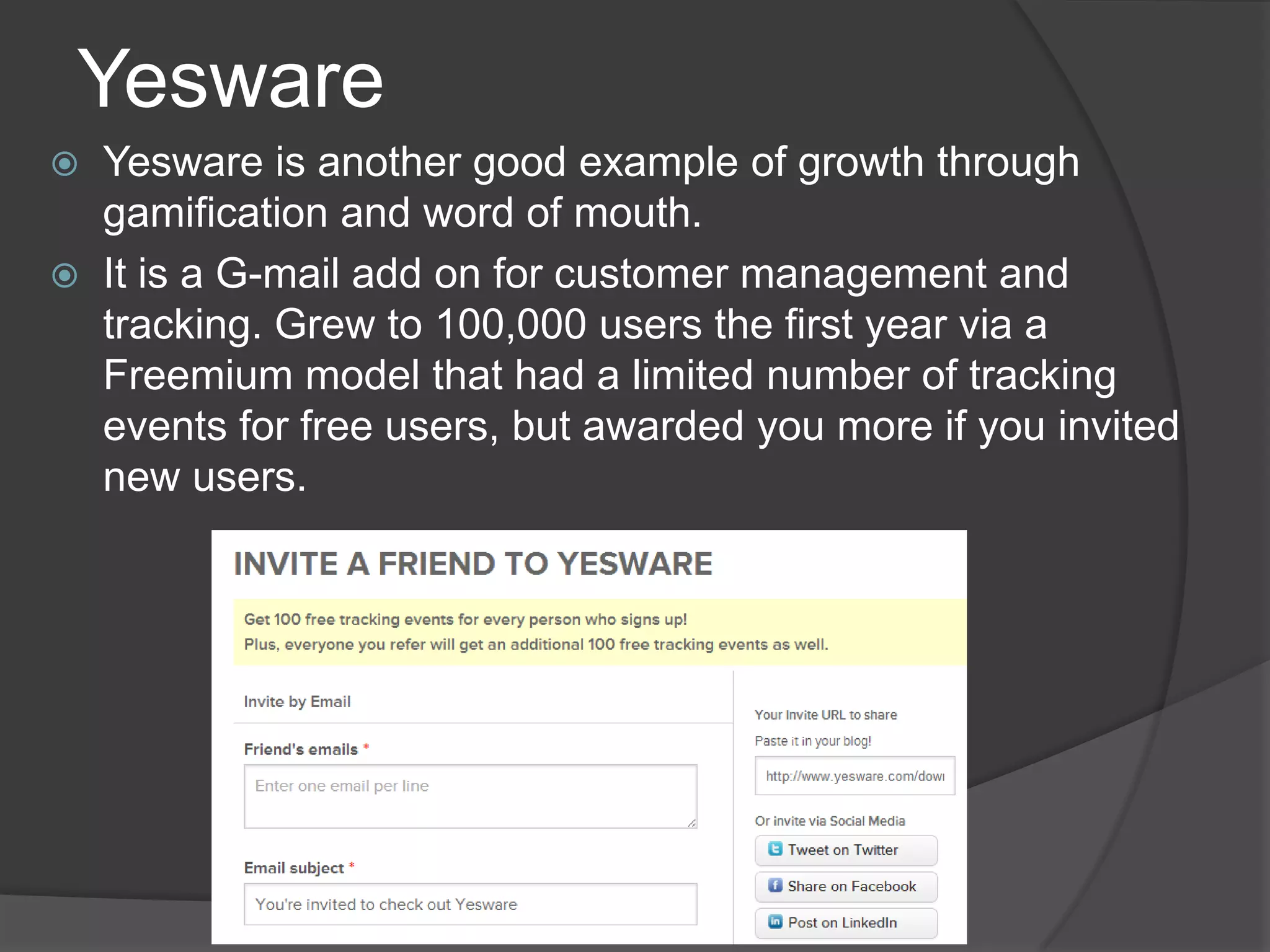
 Yesware is another good example of growth through
gamification and word of mouth.
 It is a G-mail add on for customer management and
tracking. Grew to 100,000 users the first year via a
Freemium model that had a limited number of tracking
events for free users, but awarded you more if you invited
new users.
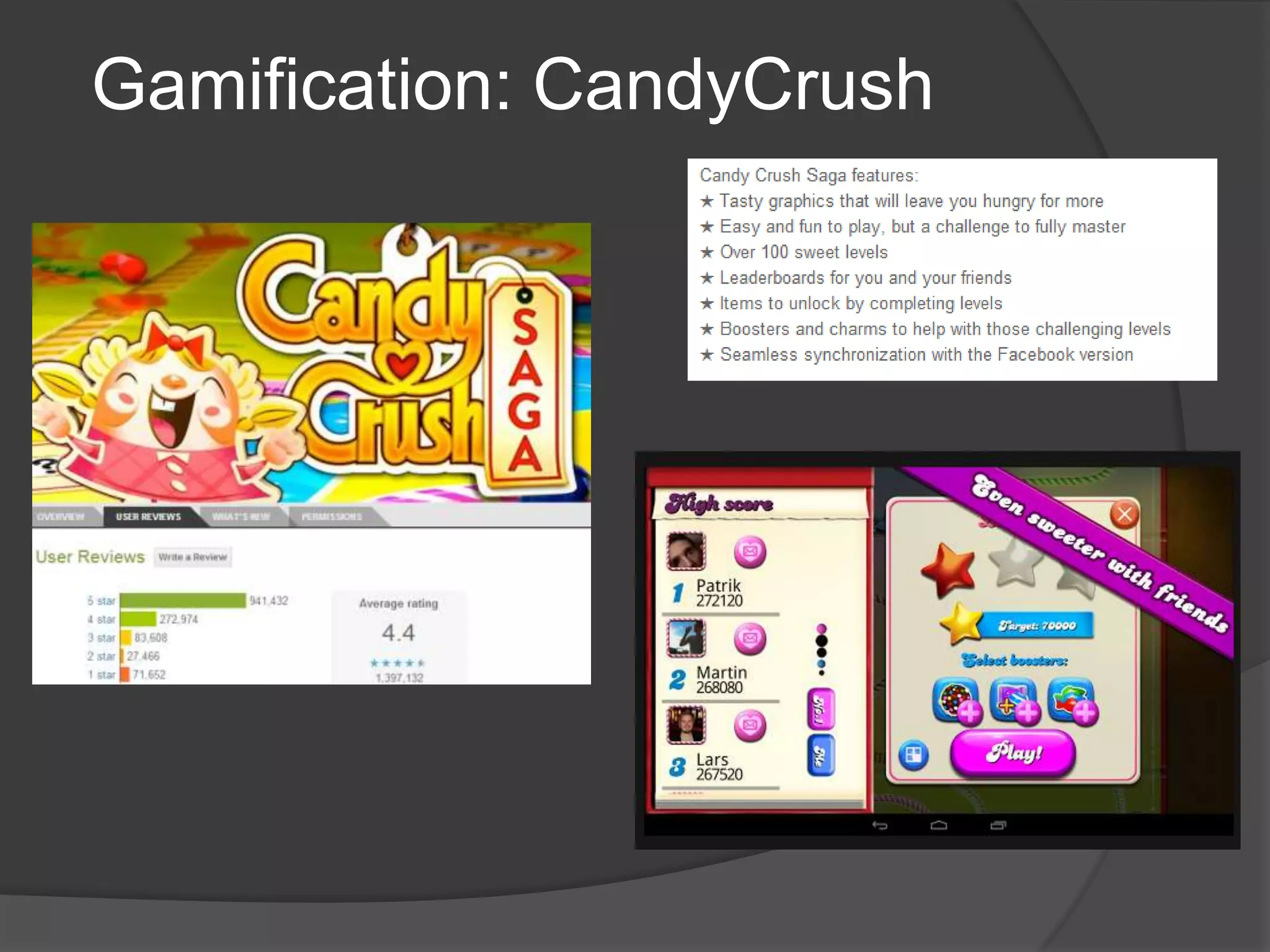
Gamification: CandyCrush
Candy Crush Social
Gamification
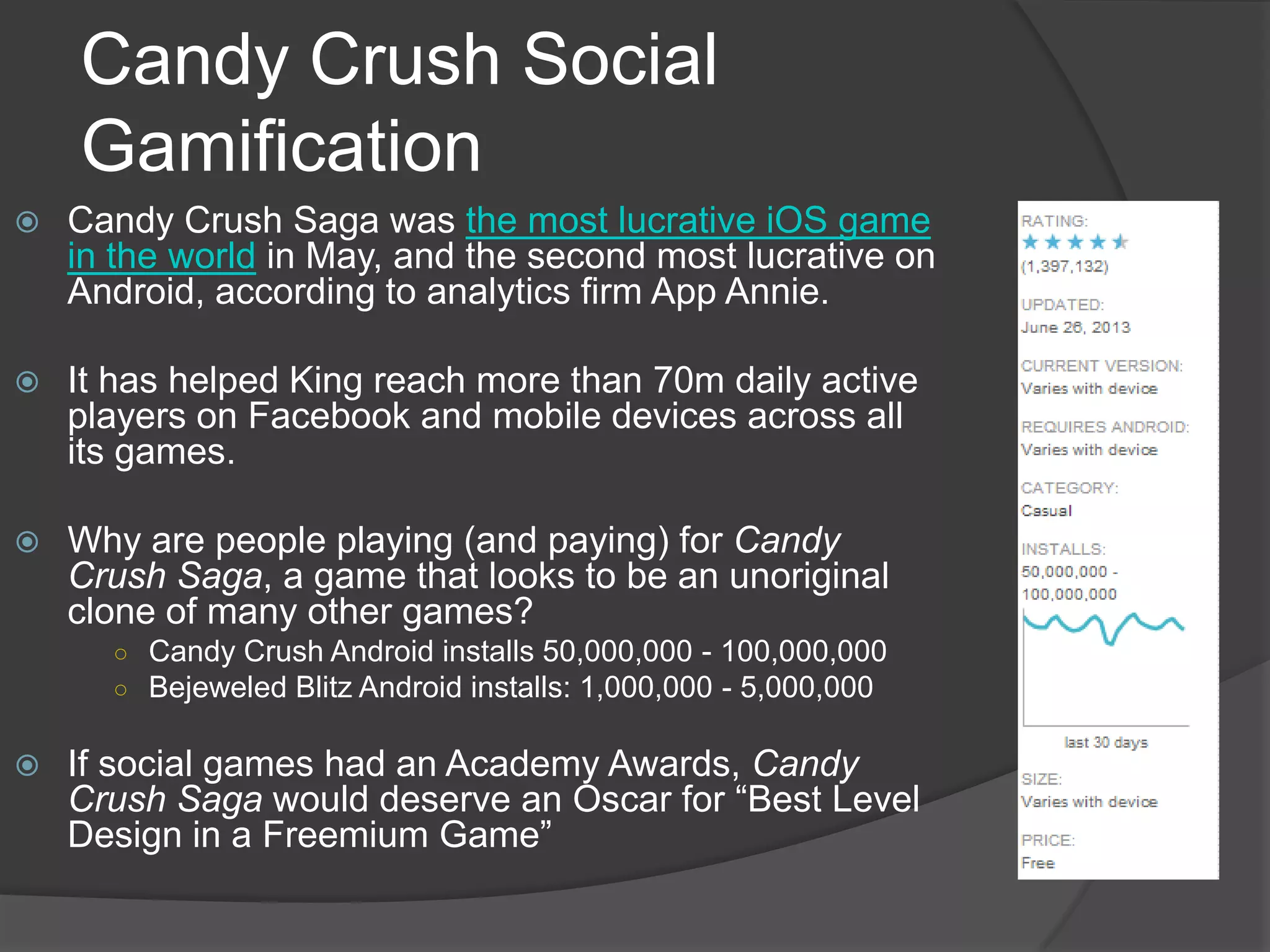
 Candy Crush Saga was the most lucrative iOS game
in the world in May, and the second most lucrative on
Android, according to analytics firm App Annie.
 It has helped King reach more than 70m daily active
players on Facebook and mobile devices across all
its games.
 Why are people playing (and paying) for Candy
Crush Saga, a game that looks to be an unoriginal
clone of many other games?
○ Candy Crush Android installs 50,000,000 - 100,000,000
○ Bejeweled Blitz Android installs: 1,000,000 - 5,000,000
 If social games had an Academy Awards, Candy
Crush Saga would deserve an Oscar for “Best Level
Design in a Freemium Game”
Social Inventory
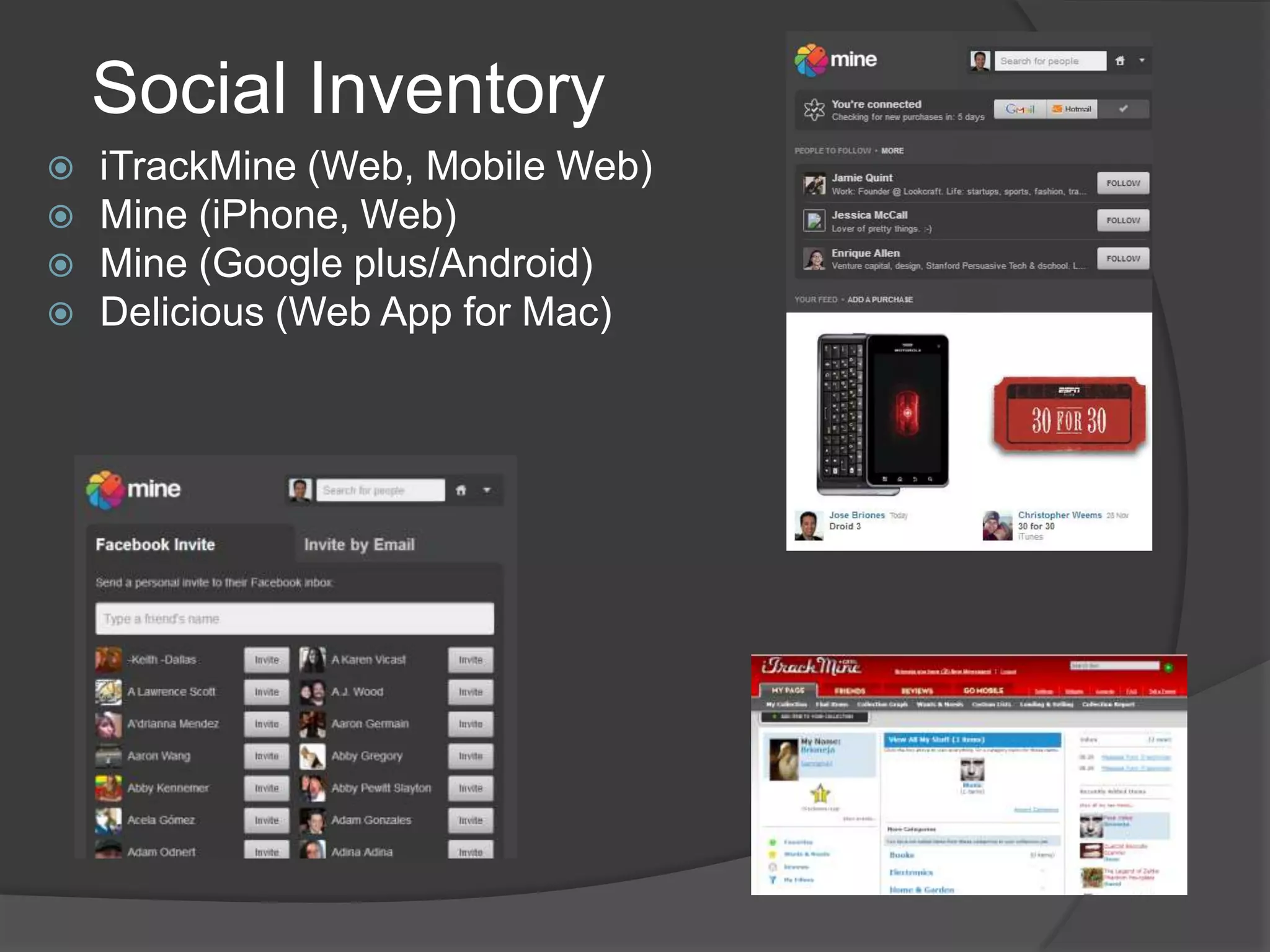
 iTrackMine (Web, Mobile Web)
 Mine (iPhone, Web)
 Mine (Google plus/Android)
 Delicious (Web App for Mac)
Siemens Gamification Case
Study
 In March of 2011, the Siemens team
launched Plantville. This online game simulates the
experience of being a plant manager. Players are
challenged to maintain operation of their plant while
improving productivity, efficiency and facility health.
 23,000 engineering professionals have spent
approximately 14 minutes with the game every time
they visit the site.
 Build brand awareness
 Engage customers and prospects
 Help employees better understand the scope of the
organization
 Recruit future engineers (there is a dearth in the
manufacturing industry)
 Showcase thought leadership in sustainability and
productivity, as well as the breadth and depth of products
and services
www.Brioneja.com
Twitter: @Brioneja
CRM Adoption Case Study
 Users of Customer Relationship Management (CRM)
systems face an adoption and usage challenge.
 50% of all CRM implementations fail.
 Badgeville implemented a “Big Game Hunter”
program for Salesforce.com to increase usage and
engagement with the system.
 Sales people started out at “Chicken Hunters” and
worked their way up to bigger and bigger game
statuses, as they utilized more and more of the CRM
system’s features.
 For one customer, compliance increased over 40%.
www.Brioneja.com
Twitter: @Brioneja
www.Brioneja.com
Twitter: @Brioneja
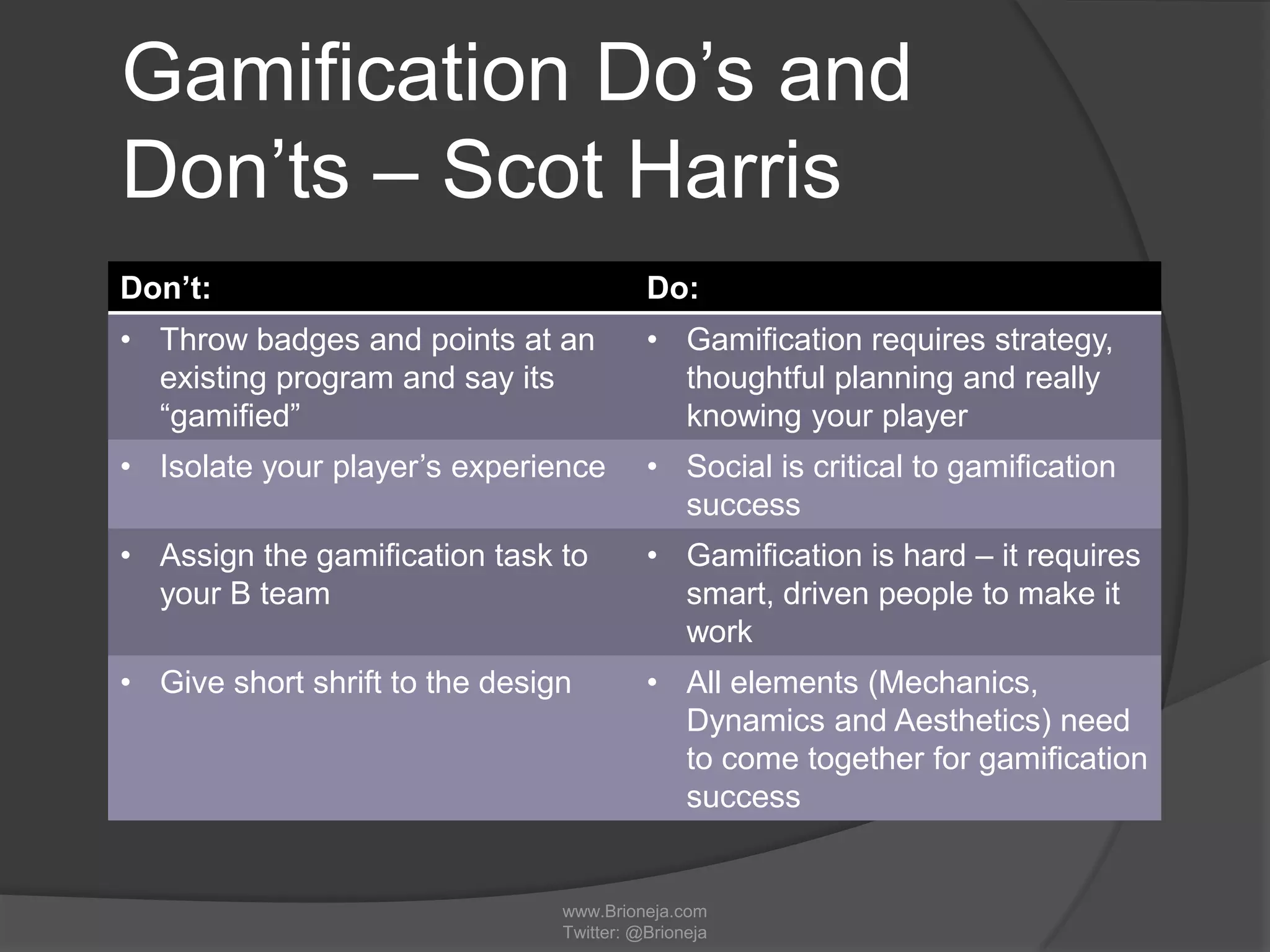
Gamification Do’s and
Don’ts – Scot Harris
Don’t: Do:
• Throw badges and points at an
existing program and say its
“gamified”
• Gamification requires strategy,
thoughtful planning and really
knowing your player
• Isolate your player’s experience • Social is critical to gamification
success
• Assign the gamification task to
your B team
• Gamification is hard – it requires
smart, driven people to make it
work
• Give short shrift to the design • All elements (Mechanics,
Dynamics and Aesthetics) need
to come together for gamification
success
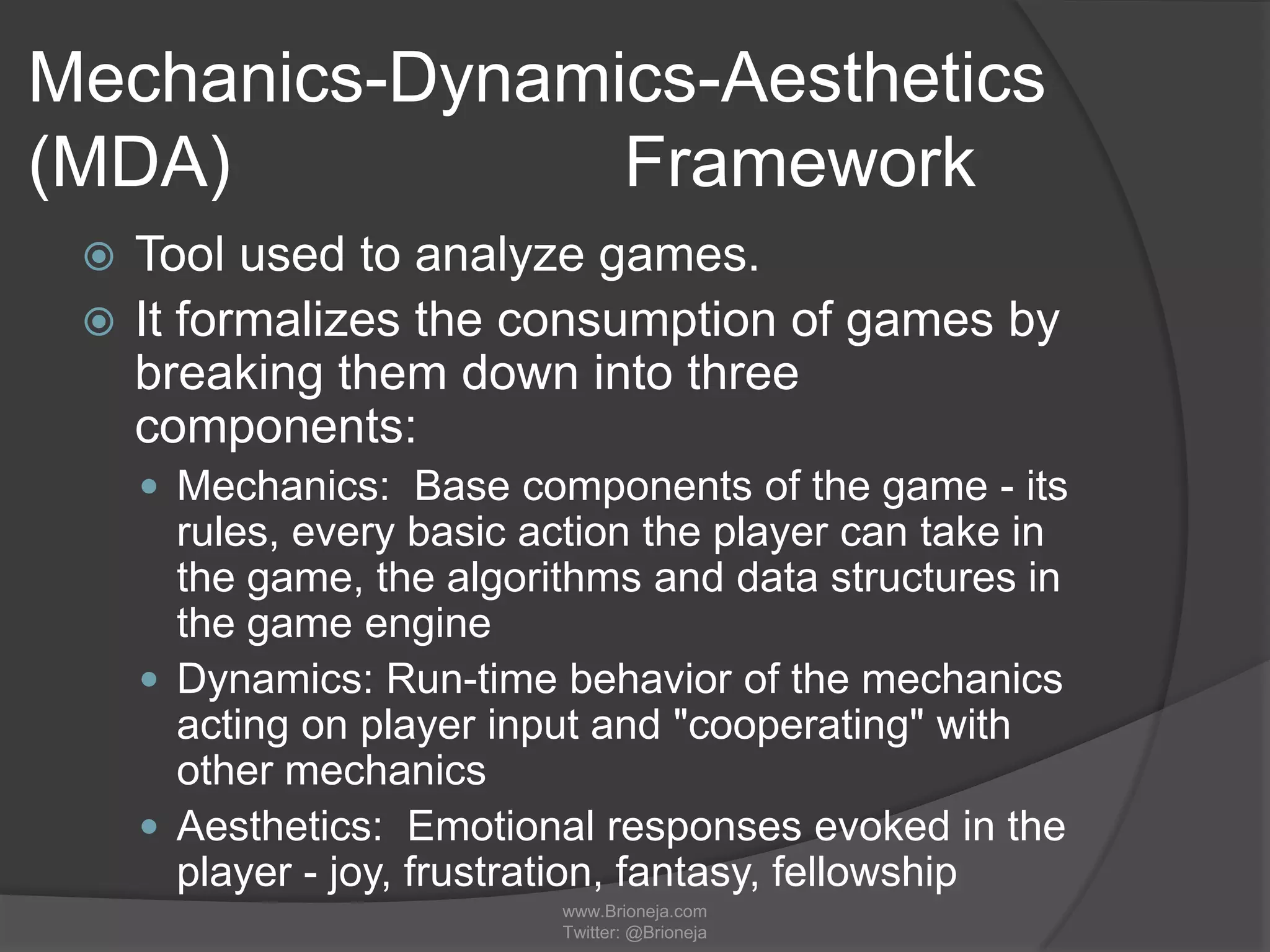
Mechanics-Dynamics-Aesthetics
(MDA) Framework
 Tool used to analyze games.
 It formalizes the consumption of games by
breaking them down into three
components:
 Mechanics: Base components of the game - its
rules, every basic action the player can take in
the game, the algorithms and data structures in
the game engine
 Dynamics: Run-time behavior of the mechanics
acting on player input and "cooperating" with
other mechanics
 Aesthetics: Emotional responses evoked in the
player - joy, frustration, fantasy, fellowship
www.Brioneja.com
Twitter: @Brioneja
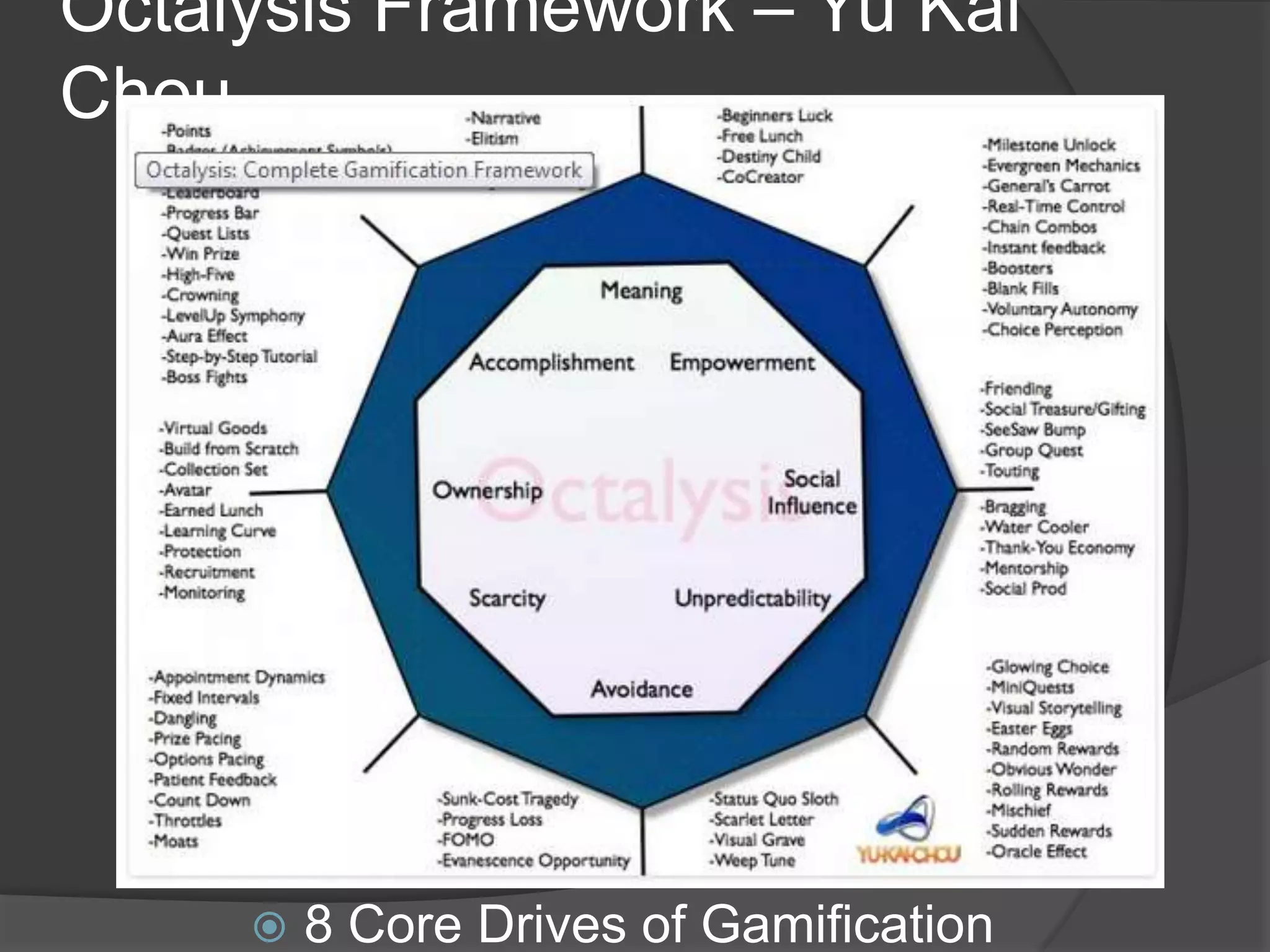
Octalysis Framework – Yu Kai
Chou
 8 Core Drives of Gamification
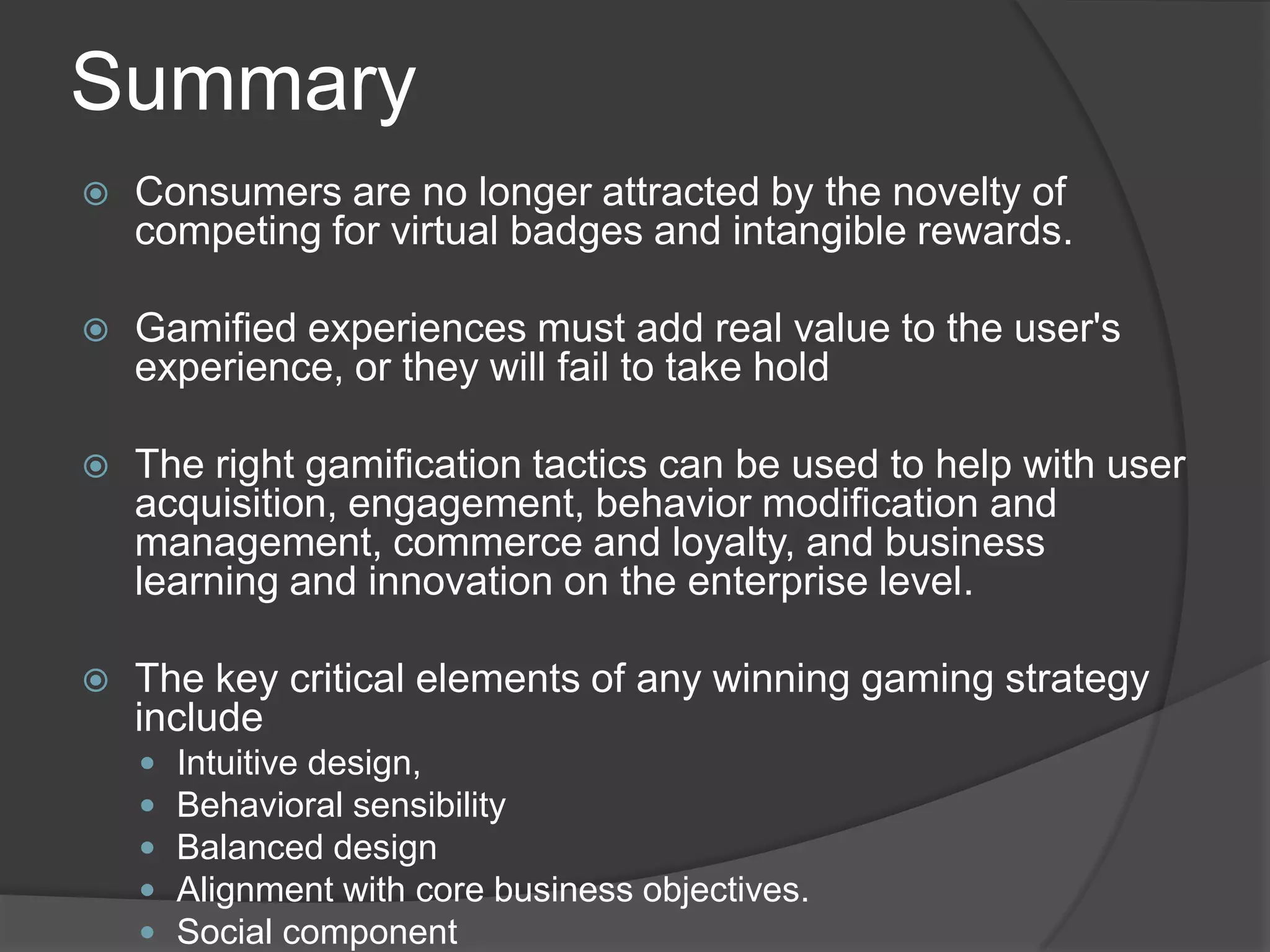
Summary
 Consumers are no longer attracted by the novelty of
competing for virtual badges and intangible rewards.
 Gamified experiences must add real value to the user's
experience, or they will fail to take hold
 The right gamification tactics can be used to help with user
acquisition, engagement, behavior modification and
management, commerce and loyalty, and business
learning and innovation on the enterprise level.
 The key critical elements of any winning gaming strategy
include
 Intuitive design,
 Behavioral sensibility
 Balanced design
 Alignment with core business objectives.
 Social component
References
 Master Gamification: Customer
Engagement in 30 Days
 Scot Harris
 Kevin O’Gorman
www.Brioneja.com
Twitter: @Brioneja
Contact Information
 Jose A. Briones, Ph.D.
 Brioneja@SpyroTek.com
 www.Brioneja.com
 Twitter: @Brioneja
www.Brioneja.com
Twitter: @Brioneja

How Gamification Can Help You Generate Ideas, Improve Product Design and Increase Sales

  • 1.
    Jose A. Briones,Ph.D. C-Level Advisors Twitter: @Brioneja AIPMM Webinar March 28, 2014
  • 2.
    Outline  Many peoplehear about gamification and think that it is not applicable to their work since they do not work in the gaming industry.  However, companies like Dropbox and other have proven that gamification is applicable to any industry, product or service.  This session will discuss how to use gamification in your company to generate ideas, improve product design and increase sales.  Recent examples of successful gamification concepts will be shown. www.Brioneja.com Twitter: @Brioneja
  • 3.
    What is Gamification? Gamification, or the use of game elements to promote desired behaviors among customers and employees, has been a popular business strategy for decades.  The always-on mobile age and integration with social networks has vastly expanded opportunities for gamification.  Gamification is design that places the most emphasis on human motivation in the process. In essence, it is Human-Focused Design (as opposed to “function-focused design”). www.Brioneja.com Twitter: @Brioneja
  • 4.
    Market Size  Marketresearch firms MarketandMarkets and M2, estimate the global market for gamification apps and services in between $400 & $500 million by the end of 2013.  M2 Research projects the market to grow to $2.8 billion by 2016.  An assessment by Gartner estimates that more than 70% of Global 2000 companies will use at least one gamified application by 2014. www.Brioneja.com Twitter: @Brioneja
  • 5.
    Market Trends  IEEEExperts Predict Gaming Will Be Integrated Into More than 85 Percent of Daily Tasks by 2020  Industries like healthcare, business and education will be integrating gaming elements into standard tasks and activities, making us all gamers.  People will accrue points for regular tasks and each person’s point cache will influence their position in society, and compliment their monetary wealth. www.Brioneja.com Twitter: @Brioneja
  • 6.
    Market Trends  Gamificationrepresents the intersection of 4 megatrends:  The explosion of social media usage,  The mobile revolution,  The rise of big data  The emergence of wearable computing.  Marketers, enterprises & governments are using gamification to achieve and expand their goals. www.Brioneja.com Twitter: @Brioneja
  • 7.
    History  Foursquare isthe most well- known mobile gamification  Early in its history, Foursquare spurred user acquisition and engagement with its focus on competition and rewards.  But Foursquare has drifted away from this gamification dimension  “The demise of superficial gamification” www.Brioneja.com Twitter: @Brioneja
  • 8.
  • 9.
  • 10.
    Dropbox History  Dropboxwas the first to perfect cloud storage for consumers and reaped the benefits – user numbers leapt from 5m in 2010 to 25m in 2011, reaching 100m last year and 175m today.  Over $500 million in revenues  96% of its customers use the service free  $125/paid customer/yr.  A 2012 US survey by Forrester Research found that 14% of online adults had used back-up or storage services, with Dropbox the most popular claiming more than 25% of the market, followed closely by Apple’s iCloud.  Claims a presence in more than 2 million businesses, including 95 percent of the Fortune 500.  Dropbox raised $250 million at a $4 billion valuation from investors including Index Ventures, Sequoia, Greylock, Benchmark, and Accel, among others www.Brioneja.com Twitter: @Brioneja
  • 11.
    Storage Pricing Dropbox GoogleDrive GB $/month $/month 100 $ 9.99 $ 4.99 200 $ 19.99 $ 9.99 400 $ 19.99 500 $ 49.99 1 TB $ 49.99
  • 12.
  • 14.
    Dropbox Gamification  Dropquestis a game in which you have to complete a series of riddles, tasks and puzzles, and if you manage to do so, you win a 1GB addition to your Dropbox storage space for life.
  • 15.
  • 16.
    Box.net Promotions In mid-2012,Box raised $125 million from General Atlantic and some of the company's previous backers, valuing Box at between $1.2 to 1.5 billion
  • 17.
    Yesware  Yesware isanother good example of growth through gamification and word of mouth.  It is a G-mail add on for customer management and tracking. Grew to 100,000 users the first year via a Freemium model that had a limited number of tracking events for free users, but awarded you more if you invited new users.
  • 18.
  • 19.
    Candy Crush Social Gamification Candy Crush Saga was the most lucrative iOS game in the world in May, and the second most lucrative on Android, according to analytics firm App Annie.  It has helped King reach more than 70m daily active players on Facebook and mobile devices across all its games.  Why are people playing (and paying) for Candy Crush Saga, a game that looks to be an unoriginal clone of many other games? ○ Candy Crush Android installs 50,000,000 - 100,000,000 ○ Bejeweled Blitz Android installs: 1,000,000 - 5,000,000  If social games had an Academy Awards, Candy Crush Saga would deserve an Oscar for “Best Level Design in a Freemium Game”
  • 20.
    Social Inventory  iTrackMine(Web, Mobile Web)  Mine (iPhone, Web)  Mine (Google plus/Android)  Delicious (Web App for Mac)
  • 21.
    Siemens Gamification Case Study In March of 2011, the Siemens team launched Plantville. This online game simulates the experience of being a plant manager. Players are challenged to maintain operation of their plant while improving productivity, efficiency and facility health.  23,000 engineering professionals have spent approximately 14 minutes with the game every time they visit the site.  Build brand awareness  Engage customers and prospects  Help employees better understand the scope of the organization  Recruit future engineers (there is a dearth in the manufacturing industry)  Showcase thought leadership in sustainability and productivity, as well as the breadth and depth of products and services www.Brioneja.com Twitter: @Brioneja
  • 22.
    CRM Adoption CaseStudy  Users of Customer Relationship Management (CRM) systems face an adoption and usage challenge.  50% of all CRM implementations fail.  Badgeville implemented a “Big Game Hunter” program for Salesforce.com to increase usage and engagement with the system.  Sales people started out at “Chicken Hunters” and worked their way up to bigger and bigger game statuses, as they utilized more and more of the CRM system’s features.  For one customer, compliance increased over 40%. www.Brioneja.com Twitter: @Brioneja
  • 23.
    www.Brioneja.com Twitter: @Brioneja Gamification Do’sand Don’ts – Scot Harris Don’t: Do: • Throw badges and points at an existing program and say its “gamified” • Gamification requires strategy, thoughtful planning and really knowing your player • Isolate your player’s experience • Social is critical to gamification success • Assign the gamification task to your B team • Gamification is hard – it requires smart, driven people to make it work • Give short shrift to the design • All elements (Mechanics, Dynamics and Aesthetics) need to come together for gamification success
  • 24.
    Mechanics-Dynamics-Aesthetics (MDA) Framework  Toolused to analyze games.  It formalizes the consumption of games by breaking them down into three components:  Mechanics: Base components of the game - its rules, every basic action the player can take in the game, the algorithms and data structures in the game engine  Dynamics: Run-time behavior of the mechanics acting on player input and "cooperating" with other mechanics  Aesthetics: Emotional responses evoked in the player - joy, frustration, fantasy, fellowship www.Brioneja.com Twitter: @Brioneja
  • 25.
    Octalysis Framework –Yu Kai Chou  8 Core Drives of Gamification
  • 26.
    Summary  Consumers areno longer attracted by the novelty of competing for virtual badges and intangible rewards.  Gamified experiences must add real value to the user's experience, or they will fail to take hold  The right gamification tactics can be used to help with user acquisition, engagement, behavior modification and management, commerce and loyalty, and business learning and innovation on the enterprise level.  The key critical elements of any winning gaming strategy include  Intuitive design,  Behavioral sensibility  Balanced design  Alignment with core business objectives.  Social component
  • 27.
    References  Master Gamification:Customer Engagement in 30 Days  Scot Harris  Kevin O’Gorman www.Brioneja.com Twitter: @Brioneja
  • 28.
    Contact Information  JoseA. Briones, Ph.D.  Brioneja@SpyroTek.com  www.Brioneja.com  Twitter: @Brioneja www.Brioneja.com Twitter: @Brioneja