Gamification
Our Week in Review
In week two of our seminars, we looked at
gamification. How did our thoughts on this
subject change and evolve throughout the
week?
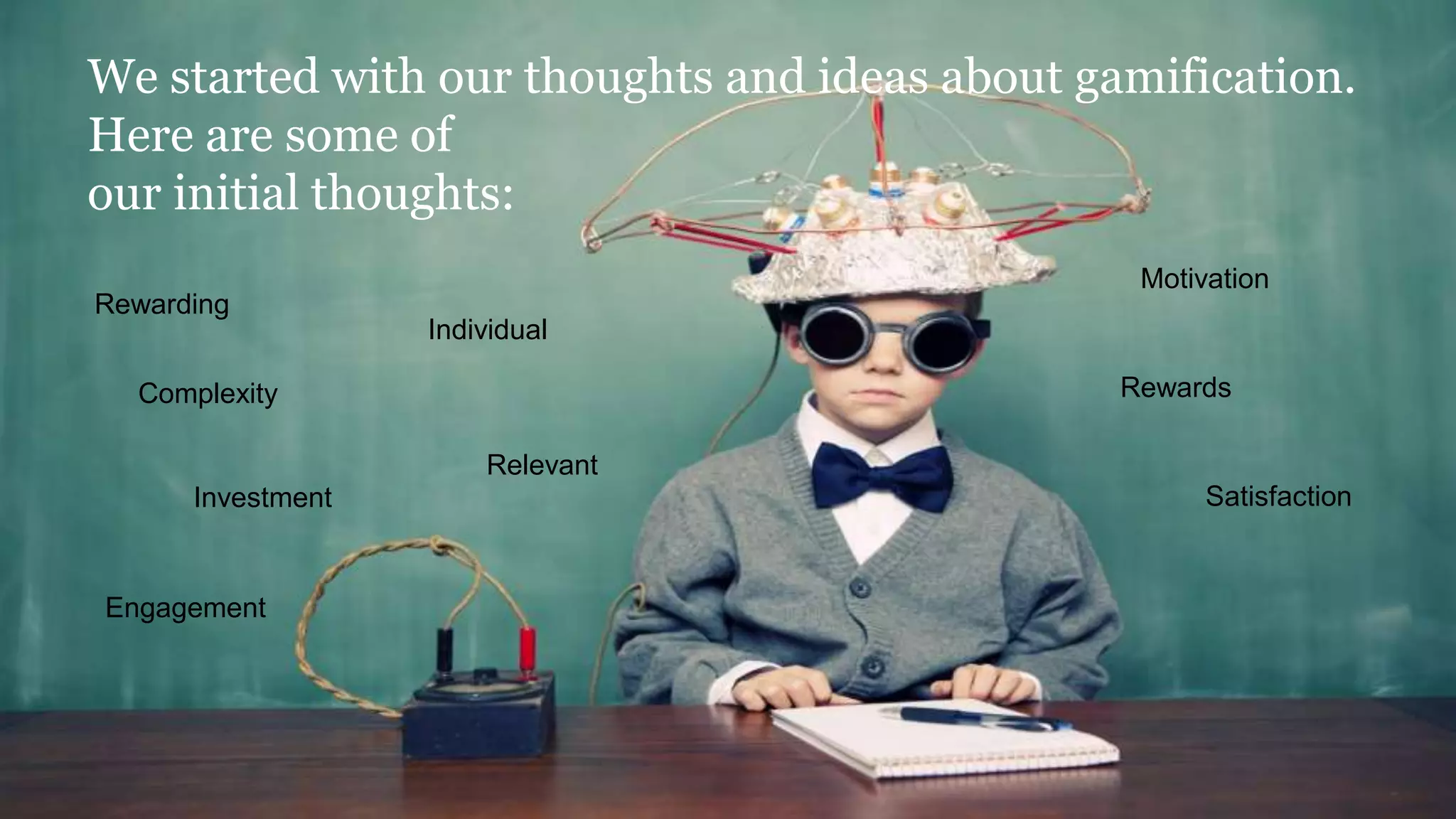
We started with our thoughts and ideas about gamification.
Here are some of
our initial thoughts:
Investment
Complexity Rewards
Motivation
Engagement
Rewarding
Individual
Relevant
Satisfaction
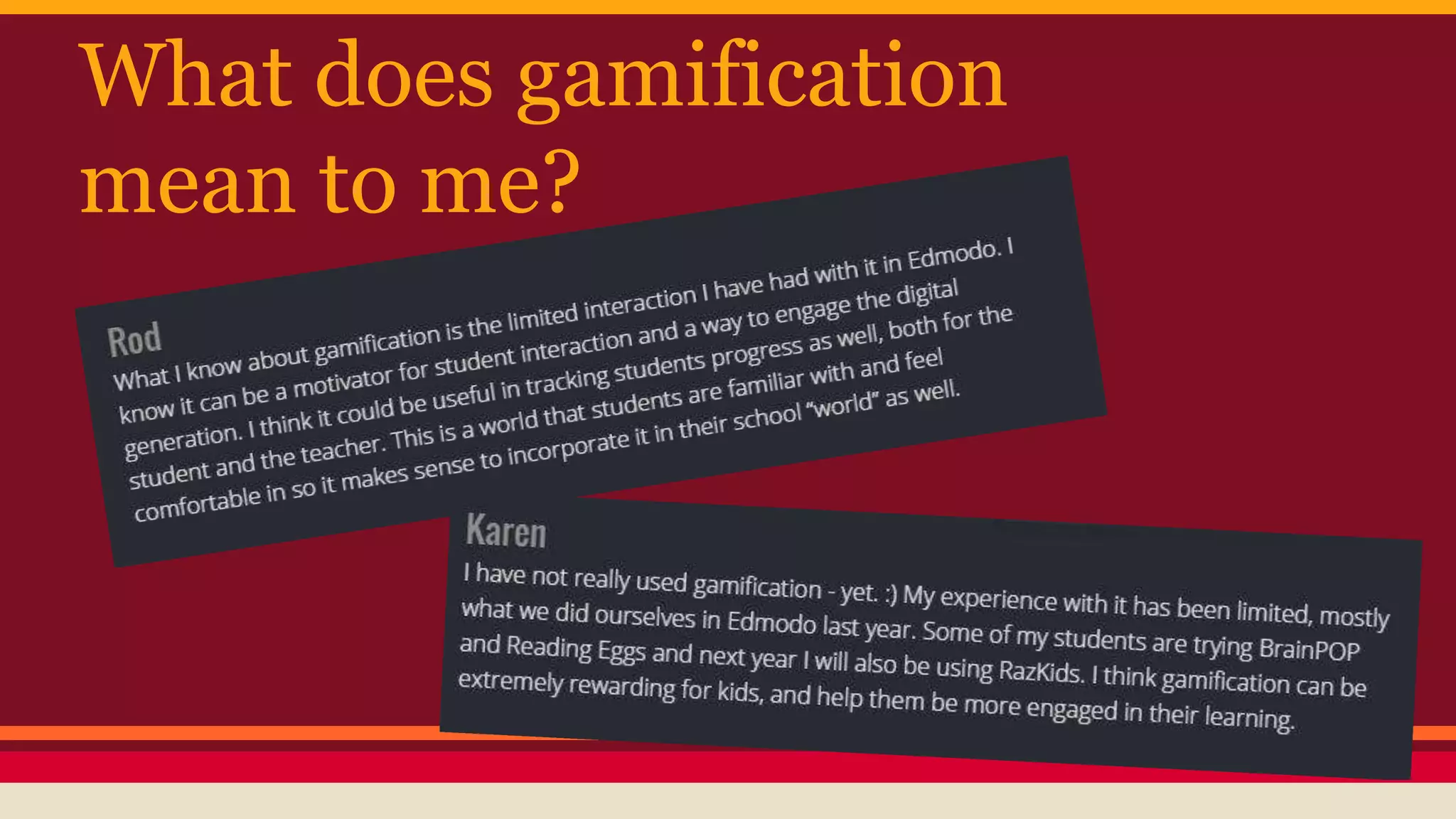
What does gamification
mean to me?
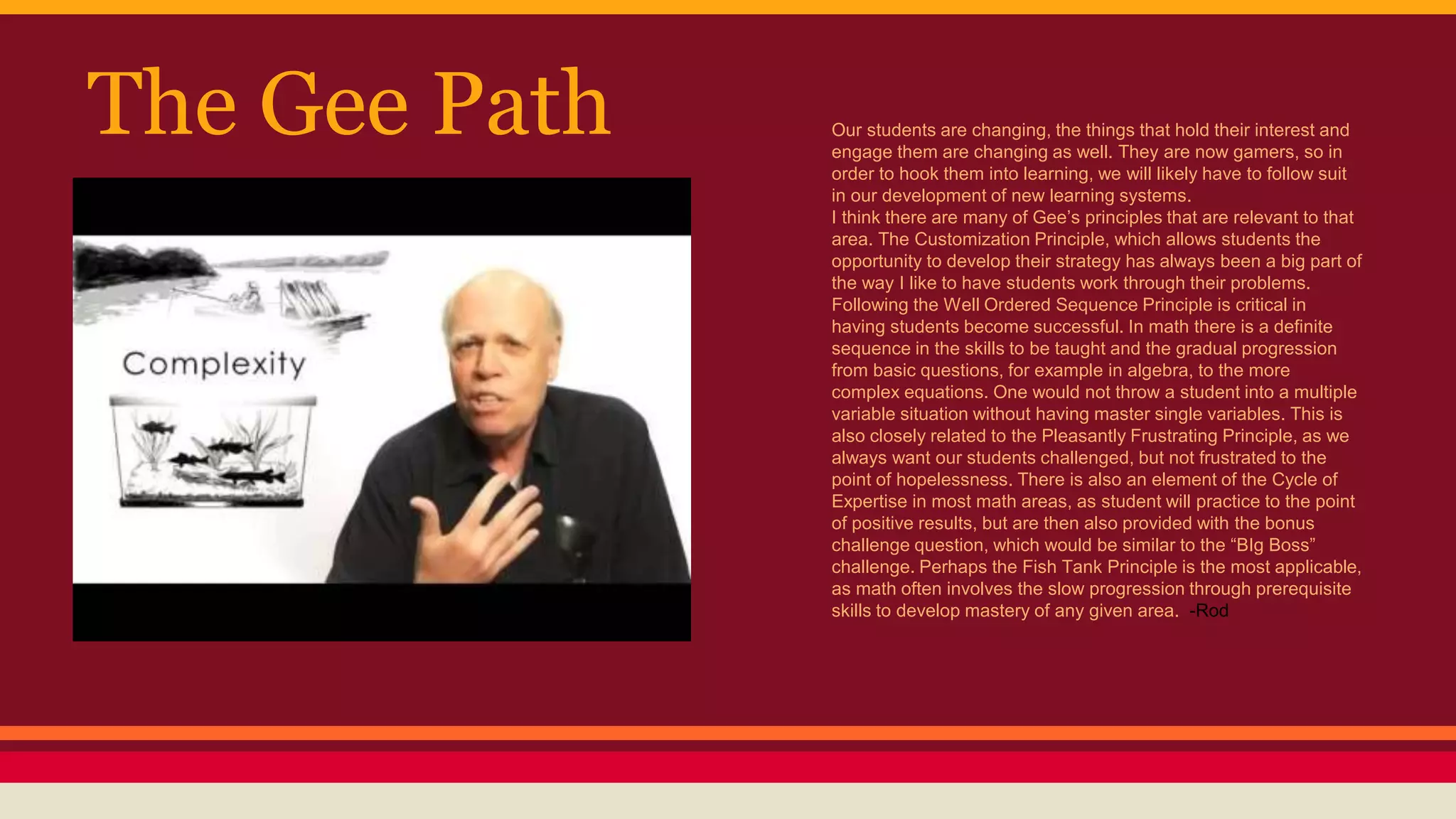
The Gee Path Our students are changing, the things that hold their interest and
engage them are changing as well. They are now gamers, so in
order to hook them into learning, we will likely have to follow suit
in our development of new learning systems.
I think there are many of Gee’s principles that are relevant to that
area. The Customization Principle, which allows students the
opportunity to develop their strategy has always been a big part of
the way I like to have students work through their problems.
Following the Well Ordered Sequence Principle is critical in
having students become successful. In math there is a definite
sequence in the skills to be taught and the gradual progression
from basic questions, for example in algebra, to the more
complex equations. One would not throw a student into a multiple
variable situation without having master single variables. This is
also closely related to the Pleasantly Frustrating Principle, as we
always want our students challenged, but not frustrated to the
point of hopelessness. There is also an element of the Cycle of
Expertise in most math areas, as student will practice to the point
of positive results, but are then also provided with the bonus
challenge question, which would be similar to the “BIg Boss”
challenge. Perhaps the Fish Tank Principle is the most applicable,
as math often involves the slow progression through prerequisite
skills to develop mastery of any given area. -Rod
The Kapp Path
I appreciated the breakdown of the
game elements into story, characters,
challenge, immediate feedback, points
and achievement. The elements of
character and story seem most
important to me, but that might be
because I am an inveterate spinner of
legends! I find myself wondering how I
can take the elements of any given
tutoring or teaching task, and translate
them into story, so that they are more
memorable. -Jay
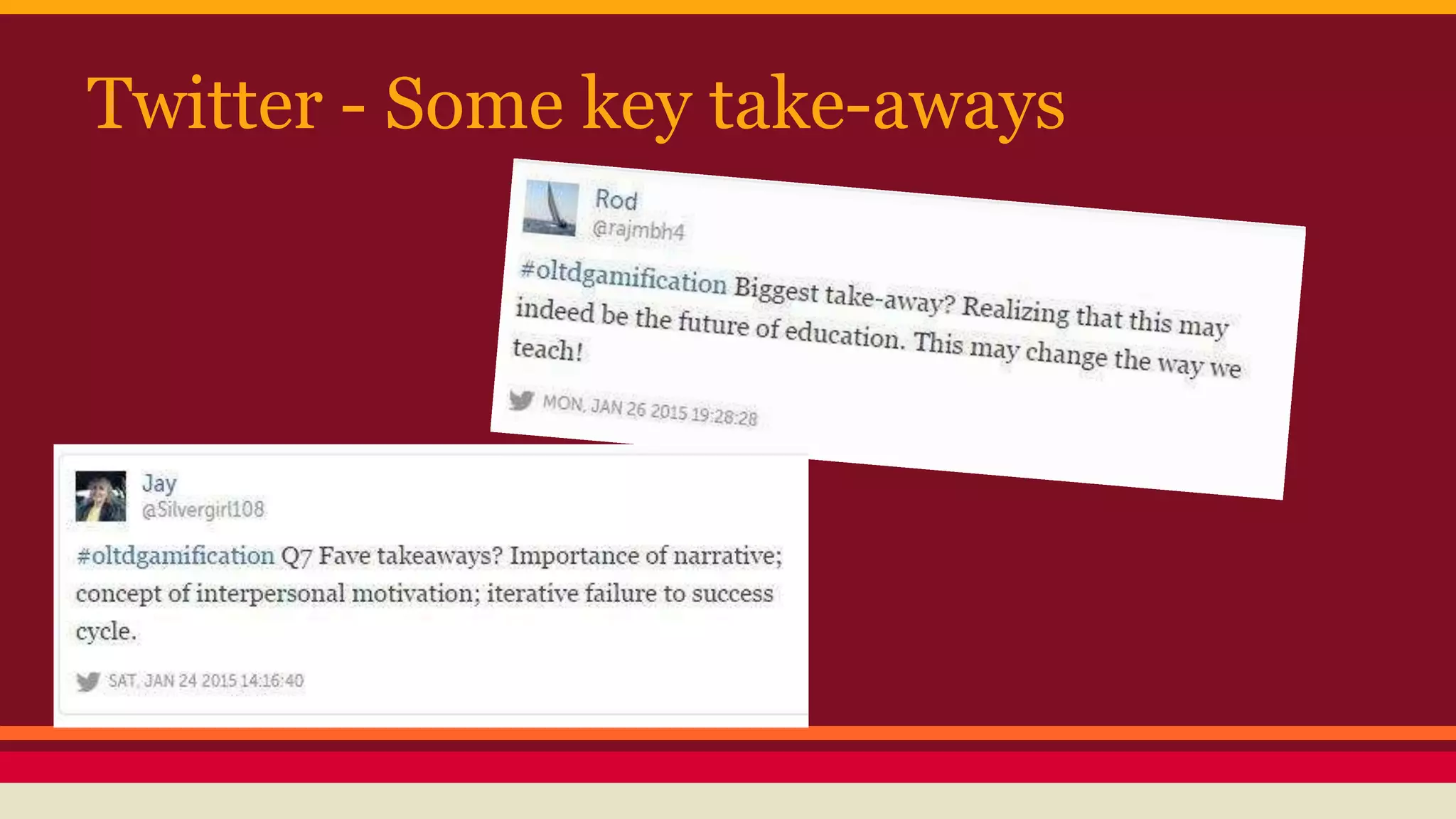
Twitter - Some key take-aways
Putting it all together
I do see gamification playing a larger role in the future development of online learning. The success of LMS’s
like Edmodo etc have shown that it can be incorporated into online learning in a meaningful way. As gaming technology continues to develop, I am sure
the educational world will follow in order to capture and hold new learners. If gamification can help students learn and become successful in any
academic pursuit, then it should have a place as an emerging pedagogy. That is after all what we should be striving for, successful, capable learners.
There may however be a few pitfalls when attempting to introduce the idea of gamification. Many parents already feel that their child “plays too many
games” already. The concept of gamification will have to be clearly explained in some circumstance, to both admin and parents that may not have a
clear understanding of its principles. The accessibility to technology may also be a limiting factor in some schools and homes. -Rod
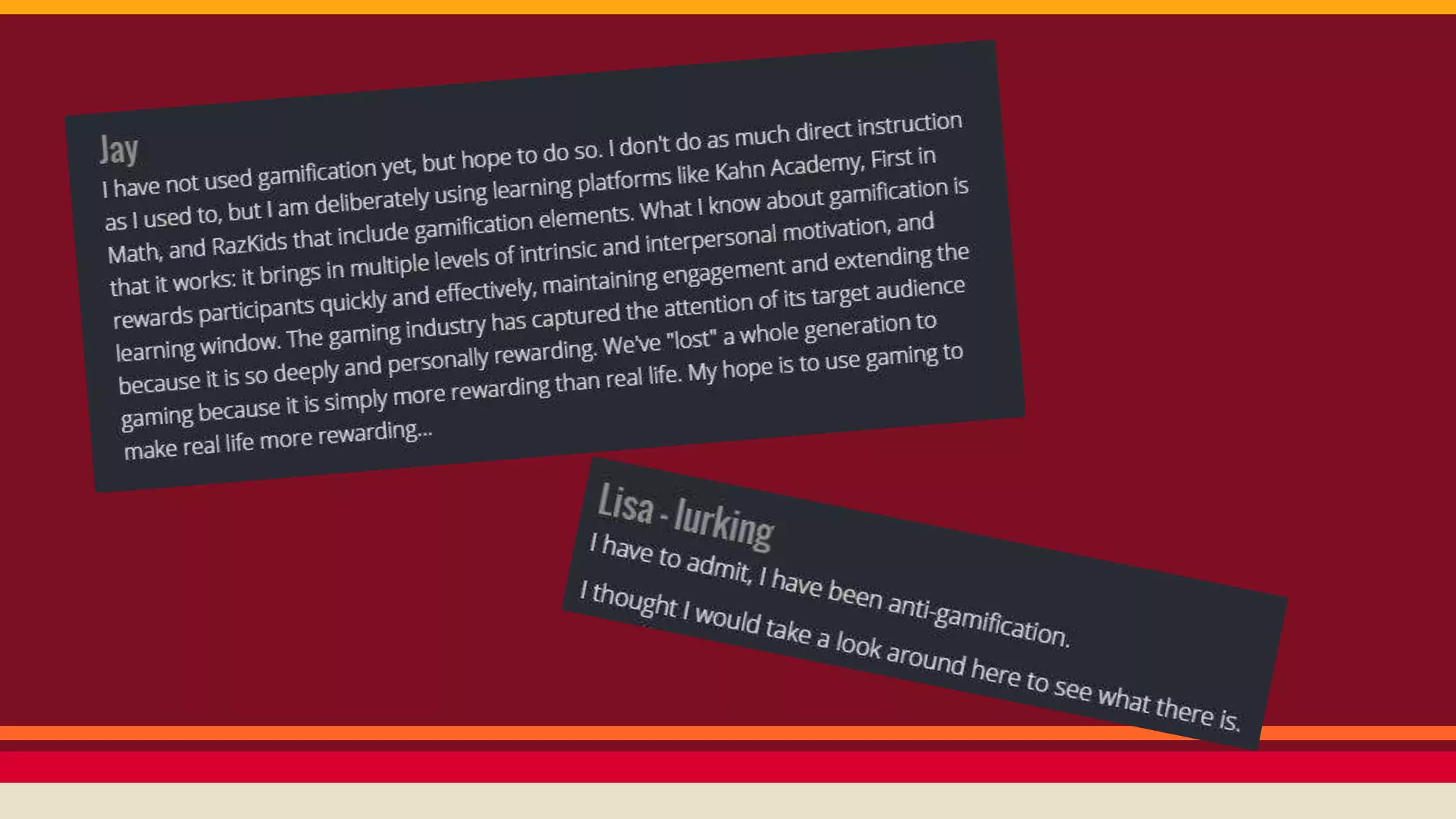
Gamification means different things to different people, and most have only a partial or personal view of gamification.
From my perspective, using game elements to increase engagement in learning is a compelling reason to introduce gamification into either the
blended or f-2-f learning environment. Engagement increases time on task and retention of detail. Struggling learners, in particular, can benefit from
game elements….It seems self-evident to me that gamification is a powerful aid to learning, but I think it is a harder sell in the education field than it
should be, probably because of the element of fun. As Kapp offered, however, we can do learning via boring (and get the same sad results we've
always had) or we can do learning via fun (and watch the difference in results). It's ultimately up to us…-Jay

Gamification

  • 1.
  • 2.
    In week twoof our seminars, we looked at gamification. How did our thoughts on this subject change and evolve throughout the week?
  • 3.
    We started withour thoughts and ideas about gamification. Here are some of our initial thoughts: Investment Complexity Rewards Motivation Engagement Rewarding Individual Relevant Satisfaction
  • 4.
  • 7.
    The Gee PathOur students are changing, the things that hold their interest and engage them are changing as well. They are now gamers, so in order to hook them into learning, we will likely have to follow suit in our development of new learning systems. I think there are many of Gee’s principles that are relevant to that area. The Customization Principle, which allows students the opportunity to develop their strategy has always been a big part of the way I like to have students work through their problems. Following the Well Ordered Sequence Principle is critical in having students become successful. In math there is a definite sequence in the skills to be taught and the gradual progression from basic questions, for example in algebra, to the more complex equations. One would not throw a student into a multiple variable situation without having master single variables. This is also closely related to the Pleasantly Frustrating Principle, as we always want our students challenged, but not frustrated to the point of hopelessness. There is also an element of the Cycle of Expertise in most math areas, as student will practice to the point of positive results, but are then also provided with the bonus challenge question, which would be similar to the “BIg Boss” challenge. Perhaps the Fish Tank Principle is the most applicable, as math often involves the slow progression through prerequisite skills to develop mastery of any given area. -Rod
  • 8.
    The Kapp Path Iappreciated the breakdown of the game elements into story, characters, challenge, immediate feedback, points and achievement. The elements of character and story seem most important to me, but that might be because I am an inveterate spinner of legends! I find myself wondering how I can take the elements of any given tutoring or teaching task, and translate them into story, so that they are more memorable. -Jay
  • 9.
    Twitter - Somekey take-aways
  • 10.
    Putting it alltogether I do see gamification playing a larger role in the future development of online learning. The success of LMS’s like Edmodo etc have shown that it can be incorporated into online learning in a meaningful way. As gaming technology continues to develop, I am sure the educational world will follow in order to capture and hold new learners. If gamification can help students learn and become successful in any academic pursuit, then it should have a place as an emerging pedagogy. That is after all what we should be striving for, successful, capable learners. There may however be a few pitfalls when attempting to introduce the idea of gamification. Many parents already feel that their child “plays too many games” already. The concept of gamification will have to be clearly explained in some circumstance, to both admin and parents that may not have a clear understanding of its principles. The accessibility to technology may also be a limiting factor in some schools and homes. -Rod Gamification means different things to different people, and most have only a partial or personal view of gamification. From my perspective, using game elements to increase engagement in learning is a compelling reason to introduce gamification into either the blended or f-2-f learning environment. Engagement increases time on task and retention of detail. Struggling learners, in particular, can benefit from game elements….It seems self-evident to me that gamification is a powerful aid to learning, but I think it is a harder sell in the education field than it should be, probably because of the element of fun. As Kapp offered, however, we can do learning via boring (and get the same sad results we've always had) or we can do learning via fun (and watch the difference in results). It's ultimately up to us…-Jay