Prof. Pier Luca Lanzi
Game Mechanics
Videogame Design and Programming
Prof. Pier Luca Lanzi
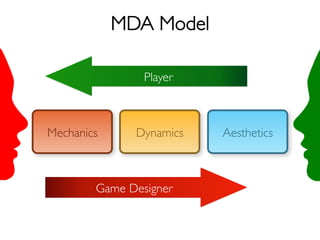
Player
grok
MDA Model
DynamicsMechanics Aesthetics
Game Designer
Prof. Pier Luca Lanzi
http://www.cs.northwestern.edu/~hunicke/pubs/MDA.pdf
Prof. Pier Luca Lanzi
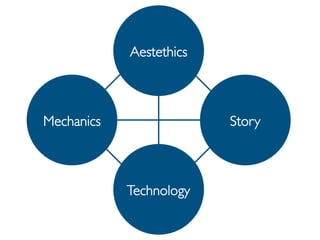
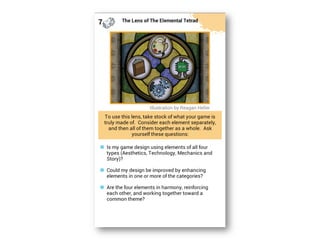
Mechanics Story
Aestethics
Technology
Prof. Pier Luca Lanzi
The Elemental Tetrad: Mechanics
•  The procedures and rules of your game
•  Describe the goal of your game
•  How players can and cannot try to achieve it
•  What happens when they try
•  If a set of mechanics is crucial to the gameplay,
§ These must be supported by the technology
§ Aesthetics must emphasize them clearly to the players
§ They should make sense with respect to the story
7
Prof. Pier Luca Lanzi
The Elemental Tetrad: Story
•  The sequence of events that unfolds in your game
•  Linear and prescripted, branching and emergent
•  The mechanics should strengthen the story and let it emerge
•  Aesthetics should reinforce the ideas of the story
•  The technology should be the best suited to the story
8
Prof. Pier Luca Lanzi
The Elemental Tetrad: Aesthetics
•  How your game looks, sounds, smells, tastes, and feels
•  It has the most direct relationship to a player’s experience
•  Technology should allow and amplify the target aesthetic tone/
mood of the game
•  Mechanics should be coherent to the world that the aesthetics
have defined
•  The story should have events that let your aesthetics emerge at
the right pace and have the most impact
9
Prof. Pier Luca Lanzi
The Elemental Tetrad: Technology
•  They define the materials and interactions that make your game
possible
•  The technology enables players to do certain things and prohibits
it from doing other things (e.g., Wii and gamepads)
•  The technology is essentially the medium in which the aesthetics
take place, in which the mechanics will occur, and through which
the story will be told.
10
Prof. Pier Luca Lanzi
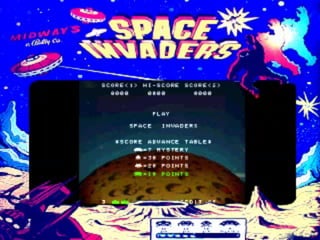
Space Invaders
http://www.youtube.com/watch?v=QObneYZIdKI
Prof. Pier Luca Lanzi
The Tedrad at Play: Space Invaders
•  Technology
§ Custom made for this game, no other game had it
•  Mechanics
§ The gameplay was completely new, with a player against and advancing
army. The player shoots and the aliens shoot back
§ You can hide behind the shields but the enemy can destroy them
§ The more enemy the player shoots down the faster the aliens go
§ Flying saucers give extra points but they are difficult to hit
13
Prof. Pier Luca Lanzi
The Tedrad at Play: Space Invaders
•  Story
§ Original story was the players shooting at advancing human soldiers but
Taito changed it because it conveyed a bad message
§ Other war-based games were available (Sea Wolf 1976)
§ People already complained about game in which you kill people (Death
Race 1976)
§ Marching soldier would better fit a top-down view, aliens give the feeling
that their aim is to touch ground
•  Aesthetics
§ Aliens are not identical and have a two frame (very effective) marching
animation and music
§ Colored strips on the screen
§ The arcade cabinet was attractive and eye catching
§ Punishing sound when you get hit
14
Prof. Pier Luca Lanzi
Skin & Skeleton
Skin
“the player’s experience”
Skeleton
“the elements that make up the game”
Designers should focus on both at the same time
Prof. Pier Luca Lanzi
Game Themes
“if our games have unifying, resonant themes, the
experiences we create will be much, much stronger.”
Jesse Schell
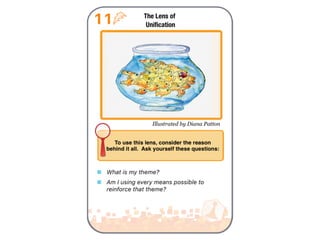
Figure out what your theme is.
Use every means possible to reinforce that theme.
Prof. Pier Luca Lanzi
Game mechanics are the core
of what a game truly is
What remain when all of the aesthetics,
technology, and story are stripped away
Prof. Pier Luca Lanzi
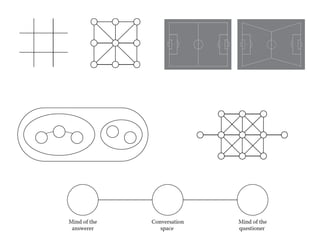
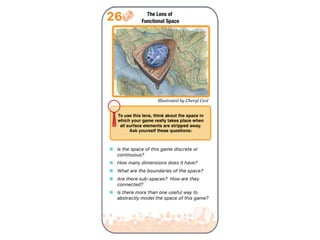
Mechanic #1: Space
Prof. Pier Luca Lanzi
Mechanic #2: Time
Prof. Pier Luca Lanzi
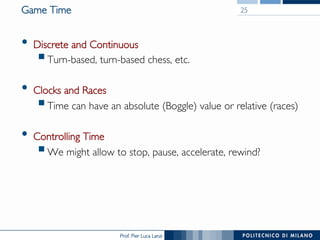
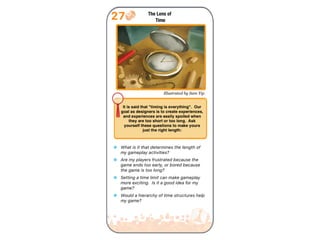
Game Time
•  Discrete and Continuous
§ Turn-based, turn-based chess, etc.
•  Clocks and Races
§ Time can have an absolute (Boggle) value or relative (races)
•  Controlling Time
§ We might allow to stop, pause, accelerate, rewind?
25
Prof. Pier Luca Lanzi
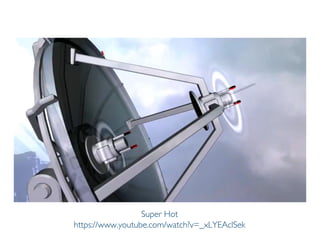
Super Hot
https://www.youtube.com/watch?v=_xLYEAclSek
Prof. Pier Luca Lanzi
Mechanic #3: Objects, Attributes & States
Prof. Pier Luca Lanzi
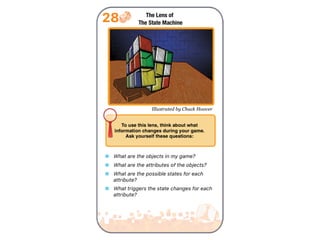
Objects, Attributes, States
•  Objects
§ Characters, props, tokens, scoreboards, or anything that can be seen or
manipulated in a game
§ Objects are the “nouns” of game mechanics
§ Sometimes, space can be considered an object
•  Attributes
§ Define categories of information about an object. In a racing game, a car
might have maximum speed and current speed as attributes. Each attribute
has a current state.
•  States
§ Each attribute has a current state.
§ The state of the “maximum speed” attribute might be 150 mph, while the
state of the “current speed” attribute might be 75 mph
29
Prof. Pier Luca Lanzi
Game designers decide objects have
what attributes and what states
There are often multiple ways to
represent the same thing.
The “right” way to think about something is
whichever way is most useful at the moment
Games that force the players to be aware of too many
states (too many game pieces, too many statistics about
each character) to play can confuse and overwhelm
Prof. Pier Luca Lanzi
Secrets
A very important decision about game attributes
and their states is who is aware of which ones.
In many board games, all information is public
In card games, some information is hidden
What about video games?
Prof. Pier Luca Lanzi
Mechanic #4: Actions
Prof. Pier Luca Lanzi
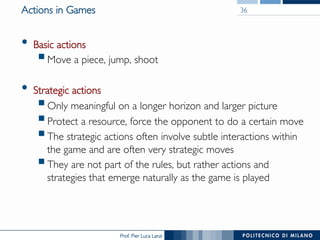
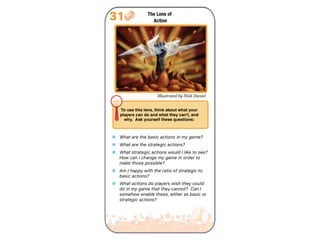
Actions in Games
•  Basic actions
§ Move a piece, jump, shoot
•  Strategic actions
§ Only meaningful on a longer horizon and larger picture
§ Protect a resource, force the opponent to do a certain move
§ The strategic actions often involve subtle interactions within
the game and are often very strategic moves
§ They are not part of the rules, but rather actions and
strategies that emerge naturally as the game is played
36
Prof. Pier Luca Lanzi
Interesting emergent actions are
the hallmark of a good game
The ratio of meaningful strategic actions
to basic actions is a good measure of
how much emergent behavior your
game features.
Elegant games allow a player few basic actions
and a large number of strategic actions
Prof. Pier Luca Lanzi
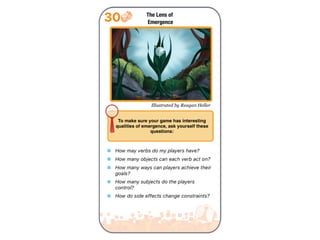
planting seeds for emergence
more verbs (basic actions)
verbs act on more objects
more ways to achieve goals
many subjects
side effects that changes constraints
Prof. Pier Luca Lanzi
Mechanic #5: Rules
Prof. Pier Luca Lanzi
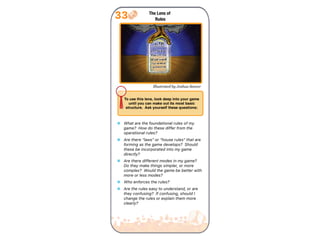
Rules are the most fundamental mechanic.
They define the space, the timing, the objects,
the actions, the consequences of the actions,
the constraints on the actions, and the goals.
Prof. Pier Luca Lanzi
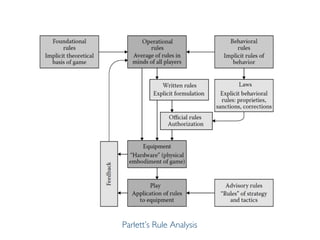
Parlett’s Rule Analysis
Prof. Pier Luca Lanzi
Parlett’s Rule Analysis
•  Operational rules
§ Define what the players do to play the game
•  Foundational rules
§ Define the underlying structure of the game.
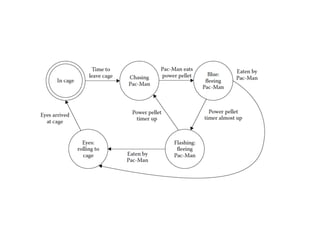
§ “When pac-man eats a pellet it will become invincible”
•  Behavioral rules
§ Implicit to the gameplay and typically part of “good sportsmanship” (don’t
hassle the player when she is thinking a move)
•  Laws
§ Formed when playing in serious competitive settings (e.g., tournament
rules for a specific game).
Prof. Pier Luca Lanzi
Parlett’s Rule Analysis
•  Official rules
§ They merge game rules and laws
§ They are defined when a game is played “seriously enough” (e.g. check!)
•  Advisory rules
§ Tips and rules of strategy to help playing better
•  House rules
§ Added by the players to make the game more fun, balanced, etc.
§ E.g., “no shotgun, no C4, no campers” in some battlefield servers
Prof. Pier Luca Lanzi
Modes
Enforcers
Cheatability
Prof. Pier Luca Lanzi
The Most Important Rule
defines the objective/goal of the game
good games goals should be
concrete, achievable, rewarding
Prof. Pier Luca Lanzi
Mechanic #6: Skill
Prof. Pier Luca Lanzi
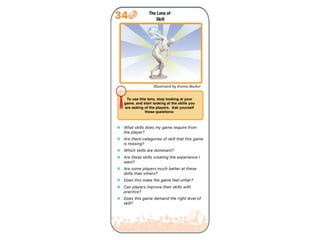
Skill Mechanics
•  Shifts the focus away from the game and onto the player
•  Game require players to exercise certain skills
•  If the player’s skill level is a good match to the game’s difficulty,
the player will feel challenged and stay in the flow channel
•  Games can require
§ Physical skills (dance games, musical instrument based games)
§ Mental skills (memory, observation, problem solving)
§ Social skills (everything that requires reading opponents’ mind,
fooling opponents, team working games)
51
Prof. Pier Luca Lanzi
real vs virtual skills
Prof. Pier Luca Lanzi
Mechanic #7: Chance
Prof. Pier Luca Lanzi
Surprises are an important source of human
pleasure and the secret ingredient of fun
Chance is an essential part of a fun game
because chance means uncertainty, and
uncertainty means surprises
Prof. Pier Luca Lanzi
Skill and Chance Get Tangled
•  Estimating chance is a skill
•  Skills have a probability of success
•  Estimating an opponent’s skill is a skill
•  Predicting pure chance is an imagined skill
•  Controlling pure chance is an imagined skill
57
Prof. Pier Luca Lanzi
Game Mechanics & Rules
•  Game mechanics are the rules, processes, and data at the heart
of a game
•  Rules and mechanics are related concepts, but mechanics are
more detailed and concrete
•  For example, the rules of Monopoly consist of only a few pages,
but the mechanics of Monopoly include the prices of all the
properties and the text of all the Chance and Community Chest
60
Prof. Pier Luca Lanzi
core mechanics indicate mechanics
that are the most influential
for example, the mechanics that implement
gravity in a platform game are core mechanics
in fact, gravity affects almost all moving
objects in the game and interact
Prof. Pier Luca Lanzi
Game mechanics are media independent
They can be implemented through
many different media
Thus, game scholars don’t distinguish
between video/card/board games
Prof. Pier Luca Lanzi
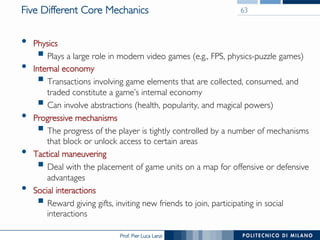
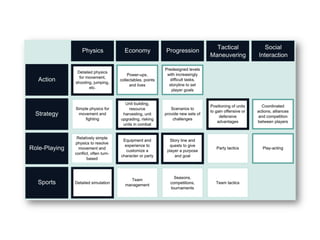
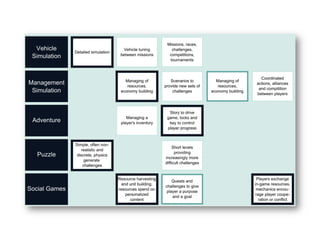
Five Different Core Mechanics
•  Physics
§ Plays a large role in modern video games (e.g., FPS, physics-puzzle games)
•  Internal economy
§ Transactions involving game elements that are collected, consumed, and
traded constitute a game’s internal economy
§ Can involve abstractions (health, popularity, and magical powers)
•  Progressive mechanisms
§ The progress of the player is tightly controlled by a number of mechanisms
that block or unlock access to certain areas
•  Tactical maneuvering
§ Deal with the placement of game units on a map for offensive or defensive
advantages
•  Social interactions
§ Reward giving gifts, inviting new friends to join, participating in social
interactions
63
Prof. Pier Luca Lanzi
Discrete Mechanics vs
Continuous Mechanics
Prof. Pier Luca Lanzi
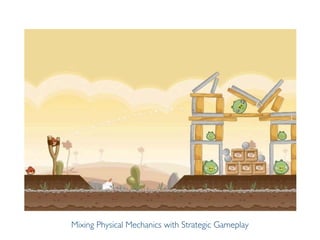
Mixing Physical Mechanics with Strategic Gameplay
Prof. Pier Luca Lanzi
progression mechanics create
games of progression
the other mechanics create
game of emergence
Prof. Pier Luca Lanzi
game of emergence have relatively
simple rules but much variations
the game’s challenge and its flow of
events are not planned in advanced
they emerge during gameplay
Prof. Pier Luca Lanzi
player’s trajectory
the path players take through
the possible states of a game
games that allows many, different, interesting
trajectories arguably have more gameplay than
games that generate fewer less interesting trajectories
Prof. Pier Luca Lanzi
Tic-tac-toe vs Connect4
Prof. Pier Luca Lanzi
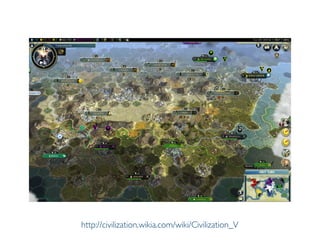
http://civilization.wikia.com/wiki/Civilization_V
Prof. Pier Luca Lanzi
Extra Credits - The Waiting Game - Why Weird Games Become Cult Hits
https://www.youtube.com/watch?v=ptk93AyICH0
73
Prof. Pier Luca Lanzi
http://www.necessarygames.com/my-games/loneliness/flash
Prof. Pier Luca Lanzi
https://www.youtube.com/watch?v=4QwcI4iQt2Y
Prof. Pier Luca Lanzi
https://www.youtube.com/watch?v=pP_qNm-96Dc
Prof. Pier Luca Lanzi
Match Game Mechanics:
An exhaustive survey
Jonathan Bailey with contributions by Christopher Floyd,
Robert Wahler, Lars Bull and Kevin Ryan
Prof. Pier Luca Lanzi
http://www.gamasutra.com/blogs/JonathanBailey/
20150227/237544/Match_Game_Mechanics.php
Prof. Pier Luca Lanzi
http://www.facebook.com/polimigamecollective
https://twitter.com/@POLIMIGC
http://www.youtube.com/PierLucaLanzi
http://www.polimigamecollective.org

Game Mechanics

  • 1.
    Prof. Pier LucaLanzi Game Mechanics Videogame Design and Programming
  • 2.
    Prof. Pier LucaLanzi Player grok MDA Model DynamicsMechanics Aesthetics Game Designer
  • 3.
    Prof. Pier LucaLanzi http://www.cs.northwestern.edu/~hunicke/pubs/MDA.pdf
  • 4.
  • 5.
  • 6.
    Prof. Pier LucaLanzi Mechanics Story Aestethics Technology
  • 7.
    Prof. Pier LucaLanzi The Elemental Tetrad: Mechanics •  The procedures and rules of your game •  Describe the goal of your game •  How players can and cannot try to achieve it •  What happens when they try •  If a set of mechanics is crucial to the gameplay, § These must be supported by the technology § Aesthetics must emphasize them clearly to the players § They should make sense with respect to the story 7
  • 8.
    Prof. Pier LucaLanzi The Elemental Tetrad: Story •  The sequence of events that unfolds in your game •  Linear and prescripted, branching and emergent •  The mechanics should strengthen the story and let it emerge •  Aesthetics should reinforce the ideas of the story •  The technology should be the best suited to the story 8
  • 9.
    Prof. Pier LucaLanzi The Elemental Tetrad: Aesthetics •  How your game looks, sounds, smells, tastes, and feels •  It has the most direct relationship to a player’s experience •  Technology should allow and amplify the target aesthetic tone/ mood of the game •  Mechanics should be coherent to the world that the aesthetics have defined •  The story should have events that let your aesthetics emerge at the right pace and have the most impact 9
  • 10.
    Prof. Pier LucaLanzi The Elemental Tetrad: Technology •  They define the materials and interactions that make your game possible •  The technology enables players to do certain things and prohibits it from doing other things (e.g., Wii and gamepads) •  The technology is essentially the medium in which the aesthetics take place, in which the mechanics will occur, and through which the story will be told. 10
  • 11.
  • 12.
    Prof. Pier LucaLanzi Space Invaders http://www.youtube.com/watch?v=QObneYZIdKI
  • 13.
    Prof. Pier LucaLanzi The Tedrad at Play: Space Invaders •  Technology § Custom made for this game, no other game had it •  Mechanics § The gameplay was completely new, with a player against and advancing army. The player shoots and the aliens shoot back § You can hide behind the shields but the enemy can destroy them § The more enemy the player shoots down the faster the aliens go § Flying saucers give extra points but they are difficult to hit 13
  • 14.
    Prof. Pier LucaLanzi The Tedrad at Play: Space Invaders •  Story § Original story was the players shooting at advancing human soldiers but Taito changed it because it conveyed a bad message § Other war-based games were available (Sea Wolf 1976) § People already complained about game in which you kill people (Death Race 1976) § Marching soldier would better fit a top-down view, aliens give the feeling that their aim is to touch ground •  Aesthetics § Aliens are not identical and have a two frame (very effective) marching animation and music § Colored strips on the screen § The arcade cabinet was attractive and eye catching § Punishing sound when you get hit 14
  • 15.
    Prof. Pier LucaLanzi Skin & Skeleton Skin “the player’s experience” Skeleton “the elements that make up the game” Designers should focus on both at the same time
  • 16.
  • 17.
    Prof. Pier LucaLanzi Game Themes “if our games have unifying, resonant themes, the experiences we create will be much, much stronger.” Jesse Schell Figure out what your theme is. Use every means possible to reinforce that theme.
  • 18.
  • 19.
  • 20.
    Prof. Pier LucaLanzi Game mechanics are the core of what a game truly is What remain when all of the aesthetics, technology, and story are stripped away
  • 21.
    Prof. Pier LucaLanzi Mechanic #1: Space
  • 22.
  • 23.
  • 24.
    Prof. Pier LucaLanzi Mechanic #2: Time
  • 25.
    Prof. Pier LucaLanzi Game Time •  Discrete and Continuous § Turn-based, turn-based chess, etc. •  Clocks and Races § Time can have an absolute (Boggle) value or relative (races) •  Controlling Time § We might allow to stop, pause, accelerate, rewind? 25
  • 26.
  • 27.
    Prof. Pier LucaLanzi Super Hot https://www.youtube.com/watch?v=_xLYEAclSek
  • 28.
    Prof. Pier LucaLanzi Mechanic #3: Objects, Attributes & States
  • 29.
    Prof. Pier LucaLanzi Objects, Attributes, States •  Objects § Characters, props, tokens, scoreboards, or anything that can be seen or manipulated in a game § Objects are the “nouns” of game mechanics § Sometimes, space can be considered an object •  Attributes § Define categories of information about an object. In a racing game, a car might have maximum speed and current speed as attributes. Each attribute has a current state. •  States § Each attribute has a current state. § The state of the “maximum speed” attribute might be 150 mph, while the state of the “current speed” attribute might be 75 mph 29
  • 30.
  • 31.
    Prof. Pier LucaLanzi Game designers decide objects have what attributes and what states There are often multiple ways to represent the same thing. The “right” way to think about something is whichever way is most useful at the moment Games that force the players to be aware of too many states (too many game pieces, too many statistics about each character) to play can confuse and overwhelm
  • 32.
  • 33.
    Prof. Pier LucaLanzi Secrets A very important decision about game attributes and their states is who is aware of which ones. In many board games, all information is public In card games, some information is hidden What about video games?
  • 34.
  • 35.
    Prof. Pier LucaLanzi Mechanic #4: Actions
  • 36.
    Prof. Pier LucaLanzi Actions in Games •  Basic actions § Move a piece, jump, shoot •  Strategic actions § Only meaningful on a longer horizon and larger picture § Protect a resource, force the opponent to do a certain move § The strategic actions often involve subtle interactions within the game and are often very strategic moves § They are not part of the rules, but rather actions and strategies that emerge naturally as the game is played 36
  • 37.
    Prof. Pier LucaLanzi Interesting emergent actions are the hallmark of a good game The ratio of meaningful strategic actions to basic actions is a good measure of how much emergent behavior your game features. Elegant games allow a player few basic actions and a large number of strategic actions
  • 38.
    Prof. Pier LucaLanzi planting seeds for emergence more verbs (basic actions) verbs act on more objects more ways to achieve goals many subjects side effects that changes constraints
  • 39.
  • 40.
  • 41.
    Prof. Pier LucaLanzi Mechanic #5: Rules
  • 42.
    Prof. Pier LucaLanzi Rules are the most fundamental mechanic. They define the space, the timing, the objects, the actions, the consequences of the actions, the constraints on the actions, and the goals.
  • 43.
    Prof. Pier LucaLanzi Parlett’s Rule Analysis
  • 44.
    Prof. Pier LucaLanzi Parlett’s Rule Analysis •  Operational rules § Define what the players do to play the game •  Foundational rules § Define the underlying structure of the game. § “When pac-man eats a pellet it will become invincible” •  Behavioral rules § Implicit to the gameplay and typically part of “good sportsmanship” (don’t hassle the player when she is thinking a move) •  Laws § Formed when playing in serious competitive settings (e.g., tournament rules for a specific game).
  • 45.
    Prof. Pier LucaLanzi Parlett’s Rule Analysis •  Official rules § They merge game rules and laws § They are defined when a game is played “seriously enough” (e.g. check!) •  Advisory rules § Tips and rules of strategy to help playing better •  House rules § Added by the players to make the game more fun, balanced, etc. § E.g., “no shotgun, no C4, no campers” in some battlefield servers
  • 46.
    Prof. Pier LucaLanzi Modes Enforcers Cheatability
  • 47.
    Prof. Pier LucaLanzi The Most Important Rule defines the objective/goal of the game good games goals should be concrete, achievable, rewarding
  • 48.
  • 49.
  • 50.
    Prof. Pier LucaLanzi Mechanic #6: Skill
  • 51.
    Prof. Pier LucaLanzi Skill Mechanics •  Shifts the focus away from the game and onto the player •  Game require players to exercise certain skills •  If the player’s skill level is a good match to the game’s difficulty, the player will feel challenged and stay in the flow channel •  Games can require § Physical skills (dance games, musical instrument based games) § Mental skills (memory, observation, problem solving) § Social skills (everything that requires reading opponents’ mind, fooling opponents, team working games) 51
  • 52.
    Prof. Pier LucaLanzi real vs virtual skills
  • 53.
  • 54.
    Prof. Pier LucaLanzi Mechanic #7: Chance
  • 55.
    Prof. Pier LucaLanzi Surprises are an important source of human pleasure and the secret ingredient of fun Chance is an essential part of a fun game because chance means uncertainty, and uncertainty means surprises
  • 56.
  • 57.
    Prof. Pier LucaLanzi Skill and Chance Get Tangled •  Estimating chance is a skill •  Skills have a probability of success •  Estimating an opponent’s skill is a skill •  Predicting pure chance is an imagined skill •  Controlling pure chance is an imagined skill 57
  • 58.
  • 59.
  • 60.
    Prof. Pier LucaLanzi Game Mechanics & Rules •  Game mechanics are the rules, processes, and data at the heart of a game •  Rules and mechanics are related concepts, but mechanics are more detailed and concrete •  For example, the rules of Monopoly consist of only a few pages, but the mechanics of Monopoly include the prices of all the properties and the text of all the Chance and Community Chest 60
  • 61.
    Prof. Pier LucaLanzi core mechanics indicate mechanics that are the most influential for example, the mechanics that implement gravity in a platform game are core mechanics in fact, gravity affects almost all moving objects in the game and interact
  • 62.
    Prof. Pier LucaLanzi Game mechanics are media independent They can be implemented through many different media Thus, game scholars don’t distinguish between video/card/board games
  • 63.
    Prof. Pier LucaLanzi Five Different Core Mechanics •  Physics § Plays a large role in modern video games (e.g., FPS, physics-puzzle games) •  Internal economy § Transactions involving game elements that are collected, consumed, and traded constitute a game’s internal economy § Can involve abstractions (health, popularity, and magical powers) •  Progressive mechanisms § The progress of the player is tightly controlled by a number of mechanisms that block or unlock access to certain areas •  Tactical maneuvering § Deal with the placement of game units on a map for offensive or defensive advantages •  Social interactions § Reward giving gifts, inviting new friends to join, participating in social interactions 63
  • 64.
  • 65.
  • 66.
    Prof. Pier LucaLanzi Discrete Mechanics vs Continuous Mechanics
  • 67.
    Prof. Pier LucaLanzi Mixing Physical Mechanics with Strategic Gameplay
  • 68.
    Prof. Pier LucaLanzi progression mechanics create games of progression the other mechanics create game of emergence
  • 69.
    Prof. Pier LucaLanzi game of emergence have relatively simple rules but much variations the game’s challenge and its flow of events are not planned in advanced they emerge during gameplay
  • 70.
    Prof. Pier LucaLanzi player’s trajectory the path players take through the possible states of a game games that allows many, different, interesting trajectories arguably have more gameplay than games that generate fewer less interesting trajectories
  • 71.
    Prof. Pier LucaLanzi Tic-tac-toe vs Connect4
  • 72.
    Prof. Pier LucaLanzi http://civilization.wikia.com/wiki/Civilization_V
  • 73.
    Prof. Pier LucaLanzi Extra Credits - The Waiting Game - Why Weird Games Become Cult Hits https://www.youtube.com/watch?v=ptk93AyICH0 73
  • 74.
    Prof. Pier LucaLanzi http://www.necessarygames.com/my-games/loneliness/flash
  • 75.
    Prof. Pier LucaLanzi https://www.youtube.com/watch?v=4QwcI4iQt2Y
  • 76.
    Prof. Pier LucaLanzi https://www.youtube.com/watch?v=pP_qNm-96Dc
  • 77.
    Prof. Pier LucaLanzi Match Game Mechanics: An exhaustive survey Jonathan Bailey with contributions by Christopher Floyd, Robert Wahler, Lars Bull and Kevin Ryan
  • 78.
    Prof. Pier LucaLanzi http://www.gamasutra.com/blogs/JonathanBailey/ 20150227/237544/Match_Game_Mechanics.php
  • 79.
    Prof. Pier LucaLanzi http://www.facebook.com/polimigamecollective https://twitter.com/@POLIMIGC http://www.youtube.com/PierLucaLanzi http://www.polimigamecollective.org