
GAME DESIGN 102
                                                   David J Gagnon
                                 University of Wisconsin - Madison
ENGAGE Program & Games, Learning and Society Research Community
SISSYFIGHT 3000
SETUP
                                      Green     Blue
• Divide   into groups of 5
                                       Red      Black
• Take    1 sheet and 10 paperclips
                                      White   No Target
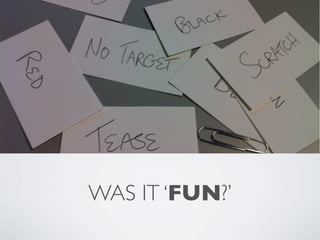
• Label   the Cards

• Choose     a color                  Tease    Scratch

                                      Cower
OVERVIEW


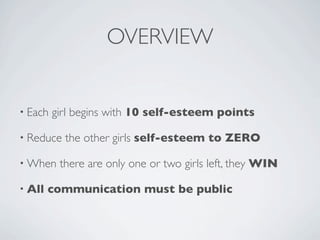
• Each   girl begins with 10 self-esteem points

• Reduce   the other girls self-esteem to ZERO

• When    there are only one or two girls left, they WIN

• All   communication must be public
TO PLAY
• Choose    an ACTION and   • Scratch - Target discards
 TARGET in secret. Defend    one paperclip
 is played with No Target   • Tease   - If anyone else teams
• Reveal
                             against the same target, she
          cards
                             discards two paperclips per
 simultaneously
                             attacking player
• Score   the result        • Cower   - If no one attacks
                             you, loose a paper clip,
                             otherwise loose half chips
                             required (round down)
WAS IT ‘FUN?’
WHAT IS ‘FUN?’
IT IS OUR PSYCHOLOGY
WAS IT A ‘GAME?’
MDA
Mechanics
Dynamics
Aesthetics
AESTHETICS
   Sensation
    Fantasy
   Narrative
   Challenge
  Fellowship
  Discovery
  Expression
  Submission
MDA APPLIED
   Mechanics
   Dynamics
   Aesthetics
WORK BACKWARD FROM
EXPERIENCE TO DESIGN

MDA Framework with SissyFight 3000

  • 1.
    GAME DESIGN 102 David J Gagnon University of Wisconsin - Madison ENGAGE Program & Games, Learning and Society Research Community
  • 2.
  • 3.
    SETUP Green Blue • Divide into groups of 5 Red Black • Take 1 sheet and 10 paperclips White No Target • Label the Cards • Choose a color Tease Scratch Cower
  • 4.
    OVERVIEW • Each girl begins with 10 self-esteem points • Reduce the other girls self-esteem to ZERO • When there are only one or two girls left, they WIN • All communication must be public
  • 5.
    TO PLAY • Choose an ACTION and • Scratch - Target discards TARGET in secret. Defend one paperclip is played with No Target • Tease - If anyone else teams • Reveal against the same target, she cards discards two paperclips per simultaneously attacking player • Score the result • Cower - If no one attacks you, loose a paper clip, otherwise loose half chips required (round down)
  • 6.
  • 7.
  • 17.
    IT IS OURPSYCHOLOGY
  • 19.
    WAS IT A‘GAME?’
  • 20.
  • 21.
    AESTHETICS Sensation Fantasy Narrative Challenge Fellowship Discovery Expression Submission
  • 22.
    MDA APPLIED Mechanics Dynamics Aesthetics
  • 23.

Editor's Notes

  • #2 I manage the design and production of: \nPresentation card games, ARIS, Bacteria, Cryo, Music\n\nI got here because of the intersection between learning and play:\nMediated consequences, Magnified Feedback, Systems thinking, Identity\n\nMy background is in programming, rave promotion, electronic-music and video production\n
  • #3 A playground fight between a group of school girls\n\nDesigned by Eric Zimmermann of Game Lab \n\n
  • #4 \n
  • #5 \n
  • #6 \n
  • #7 Who can answer this? It must be observed\n\nDoes everyone have the same answer?\n\nWas it fun for you?\n\n\n
  • #8 \n\n
  • #9 \n\n
  • #10 \n\n
  • #11 \n\n
  • #12 \n\n
  • #13 \n\n
  • #14 \n\n
  • #15 \n\n
  • #16 \n\n
  • #17 \n\n
  • #18 \n\n\n
  • #19 1949 - Right here at UW Madison\n\nHarry Harlow saw intrinsic motivation in monkeys solving puzzles. \n\nUp until then the only motivations were considered to be BIOLOGICAL or EXTERNAL\n\nHe called it the THIRD DRIVE. \n\n1969 - Edward Deci repeated the experiment with human students, got the same results\n
  • #20 Defining a game may be even harder than fun\n\n\n
  • #21 Mechanics - Rules and concepts that formally specify the game as a system\n\nDynamics - The run-time behavior of the game.\n\nAesthetics -The desirable emotional responses (aka fun) by the games dynamics\n
  • #22 Game as Art Object\nGame as make-believe\nGame as unfolding story\nGame as obstacle course\nGame as social framework\nGame as uncharted territory\nGame as soap box\n\n
  • #23 MDA applied to SissyFight\n\nMechanics:\nTurn-Based\nHit Points\nPublic Communication\nSimultaneous Action\n\nDynamics:\nCooperation and Team Attacks\nCompetition and Random Attacks\n\nAesthetics:\nFellowship: Negotiation, Cooperation, Betrayal, Manipulation\nNarrative: Drama and lots of emergence\n\n
  • #24 When I talk with Artists they often hate this. It’s not about the designer pushing themselves out, making their feelings known. No one cares about the designer. Players want to experience something themselves. \n\nOur job as designers is to give them something they will feel.\n\nAesthetics: What do I want them to feel?\n\nDynamics: What kinds of emergent behaviors get us there?\n\nMechanics: What systems will give rise to those behaviors?\n\n\n\n\n\n\n