











Prof. Pier Luca Lanzi
engagement through gamification
Pier Luca Lanzi – Politecnico di Milano
Design Methods and Processes – May, 19th 2016
Prof. Pier Luca Lanzi
what is gamification?
Prof. Pier Luca Lanzi
gamification is …
the use of game elements and
game design techniques in
non-game contexts.
Prof. Pier Luca Lanzi
gamification is …
the use of the elements of play
in non-game contexts.
Prof. Pier Luca Lanzi
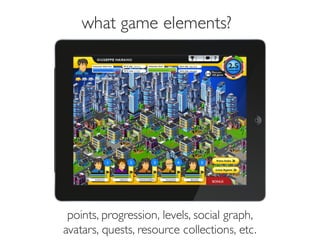
what game elements?
points, progression, levels, social graph,
avatars, quests, resource collections, etc.
Prof. Pier Luca Lanzi
what is the goal?
to engage users in an activity
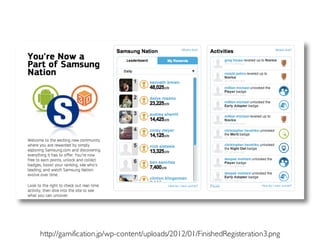
Prof. Pier Luca Lanzihttp://gamification.jp/wp-content/uploads/2012/01/FinishedRegisteration3.png
Prof. Pier Luca Lanzi
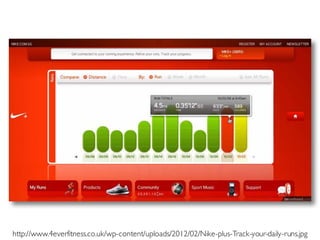
Prof. Pier Luca Lanzihttp://www.4everfitness.co.uk/wp-content/uploads/2012/02/Nike-plus-Track-your-daily-runs.jpg
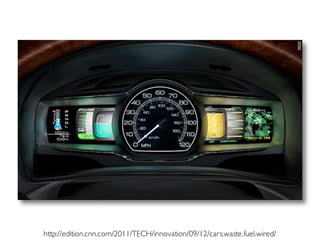
Prof. Pier Luca Lanzihttp://edition.cnn.com/2011/TECH/innovation/09/12/cars.waste.fuel.wired/
Prof. Pier Luca Lanzi
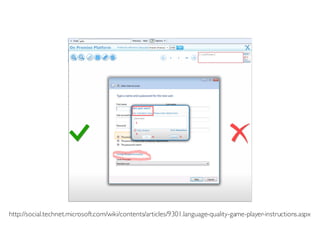
http://social.technet.microsoft.com/wiki/contents/articles/9301.language-quality-game-player-instructions.aspx
Prof. Pier Luca Lanzi
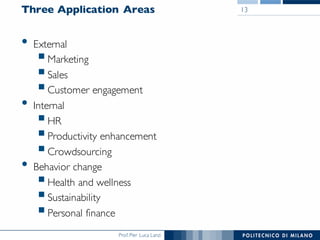
Three Application Areas
• External
§Marketing
§Sales
§Customer engagement
• Internal
§HR
§Productivity enhancement
§Crowdsourcing
• Behavior change
§Health and wellness
§Sustainability
§Personal finance
13
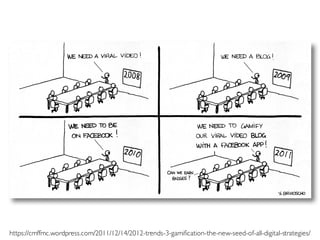
Prof. Pier Luca Lanzihttps://cmffmc.wordpress.com/2011/12/14/2012-trends-3-gamification-the-new-seed-of-all-digital-strategies/
Prof. Pier Luca Lanzi
a brief history of gamification
Prof. Pier Luca Lanzi
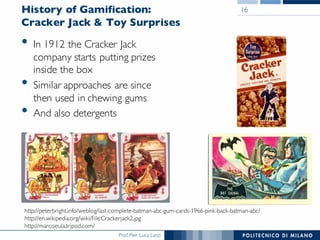
History of Gamification:
Cracker Jack & Toy Surprises
• In 1912 the Cracker Jack
company starts putting prizes
inside the box
• Similar approaches are since
then used in chewing gums
• And also detergents
16
http://peterbright.info/weblog/last-complete-batman-abc-gum-cards-1966-pink-back-batman-abc/
http://en.wikipedia.org/wiki/File:Crackerjack2.jpg
http://marcoeula.tripod.com/
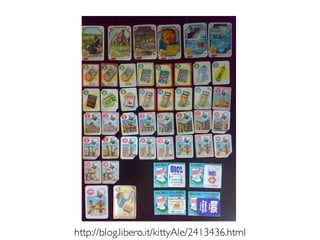
Prof. Pier Luca Lanzihttp://blog.libero.it/kittyAle/2413436.html
Prof. Pier Luca Lanzi
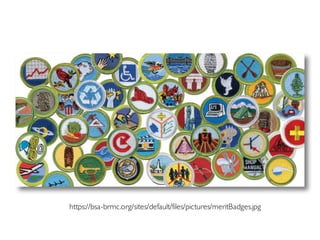
https://bsa-brmc.org/sites/default/files/pictures/meritBadges.jpg
Prof. Pier Luca Lanzi
History of Gamification: The Serious
Games Initiative & Games for Change
19
http://www.gamesforchange.org/
Prof. Pier Luca Lanzi
Gamification as a Service 20
Prof. Pier Luca Lanzi
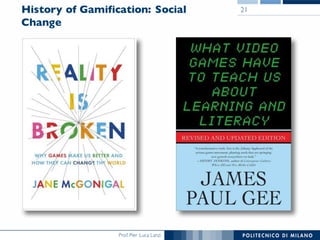
History of Gamification: Social
Change
21
Prof. Pier Luca Lanzi
behavior change
Prof. Pier Luca Lanzi
23
Prof. Pier Luca Lanzi
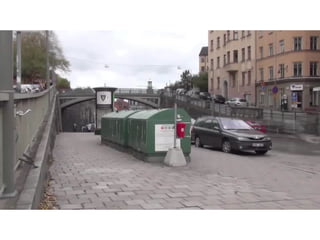
The FunTheory
https://www.youtube.com/watch?v=iynzHWwJXaA
https://www.youtube.com/watch?v=qRgWttqFKu8
https://www.youtube.com/watch?v=zCt_MzsnIUk
https://www.youtube.com/watch?v=lZ9uT23ixLc
https://www.youtube.com/watch?v=vWG6IWgX0Q8
Prof. Pier Luca Lanzi
so what is gamification?
and what is not?
Prof. Pier Luca Lanzi
Gamification is not …
• “Making everything a game” or a “Virtual 3D World”
• Any games in the workplace
• Any use of games in business
• Simulations (although they may constitute serious games)
• Just for marketing or customer engagement
• Just PBLs (points, badges, leaderboards)
31
Prof. Pier Luca Lanzi
it is not about “making games”
Gamification is not about game-making.It is about using game-like mechanics to
modify a behavior,improve a business process, or customer experience,or profits.
Stop thinking about how you can build a real-time strategy game with resources
allocated according to your customers needs and start focusing on tweaks and
behavioral changes that improve your users’experience and your bottom
Prof. Pier Luca Lanzi
know what you are
trying to achieve
Gamification is not about trying to make a game. Thus, what is the point of your
game?To increase consumer engagement? Can you measure success?
How will you know if you have succeeded?
List the three major goals you want to achieve through “gamification”.
Make the goals measurable.
Prof. Pier Luca Lanzi
games are rubbish
at customer acquisition
Gamification won’t work as a way of acquiring an audience,it will be a total waste
of money. Gamification is effective to encourage behaviors amongst users,to keep
them engaged with a brand or to spread a message.
It should not be used to get customers in the first place.
Prof. Pier Luca Lanzi
retention is crucial
whatever the gamification objective is,users should be coming back regularly rather
than just once.Users are more likely to remember the message if they come back
every day for seven days. If you want them to share with their friends, they need to
spend some time to feel that is useful,fun or rewarding.
Prof. Pier Luca Lanzi
games are not just
about competition
“gamification”often translates into points, badges and leaderboards.
The general assumption is that the desire for people to be
at the top of the leaderboard will do the rest. But it won’t.
Gamers have different goals and many of them
are not fulfilled by points, badges,and leaderboards.
Prof. Pier Luca Lanzi
foundations
Prof. Pier Luca Lanzi
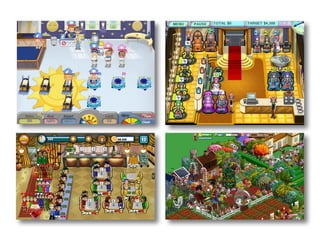
everything has the
potential to be fun!
Prof. Pier Luca Lanzi
https://www.youtube.com/watch?v=U8VHc49ZdP4
Prof. Pier Luca Lanzi
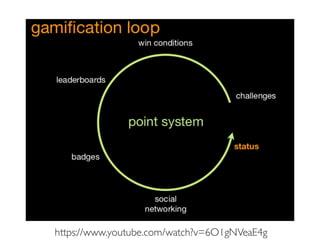
Prof. Pier Luca Lanzihttps://www.youtube.com/watch?v=6O1gNVeaE4g
Prof. Pier Luca Lanzi
status is everything
Prof. Pier Luca Lanzi
The Evolution of Loyalty
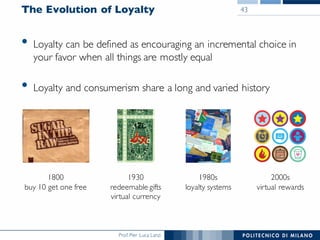
• Loyalty can be defined as encouraging an incremental choice in
your favor when all things are mostly equal
• Loyalty and consumerism share a long and varied history
43
1800
buy 10 get one free
1930
redeemable gifts
virtual currency
1980s
loyalty systems
2000s
virtual rewards
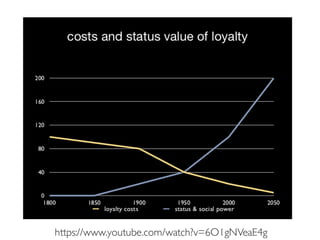
Prof. Pier Luca Lanzihttps://www.youtube.com/watch?v=6O1gNVeaE4g
Prof. Pier Luca Lanzi
status, access, power (SAP)
this acronym identifies the system or rewards (each potential prize) in order from
the most to the least desired,the most sticky to the least sticky, and the cheapest
to the most expensive
Prof. Pier Luca Lanzi
Status
• Defines the relative position of an individual in relation to others,
especially in a social group
• The benefits and rewards status provides give players the ability
to move ahead of others in a defined ranking system
• The ranking system need not be based on the real world at all
• Status works perfectly in a purely constructed environment
• Badges and leaderboards are typical status items
47
Prof. Pier Luca Lanzi
Badges, Levels and Leaderboards
• Badges
§Badges are a known status item
§They can be given out virtually or physically
§They must be visible to other players in the game; otherwise,
their meaning and valuation is limited
• Levels and Leaderboards
§Levels and leaderboards are another way to indicate that a
player has more or less status or achievement in a given game;
they can be a powerful tool in your quest for engagement.
48
Prof. Pier Luca Lanzi
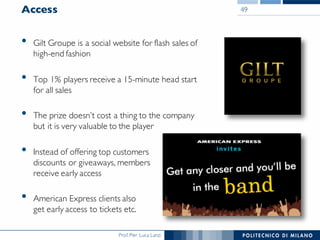
Access
• Gilt Groupe is a social website for flash sales of
high-end fashion
• Top 1% players receive a 15-minute head start
for all sales
• The prize doesn’t cost a thing to the company
but it is very valuable to the player
• Instead of offering top customers
discounts or giveaways, members
receive early access
• American Express clients also
get early access to tickets etc.
49
Prof. Pier Luca Lanzi
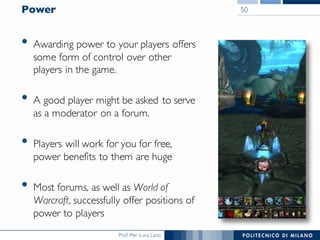
Power
• Awarding power to your players offers
some form of control over other
players in the game.
• A good player might be asked to serve
as a moderator on a forum.
• Players will work for you for free,
power benefits to them are huge
• Most forums, as well as World of
Warcraft, successfully offer positions of
power to players
50
Prof. Pier Luca Lanzi
Stuff
• This is the least powerful rewards or prize
• If there are great items to give away, and if players are expecting
to receive free items, stuff can be a strong incentive.
• Once the item has been given away, however, the incentive to
play is finished.
• In other words, stuff is only good until it is redeemed, which is
the exact length of time your players will engage in the game.
51
Prof. Pier Luca Lanzi
Players cannot accurately price status, access and power
Thus they tend to overvalue them.
When assessing the importance of not having to wait
in line, most people overvalue their time saved.
Similarly, people cannot quantify the minutes they got to
meet with Lady Gaga backstage after winning a contest.
The price of this valuables is almost always cheaper—
and the reward stickier—than giving away free stuff.
Prof. Pier Luca Lanzi
motivation
Prof. Pier Luca Lanzi
reinforcement
studies how we convert expected rewards into player action by
varying the reward quantity and delivery schedule
Prof. Pier Luca Lanzi
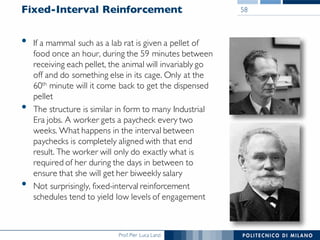
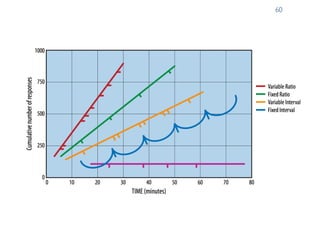
Fixed-Interval Reinforcement
• If a mammal such as a lab rat is given a pellet of
food once an hour, during the 59 minutes between
receiving each pellet, the animal will invariably go
off and do something else in its cage. Only at the
60th minute will it come back to get the dispensed
pellet
• The structure is similar in form to many Industrial
Era jobs. A worker gets a paycheck every two
weeks. What happens in the interval between
paychecks is completely aligned with that end
result. The worker will only do exactly what is
required of her during the days in between to
ensure that she will get her biweekly salary
• Not surprisingly, fixed-interval reinforcement
schedules tend to yield low levels of engagement
58
Prof. Pier Luca Lanzi
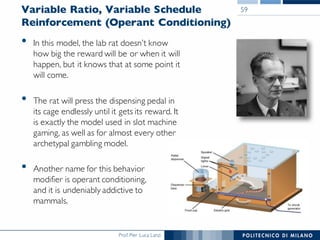
Variable Ratio, Variable Schedule
Reinforcement (Operant Conditioning)
• In this model, the lab rat doesn’t know
how big the reward will be or when it will
happen, but it knows that at some point it
will come.
• The rat will press the dispensing pedal in
its cage endlessly until it gets its reward. It
is exactly the model used in slot machine
gaming, as well as for almost every other
archetypal gambling model.
• Another name for this behavior
modifier is operant conditioning,
and it is undeniably addictive to
mammals.
59
Prof. Pier Luca Lanzi
60
Prof. Pier Luca Lanzi
Intrinsic versus Extrinsic Motivation
• To understand player motivations we need to understand where
motivations come from
• Psychology has divided our motivations into two groups: intrinsic
and extrinsic
• Intrinsic motivations are those that derive from our core self and
are not necessarily based on the world around us
• Extrinsic motivations are driven mostly by the world around us,
such as the desire to make money or win a spelling bee.
61
Prof. Pier Luca Lanzi
three views
Prof. Pier Luca Lanzi
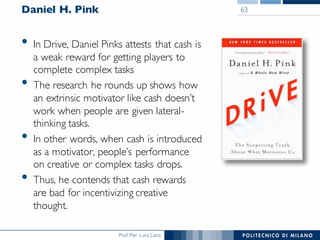
Daniel H. Pink
• In Drive, Daniel Pinks attests that cash is
a weak reward for getting players to
complete complex tasks
• The research he rounds up shows how
an extrinsic motivator like cash doesn’t
work when people are given lateral-
thinking tasks.
• In other words, when cash is introduced
as a motivator, people’s performance
on creative or complex tasks drops.
• Thus, he contends that cash rewards
are bad for incentivizing creative
thought.
63
Prof. Pier Luca Lanzi
Dr. John Houston
• Exceptionally competitive people can be self-destructively
competitive.
• People—principally achiever/killer types—with a high level of
competitiveness compete even when there is nothing to be
gained
• Moreover, they tend to compete even when there’s a clear
disincentive to do so
• When told that they must collaborate with a partner,
hypercompetitive people will continue to try and figure out how
to win, even against a friend, even when there is nothing to win.
64
Prof. Pier Luca Lanzi
Overjustification/Replacement Bias
• Replacing an intrinsic motivation with an extrinsic reward is fairly easy
• When a child who plays the piano simply because she enjoys it is introduced
to competitive piano playing, many changes in her behavior can occur.
• For instance, if she begins to win competitions, then subsequently loses, she
will stop playing piano
• Extrinsic rewards crush intrinsic motivation, which never returns
• The challenge for overjustification as a design constraint is that it’s not obvious
that we care to preserve intrinsic motivation if the player is failing
• For instance, if a player is really intrinsically motivated as an accountant, but
he’s not good at his job, why would we want to preserve his intrinsic desire?
65
Prof. Pier Luca Lanzi
over-justification effect
rewards used as extrinsic motivators can
eliminate existing intrinsic motivation
Prof. Pier Luca Lanzi
self determination theory
Prof. Pier Luca Lanzi
Limits of Behaviorism?
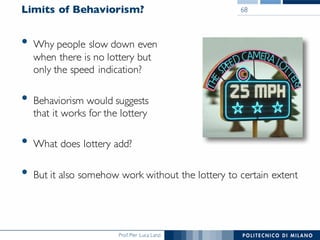
• Why people slow down even
when there is no lottery but
only the speed indication?
• Behaviorism would suggests
that it works for the lottery
• What does lottery add?
• But it also somehow work without the lottery to certain extent
68
Prof. Pier Luca Lanzi
Danger of Behaviorism
• Behaviorism by focusing on the reward distribution do
not consider what might really motivate people
• Potential abuse/manipulation (use to convince people to
do things they don’t want to do, to become addicted)
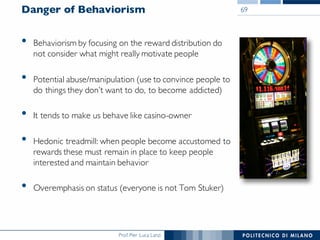
• It tends to make us behave like casino-owner
• Hedonic treadmill: when people become accustomed to
rewards these must remain in place to keep people
interested and maintain behavior
• Overemphasis on status (everyone is not Tom Stuker)
69
Prof. Pier Luca Lanzi
Self Determination Theory
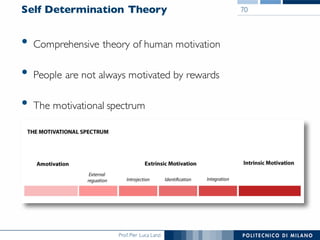
• Comprehensive theory of human motivation
• People are not always motivated by rewards
• The motivational spectrum
70
Prof. Pier Luca Lanzi
The Motivational Spectrum
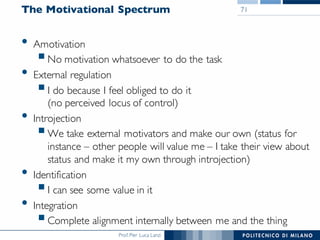
• Amotivation
§No motivation whatsoever to do the task
• External regulation
§I do because I feel obliged to do it
(no perceived locus of control)
• Introjection
§We take external motivators and make our own (status for
instance – other people will value me – I take their view about
status and make it my own through introjection)
• Identification
§I can see some value in it
• Integration
§Complete alignment internally between me and the thing
71
Prof. Pier Luca Lanzi
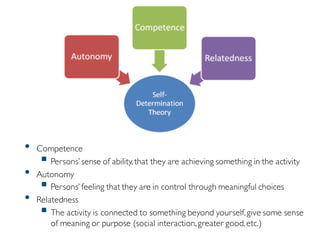
• Competence
§ Persons’ sense of ability, that they are achieving something in the activity
• Autonomy
§ Persons’ feeling that they are in control through meaningful choices
• Relatedness
§ The activity is connected to something beyond yourself,give some sense
of meaning or purpose (social interaction,greater good,etc.)
Prof. Pier Luca Lanzi
and now the end is near and
so I face the final curtain …
Prof. Pier Luca Lanzi
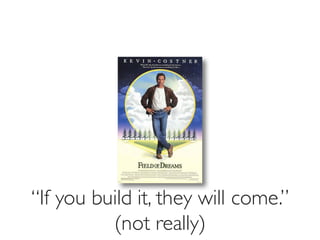
“If you build it, they will come.”
(not really)
Prof. Pier Luca Lanzi
it is all about engaging the users
and rely on their motivations
Prof. Pier Luca Lanzi
mastery
Prof. Pier Luca Lanzi
you are not the mountain,
you are the sherpa
Prof. Pier Luca Lanzi
designing for the novice,
considering the elder
Prof. Pier Luca Lanzi
what about serious games?
they are games! Games that have a major
objective that is not entertainment but still games!
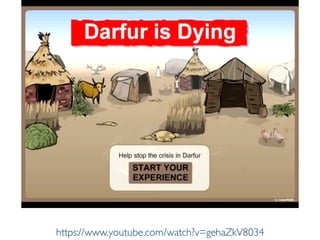
Prof. Pier Luca Lanzihttps://www.youtube.com/watch?v=gehaZkV8034
Prof. Pier Luca Lanzi
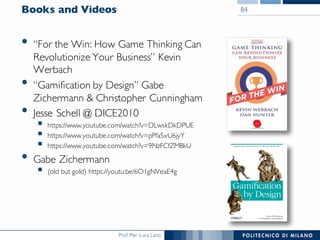
Books and Videos
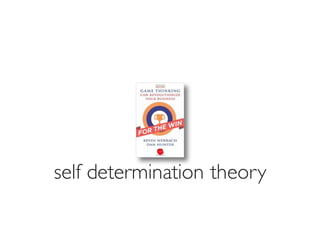
• “For the Win: How Game Thinking Can
Revolutionize Your Business” Kevin
Werbach
• “Gamification by Design” Gabe
Zichermann & Christopher Cunningham
• Jesse Schell @ DICE2010
§ https://www.youtube.com/watch?v=DLwskDkDPUE
§ https://www.youtube.com/watch?v=pPfaSxU6jyY
§ https://www.youtube.com/watch?v=9NzFCfZMBkU
• Gabe Zichermann
§ (old but gold) https://youtu.be/6O1gNVeaE4g
84
Prof. Pier Luca Lanzi
Congratulations!You unlocked the
“attending a gamification seminar” badge!
Prof. Pier Luca Lanzi

Engagement through Gamification

  • 1.
    Prof. Pier LucaLanzi engagement through gamification Pier Luca Lanzi – Politecnico di Milano Design Methods and Processes – May, 19th 2016
  • 2.
    Prof. Pier LucaLanzi what is gamification?
  • 3.
    Prof. Pier LucaLanzi gamification is … the use of game elements and game design techniques in non-game contexts.
  • 4.
    Prof. Pier LucaLanzi gamification is … the use of the elements of play in non-game contexts.
  • 5.
    Prof. Pier LucaLanzi what game elements? points, progression, levels, social graph, avatars, quests, resource collections, etc.
  • 6.
    Prof. Pier LucaLanzi what is the goal? to engage users in an activity
  • 7.
    Prof. Pier LucaLanzihttp://gamification.jp/wp-content/uploads/2012/01/FinishedRegisteration3.png
  • 8.
  • 9.
    Prof. Pier LucaLanzihttp://www.4everfitness.co.uk/wp-content/uploads/2012/02/Nike-plus-Track-your-daily-runs.jpg
  • 10.
    Prof. Pier LucaLanzihttp://edition.cnn.com/2011/TECH/innovation/09/12/cars.waste.fuel.wired/
  • 11.
  • 12.
    Prof. Pier LucaLanzi http://social.technet.microsoft.com/wiki/contents/articles/9301.language-quality-game-player-instructions.aspx
  • 13.
    Prof. Pier LucaLanzi Three Application Areas • External §Marketing §Sales §Customer engagement • Internal §HR §Productivity enhancement §Crowdsourcing • Behavior change §Health and wellness §Sustainability §Personal finance 13
  • 14.
    Prof. Pier LucaLanzihttps://cmffmc.wordpress.com/2011/12/14/2012-trends-3-gamification-the-new-seed-of-all-digital-strategies/
  • 15.
    Prof. Pier LucaLanzi a brief history of gamification
  • 16.
    Prof. Pier LucaLanzi History of Gamification: Cracker Jack & Toy Surprises • In 1912 the Cracker Jack company starts putting prizes inside the box • Similar approaches are since then used in chewing gums • And also detergents 16 http://peterbright.info/weblog/last-complete-batman-abc-gum-cards-1966-pink-back-batman-abc/ http://en.wikipedia.org/wiki/File:Crackerjack2.jpg http://marcoeula.tripod.com/
  • 17.
    Prof. Pier LucaLanzihttp://blog.libero.it/kittyAle/2413436.html
  • 18.
    Prof. Pier LucaLanzi https://bsa-brmc.org/sites/default/files/pictures/meritBadges.jpg
  • 19.
    Prof. Pier LucaLanzi History of Gamification: The Serious Games Initiative & Games for Change 19 http://www.gamesforchange.org/
  • 20.
    Prof. Pier LucaLanzi Gamification as a Service 20
  • 21.
    Prof. Pier LucaLanzi History of Gamification: Social Change 21
  • 22.
    Prof. Pier LucaLanzi behavior change
  • 23.
  • 24.
  • 25.
  • 26.
    Prof. Pier LucaLanzi The FunTheory https://www.youtube.com/watch?v=iynzHWwJXaA https://www.youtube.com/watch?v=qRgWttqFKu8 https://www.youtube.com/watch?v=zCt_MzsnIUk https://www.youtube.com/watch?v=lZ9uT23ixLc https://www.youtube.com/watch?v=vWG6IWgX0Q8
  • 27.
  • 28.
  • 29.
  • 30.
    Prof. Pier LucaLanzi so what is gamification? and what is not?
  • 31.
    Prof. Pier LucaLanzi Gamification is not … • “Making everything a game” or a “Virtual 3D World” • Any games in the workplace • Any use of games in business • Simulations (although they may constitute serious games) • Just for marketing or customer engagement • Just PBLs (points, badges, leaderboards) 31
  • 32.
    Prof. Pier LucaLanzi it is not about “making games” Gamification is not about game-making.It is about using game-like mechanics to modify a behavior,improve a business process, or customer experience,or profits. Stop thinking about how you can build a real-time strategy game with resources allocated according to your customers needs and start focusing on tweaks and behavioral changes that improve your users’experience and your bottom
  • 33.
    Prof. Pier LucaLanzi know what you are trying to achieve Gamification is not about trying to make a game. Thus, what is the point of your game?To increase consumer engagement? Can you measure success? How will you know if you have succeeded? List the three major goals you want to achieve through “gamification”. Make the goals measurable.
  • 34.
    Prof. Pier LucaLanzi games are rubbish at customer acquisition Gamification won’t work as a way of acquiring an audience,it will be a total waste of money. Gamification is effective to encourage behaviors amongst users,to keep them engaged with a brand or to spread a message. It should not be used to get customers in the first place.
  • 35.
    Prof. Pier LucaLanzi retention is crucial whatever the gamification objective is,users should be coming back regularly rather than just once.Users are more likely to remember the message if they come back every day for seven days. If you want them to share with their friends, they need to spend some time to feel that is useful,fun or rewarding.
  • 36.
    Prof. Pier LucaLanzi games are not just about competition “gamification”often translates into points, badges and leaderboards. The general assumption is that the desire for people to be at the top of the leaderboard will do the rest. But it won’t. Gamers have different goals and many of them are not fulfilled by points, badges,and leaderboards.
  • 37.
    Prof. Pier LucaLanzi foundations
  • 38.
    Prof. Pier LucaLanzi everything has the potential to be fun!
  • 39.
    Prof. Pier LucaLanzi https://www.youtube.com/watch?v=U8VHc49ZdP4
  • 40.
  • 41.
    Prof. Pier LucaLanzihttps://www.youtube.com/watch?v=6O1gNVeaE4g
  • 42.
    Prof. Pier LucaLanzi status is everything
  • 43.
    Prof. Pier LucaLanzi The Evolution of Loyalty • Loyalty can be defined as encouraging an incremental choice in your favor when all things are mostly equal • Loyalty and consumerism share a long and varied history 43 1800 buy 10 get one free 1930 redeemable gifts virtual currency 1980s loyalty systems 2000s virtual rewards
  • 44.
    Prof. Pier LucaLanzihttps://www.youtube.com/watch?v=6O1gNVeaE4g
  • 45.
  • 46.
    Prof. Pier LucaLanzi status, access, power (SAP) this acronym identifies the system or rewards (each potential prize) in order from the most to the least desired,the most sticky to the least sticky, and the cheapest to the most expensive
  • 47.
    Prof. Pier LucaLanzi Status • Defines the relative position of an individual in relation to others, especially in a social group • The benefits and rewards status provides give players the ability to move ahead of others in a defined ranking system • The ranking system need not be based on the real world at all • Status works perfectly in a purely constructed environment • Badges and leaderboards are typical status items 47
  • 48.
    Prof. Pier LucaLanzi Badges, Levels and Leaderboards • Badges §Badges are a known status item §They can be given out virtually or physically §They must be visible to other players in the game; otherwise, their meaning and valuation is limited • Levels and Leaderboards §Levels and leaderboards are another way to indicate that a player has more or less status or achievement in a given game; they can be a powerful tool in your quest for engagement. 48
  • 49.
    Prof. Pier LucaLanzi Access • Gilt Groupe is a social website for flash sales of high-end fashion • Top 1% players receive a 15-minute head start for all sales • The prize doesn’t cost a thing to the company but it is very valuable to the player • Instead of offering top customers discounts or giveaways, members receive early access • American Express clients also get early access to tickets etc. 49
  • 50.
    Prof. Pier LucaLanzi Power • Awarding power to your players offers some form of control over other players in the game. • A good player might be asked to serve as a moderator on a forum. • Players will work for you for free, power benefits to them are huge • Most forums, as well as World of Warcraft, successfully offer positions of power to players 50
  • 51.
    Prof. Pier LucaLanzi Stuff • This is the least powerful rewards or prize • If there are great items to give away, and if players are expecting to receive free items, stuff can be a strong incentive. • Once the item has been given away, however, the incentive to play is finished. • In other words, stuff is only good until it is redeemed, which is the exact length of time your players will engage in the game. 51
  • 52.
    Prof. Pier LucaLanzi Players cannot accurately price status, access and power Thus they tend to overvalue them. When assessing the importance of not having to wait in line, most people overvalue their time saved. Similarly, people cannot quantify the minutes they got to meet with Lady Gaga backstage after winning a contest. The price of this valuables is almost always cheaper— and the reward stickier—than giving away free stuff.
  • 53.
    Prof. Pier LucaLanzi motivation
  • 54.
  • 55.
  • 56.
  • 57.
    Prof. Pier LucaLanzi reinforcement studies how we convert expected rewards into player action by varying the reward quantity and delivery schedule
  • 58.
    Prof. Pier LucaLanzi Fixed-Interval Reinforcement • If a mammal such as a lab rat is given a pellet of food once an hour, during the 59 minutes between receiving each pellet, the animal will invariably go off and do something else in its cage. Only at the 60th minute will it come back to get the dispensed pellet • The structure is similar in form to many Industrial Era jobs. A worker gets a paycheck every two weeks. What happens in the interval between paychecks is completely aligned with that end result. The worker will only do exactly what is required of her during the days in between to ensure that she will get her biweekly salary • Not surprisingly, fixed-interval reinforcement schedules tend to yield low levels of engagement 58
  • 59.
    Prof. Pier LucaLanzi Variable Ratio, Variable Schedule Reinforcement (Operant Conditioning) • In this model, the lab rat doesn’t know how big the reward will be or when it will happen, but it knows that at some point it will come. • The rat will press the dispensing pedal in its cage endlessly until it gets its reward. It is exactly the model used in slot machine gaming, as well as for almost every other archetypal gambling model. • Another name for this behavior modifier is operant conditioning, and it is undeniably addictive to mammals. 59
  • 60.
  • 61.
    Prof. Pier LucaLanzi Intrinsic versus Extrinsic Motivation • To understand player motivations we need to understand where motivations come from • Psychology has divided our motivations into two groups: intrinsic and extrinsic • Intrinsic motivations are those that derive from our core self and are not necessarily based on the world around us • Extrinsic motivations are driven mostly by the world around us, such as the desire to make money or win a spelling bee. 61
  • 62.
    Prof. Pier LucaLanzi three views
  • 63.
    Prof. Pier LucaLanzi Daniel H. Pink • In Drive, Daniel Pinks attests that cash is a weak reward for getting players to complete complex tasks • The research he rounds up shows how an extrinsic motivator like cash doesn’t work when people are given lateral- thinking tasks. • In other words, when cash is introduced as a motivator, people’s performance on creative or complex tasks drops. • Thus, he contends that cash rewards are bad for incentivizing creative thought. 63
  • 64.
    Prof. Pier LucaLanzi Dr. John Houston • Exceptionally competitive people can be self-destructively competitive. • People—principally achiever/killer types—with a high level of competitiveness compete even when there is nothing to be gained • Moreover, they tend to compete even when there’s a clear disincentive to do so • When told that they must collaborate with a partner, hypercompetitive people will continue to try and figure out how to win, even against a friend, even when there is nothing to win. 64
  • 65.
    Prof. Pier LucaLanzi Overjustification/Replacement Bias • Replacing an intrinsic motivation with an extrinsic reward is fairly easy • When a child who plays the piano simply because she enjoys it is introduced to competitive piano playing, many changes in her behavior can occur. • For instance, if she begins to win competitions, then subsequently loses, she will stop playing piano • Extrinsic rewards crush intrinsic motivation, which never returns • The challenge for overjustification as a design constraint is that it’s not obvious that we care to preserve intrinsic motivation if the player is failing • For instance, if a player is really intrinsically motivated as an accountant, but he’s not good at his job, why would we want to preserve his intrinsic desire? 65
  • 66.
    Prof. Pier LucaLanzi over-justification effect rewards used as extrinsic motivators can eliminate existing intrinsic motivation
  • 67.
    Prof. Pier LucaLanzi self determination theory
  • 68.
    Prof. Pier LucaLanzi Limits of Behaviorism? • Why people slow down even when there is no lottery but only the speed indication? • Behaviorism would suggests that it works for the lottery • What does lottery add? • But it also somehow work without the lottery to certain extent 68
  • 69.
    Prof. Pier LucaLanzi Danger of Behaviorism • Behaviorism by focusing on the reward distribution do not consider what might really motivate people • Potential abuse/manipulation (use to convince people to do things they don’t want to do, to become addicted) • It tends to make us behave like casino-owner • Hedonic treadmill: when people become accustomed to rewards these must remain in place to keep people interested and maintain behavior • Overemphasis on status (everyone is not Tom Stuker) 69
  • 70.
    Prof. Pier LucaLanzi Self Determination Theory • Comprehensive theory of human motivation • People are not always motivated by rewards • The motivational spectrum 70
  • 71.
    Prof. Pier LucaLanzi The Motivational Spectrum • Amotivation §No motivation whatsoever to do the task • External regulation §I do because I feel obliged to do it (no perceived locus of control) • Introjection §We take external motivators and make our own (status for instance – other people will value me – I take their view about status and make it my own through introjection) • Identification §I can see some value in it • Integration §Complete alignment internally between me and the thing 71
  • 72.
    Prof. Pier LucaLanzi • Competence § Persons’ sense of ability, that they are achieving something in the activity • Autonomy § Persons’ feeling that they are in control through meaningful choices • Relatedness § The activity is connected to something beyond yourself,give some sense of meaning or purpose (social interaction,greater good,etc.)
  • 73.
  • 74.
  • 75.
  • 76.
    Prof. Pier LucaLanzi and now the end is near and so I face the final curtain …
  • 77.
    Prof. Pier LucaLanzi “If you build it, they will come.” (not really)
  • 78.
    Prof. Pier LucaLanzi it is all about engaging the users and rely on their motivations
  • 79.
    Prof. Pier LucaLanzi mastery
  • 80.
    Prof. Pier LucaLanzi you are not the mountain, you are the sherpa
  • 81.
    Prof. Pier LucaLanzi designing for the novice, considering the elder
  • 82.
    Prof. Pier LucaLanzi what about serious games? they are games! Games that have a major objective that is not entertainment but still games!
  • 83.
    Prof. Pier LucaLanzihttps://www.youtube.com/watch?v=gehaZkV8034
  • 84.
    Prof. Pier LucaLanzi Books and Videos • “For the Win: How Game Thinking Can Revolutionize Your Business” Kevin Werbach • “Gamification by Design” Gabe Zichermann & Christopher Cunningham • Jesse Schell @ DICE2010 § https://www.youtube.com/watch?v=DLwskDkDPUE § https://www.youtube.com/watch?v=pPfaSxU6jyY § https://www.youtube.com/watch?v=9NzFCfZMBkU • Gabe Zichermann § (old but gold) https://youtu.be/6O1gNVeaE4g 84
  • 85.
    Prof. Pier LucaLanzi Congratulations!You unlocked the “attending a gamification seminar” badge!
  • 86.