IOSR Journal of Mathematics (IOSR-JM)
e-ISSN: 2278-5728,p-ISSN: 2319-765X, Volume 6, Issue 5 (May. - Jun. 2013), PP 56-65
www.iosrjournals.org
www.iosrjournals.org 56 | Page
TT--PPrree ––OOppeerraattoorrss
PPrrooff.. DDrr.. NNaaddiirr.. GG.. MMaannssoouurr ,, HHaannaann.. kk.. mmoouussssaa
((DDeeppaarrttmmeenntt ooff MMaattiimmaattiiccss,, CCoolllleeggee ooff EEdduuccaattiioonn,,AALL--MMuussttaannssiirryyaa UUnniivveerrssiittyy,, IIrraaqq))
AAbbssttrraacctt:: TThhee mmaaiinn oobbjjeecctt ooff tthhiiss ppaappeerr ttoo iinnttrroodduuccee TT--pprree--ooppeerraattoorr,,TT--pprree--ooppeenn sseett,, TT--pprree--mmoonnoottoonnee,,pprree--
ssuubbaaddiittiivvee ooppeerraattoorr aanndd pprree--rreegguullaarr ooppeerraattoorr.. AAss wweellll aass wwee iinnttrroodduuccee ((TT,,LL))pprree--ccoonnttiinnuuiittyy..
KKeeyywwoorrddss:: TT--pprree--ooppeerraattoorr,, TT--pprree--ooppeenn sseett,, ((TT,,LL))pprree--ccoonnttiinnuuiittyy
II.. IInnttrroodduuccttiioonn
Mashhour [2] introduced pre-open sets in a topological space and studied some of their properties. IInn
11997799 kkaassaahhaarraa [[11]] ddeeffiinneedd tthhee ooppeerraattoorr α oonn aattooppoollooggiiccaall ssppaaccee ((XX,,)) aass aa mmaapp ffrroomm PP((XX)) ttoo PP((XX)) ssuucchh tthhaatt
UUα ((UU)) ffoorr eevveerryy U   . In 1991 Ogata[4] called the operation α as γ operation and introduced the notion of
τγ which is the collection of all γ- open sets in atopological space (X ,τ). Several research papers published in
recent years using γ operator due to Ogata[4].
In1999 Rossas and Vielma [5] modified the definition by allowing the operator α to be defined in P(X)
as a map α from P(X) to P(X). In 2006 Mansur and Ibrahim [3] introduced the concept of an operation T on α-
open set in a topological space (X,) namely T- α-operator and studied some of their properties .
In this paper we introduce the concept of an operation T on a family of pre-open sets in atopological space
(X,). Asubset S of X is called pre-open set if S int(cl(S)). In §2 Using the operation T, we introduce the
concept T-pre-open sets, T-pre-monotone, pre-subaditive operator and pre-regular operator. We study some of
their properties and optained new results. In §3 we present and study new types of function by using the
operations T and L. say (T,L)pre-continuous, (T,L)pre-irresolute continuous and (T,L)strongly pre-continuous.
IIII.. TT--PPrree--OOppeerraattoorrss
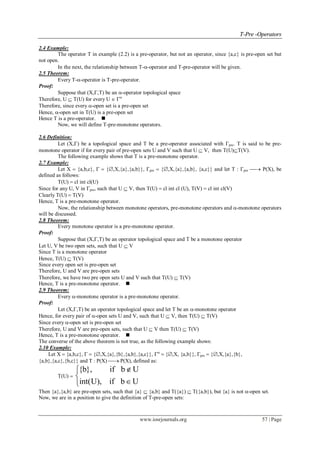
2.1 Definition:
Let (X,) be a topological space and T be an operator from pre to P(X), i.e., T : pre  P(X). We say
that T is a pre-operator associated with pre if:
U  T(U), for every U  pre
and the triple (X,,T) is called T-pre-operator topological space.
The following example shows that T is a pre-operator.
2.2 Example:
Let X  {a,b,c},   {,X,{a},{a,b}}, pre  {,X,{a},{a,b}, {a,c}} and T : pre  P(X), defined
as:
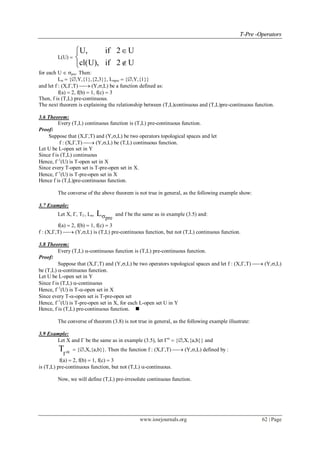
T(U) 
U, if U {a}
cl(U), if U {a}



Clearly U  T(U), for every U  pre
Hence, T is a pre-operator.
In the following theorem, we present the relationship between T-operator and T-pre-operator.
2.3 Theorem:
Every T-operator is T-pre-operator.
Proof:
Suppose that (X,,T) is an operator topological space
Therefore, U  T(U), for every U  
Since every open set is a pre-open set
Hence, each open set in T(U) is a pre-open set
Therefore, T is a pre operator. 
The Converse of the theorem is not true in general, as the following example shows:
TT--PPrree --OOppeerraattoorrss
www.iosrjournals.org 57 | Page
2.4 Example:
The operator T in example (2.2) is a pre-operator, but not an operator, since {a,c} is pre-open set but
not open.
In the next, the relationship between T--operator and T-pre-operator will be given.
2.5 Theorem:
Every T--operator is T-pre-operator.
Proof:
Suppose that (X,,T) be an -operator topological space
Therefore, U  T(U) for every U  
Therefore, since every -open set is a pre-open set
Hence, -open set in T(U) is a pre-open set
Hence T is a pre-operator. 
Now, we will define T-pre-monotone operators.
2.6 Definition:
Let (X,) be a topological space and T be a pre-operator associated with pre. T is said to be pre-
monotone operator if for every pair of pre-open sets U and V such that U  V, then T(U)T(V).
The following example shows that T is a pre-monotone operator.
2.7 Example:
Let X  {a,b,c},   {,X,{a},{a,b}}, pre  {,X,{a},{a,b}, {a,c}} and let T : pre  P(X), be
defined as follows:
T(U)  cl int cl(U)
Since for any U, V in pre, such that U  V, then T(U)  cl int cl (U), T(V)  cl int cl(V)
Clearly T(U)  T(V)
Hence, T is a pre-monotone operator.
Now, the relationship between monotone operators, pre-monotone operators and -monotone operators
will be discussed.
2.8 Theorem:
Every monotone operator is a pre-monotone operator.
Proof:
Suppose that (X,,T) be an operator topological space and T be a monotone operator
Let U, V be two open sets, such that U  V
Since T is a monotone operator
Hence, T(U)  T(V)
Since every open set is pre-open set
Therefore, U and V are pre-open sets
Therefore, we have two pre open sets U and V such that T(U)  T(V)
Hence, T is a pre-monotone operator. 
2.9 Theorem:
Every -monotone operator is a pre-monotone operator.
Proof:
Let (X,,T) be an operator topological space and let T be an -monotone operator
Hence, for every pair of -open sets U and V, such that U  V, then T(U)  T(V)
Since every -open set is pre-open set
Therefore, U and V are pre-open sets, such that U  V then T(U)  T(V)
Hence, T is a pre-monotone operator. 
The converse of the above theorem is not true, as the following example shows:
2.10 Example:
Let X  {a,b,c},   {,X,{a},{b},{a,b},{a,c}}, 
 {,X, {a,b}}, pre  {,X,{a},{b},
{a,b},{a,c},{b,c}} and T : P(X)  P(X), defined as:
T(U) 
{b}, if b U
int(U), if b U



Then {a},{a,b} are pre-open sets, such that {a}  {a,b} and T({a})  T({a,b}), but {a} is not -open set.
Now, we are in a position to give the definition of T-pre-open sets:
TT--PPrree --OOppeerraattoorrss
www.iosrjournals.org 58 | Page
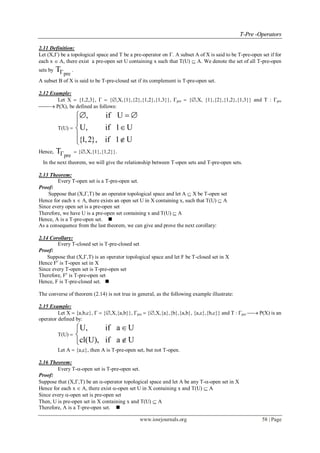
2.11 Definition:
Let (X,) be a topological space and T be a pre-operator on . A subset A of X is said to be T-pre-open set if for
each x  A, there exist a pre-open set U containing x such that T(U)  A. We denote the set of all T-pre-open
sets by
pre
T .
A subset B of X is said to be T-pre-closed set if its complement is T-pre-open set.
2.12 Example:
Let X  {1,2,3},   {,X,{1},{2},{1,2},{1,3}}, pre  {,X, {1},{2},{1,2},{1,3}} and T : pre
 P(X), be defined as follows:
T(U) 
, if U
U, if 1 U
{1,2}, if 1 U
  


 
Hence,
pre
T  {,X,{1},{1,2}}.
In the next theorem, we will give the relationship between T-open sets and T-pre-open sets.
2.13 Theorem:
Every T-open set is a T-pre-open set.
Proof:
Suppose that (X,,T) be an operator topological space and let A  X be T-open set
Hence for each x  A, there exists an open set U in X containing x, such that T(U)  A
Since every open set is a pre-open set
Therefore, we have U is a pre-open set containing x and T(U)  A
Hence, A is a T-pre-open set. 
As a consequence from the last theorem, we can give and prove the next corollary:
2.14 Corollary:
Every T-closed set is T-pre-closed set
Proof:
Suppose that (X,,T) is an operator topological space and let F be T-closed set in X
Hence Fc
is T-open set in X
Since every T-open set is T-pre-open set
Therefore, Fc
is T-pre-open set
Hence, F is T-pre-closed set. 
The converse of theorem (2.14) is not true in general, as the following example illustrate:
2.15 Example:
Let X  {a,b,c},   {,X,{a,b}}, pre  {,X,{a},{b},{a,b}, {a,c},{b,c}} and T : pre  P(X) is an
operator defined by:
T(U) 
U, if a U
cl(U), if a U



Let A  {a,c}, then A is T-pre-open set, but not T-open.
2.16 Theorem:
Every T--open set is T-pre-open set.
Proof:
Suppose that (X,,T) be an -operator topological space and let A be any T--open set in X
Hence for each x  A, there exist -open set U in X containing x and T(U)  A
Since every -open set is pre-open set
Then, U is pre-open set in X containing x and T(U)  A
Therefore, A is a T-pre-open set. 
TT--PPrree --OOppeerraattoorrss
www.iosrjournals.org 59 | Page
The converse of the above theorem is not true, as it is seen from the following example:
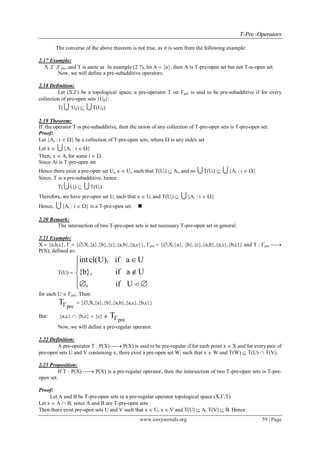
2.17 Example:
X , , pre ,and T is same as In example (2.7), let A  {a}, then A is T-pre-open set but not T--open set.
Now, we will define a pre-subadditive operators.
2.18 Definition:
Let (X,) be a topological space, a pre-operator T on pre is said to be pre-subadditive if for every
collection of pre-open sets {U}:
T(  U)  T(U)
2.19 Theorem:
If the operator T is pre-subadditive, then the union of any collection of T-pre-open sets is T-pre-open set.
Proof:
Let {Ai : i  } be a collection of T-pre-open sets, where  is any index set
Let x  {Ai : i  }
Then, x  Ai for some i  
Since Ai is T-pre-open set
Hence there exist a pre-open set Ui, x  Ui, such that T(Ui)  Ai, and so T(Ui)  {Ai : i  }
Since, T is a pre-subadditive, hence:
T( Ui)  T(Ui)
Therefore, we have pre-open set Ui such that x  Ui and T(Ui)  {Ai : i  }
Hence, {Ai : i  } is a T-pre-open set. 
2.20 Remark:
The intersection of two T-pre-open sets is not necessary T-pre-open set in general.
2.21 Example:
X  {a,b,c},   {,X,{a},{b},{c},{a,b},{a,c}}, pre  {,X,{a}, {b},{c},{a,b},{a,c},{b,c}} and T : pre 
P(X), defined as:
T(U) 
intcl(U), if a U
{b}, if a U
, if U



  
for each U  pre. Then:
pre
T  {,X,{a},{b},{a,b},{a,c},{b,c}}
But: {a,c}  {b,c}  {c} 
pre
T
Now, we will define a pre-regular operator.
2.22 Definition:
A pre-operator T : P(X)  P(X) is said to be pre-regular if for each point x  X and for every pair of
pre-open sets U and V containing x, there exist a pre-open set W, such that x  W and T(W)  T(U)  T(V).
2.23 Proposition:
If T : P(X)  P(X) is a pre-regular operator, then the intersection of two T-pre-open sets is T-pre-
open set.
Proof:
Let A and B be T-pre-open sets in a pre-regular operator topological space (X,,T)
Let x  A  B, since A and B are T-pre-open sets
Then there exist pre-open sets U and V such that x  U, x  V and T(U)  A, T(V)  B. Hence:
TT--PPrree --OOppeerraattoorrss
www.iosrjournals.org 60 | Page
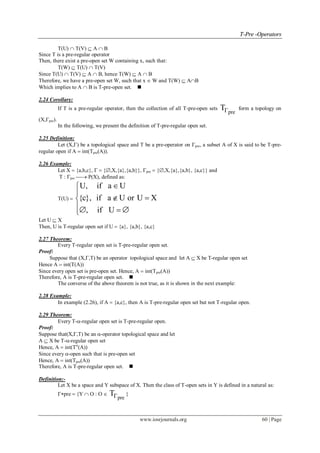
T(U)  T(V)  A  B
Since T is a pre-regular operator
Then, there exist a pre-open set W containing x, such that:
T(W)  T(U)  T(V)
Since T(U)  T(V)  A  B, hence T(W)  A  B
Therefore, we have a pre-open set W, such that x  W and T(W)  AB
Which implies to A  B is T-pre-open set. 
2.24 Corollary:
If T is a pre-regular operator, then the collection of all T-pre-open sets
pre
T form a topology on
(X,pre).
In the following, we present the definition of T-pre-regular open set.
2.25 Definition:
Let (X,) be a topological space and T be a pre-operator on pre, a subset A of X is said to be T-pre-
regular open if A  int(Tpre(A)).
2.26 Example:
Let X  {a,b,c},   {,X,{a},{a,b}}, pre  {,X,{a},{a,b}, {a,c}} and
T : pre  P(X), defined as:
T(U) 
U, if a U
{c}, if a U or U X
, if U


 
  
Let U  X
Then, U is T-regular open set if U  {a}, {a,b}, {a,c}
2.27 Theorem:
Every T-regular open set is T-pre-regular open set.
Proof:
Suppose that (X,,T) be an operator topological space and let A  X be T-regular open set
Hence A  int(T(A))
Since every open set is pre-open set. Hence, A  int(Tpre(A))
Therefore, A is T-pre-regular open set. 
The converse of the above theorem is not true, as it is shown in the next example:
2.28 Example:
In example (2.26), if A  {a,c}, then A is T-pre-regular open set but not T-regular open.
2.29 Theorem:
Every T--regular open set is T-pre-regular open.
Proof:
Suppose that(X,,T) be an -operator topological space and let
A  X be T--regular open set
Hence, A  int(T
(A))
Since every -open such that is pre-open set
Hence, A  int(Tpre(A))
Therefore, A is T-pre-regular open set. 
Definition:-
Let X be a space and Y subspace of X. Then the class of T-open sets in Y is defined in a natural as:
pre  {Y  O : O 
pre
T }
TT--PPrree --OOppeerraattoorrss
www.iosrjournals.org 61 | Page
where
pre
T is the class of T-pre-open sets of X. That is U is T-pre-open set in Y if and only if U  Y  O,
where O is a T-pre-open set in X.
IIIIII.. PPRREE--OOppeerraattoorr ooff CCoonnttiinnuuoouuss FFuunnccttiioonnss
3.1 Definition:[3]
Let (X,) and (Y,) be two topological spaces and T, L be an operators on  and , respectively. A
function f : (X,,T)  (Y,,L) is said to be (T,L) -continuous if and only if for every L-open set U in Y,
f1
(U) is T--open set in X.
The following example shows that the function f is (T,L) -continuous.
3.2 Example:
Let X  {1,2,3},   {,X,{1},{1,3}}, 
 {,X,{1},{1,2}, {1,3}} and
T : P(X)  P(X) defined as:
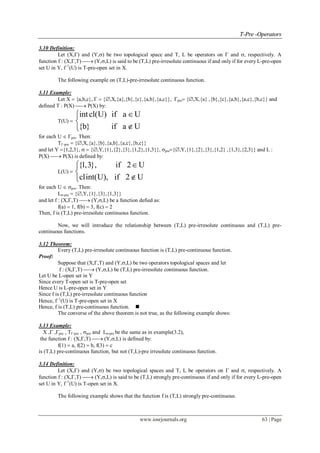
T(U) 
U, if 1 U
cl(U), if 1 U



for each U  
. Then:
T  {,X,{1},{1,3}}
T 
 {,X,{1},{1,2},{1,3}}
and let Y  {a,b,c},   {,Y,{a,b}}, L : P(X)  P(X) defined as:
L(U) 
U, if a U
intcl(U), if a U



for each U  . Then:
L  {,Y,{a,b}}
and let f : (X,,T)  (Y,,L) be a function defined as:
f(1)  a, f(2)  b, f(3)  c
Then f is (T,L) -continuous function.
In the following theorem we present the relationship between (T,L) continuous and (T,L) -continuous
functions.
3.3 Theorem:
Every (T,L) continuous function is (T,L) -continuous function.
Now, we will define (T,L) pre-continuous function.
3.4 Definition:
Let (X,) and (Y,) be two topological spaces and T and L be an operator on  and , respectively. A
function f : (X,,T)  (Y,,L) is (T,L) pre-continuous if and only if for every L-open set U in Y, f1
(U) is T-
pre-open set in X.
The following example shows that the function is (T,L) pre-continuous.
3.5 Example:
Let X  {a,b,c,},   {,X,{a,b}} and T : P(X)  P(X) is defined by:
T(U) 
U, if a U
cl(U), if a U



for each U  . Then:
T  {,X,{a,b}}
and let Y {1,2,3},   {,Y,{1},{3},{1,3},{2,3}}, pre  {,Y,{1}, {3},{1,3}} and L : P(X)  P(X) is
defined by:
TT--PPrree --OOppeerraattoorrss
www.iosrjournals.org 62 | Page
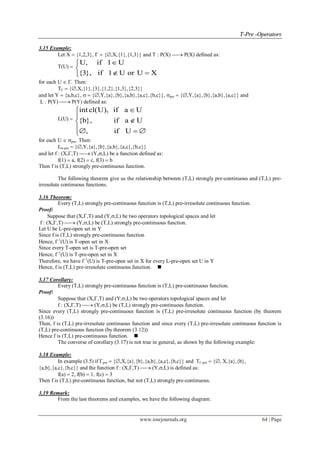
L(U) 
U, if 2 U
cl(U), if 2 U



for each U  pre. Then:
L  {,Y,{1},{2,3}}, Lpre  {,Y,{1}}
and let f : (X,,T)  (Y,,L) be a function defined as:
f(a)  2, f(b)  1, f(c)  3
Then, f is (T,L) pre-continuous.
The next theorem is explaining the relationship between (T,L)continuous and (T,L)pre-continuous function.
3.6 Theorem:
Every (T,L) continuous function is (T,L) pre-continuous function.
Proof:
Suppose that (X,,T) and (Y,,L) be two operators topological spaces and let
f : (X,,T)  (Y,,L) be (T,L) continuous function.
Let U be L-open set in Y
Since f is (T,L) continuous
Hence, f1
(U) is T-open set in X
Since every T-open set is T-pre-open set in X.
Hence, f1
(U) is T-pre-open set in X
Hence f is (T,L)pre-continuous function.
The converse of the above theorem is not true in general, as the following example show:
3.7 Example:
Let X, , T, L,
pre
L and f be the same as in example (3.5) and:
f(a)  2, f(b)  1, f(c)  3
f : (X,,T)  (Y,,L) is (T,L) pre-continuous function, but not (T,L) continuous function.
3.8 Theorem:
Every (T,L) -continuous function is (T,L) pre-continuous function.
Proof:
Suppose that (X,,T) and (Y,,L) be two operators topological spaces and let f : (X,,T)  (Y,,L)
be (T,L) -continuous function.
Let U be L-open set in Y
Since f is (T,L) -continuous
Hence, f1
(U) is T--open set in X
Since every T--open set is T-pre-open set
Hence, f1
(U) is T-pre-open set in X, for each L-open set U in Y
Hence, f is (T,L) pre-continuous function. 
The converse of theorem (3.8) is not true in general, as the following example illustrate:
3.9 Example:
Let X and  be the same as in example (3.5), let 
 {,X,{a,b}} and
T 
 {,X,{a,b}}. Then the function f : (X,,T)  (Y,,L) defined by :
f(a)  2, f(b)  1, f(c)  3
is (T,L) pre-continuous function, but not (T,L) -continuous.
Now, we will define (T,L) pre-irresolute continuous function.
TT--PPrree --OOppeerraattoorrss
www.iosrjournals.org 63 | Page
3.10 Definition:
Let (X,) and (Y,) be two topological space and T, L be operators on  and , respectively. A
function f : (X,,T)  (Y,,L) is said to be (T,L) pre-irresolute continuous if and only if for every L-pre-open
set U in Y, f1
(U) is T-pre-open set in X.
The following example on (T,L)-pre-irresolute continuous function.
3.11 Example:
Let X  {a,b,c},   {,X,{a},{b},{c},{a,b},{a,c}}, pre {,X,{a} ,{b},{c},{a,b},{a,c},{b,c}} and
defined T : P(X)  P(X) by:
T(U) 
intcl(U) if a U
{b} if a U



for each U  pre. Then:
T-pre  {,X,{a},{b},{a,b},{a,c},{b,c}}
and let Y {1,2,3},   {,Y,{1},{2},{3},{1,2},{1,3}}, pre{,Y,{1},{2},{3},{1,2} ,{1,3},{2,3}} and L :
P(X)  P(X) is defined by:
L(U) 
{1,3}, if 2 U
clint(U), if 2 U



for each U  pre. Then:
L-pre  {,Y,{1},{3},{1,3}}
and let f : (X,,T)  (Y,,L) be a function defied as:
f(a)  1, f(b)  3, f(c)  2
Then, f is (T,L) pre-irresolute continuous function.
Now, we will introduce the relationship between (T,L) pre-irresolute continuous and (T,L) pre-
continuous functions.
3.12 Theorem:
Every (T,L) pre-irresolute continuous function is (T,L) pre-continuous function.
Proof:
Suppose that (X,,T) and (Y,,L) be two operators topological spaces and let
f : (X,,T)  (Y,,L) be (T,L) pre-irresolute continuous function.
Let U be L-open set in Y
Since every T-open set is T-pre-open set
Hence U is L-pre-open set in Y
Since f is (T,L) pre-irresolute continuous function
Hence, f1
(U) is T-pre-open set in X
Hence, f is (T,L) pre-continuous function. 
The converse of the above theorem is not true, as the following example shows:
3.13 Example:
X , ,pre , T-pre , pre and L-pre be the same as in example(3.2),
the function f : (X,,T)  (Y,,L) is defined by:
f(1)  a, f(2)  b, f(3)  c
is (T,L) pre-continuous function, but not (T,L)-pre irresolute continuous function.
3.14 Definition:
Let (X,) and (Y,) be two topological spaces and T, L be operators on  and , respectively. A
function f : (X,,T)  (Y,,L) is said to be (T,L) strongly pre-continuous if and only if for every L-pre-open
set U in Y, f1
(U) is T-open set in X.
The following example shows that the function f is (T,L) strongly pre-continuous.
TT--PPrree --OOppeerraattoorrss
www.iosrjournals.org 64 | Page
3.15 Example:
Let X  {1,2,3},   {,X,{1},{1,3}} and T : P(X)  P(X) defined as:
T(U) 
U, if 1 U
{3}, if 1 U or U X


 
for each U  . Then:
T  {,X,{1},{3},{1,2},{1,3},{2,3}}
and let Y  {a,b,c},   {,Y,{a},{b},{a,b},{a,c},{b,c}}, pre  {,Y,{a},{b},{a,b},{a,c}} and
L : P(Y)  P(Y) defined as:
L(U) 
int cl(U), if a U
{b}, if a U
, if U



  
for each U  pre. Then:
L-pre  {,Y,{a},{b},{a,b},{a,c},{b,c}}
and let f : (X,,T)  (Y,,L) be a function defined as:
f(1)  a, f(2)  c, f(3)  b
Then f is (T,L) strongly pre-continuous function.
The following theorem give us the relationship between (T,L) strongly pre-continuous and (T,L) pre-
irresolute continuous functions.
3.16 Theorem:
Every (T,L) strongly pre-continuous function is (T,L) pre-irresolute continuous function.
Proof:
Suppose that (X,,T) and (Y,,L) be two operators topological spaces and let
f : (X,,T)  (Y,,L) be (T,L) strongly pre-continuous function.
Let U be L-pre-open set in Y
Since f is (T,L) strongly pre-continuous function
Hence, f1
(U) is T-open set in X
Since every T-open set is T-pre-open set
Hence, f1
(U) is T-pre-open set in X
Therefore, we have f1
(U) is T-pre-open set in X for every L-pre-open set U in Y
Hence, f is (T,L) pre-irresolute continuous function. 
3.17 Corollary:
Every (T,L) strongly pre-continuous function is (T,L) pre-continuous function.
Proof:
Suppose that (X,,T) and (Y,,L) be two operators topological spaces and let
f : (X,,T)  (Y,,L) be (T,L) strongly pre-continuous function.
Since every (T,L) strongly pre-continuous function is (T,L) pre-irresolute continuous function (by theorem
(3.16))
Then, f is (T,L) pre-irresolute continuous function and since every (T,L) pre-irresolute continuous function is
(T,L) pre-continuous function (by theorem (3.12))
Hence f is (T,L) pre-continuous function. 
The converse of corollary (3.17) is not true in general, as shown by the following example:
3.18 Example:
In example (3.5) if pre  {,X,{a},{b},{a,b},{a,c},{b,c}} and T-pre  {, X,{a},{b},
{a,b},{a,c},{b,c}} and the function f : (X,,T)  (Y,,L) is defined as:
f(a)  2, f(b)  1, f(c)  3
Then f is (T,L) pre-continuous function, but not (T,L) strongly pre-continuous.
3.19 Remark:
From the last theorems and examples, we have the following diagram:
TT--PPrree --OOppeerraattoorrss
www.iosrjournals.org 65 | Page
T-continuous
(T,L) pre-continuous
(T,L) -continuous
(T,L) strongly pre-continuous
(T,L) pre-irresolute continuous
References
[1] S. Kasahara, Operation- compact spaces,Math. Japonica, 24 (1979), 97.
[2] A.S. Mashhour, M.E. Abd EI-Monsef and S.N.EI-Deep, "On Precontinuous and Weak Continuous Mappings" ,Proc., Math., Phys.,
Soc., Egypt,53(1982),47-53.
[3] N.G.Mansur, A.M.Ibrahim "T- -operator" ,Journal of college of education, No.3(2006), p 118-124.
[4] H. Ogata,"Operation on topological spaces and associated topology", Math. Japonica, 36 (1991), 175-184.
[5] E. Rosas, J. Vielma, "Operator decomposition of continuous mappings", Divu’aciones Matem´aticas, 7, No. 1 (1999), 29-
33.

T--Pre –Operattors

  • 1.
    IOSR Journal ofMathematics (IOSR-JM) e-ISSN: 2278-5728,p-ISSN: 2319-765X, Volume 6, Issue 5 (May. - Jun. 2013), PP 56-65 www.iosrjournals.org www.iosrjournals.org 56 | Page TT--PPrree ––OOppeerraattoorrss PPrrooff.. DDrr.. NNaaddiirr.. GG.. MMaannssoouurr ,, HHaannaann.. kk.. mmoouussssaa ((DDeeppaarrttmmeenntt ooff MMaattiimmaattiiccss,, CCoolllleeggee ooff EEdduuccaattiioonn,,AALL--MMuussttaannssiirryyaa UUnniivveerrssiittyy,, IIrraaqq)) AAbbssttrraacctt:: TThhee mmaaiinn oobbjjeecctt ooff tthhiiss ppaappeerr ttoo iinnttrroodduuccee TT--pprree--ooppeerraattoorr,,TT--pprree--ooppeenn sseett,, TT--pprree--mmoonnoottoonnee,,pprree-- ssuubbaaddiittiivvee ooppeerraattoorr aanndd pprree--rreegguullaarr ooppeerraattoorr.. AAss wweellll aass wwee iinnttrroodduuccee ((TT,,LL))pprree--ccoonnttiinnuuiittyy.. KKeeyywwoorrddss:: TT--pprree--ooppeerraattoorr,, TT--pprree--ooppeenn sseett,, ((TT,,LL))pprree--ccoonnttiinnuuiittyy II.. IInnttrroodduuccttiioonn Mashhour [2] introduced pre-open sets in a topological space and studied some of their properties. IInn 11997799 kkaassaahhaarraa [[11]] ddeeffiinneedd tthhee ooppeerraattoorr α oonn aattooppoollooggiiccaall ssppaaccee ((XX,,)) aass aa mmaapp ffrroomm PP((XX)) ttoo PP((XX)) ssuucchh tthhaatt UUα ((UU)) ffoorr eevveerryy U   . In 1991 Ogata[4] called the operation α as γ operation and introduced the notion of τγ which is the collection of all γ- open sets in atopological space (X ,τ). Several research papers published in recent years using γ operator due to Ogata[4]. In1999 Rossas and Vielma [5] modified the definition by allowing the operator α to be defined in P(X) as a map α from P(X) to P(X). In 2006 Mansur and Ibrahim [3] introduced the concept of an operation T on α- open set in a topological space (X,) namely T- α-operator and studied some of their properties . In this paper we introduce the concept of an operation T on a family of pre-open sets in atopological space (X,). Asubset S of X is called pre-open set if S int(cl(S)). In §2 Using the operation T, we introduce the concept T-pre-open sets, T-pre-monotone, pre-subaditive operator and pre-regular operator. We study some of their properties and optained new results. In §3 we present and study new types of function by using the operations T and L. say (T,L)pre-continuous, (T,L)pre-irresolute continuous and (T,L)strongly pre-continuous. IIII.. TT--PPrree--OOppeerraattoorrss 2.1 Definition: Let (X,) be a topological space and T be an operator from pre to P(X), i.e., T : pre  P(X). We say that T is a pre-operator associated with pre if: U  T(U), for every U  pre and the triple (X,,T) is called T-pre-operator topological space. The following example shows that T is a pre-operator. 2.2 Example: Let X  {a,b,c},   {,X,{a},{a,b}}, pre  {,X,{a},{a,b}, {a,c}} and T : pre  P(X), defined as: T(U)  U, if U {a} cl(U), if U {a}    Clearly U  T(U), for every U  pre Hence, T is a pre-operator. In the following theorem, we present the relationship between T-operator and T-pre-operator. 2.3 Theorem: Every T-operator is T-pre-operator. Proof: Suppose that (X,,T) is an operator topological space Therefore, U  T(U), for every U   Since every open set is a pre-open set Hence, each open set in T(U) is a pre-open set Therefore, T is a pre operator.  The Converse of the theorem is not true in general, as the following example shows:
  • 2.
    TT--PPrree --OOppeerraattoorrss www.iosrjournals.org 57| Page 2.4 Example: The operator T in example (2.2) is a pre-operator, but not an operator, since {a,c} is pre-open set but not open. In the next, the relationship between T--operator and T-pre-operator will be given. 2.5 Theorem: Every T--operator is T-pre-operator. Proof: Suppose that (X,,T) be an -operator topological space Therefore, U  T(U) for every U   Therefore, since every -open set is a pre-open set Hence, -open set in T(U) is a pre-open set Hence T is a pre-operator.  Now, we will define T-pre-monotone operators. 2.6 Definition: Let (X,) be a topological space and T be a pre-operator associated with pre. T is said to be pre- monotone operator if for every pair of pre-open sets U and V such that U  V, then T(U)T(V). The following example shows that T is a pre-monotone operator. 2.7 Example: Let X  {a,b,c},   {,X,{a},{a,b}}, pre  {,X,{a},{a,b}, {a,c}} and let T : pre  P(X), be defined as follows: T(U)  cl int cl(U) Since for any U, V in pre, such that U  V, then T(U)  cl int cl (U), T(V)  cl int cl(V) Clearly T(U)  T(V) Hence, T is a pre-monotone operator. Now, the relationship between monotone operators, pre-monotone operators and -monotone operators will be discussed. 2.8 Theorem: Every monotone operator is a pre-monotone operator. Proof: Suppose that (X,,T) be an operator topological space and T be a monotone operator Let U, V be two open sets, such that U  V Since T is a monotone operator Hence, T(U)  T(V) Since every open set is pre-open set Therefore, U and V are pre-open sets Therefore, we have two pre open sets U and V such that T(U)  T(V) Hence, T is a pre-monotone operator.  2.9 Theorem: Every -monotone operator is a pre-monotone operator. Proof: Let (X,,T) be an operator topological space and let T be an -monotone operator Hence, for every pair of -open sets U and V, such that U  V, then T(U)  T(V) Since every -open set is pre-open set Therefore, U and V are pre-open sets, such that U  V then T(U)  T(V) Hence, T is a pre-monotone operator.  The converse of the above theorem is not true, as the following example shows: 2.10 Example: Let X  {a,b,c},   {,X,{a},{b},{a,b},{a,c}},   {,X, {a,b}}, pre  {,X,{a},{b}, {a,b},{a,c},{b,c}} and T : P(X)  P(X), defined as: T(U)  {b}, if b U int(U), if b U    Then {a},{a,b} are pre-open sets, such that {a}  {a,b} and T({a})  T({a,b}), but {a} is not -open set. Now, we are in a position to give the definition of T-pre-open sets:
  • 3.
    TT--PPrree --OOppeerraattoorrss www.iosrjournals.org 58| Page 2.11 Definition: Let (X,) be a topological space and T be a pre-operator on . A subset A of X is said to be T-pre-open set if for each x  A, there exist a pre-open set U containing x such that T(U)  A. We denote the set of all T-pre-open sets by pre T . A subset B of X is said to be T-pre-closed set if its complement is T-pre-open set. 2.12 Example: Let X  {1,2,3},   {,X,{1},{2},{1,2},{1,3}}, pre  {,X, {1},{2},{1,2},{1,3}} and T : pre  P(X), be defined as follows: T(U)  , if U U, if 1 U {1,2}, if 1 U        Hence, pre T  {,X,{1},{1,2}}. In the next theorem, we will give the relationship between T-open sets and T-pre-open sets. 2.13 Theorem: Every T-open set is a T-pre-open set. Proof: Suppose that (X,,T) be an operator topological space and let A  X be T-open set Hence for each x  A, there exists an open set U in X containing x, such that T(U)  A Since every open set is a pre-open set Therefore, we have U is a pre-open set containing x and T(U)  A Hence, A is a T-pre-open set.  As a consequence from the last theorem, we can give and prove the next corollary: 2.14 Corollary: Every T-closed set is T-pre-closed set Proof: Suppose that (X,,T) is an operator topological space and let F be T-closed set in X Hence Fc is T-open set in X Since every T-open set is T-pre-open set Therefore, Fc is T-pre-open set Hence, F is T-pre-closed set.  The converse of theorem (2.14) is not true in general, as the following example illustrate: 2.15 Example: Let X  {a,b,c},   {,X,{a,b}}, pre  {,X,{a},{b},{a,b}, {a,c},{b,c}} and T : pre  P(X) is an operator defined by: T(U)  U, if a U cl(U), if a U    Let A  {a,c}, then A is T-pre-open set, but not T-open. 2.16 Theorem: Every T--open set is T-pre-open set. Proof: Suppose that (X,,T) be an -operator topological space and let A be any T--open set in X Hence for each x  A, there exist -open set U in X containing x and T(U)  A Since every -open set is pre-open set Then, U is pre-open set in X containing x and T(U)  A Therefore, A is a T-pre-open set. 
  • 4.
    TT--PPrree --OOppeerraattoorrss www.iosrjournals.org 59| Page The converse of the above theorem is not true, as it is seen from the following example: 2.17 Example: X , , pre ,and T is same as In example (2.7), let A  {a}, then A is T-pre-open set but not T--open set. Now, we will define a pre-subadditive operators. 2.18 Definition: Let (X,) be a topological space, a pre-operator T on pre is said to be pre-subadditive if for every collection of pre-open sets {U}: T(  U)  T(U) 2.19 Theorem: If the operator T is pre-subadditive, then the union of any collection of T-pre-open sets is T-pre-open set. Proof: Let {Ai : i  } be a collection of T-pre-open sets, where  is any index set Let x  {Ai : i  } Then, x  Ai for some i   Since Ai is T-pre-open set Hence there exist a pre-open set Ui, x  Ui, such that T(Ui)  Ai, and so T(Ui)  {Ai : i  } Since, T is a pre-subadditive, hence: T( Ui)  T(Ui) Therefore, we have pre-open set Ui such that x  Ui and T(Ui)  {Ai : i  } Hence, {Ai : i  } is a T-pre-open set.  2.20 Remark: The intersection of two T-pre-open sets is not necessary T-pre-open set in general. 2.21 Example: X  {a,b,c},   {,X,{a},{b},{c},{a,b},{a,c}}, pre  {,X,{a}, {b},{c},{a,b},{a,c},{b,c}} and T : pre  P(X), defined as: T(U)  intcl(U), if a U {b}, if a U , if U       for each U  pre. Then: pre T  {,X,{a},{b},{a,b},{a,c},{b,c}} But: {a,c}  {b,c}  {c}  pre T Now, we will define a pre-regular operator. 2.22 Definition: A pre-operator T : P(X)  P(X) is said to be pre-regular if for each point x  X and for every pair of pre-open sets U and V containing x, there exist a pre-open set W, such that x  W and T(W)  T(U)  T(V). 2.23 Proposition: If T : P(X)  P(X) is a pre-regular operator, then the intersection of two T-pre-open sets is T-pre- open set. Proof: Let A and B be T-pre-open sets in a pre-regular operator topological space (X,,T) Let x  A  B, since A and B are T-pre-open sets Then there exist pre-open sets U and V such that x  U, x  V and T(U)  A, T(V)  B. Hence:
  • 5.
    TT--PPrree --OOppeerraattoorrss www.iosrjournals.org 60| Page T(U)  T(V)  A  B Since T is a pre-regular operator Then, there exist a pre-open set W containing x, such that: T(W)  T(U)  T(V) Since T(U)  T(V)  A  B, hence T(W)  A  B Therefore, we have a pre-open set W, such that x  W and T(W)  AB Which implies to A  B is T-pre-open set.  2.24 Corollary: If T is a pre-regular operator, then the collection of all T-pre-open sets pre T form a topology on (X,pre). In the following, we present the definition of T-pre-regular open set. 2.25 Definition: Let (X,) be a topological space and T be a pre-operator on pre, a subset A of X is said to be T-pre- regular open if A  int(Tpre(A)). 2.26 Example: Let X  {a,b,c},   {,X,{a},{a,b}}, pre  {,X,{a},{a,b}, {a,c}} and T : pre  P(X), defined as: T(U)  U, if a U {c}, if a U or U X , if U        Let U  X Then, U is T-regular open set if U  {a}, {a,b}, {a,c} 2.27 Theorem: Every T-regular open set is T-pre-regular open set. Proof: Suppose that (X,,T) be an operator topological space and let A  X be T-regular open set Hence A  int(T(A)) Since every open set is pre-open set. Hence, A  int(Tpre(A)) Therefore, A is T-pre-regular open set.  The converse of the above theorem is not true, as it is shown in the next example: 2.28 Example: In example (2.26), if A  {a,c}, then A is T-pre-regular open set but not T-regular open. 2.29 Theorem: Every T--regular open set is T-pre-regular open. Proof: Suppose that(X,,T) be an -operator topological space and let A  X be T--regular open set Hence, A  int(T (A)) Since every -open such that is pre-open set Hence, A  int(Tpre(A)) Therefore, A is T-pre-regular open set.  Definition:- Let X be a space and Y subspace of X. Then the class of T-open sets in Y is defined in a natural as: pre  {Y  O : O  pre T }
  • 6.
    TT--PPrree --OOppeerraattoorrss www.iosrjournals.org 61| Page where pre T is the class of T-pre-open sets of X. That is U is T-pre-open set in Y if and only if U  Y  O, where O is a T-pre-open set in X. IIIIII.. PPRREE--OOppeerraattoorr ooff CCoonnttiinnuuoouuss FFuunnccttiioonnss 3.1 Definition:[3] Let (X,) and (Y,) be two topological spaces and T, L be an operators on  and , respectively. A function f : (X,,T)  (Y,,L) is said to be (T,L) -continuous if and only if for every L-open set U in Y, f1 (U) is T--open set in X. The following example shows that the function f is (T,L) -continuous. 3.2 Example: Let X  {1,2,3},   {,X,{1},{1,3}},   {,X,{1},{1,2}, {1,3}} and T : P(X)  P(X) defined as: T(U)  U, if 1 U cl(U), if 1 U    for each U   . Then: T  {,X,{1},{1,3}} T   {,X,{1},{1,2},{1,3}} and let Y  {a,b,c},   {,Y,{a,b}}, L : P(X)  P(X) defined as: L(U)  U, if a U intcl(U), if a U    for each U  . Then: L  {,Y,{a,b}} and let f : (X,,T)  (Y,,L) be a function defined as: f(1)  a, f(2)  b, f(3)  c Then f is (T,L) -continuous function. In the following theorem we present the relationship between (T,L) continuous and (T,L) -continuous functions. 3.3 Theorem: Every (T,L) continuous function is (T,L) -continuous function. Now, we will define (T,L) pre-continuous function. 3.4 Definition: Let (X,) and (Y,) be two topological spaces and T and L be an operator on  and , respectively. A function f : (X,,T)  (Y,,L) is (T,L) pre-continuous if and only if for every L-open set U in Y, f1 (U) is T- pre-open set in X. The following example shows that the function is (T,L) pre-continuous. 3.5 Example: Let X  {a,b,c,},   {,X,{a,b}} and T : P(X)  P(X) is defined by: T(U)  U, if a U cl(U), if a U    for each U  . Then: T  {,X,{a,b}} and let Y {1,2,3},   {,Y,{1},{3},{1,3},{2,3}}, pre  {,Y,{1}, {3},{1,3}} and L : P(X)  P(X) is defined by:
  • 7.
    TT--PPrree --OOppeerraattoorrss www.iosrjournals.org 62| Page L(U)  U, if 2 U cl(U), if 2 U    for each U  pre. Then: L  {,Y,{1},{2,3}}, Lpre  {,Y,{1}} and let f : (X,,T)  (Y,,L) be a function defined as: f(a)  2, f(b)  1, f(c)  3 Then, f is (T,L) pre-continuous. The next theorem is explaining the relationship between (T,L)continuous and (T,L)pre-continuous function. 3.6 Theorem: Every (T,L) continuous function is (T,L) pre-continuous function. Proof: Suppose that (X,,T) and (Y,,L) be two operators topological spaces and let f : (X,,T)  (Y,,L) be (T,L) continuous function. Let U be L-open set in Y Since f is (T,L) continuous Hence, f1 (U) is T-open set in X Since every T-open set is T-pre-open set in X. Hence, f1 (U) is T-pre-open set in X Hence f is (T,L)pre-continuous function. The converse of the above theorem is not true in general, as the following example show: 3.7 Example: Let X, , T, L, pre L and f be the same as in example (3.5) and: f(a)  2, f(b)  1, f(c)  3 f : (X,,T)  (Y,,L) is (T,L) pre-continuous function, but not (T,L) continuous function. 3.8 Theorem: Every (T,L) -continuous function is (T,L) pre-continuous function. Proof: Suppose that (X,,T) and (Y,,L) be two operators topological spaces and let f : (X,,T)  (Y,,L) be (T,L) -continuous function. Let U be L-open set in Y Since f is (T,L) -continuous Hence, f1 (U) is T--open set in X Since every T--open set is T-pre-open set Hence, f1 (U) is T-pre-open set in X, for each L-open set U in Y Hence, f is (T,L) pre-continuous function.  The converse of theorem (3.8) is not true in general, as the following example illustrate: 3.9 Example: Let X and  be the same as in example (3.5), let   {,X,{a,b}} and T   {,X,{a,b}}. Then the function f : (X,,T)  (Y,,L) defined by : f(a)  2, f(b)  1, f(c)  3 is (T,L) pre-continuous function, but not (T,L) -continuous. Now, we will define (T,L) pre-irresolute continuous function.
  • 8.
    TT--PPrree --OOppeerraattoorrss www.iosrjournals.org 63| Page 3.10 Definition: Let (X,) and (Y,) be two topological space and T, L be operators on  and , respectively. A function f : (X,,T)  (Y,,L) is said to be (T,L) pre-irresolute continuous if and only if for every L-pre-open set U in Y, f1 (U) is T-pre-open set in X. The following example on (T,L)-pre-irresolute continuous function. 3.11 Example: Let X  {a,b,c},   {,X,{a},{b},{c},{a,b},{a,c}}, pre {,X,{a} ,{b},{c},{a,b},{a,c},{b,c}} and defined T : P(X)  P(X) by: T(U)  intcl(U) if a U {b} if a U    for each U  pre. Then: T-pre  {,X,{a},{b},{a,b},{a,c},{b,c}} and let Y {1,2,3},   {,Y,{1},{2},{3},{1,2},{1,3}}, pre{,Y,{1},{2},{3},{1,2} ,{1,3},{2,3}} and L : P(X)  P(X) is defined by: L(U)  {1,3}, if 2 U clint(U), if 2 U    for each U  pre. Then: L-pre  {,Y,{1},{3},{1,3}} and let f : (X,,T)  (Y,,L) be a function defied as: f(a)  1, f(b)  3, f(c)  2 Then, f is (T,L) pre-irresolute continuous function. Now, we will introduce the relationship between (T,L) pre-irresolute continuous and (T,L) pre- continuous functions. 3.12 Theorem: Every (T,L) pre-irresolute continuous function is (T,L) pre-continuous function. Proof: Suppose that (X,,T) and (Y,,L) be two operators topological spaces and let f : (X,,T)  (Y,,L) be (T,L) pre-irresolute continuous function. Let U be L-open set in Y Since every T-open set is T-pre-open set Hence U is L-pre-open set in Y Since f is (T,L) pre-irresolute continuous function Hence, f1 (U) is T-pre-open set in X Hence, f is (T,L) pre-continuous function.  The converse of the above theorem is not true, as the following example shows: 3.13 Example: X , ,pre , T-pre , pre and L-pre be the same as in example(3.2), the function f : (X,,T)  (Y,,L) is defined by: f(1)  a, f(2)  b, f(3)  c is (T,L) pre-continuous function, but not (T,L)-pre irresolute continuous function. 3.14 Definition: Let (X,) and (Y,) be two topological spaces and T, L be operators on  and , respectively. A function f : (X,,T)  (Y,,L) is said to be (T,L) strongly pre-continuous if and only if for every L-pre-open set U in Y, f1 (U) is T-open set in X. The following example shows that the function f is (T,L) strongly pre-continuous.
  • 9.
    TT--PPrree --OOppeerraattoorrss www.iosrjournals.org 64| Page 3.15 Example: Let X  {1,2,3},   {,X,{1},{1,3}} and T : P(X)  P(X) defined as: T(U)  U, if 1 U {3}, if 1 U or U X     for each U  . Then: T  {,X,{1},{3},{1,2},{1,3},{2,3}} and let Y  {a,b,c},   {,Y,{a},{b},{a,b},{a,c},{b,c}}, pre  {,Y,{a},{b},{a,b},{a,c}} and L : P(Y)  P(Y) defined as: L(U)  int cl(U), if a U {b}, if a U , if U       for each U  pre. Then: L-pre  {,Y,{a},{b},{a,b},{a,c},{b,c}} and let f : (X,,T)  (Y,,L) be a function defined as: f(1)  a, f(2)  c, f(3)  b Then f is (T,L) strongly pre-continuous function. The following theorem give us the relationship between (T,L) strongly pre-continuous and (T,L) pre- irresolute continuous functions. 3.16 Theorem: Every (T,L) strongly pre-continuous function is (T,L) pre-irresolute continuous function. Proof: Suppose that (X,,T) and (Y,,L) be two operators topological spaces and let f : (X,,T)  (Y,,L) be (T,L) strongly pre-continuous function. Let U be L-pre-open set in Y Since f is (T,L) strongly pre-continuous function Hence, f1 (U) is T-open set in X Since every T-open set is T-pre-open set Hence, f1 (U) is T-pre-open set in X Therefore, we have f1 (U) is T-pre-open set in X for every L-pre-open set U in Y Hence, f is (T,L) pre-irresolute continuous function.  3.17 Corollary: Every (T,L) strongly pre-continuous function is (T,L) pre-continuous function. Proof: Suppose that (X,,T) and (Y,,L) be two operators topological spaces and let f : (X,,T)  (Y,,L) be (T,L) strongly pre-continuous function. Since every (T,L) strongly pre-continuous function is (T,L) pre-irresolute continuous function (by theorem (3.16)) Then, f is (T,L) pre-irresolute continuous function and since every (T,L) pre-irresolute continuous function is (T,L) pre-continuous function (by theorem (3.12)) Hence f is (T,L) pre-continuous function.  The converse of corollary (3.17) is not true in general, as shown by the following example: 3.18 Example: In example (3.5) if pre  {,X,{a},{b},{a,b},{a,c},{b,c}} and T-pre  {, X,{a},{b}, {a,b},{a,c},{b,c}} and the function f : (X,,T)  (Y,,L) is defined as: f(a)  2, f(b)  1, f(c)  3 Then f is (T,L) pre-continuous function, but not (T,L) strongly pre-continuous. 3.19 Remark: From the last theorems and examples, we have the following diagram:
  • 10.
    TT--PPrree --OOppeerraattoorrss www.iosrjournals.org 65| Page T-continuous (T,L) pre-continuous (T,L) -continuous (T,L) strongly pre-continuous (T,L) pre-irresolute continuous References [1] S. Kasahara, Operation- compact spaces,Math. Japonica, 24 (1979), 97. [2] A.S. Mashhour, M.E. Abd EI-Monsef and S.N.EI-Deep, "On Precontinuous and Weak Continuous Mappings" ,Proc., Math., Phys., Soc., Egypt,53(1982),47-53. [3] N.G.Mansur, A.M.Ibrahim "T- -operator" ,Journal of college of education, No.3(2006), p 118-124. [4] H. Ogata,"Operation on topological spaces and associated topology", Math. Japonica, 36 (1991), 175-184. [5] E. Rosas, J. Vielma, "Operator decomposition of continuous mappings", Divu’aciones Matem´aticas, 7, No. 1 (1999), 29- 33.