IOSR Journal of Computer Engineering (IOSRJCE)
ISSN: 2278-0661, ISBN: 2278-8727 Volume 6, Issue 4 (Sep-Oct. 2012), PP 01-05
www.iosrjournals.org
www.iosrjournals.org 1 | Page
Fuzzy Bitopological Ideals Spaces
M. E. Abd El-Monsef1
; A.Kozae2
; A. A. Salama3
and H.M.Elagmy4
3
Dept. of Math and Computer Sci., Faculty of Science, Port Said Univ., Egypt
1, 2 .4
Dept. Of Math., Faculty of Science, Tanta Univ., Egypt
Abstract : In this paper we introduce the notion of fuzzy bitopological ideals .The concept of fuzzy pairwise
local function is also introduced here by utilizing the q-neighborhood structure for a fuzzy topological space
.These concepts are discussed fuzzy bitopologies and several relations between different fuzzy bitopological
ideals .
Keywords: Fuzzy bitopological space; fuzzy ideals; fuzzy pairwise local function
I. Introduction
The concept of fuzzy sets and fuzzy set operations was first introduced by Zadeh [6]. Subsequently,
Chang defined the notion of fuzzy topology [2]. Since then various aspects of general topology were
investigated and. carried out in fuzzy since by several authors of this field. The notions of fuzzy ideal and fuzzy
local function introduced and studied in [5]. Nouh [ 4 ] initiated the study of fuzzy bitopological spaces . A
fuzzy set equipped with two fuzzy topologies is called a fuzzy bitopological space. Concepts of fuzzy ideals
and fuzzy local function were introduced by Sarkar [5].The purpose of this paper is to suggest the fuzzy ideals
in fuzzy bitopological space. The concept of fuzzy pairwise local function is also introduced here by utilizing
the q-neighborhood structure [3].
I. Preliminaries
Throughout this paper, by (X, 21, ) we mean a fuzzy bitopological space (fbts in short) in Nouh's [ 4
] sense. A fuzzy point in X with support x  X and value  (0 <   1) is denoted by x [1]. A fuzzy point x
is said to be contained in a fuzzy set  in IX
iff    and this will be denoted by x   [ 3 ] .For a fuzzy
set  in a fbts (X, 21, ), i cl(), i Int (),  2,1i , and c
will respectively denote closure,
interior and complement of . The constant fuzzy sets taking values 0 and 1 on X are denoted by ox, 1x
respectively. A fuzzy set  in fts is said to be quasi-coincident [3] with a fuzzy set  , denoted by  q , if
there exists x  X such that  (x) + (x) > 1. A fuzzy set  in a fts (X, ) is called a q-nbd [1,3] of a fuzzy
point x iff there exists a fuzzy open set  such that x q    we will denoted the set of all q-nbd of x in
(X, ) by N (X, ). A nonempty collection of fuzzy sets L of a set X is called fuzzy ideal [5] on X iff i)  
L and       L (heredity), (ii)   L and   L      L (finite additivity). The fuzzy
local function [5] *
(L, ) of a fuzzy set  is the union of all fuzzy points x such that if   N (x) and
  L then there is at least one r  X for which  (r) +  (r) - 1 >  (r). For a fts (X, ) with fuzzy ideal L
cl*
() =   *
[ 5 ] for any fuzzy set  of X and *
(L) be the fuzzy topology generated by cl*
[5].
II. Fuzzy Pair wise Local Functions.
Definition 2.1. A fuzzy set  in a fbts (X, 21, ) is called Pairwise Quasi-coincident with a fuzzy set  .
denoted by  qP , if there exists Xx such that 1)()(  xx  .Obviously, for any two fuzzy sets 
and  ,  qP will imply  qP .
Definition 2.2. A fuzzy set  in a fbts (X, 21, ) is called pairwise quasi-neighborhood of point x if and
only if there exists a fuzzy openi  ,  2,1i set  such that  qx We will denote the set of all
pairwise q-nbd of x in (X, 21, ) by  ixPN  , ,  2,1i .
Fuzzy Bitopological Ideals Theory
www.iosrjournals.org 2 | Page
Definition 2.3. Let (X, 21, ) be a fbts with fuzzy ideal L on X, and
X
I . Then the fuzzy pairwise
local function P * (L,i ),  2,1i of  is the union of all fuzzy points x such that for PN (x,i ) and
 L then there is at least one rX for which      rrr  1 , where PN (x,i ) is the set of all q-
nbd of x . Therefore, any x P * (L,i ),  2,1i ( for any x  ( any fuzzy set ) implies
hereafter, x is not contained in the fuzzy set , i.e. )(x  implies there is at least one PN (x)
such that for every r  X, (r) + (r) - 1   (r) for some   L.
We will occasionally write P *
or P *
(L) for P *
(L,i ).We define P *-fuzzy closure operator,
denoted by pcl*
for fuzzy topology *
i (L) finer than i as follows: pcl*
(  )= μ  P *
for every fuzzy set 
on X. When there is no ambiguity, we will simply write for P *
and i
*
for P *
(L,i ) and

i (L),
respectively.
Definition 2.4. Let (X, 21, ) be a fbts with fuzzy ideal L on X, a fuzzy pairwise local function P *
(L, 21   ),  2,1i of
X
I is the union of all fuzzy points x such that for PN (x,i ) and  L
then there is at least one rX for which      rrr  1 , where PN (x,i ) is the set of all q-nbd of
x in 21   (where 21   is fuzzy topology generated by 21, .
Example 2.1.One may easily verify that
i- L = {0x}, then P *
(L, i ) = ),( cli  for any ,X
I  2,1i .
ii- ,X
IL  then P *
(L, i ) = X0 , for any ,X
I  2,1i .
Note 2.1. In a fbts (X, 21, ) with fuzzy ideal L on X , we will denote by )( cl (resp. )int(  ) the
closure (resp. interior ) of a fuzzy subset
X
I with respect to the fuzzy topology 21   .
The following theorem gives some general properties of fuzzy pairwise-local function.
Theorem 2.1. Let (X, 21, ) be a fbts with fuzzy ideal L on X,
X
I, and 21   . Then we
have:
i- P *
(L, )  P *
(L, i );  2,1i .
ii- If   then P *
(L, )  P *
(L, i );  2,1i .
iii- P *
(L, )  )( cl  i )(cl .
iv- P **
(L, )  P *
(L, i );  2,1i .
Proof
i- Let x  P *
(L ,i ) i.e. )(*
xP  so x is not contained in
*
P
This implies there is at least one  PN(x) in i such that for every rX,
(r) +(r)-1 (r) for some   L . Hence   ),( xPN and so x P *
(L, ) . Therefore
P *
(L, )  P *
(L, i );  2,1i .
ii-  Px  *
(L, i );  2,1i , then ),.(*
xP  so x is contained in
*
P . This implies there is at
least one q-nbd   ),( ixPN  such that every rX,
(r) + (r)-1> (r) ,   L . Hence   ),( xPN . Since   , by heredity
(r) +  (r)-1> (r) ,   L. Therefore  Px  *
(L, )
iii- , (iv) Obvious.
Fuzzy Bitopological Ideals Theory
www.iosrjournals.org 3 | Page
Theorem 2.2 . Let ( X, 21, ) be a fbts with fuzzy ideal L on X,
X
I , If 21   , then
i- P *
(L, 2 )  P *
(L, 1 ), for every
X
I ,
*
2
*
1   .
Proof .Since every q-nbd in 1 of any fuzzy point x is also q-nbd in 2 .Therefore, P *
(L, 2 ) 
P *
(L, 1 ) as there may be other q-nbd in 2 of x where is condition for x  P *
(L, 2 ) may not hold
true, although x  P *
(L, 1 ).
ii- Cleary,
*
2
*
1   as P *
(L, 2 )  P *
(L, 1 ).
Theorem 2.3 . Let ( X, 21, ) be a fbts and L, J be two fuzzy ideals on X,. Then for any fuzzy sets
X
I, .
i-   P *
(L, i )  P *
(L, i ),  2,1i .
ii-  JL P *
(J, i )  P *
(L, i ),  2,1i ,
iii- P *
= i - cl  
P  , i -  cl ,  2,1i ,
iv-
**
P (L, i )  P *
(L, i ),  2,1i ,
v-  *
 P (L, i )= P *
(L, i )  iL  ,*
 .
vi- L  *
 P (L, i )= P *
(L, i ).
Proof.
i- Since   implies    xx   for every x in X , therefore by Definition 2.1
 Px  *
(L, i ) implies  Px  *
(L, i ) , which complete the proof of (i)
ii- Cleary,  JL P *
(J, i )  P *
(L, i ),  2,1i as there may be other fuzzy sets which
belong to J so that for a fuzzy point  Px  *
(J, i ) but x may not be contained in P *
(L, i ) .
iii- Since   Lx 0 for any fuzzy ideal L on X , Therefore by (ii) and Example 2.1, P *
(L, i ) 
P *
( x0 , i )=   cli  for any fuzzy set  of X . Suppose,  
  clx i , so there is at is at
least one rX for which      rrr 
1 , for each q-nbd  of x .Hence   .0xr 
 Let
 .rS 
  Cleary tr P *
(L, i ) and   1 rt  so that  is also q-nbd of tr in i . Now
 it Lpr  ,
 , So there is at is at least one Xr /
for which      ///
1 rrr   , for each q-
nbd  of tr and .L this is also true for  so there is at is at least one Xr //
such that
     //////
1 rrr   , for each .L Since  is an arbitrary q-nbd of x in i therefore
 iLpx  ,
 hence , P *
= i - cl  
P  , i -  cl ,  2,1i ,
iv- Clear
v- Suppose, x , P *
(L, i )  iL  ,*
 i-e.  > (P

  P  *
) (x) = max { P *
(x), P  *
(x)}. So
x is not contained in both P *
and P *
. This implies there is at least one q-nbd 1 in i , of x such
that for every r  X,  1 (r) +  (r) - 1  1(r), for some  1  L and similarly, there is at least one q-
nbd  2 of x in i such that, for every r  X, 2(r) +  (r) - 1  2(x) for some  2 L. Let  =
 1   2, so  is also q-nbd of x in i and  (r) + (   )(r) - 1 1   2 (r), for every rX.
Therefore, by finite additively of fuzzy ideal as 1   2  L, x  (   )*
. Hence
 *
 P (L, i )  P *
(L, i )  iL  ,*
 . Clearly, both 
and     implies
Fuzzy Bitopological Ideals Theory
www.iosrjournals.org 4 | Page
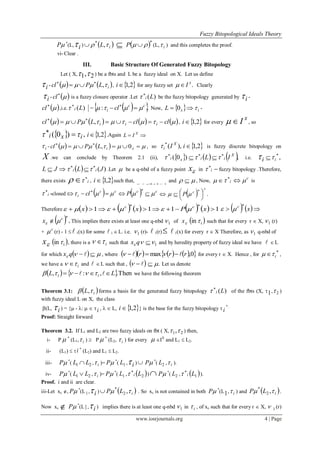
P *
(L, i )  iL  ,*
   *
 P (L, i ) and this completes the proof.
vi-Clear .
III. Basic Structure Of Generated Fuzzy Bitopology
Let ( X, 21, ) be a fbts and L be a fuzzy ideal on X. Let us define
i -    iLPcl  ,
 ,  2,1i for any fuzzy set .x
I Clearly
i -  
cl is a fuzzy closure operator .Let )(Li

 be the fuzzy bitopology generated by i -
 
cl ,i.e. )(Li

 =   .: cc
i cl   
Now,   xL 0 i -
        clclLPcl iii  
, ,  2,1i for every
x
I , so
  ixi  
)0( ,  2,1i .Again  X
IL
i -       
xiLPcl 0, , so ),( X
i I

  2,1i is fuzzy discrete bitopology on
X .we can conclude by Theorem 2.1 (ii),      ,)0( X
iixi IL 
  i.e. i ,

 i
 JL   )(JL ii

 .Let  be a q-nbd of a fuzzy point x in 
i fuzzy bitopology .Therefore,
there exists  i

 ,  2,1i such that,   1 x
and   , Now,  i

 c
 is
i

 -closed     cccc
i Pcl  

  .
c
c
P 






Therefore           1111 

xPxx cc
    

xc

 
 c
x  . This implies there exists at least one q-nbd 1 of x  iin such that for every r  X, 1 (r)
+
c
 (r) - 1  1(x) for some  1 L. i.e. 1 (r)-  1(r)  1(x) for every r  X Therefore, as 1 q-nbd of
x  iin , there is a i  such that 1 qx and by heredity property of fuzzy ideal we have  L
for which     qx , where        0,max rrr    for every r  X. Hence , for

 i ,
we have a i  and  L such that ,   . Let us denote
   .Then,:, LL ii    we have the following theorem
Theorem 3.1:  iL  , forms a basis for the generated fuzzy bitopology )(Li

 of the fbts (X, 1, 2 )
with fuzzy ideal L on X, the class
(L, i ) = { - :   i ,   L,  2,1i } is the base for the fuzzy bitopology i
*.
Proof: Straight forward
Theorem 3.2. If L1 and L2 are two fuzzy ideals on fbt ( X, 21, ) then,
i- P  *
(L1, i )  P  *
(L2, i ) for every  IX
and L1  L2.
ii- (L1)  i *
(L2) and L1  L2.
iii- P *
( 21 LL  , i )= P *
( 1L , i )  P *
( 2L , i ).
iv- P *
( 21 LL  , i )= P *
( 1L ,  2Li

 )  P *
( 2L ,  1Li

 ).
Proof. i and ii are clear.
iii-Let x , P *
(L1 , i )  iLP  ,2
*
 . So x is not contained in both P *
(L1, i ) and  iLP  ,2
*
.
Now x  P *
(L1, i ) implies there is at least one q-nbd 1 in i , of x such that for every r  X,  1 (r)
Fuzzy Bitopological Ideals Theory
www.iosrjournals.org 5 | Page
+  (r) - 1  1(r), for some  1  L . Again x  P
*
(L 2 , i ) and similarly, there is at least one q-nbd
 2 of x in i such that, for every r  X, 2(r) +  (r) - 1  2(x) for some  2  L. Therefore, we have
 =  1   2, so  is also q-nbd of x in i and  (r) + (r) - 1 1 2  r for every r  X . Since  is
also q-nbd of x in i and 1 2  , therefore x  P *
( 21 LL  , i ) ,so that
P *
( 21 LL  , i )  P *
( 1L , i ) P *
( 2L , i ). Also 21 LL  included in both 21 and LL , so by
Theorem 2.2(ii), reverse inclusion is obvious, which completes the proof of (iii)
v- iv) Let x , P *
(L1 2L , i ) implies there is at least one q-nbd 1 of x in i such that for every
r  X,  1 (r) +  (r) - 1  1(r), for some  1  L1 2L . Therefore, by heredity of fuzzy ideals and
considering the structure of fuzzy i open sets generated fuzzy bitopology, we can find  1 , 2 the q-nbd
of x in  1Li

 or  2Li

 respectively, such that, for every r  X,  1(r) +  (r) - 1  1 (r) or
2 (r) +  (r) - 1  2 (r) for some 2 L 2 or 1 L1 for every r  X . This implies
x P *
( 1L ,  2Li

 )or x P *
( 2L ,  1Li

 ). Thus we have,
P *
( 1L ,  2Li

 )  P *
( 2L ,  1Li

 ) P *
( 21 LL  , i ).
Conversely, let x P *
( 1L ,  2Li

 ).This implies there is least one on q-nbd  of x in i

 such that for
every r  X,  (r) +  (r) - 1  1(r), for some  1 L1. Since  is a  2Li

 q-nbd of x , by heredity of
fuzzy ideals, we have a q-nbd
/
 of x in i such that for every r  X,  (r) +  (r) - 1  1 2 (r), for
some  1 L1and for some 2  L 2 .i.e., x , P *
(L1 2L , i ).Thus,
P *
(L1 2L , i )  P *
( 1L ,  2Li

 ) and P *
( 2L ,  1Li

 ).Then
P *
(L1 2L , i )  P *
( 1L ,  2Li

 )  P *
( 2L ,  1Li

 )and this completes the proof .
An important result follows form the above theorem that  Li

 and  Li

 are
Equal for any fuzzy ideal on X.
Corollary 3.1: Let (X, 21, ) be a fbts with fuzzy ideal L. Then  Li

 =  Li


Proof. By taking L1=L2=L in the above Theorem, we have the required result
Corollary 3.2. . If L1 and L2 are two fuzzy ideals on fbt ( X, 21, ) then,
i-       
1221 ,, LLLL iiii     21, LL ii  
,
ii-     iiii LLL  ,, 121

    ii L  ,2

,
iii-      
iiii LLL  ,, 121   ii L  ,2

Proof .Clear
References
[1] M. K. Chakraborty and T.M.G. Ahasanullah, Fuzzy topology on fuzzy sets and tolerance topology, Fuzzy Sets and Systems 45
(1992) 103-108.
[2] C. L. Chang, Fuzzy Topological Spaces, J. Math. Anal. Appl. 24 (1968) 128 - 189.
[3] Pu Pao - Ming and Liu Ying, Fuzzy Topology.1. Neighbourhood structure of a fuzzy point and moore smith convergence, J.
Math. Anal. Appl. 76 (1980) 571 - 599.
[4] A. A. Nouh, On separation axioms in fuzzy bitopological spaces, Fuzzy Sets and Systems, 80(1996)225-236.
[5] Debasis Sarkar, Fuzzy ideal theory, Fuzzy local function and generated fuzzy topology, Fuzzy Sets and Systems 87 (1997) 117
- 123.
[6] L . A. Zadeh, Fuzzy Sets Inform. and Control 8 (1965) 338 - 353.

Fuzzy Bitopological Ideals Spaces

  • 1.
    IOSR Journal ofComputer Engineering (IOSRJCE) ISSN: 2278-0661, ISBN: 2278-8727 Volume 6, Issue 4 (Sep-Oct. 2012), PP 01-05 www.iosrjournals.org www.iosrjournals.org 1 | Page Fuzzy Bitopological Ideals Spaces M. E. Abd El-Monsef1 ; A.Kozae2 ; A. A. Salama3 and H.M.Elagmy4 3 Dept. of Math and Computer Sci., Faculty of Science, Port Said Univ., Egypt 1, 2 .4 Dept. Of Math., Faculty of Science, Tanta Univ., Egypt Abstract : In this paper we introduce the notion of fuzzy bitopological ideals .The concept of fuzzy pairwise local function is also introduced here by utilizing the q-neighborhood structure for a fuzzy topological space .These concepts are discussed fuzzy bitopologies and several relations between different fuzzy bitopological ideals . Keywords: Fuzzy bitopological space; fuzzy ideals; fuzzy pairwise local function I. Introduction The concept of fuzzy sets and fuzzy set operations was first introduced by Zadeh [6]. Subsequently, Chang defined the notion of fuzzy topology [2]. Since then various aspects of general topology were investigated and. carried out in fuzzy since by several authors of this field. The notions of fuzzy ideal and fuzzy local function introduced and studied in [5]. Nouh [ 4 ] initiated the study of fuzzy bitopological spaces . A fuzzy set equipped with two fuzzy topologies is called a fuzzy bitopological space. Concepts of fuzzy ideals and fuzzy local function were introduced by Sarkar [5].The purpose of this paper is to suggest the fuzzy ideals in fuzzy bitopological space. The concept of fuzzy pairwise local function is also introduced here by utilizing the q-neighborhood structure [3]. I. Preliminaries Throughout this paper, by (X, 21, ) we mean a fuzzy bitopological space (fbts in short) in Nouh's [ 4 ] sense. A fuzzy point in X with support x  X and value  (0 <   1) is denoted by x [1]. A fuzzy point x is said to be contained in a fuzzy set  in IX iff    and this will be denoted by x   [ 3 ] .For a fuzzy set  in a fbts (X, 21, ), i cl(), i Int (),  2,1i , and c will respectively denote closure, interior and complement of . The constant fuzzy sets taking values 0 and 1 on X are denoted by ox, 1x respectively. A fuzzy set  in fts is said to be quasi-coincident [3] with a fuzzy set  , denoted by  q , if there exists x  X such that  (x) + (x) > 1. A fuzzy set  in a fts (X, ) is called a q-nbd [1,3] of a fuzzy point x iff there exists a fuzzy open set  such that x q    we will denoted the set of all q-nbd of x in (X, ) by N (X, ). A nonempty collection of fuzzy sets L of a set X is called fuzzy ideal [5] on X iff i)   L and       L (heredity), (ii)   L and   L      L (finite additivity). The fuzzy local function [5] * (L, ) of a fuzzy set  is the union of all fuzzy points x such that if   N (x) and   L then there is at least one r  X for which  (r) +  (r) - 1 >  (r). For a fts (X, ) with fuzzy ideal L cl* () =   * [ 5 ] for any fuzzy set  of X and * (L) be the fuzzy topology generated by cl* [5]. II. Fuzzy Pair wise Local Functions. Definition 2.1. A fuzzy set  in a fbts (X, 21, ) is called Pairwise Quasi-coincident with a fuzzy set  . denoted by  qP , if there exists Xx such that 1)()(  xx  .Obviously, for any two fuzzy sets  and  ,  qP will imply  qP . Definition 2.2. A fuzzy set  in a fbts (X, 21, ) is called pairwise quasi-neighborhood of point x if and only if there exists a fuzzy openi  ,  2,1i set  such that  qx We will denote the set of all pairwise q-nbd of x in (X, 21, ) by  ixPN  , ,  2,1i .
  • 2.
    Fuzzy Bitopological IdealsTheory www.iosrjournals.org 2 | Page Definition 2.3. Let (X, 21, ) be a fbts with fuzzy ideal L on X, and X I . Then the fuzzy pairwise local function P * (L,i ),  2,1i of  is the union of all fuzzy points x such that for PN (x,i ) and  L then there is at least one rX for which      rrr  1 , where PN (x,i ) is the set of all q- nbd of x . Therefore, any x P * (L,i ),  2,1i ( for any x  ( any fuzzy set ) implies hereafter, x is not contained in the fuzzy set , i.e. )(x  implies there is at least one PN (x) such that for every r  X, (r) + (r) - 1   (r) for some   L. We will occasionally write P * or P * (L) for P * (L,i ).We define P *-fuzzy closure operator, denoted by pcl* for fuzzy topology * i (L) finer than i as follows: pcl* (  )= μ  P * for every fuzzy set  on X. When there is no ambiguity, we will simply write for P * and i * for P * (L,i ) and  i (L), respectively. Definition 2.4. Let (X, 21, ) be a fbts with fuzzy ideal L on X, a fuzzy pairwise local function P * (L, 21   ),  2,1i of X I is the union of all fuzzy points x such that for PN (x,i ) and  L then there is at least one rX for which      rrr  1 , where PN (x,i ) is the set of all q-nbd of x in 21   (where 21   is fuzzy topology generated by 21, . Example 2.1.One may easily verify that i- L = {0x}, then P * (L, i ) = ),( cli  for any ,X I  2,1i . ii- ,X IL  then P * (L, i ) = X0 , for any ,X I  2,1i . Note 2.1. In a fbts (X, 21, ) with fuzzy ideal L on X , we will denote by )( cl (resp. )int(  ) the closure (resp. interior ) of a fuzzy subset X I with respect to the fuzzy topology 21   . The following theorem gives some general properties of fuzzy pairwise-local function. Theorem 2.1. Let (X, 21, ) be a fbts with fuzzy ideal L on X, X I, and 21   . Then we have: i- P * (L, )  P * (L, i );  2,1i . ii- If   then P * (L, )  P * (L, i );  2,1i . iii- P * (L, )  )( cl  i )(cl . iv- P ** (L, )  P * (L, i );  2,1i . Proof i- Let x  P * (L ,i ) i.e. )(* xP  so x is not contained in * P This implies there is at least one  PN(x) in i such that for every rX, (r) +(r)-1 (r) for some   L . Hence   ),( xPN and so x P * (L, ) . Therefore P * (L, )  P * (L, i );  2,1i . ii-  Px  * (L, i );  2,1i , then ),.(* xP  so x is contained in * P . This implies there is at least one q-nbd   ),( ixPN  such that every rX, (r) + (r)-1> (r) ,   L . Hence   ),( xPN . Since   , by heredity (r) +  (r)-1> (r) ,   L. Therefore  Px  * (L, ) iii- , (iv) Obvious.
  • 3.
    Fuzzy Bitopological IdealsTheory www.iosrjournals.org 3 | Page Theorem 2.2 . Let ( X, 21, ) be a fbts with fuzzy ideal L on X, X I , If 21   , then i- P * (L, 2 )  P * (L, 1 ), for every X I , * 2 * 1   . Proof .Since every q-nbd in 1 of any fuzzy point x is also q-nbd in 2 .Therefore, P * (L, 2 )  P * (L, 1 ) as there may be other q-nbd in 2 of x where is condition for x  P * (L, 2 ) may not hold true, although x  P * (L, 1 ). ii- Cleary, * 2 * 1   as P * (L, 2 )  P * (L, 1 ). Theorem 2.3 . Let ( X, 21, ) be a fbts and L, J be two fuzzy ideals on X,. Then for any fuzzy sets X I, . i-   P * (L, i )  P * (L, i ),  2,1i . ii-  JL P * (J, i )  P * (L, i ),  2,1i , iii- P * = i - cl   P  , i -  cl ,  2,1i , iv- ** P (L, i )  P * (L, i ),  2,1i , v-  *  P (L, i )= P * (L, i )  iL  ,*  . vi- L  *  P (L, i )= P * (L, i ). Proof. i- Since   implies    xx   for every x in X , therefore by Definition 2.1  Px  * (L, i ) implies  Px  * (L, i ) , which complete the proof of (i) ii- Cleary,  JL P * (J, i )  P * (L, i ),  2,1i as there may be other fuzzy sets which belong to J so that for a fuzzy point  Px  * (J, i ) but x may not be contained in P * (L, i ) . iii- Since   Lx 0 for any fuzzy ideal L on X , Therefore by (ii) and Example 2.1, P * (L, i )  P * ( x0 , i )=   cli  for any fuzzy set  of X . Suppose,     clx i , so there is at is at least one rX for which      rrr  1 , for each q-nbd  of x .Hence   .0xr   Let  .rS    Cleary tr P * (L, i ) and   1 rt  so that  is also q-nbd of tr in i . Now  it Lpr  ,  , So there is at is at least one Xr / for which      /// 1 rrr   , for each q- nbd  of tr and .L this is also true for  so there is at is at least one Xr // such that      ////// 1 rrr   , for each .L Since  is an arbitrary q-nbd of x in i therefore  iLpx  ,  hence , P * = i - cl   P  , i -  cl ,  2,1i , iv- Clear v- Suppose, x , P * (L, i )  iL  ,*  i-e.  > (P    P  * ) (x) = max { P * (x), P  * (x)}. So x is not contained in both P * and P * . This implies there is at least one q-nbd 1 in i , of x such that for every r  X,  1 (r) +  (r) - 1  1(r), for some  1  L and similarly, there is at least one q- nbd  2 of x in i such that, for every r  X, 2(r) +  (r) - 1  2(x) for some  2 L. Let  =  1   2, so  is also q-nbd of x in i and  (r) + (   )(r) - 1 1   2 (r), for every rX. Therefore, by finite additively of fuzzy ideal as 1   2  L, x  (   )* . Hence  *  P (L, i )  P * (L, i )  iL  ,*  . Clearly, both  and     implies
  • 4.
    Fuzzy Bitopological IdealsTheory www.iosrjournals.org 4 | Page P * (L, i )  iL  ,*    *  P (L, i ) and this completes the proof. vi-Clear . III. Basic Structure Of Generated Fuzzy Bitopology Let ( X, 21, ) be a fbts and L be a fuzzy ideal on X. Let us define i -    iLPcl  ,  ,  2,1i for any fuzzy set .x I Clearly i -   cl is a fuzzy closure operator .Let )(Li   be the fuzzy bitopology generated by i -   cl ,i.e. )(Li   =   .: cc i cl    Now,   xL 0 i -         clclLPcl iii   , ,  2,1i for every x I , so   ixi   )0( ,  2,1i .Again  X IL i -        xiLPcl 0, , so ),( X i I    2,1i is fuzzy discrete bitopology on X .we can conclude by Theorem 2.1 (ii),      ,)0( X iixi IL    i.e. i ,   i  JL   )(JL ii   .Let  be a q-nbd of a fuzzy point x in  i fuzzy bitopology .Therefore, there exists  i   ,  2,1i such that,   1 x and   , Now,  i   c  is i   -closed     cccc i Pcl      . c c P        Therefore           1111   xPxx cc       xc     c x  . This implies there exists at least one q-nbd 1 of x  iin such that for every r  X, 1 (r) + c  (r) - 1  1(x) for some  1 L. i.e. 1 (r)-  1(r)  1(x) for every r  X Therefore, as 1 q-nbd of x  iin , there is a i  such that 1 qx and by heredity property of fuzzy ideal we have  L for which     qx , where        0,max rrr    for every r  X. Hence , for   i , we have a i  and  L such that ,   . Let us denote    .Then,:, LL ii    we have the following theorem Theorem 3.1:  iL  , forms a basis for the generated fuzzy bitopology )(Li   of the fbts (X, 1, 2 ) with fuzzy ideal L on X, the class (L, i ) = { - :   i ,   L,  2,1i } is the base for the fuzzy bitopology i *. Proof: Straight forward Theorem 3.2. If L1 and L2 are two fuzzy ideals on fbt ( X, 21, ) then, i- P  * (L1, i )  P  * (L2, i ) for every  IX and L1  L2. ii- (L1)  i * (L2) and L1  L2. iii- P * ( 21 LL  , i )= P * ( 1L , i )  P * ( 2L , i ). iv- P * ( 21 LL  , i )= P * ( 1L ,  2Li   )  P * ( 2L ,  1Li   ). Proof. i and ii are clear. iii-Let x , P * (L1 , i )  iLP  ,2 *  . So x is not contained in both P * (L1, i ) and  iLP  ,2 * . Now x  P * (L1, i ) implies there is at least one q-nbd 1 in i , of x such that for every r  X,  1 (r)
  • 5.
    Fuzzy Bitopological IdealsTheory www.iosrjournals.org 5 | Page +  (r) - 1  1(r), for some  1  L . Again x  P * (L 2 , i ) and similarly, there is at least one q-nbd  2 of x in i such that, for every r  X, 2(r) +  (r) - 1  2(x) for some  2  L. Therefore, we have  =  1   2, so  is also q-nbd of x in i and  (r) + (r) - 1 1 2  r for every r  X . Since  is also q-nbd of x in i and 1 2  , therefore x  P * ( 21 LL  , i ) ,so that P * ( 21 LL  , i )  P * ( 1L , i ) P * ( 2L , i ). Also 21 LL  included in both 21 and LL , so by Theorem 2.2(ii), reverse inclusion is obvious, which completes the proof of (iii) v- iv) Let x , P * (L1 2L , i ) implies there is at least one q-nbd 1 of x in i such that for every r  X,  1 (r) +  (r) - 1  1(r), for some  1  L1 2L . Therefore, by heredity of fuzzy ideals and considering the structure of fuzzy i open sets generated fuzzy bitopology, we can find  1 , 2 the q-nbd of x in  1Li   or  2Li   respectively, such that, for every r  X,  1(r) +  (r) - 1  1 (r) or 2 (r) +  (r) - 1  2 (r) for some 2 L 2 or 1 L1 for every r  X . This implies x P * ( 1L ,  2Li   )or x P * ( 2L ,  1Li   ). Thus we have, P * ( 1L ,  2Li   )  P * ( 2L ,  1Li   ) P * ( 21 LL  , i ). Conversely, let x P * ( 1L ,  2Li   ).This implies there is least one on q-nbd  of x in i   such that for every r  X,  (r) +  (r) - 1  1(r), for some  1 L1. Since  is a  2Li   q-nbd of x , by heredity of fuzzy ideals, we have a q-nbd /  of x in i such that for every r  X,  (r) +  (r) - 1  1 2 (r), for some  1 L1and for some 2  L 2 .i.e., x , P * (L1 2L , i ).Thus, P * (L1 2L , i )  P * ( 1L ,  2Li   ) and P * ( 2L ,  1Li   ).Then P * (L1 2L , i )  P * ( 1L ,  2Li   )  P * ( 2L ,  1Li   )and this completes the proof . An important result follows form the above theorem that  Li   and  Li   are Equal for any fuzzy ideal on X. Corollary 3.1: Let (X, 21, ) be a fbts with fuzzy ideal L. Then  Li   =  Li   Proof. By taking L1=L2=L in the above Theorem, we have the required result Corollary 3.2. . If L1 and L2 are two fuzzy ideals on fbt ( X, 21, ) then, i-        1221 ,, LLLL iiii     21, LL ii   , ii-     iiii LLL  ,, 121      ii L  ,2  , iii-       iiii LLL  ,, 121   ii L  ,2  Proof .Clear References [1] M. K. Chakraborty and T.M.G. Ahasanullah, Fuzzy topology on fuzzy sets and tolerance topology, Fuzzy Sets and Systems 45 (1992) 103-108. [2] C. L. Chang, Fuzzy Topological Spaces, J. Math. Anal. Appl. 24 (1968) 128 - 189. [3] Pu Pao - Ming and Liu Ying, Fuzzy Topology.1. Neighbourhood structure of a fuzzy point and moore smith convergence, J. Math. Anal. Appl. 76 (1980) 571 - 599. [4] A. A. Nouh, On separation axioms in fuzzy bitopological spaces, Fuzzy Sets and Systems, 80(1996)225-236. [5] Debasis Sarkar, Fuzzy ideal theory, Fuzzy local function and generated fuzzy topology, Fuzzy Sets and Systems 87 (1997) 117 - 123. [6] L . A. Zadeh, Fuzzy Sets Inform. and Control 8 (1965) 338 - 353.