

Future Time Clauses And
If Clauses
BY:
Hussain Al-ghawi
What Is Future Time Clauses
• Future time clauses are dependent clauses that must be joined to independent
(main) clauses. It is customary to the future tense in the independent clause and the
present tense in the dependent (time) clause. Do not use the future tense in the
time clause.
Clauses Overview
Clause is a group of words that has a subject and a verb.
A main clause can stand alone as a complete sentence.
A dependent clause cannot stand alone and must be used with a main
clause.
Future Time Clauses
• Future time clauses are dependent clauses. They begin with words such as before,
when, while, and after.
• The verb in the future time clause is in the simple present even though it has a
future meaning.
• A future time clause can come before or after the main clause with no change in
the meaning.
• If the future time comes first, it is separated from the main clause by a comma.
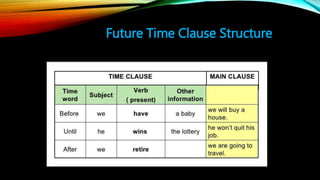
Future Time Clause Structure
If Clauses: review
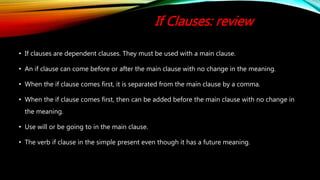
• If clauses are dependent clauses. They must be used with a main clause.
• An if clause can come before or after the main clause with no change in the meaning.
• When the if clause comes first, it is separated from the main clause by a comma.
• When the if clause comes first, then can be added before the main clause with no change in
the meaning.
• Use will or be going to in the main clause.
• The verb if clause in the simple present even though it has a future meaning.
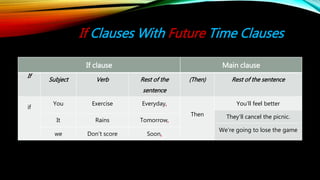
If Clauses With Future Time Clauses
If clause Main clause
If
Subject Verb Rest of the
sentence
(Then) Rest of the sentence
if
You Exercise Everyday,
Then
You’ll feel better
They’ll cancel the picnic.
It Rains Tomorrow,
We’re going to lose the game
we Don’t score Soon,
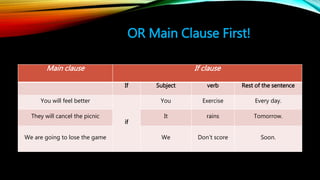
OR Main Clause First!
Main clause If clause
If Subject verb Rest of the sentence
You will feel better
if
You Exercise Every day.
They will cancel the picnic It rains Tomorrow.
We are going to lose the game We Don’t score Soon.
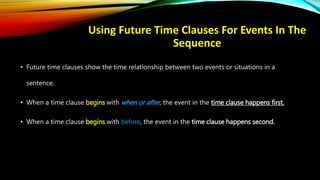
Using Future Time Clauses For Events In The
Sequence
• Future time clauses show the time relationship between two events or situations in a
sentence.
• When a time clause begins with when or after, the event in the time clause happens first.
• When a time clause begins with before, the event in the time clause happens second.
Future time clauses and if clauses

Future time clauses and if clauses

  • 1.
    Future Time ClausesAnd If Clauses BY: Hussain Al-ghawi
  • 2.
    What Is FutureTime Clauses • Future time clauses are dependent clauses that must be joined to independent (main) clauses. It is customary to the future tense in the independent clause and the present tense in the dependent (time) clause. Do not use the future tense in the time clause.
  • 3.
    Clauses Overview Clause isa group of words that has a subject and a verb. A main clause can stand alone as a complete sentence. A dependent clause cannot stand alone and must be used with a main clause.
  • 4.
    Future Time Clauses •Future time clauses are dependent clauses. They begin with words such as before, when, while, and after. • The verb in the future time clause is in the simple present even though it has a future meaning. • A future time clause can come before or after the main clause with no change in the meaning. • If the future time comes first, it is separated from the main clause by a comma.
  • 5.
  • 6.
    If Clauses: review •If clauses are dependent clauses. They must be used with a main clause. • An if clause can come before or after the main clause with no change in the meaning. • When the if clause comes first, it is separated from the main clause by a comma. • When the if clause comes first, then can be added before the main clause with no change in the meaning. • Use will or be going to in the main clause. • The verb if clause in the simple present even though it has a future meaning.
  • 7.
    If Clauses WithFuture Time Clauses If clause Main clause If Subject Verb Rest of the sentence (Then) Rest of the sentence if You Exercise Everyday, Then You’ll feel better They’ll cancel the picnic. It Rains Tomorrow, We’re going to lose the game we Don’t score Soon,
  • 8.
    OR Main ClauseFirst! Main clause If clause If Subject verb Rest of the sentence You will feel better if You Exercise Every day. They will cancel the picnic It rains Tomorrow. We are going to lose the game We Don’t score Soon.
  • 9.
    Using Future TimeClauses For Events In The Sequence • Future time clauses show the time relationship between two events or situations in a sentence. • When a time clause begins with when or after, the event in the time clause happens first. • When a time clause begins with before, the event in the time clause happens second.