A Future For Education:
   Some Core Ideas

                          Jack Park
               SRI International, Menlo Park, California
                                 And
    Knowledge Media Institute, Open University, Milton Keynes, U.K.


          National Assembly of South Korea
                     Seoul, Korea
                   26 October, 2007
“Discovery consists
of seeing what
everybody has seen
and thinking what
nobody has thought.”
    –Albert Szent-Gyorgyi
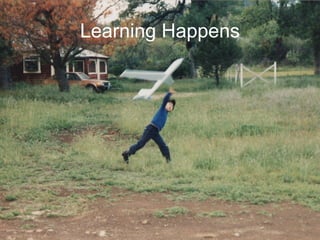
Learning Happens
Quote
“We are what we eat, and we
think what we practice.”
    Geoffrey C. Bowker, Memory Practices in the Sciences, p. 229


             Let’s talk about practice
A Story About a
Future for Education

 Just-in-time
 Life-long
 Collaborative
 Global
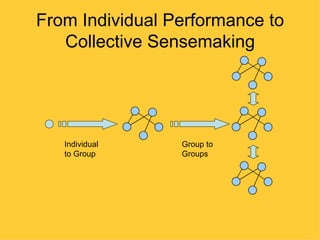
From Individual Performance to
   Collective Sensemaking


   Individual    Group to
   to Group      Groups
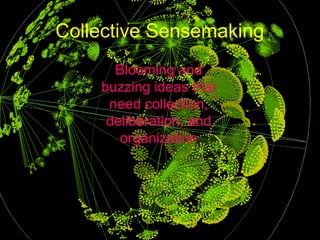
Collective Sensemaking
      Blooming and
    buzzing ideas that
     need collection,
     deliberation, and
       organization
Learning
    is
Sensemaking
Our story is about innovation


Image courtesy Gail Johnson
http://admin-solutions.co.uk/
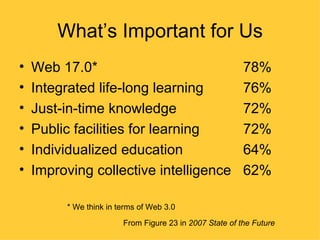
What’s Important for Us
•   Web 17.0*                                            78%
•   Integrated life-long learning                        76%
•   Just-in-time knowledge                               72%
•   Public facilities for learning                       72%
•   Individualized education                             64%
•   Improving collective intelligence                    62%

         * We think in terms of Web 3.0

                        From Figure 23 in 2007 State of the Future
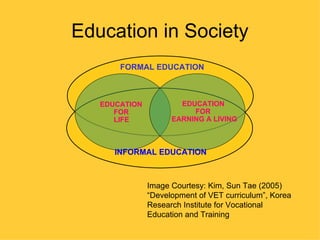
Education in Society
       FORMAL EDUCATION


   EDUCATION           EDUCATION
      FOR                 FOR
      LIFE           EARNING A LIVING


      INFORMAL EDUCATION


               Image Courtesy: Kim, Sun Tae (2005)
               “Development of VET curriculum”, Korea
               Research Institute for Vocational
               Education and Training
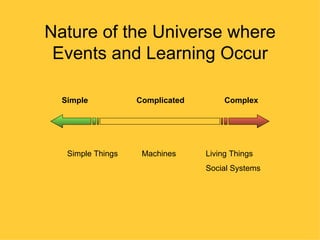
Nature of the Universe where
 Events and Learning Occur

  Simple           Complicated        Complex


   Simple Things    Machines     Living Things
                                 Social Systems
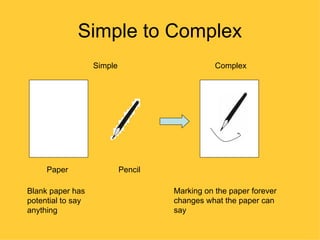
Simple to Complex
                   Simple                       Complex


     Paper                  Pencil

Blank paper has                      Marking on the paper forever
potential to say                     changes what the paper can
anything                             say
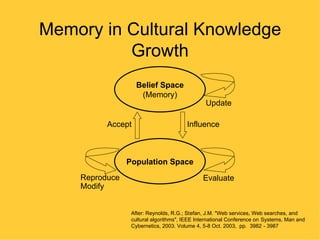
Memory in Cultural Knowledge
          Growth
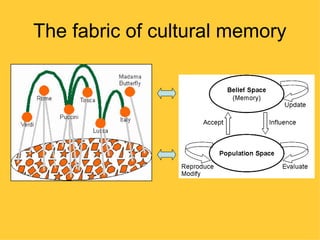
                   Belief Space
                    (Memory)
                                               Update

          Accept                       Influence


                Population Space
    Reproduce                                 Evaluate
    Modify


                 After: Reynolds, R.G.; Stefan, J.M. "Web services, Web searches, and
                 cultural algorithms", IEEE International Conference on Systems, Man and
                 Cybernetics, 2003. Volume 4, 5-8 Oct. 2003, pp. 3982 - 3987
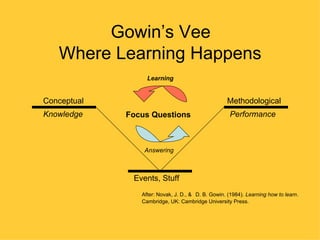
Gowin’s Vee
   Where Learning Happens
                  Learning


Conceptual                                         Methodological
Knowledge    Focus Questions                         Performance


                 Answering


              Events, Stuff
                After: Novak, J. D., & D. B. Gowin. (1984). Learning how to learn.
                Cambridge, UK: Cambridge University Press.
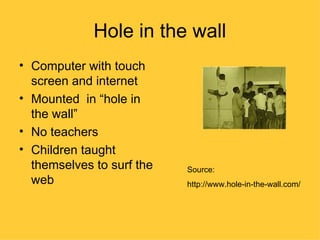
Hole in the wall
• Computer with touch
  screen and internet
• Mounted in “hole in
  the wall”
• No teachers
• Children taught
  themselves to surf the   Source:
  web                      http://www.hole-in-the-wall.com/
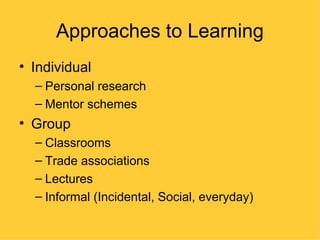
Approaches to Learning
• Individual
  – Personal research
  – Mentor schemes
• Group
  – Classrooms
  – Trade associations
  – Lectures
  – Informal (Incidental, Social, everyday)
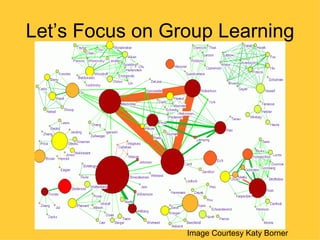
Let’s Focus on Group Learning


                 Image Courtesy Katy Borner
A Step Toward the Future
• A Modest Proposition
  – A global learning support
    infrastructure
  – Uses collaborative and
    social opportunities on
    the Web
  – Let’s call it a:
     • Dynamic
       Knowledge
       Garden
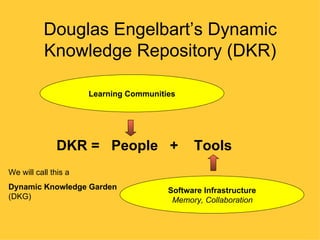
Douglas Engelbart’s Dynamic
          Knowledge Repository (DKR)

                      Learning Communities


              DKR = People +                  Tools
We will call this a
Dynamic Knowledge Garden                Software Infrastructure
(DKG)                                    Memory, Collaboration
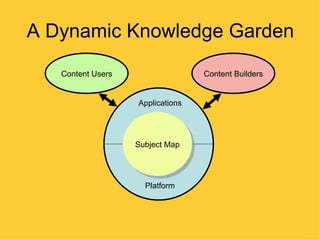
A Dynamic Knowledge Garden

   Content Users                  Content Builders


                   Applications


                   Subject Map


                     Platform
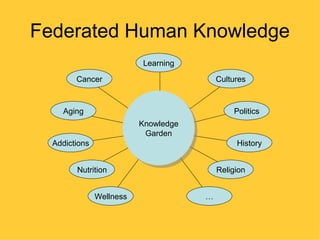
Federated Human Knowledge
                          Learning

        Cancer                            Cultures


    Aging                                     Politics
                          Knowledge
                           Garden
  Addictions                                   History


        Nutrition                         Religion


               Wellness               …
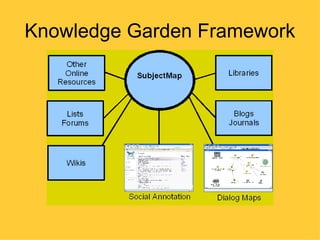
Knowledge Garden Framework
Quote

Upon this gifted age, in its dark hour
Rains from the sky a meteor shower
Of facts…they lie unquestioned,
Uncombined.
Wisdom enough to leach us of our ill
Is daily spun; but there exists no loom
To weave it into fabric.
                  Edna St. Vincent Millay
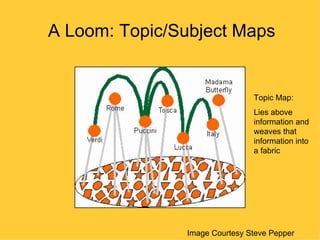
A Loom: Topic/Subject Maps


                               Topic Map:
                               Lies above
                               information and
                               weaves that
                               information into
                               a fabric


               Image Courtesy Steve Pepper
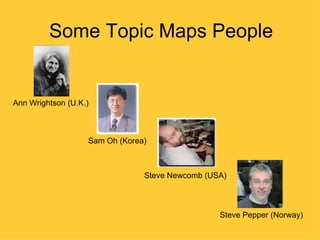
Some Topic Maps People


Ann Wrightson (U.K.)


                   Sam Oh (Korea)


                                Steve Newcomb (USA)


                                                 Steve Pepper (Norway)
The fabric of cultural memory
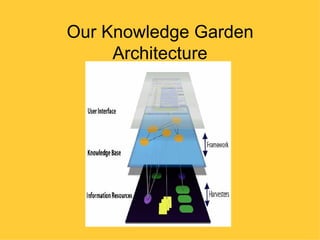
Our Knowledge Garden
     Architecture
Enough Theory…
• Let’s look at a few examples
  – Information Design Course
  – Bay Area Science Collaboratory
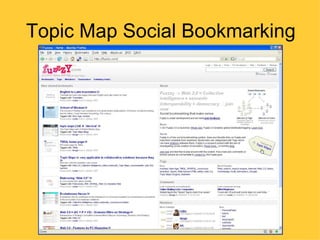
  – Fuzzzy Social Bookmarking
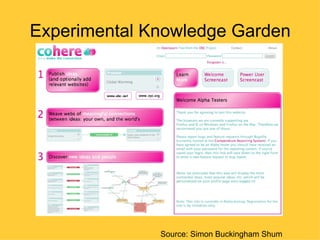
  – Cohere experimental knowledge portal
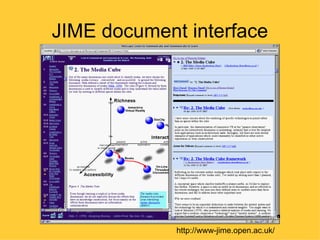
  – Journal of Interactive Media in Education
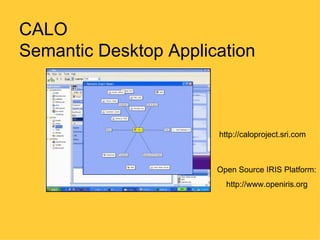
  – CALO Semantic Desktop Application
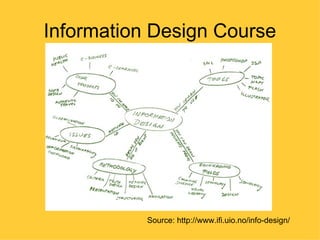
Information Design Course


           Source: http://www.ifi.uio.no/info-design/
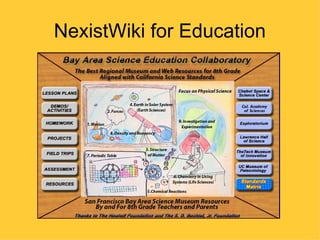
NexistWiki for Education
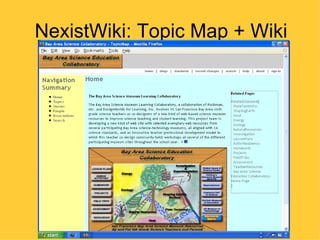
NexistWiki: Topic Map + Wiki
Topic Map Social Bookmarking
Experimental Knowledge Garden


              Source: Simon Buckingham Shum
JIME document interface


             http://www-jime.open.ac.uk/
CALO
Semantic Desktop Application


                       http://caloproject.sri.com


                       Open Source IRIS Platform:
                         http://www.openiris.org
What can we do in our garden?
• Plant seeds
  – Create new subjects
• Cultivate the garden
  – Annotate subjects
     • Annotate by connecting ideas in different subjects
     • Annotate by tagging
     • Discuss issues raised as subjects evolve
• Harvest the garden
  – Create learning opportunities
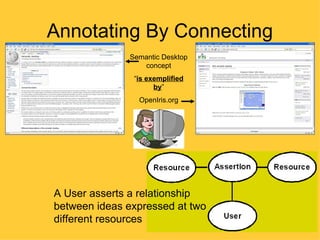
Annotating By Connecting
              Semantic Desktop
                 concept
               “is exemplified
                     by”
                OpenIris.org


A User asserts a relationship
between ideas expressed at two
different resources
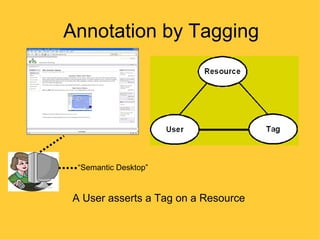
Annotation by Tagging


 “Semantic Desktop”


A User asserts a Tag on a Resource
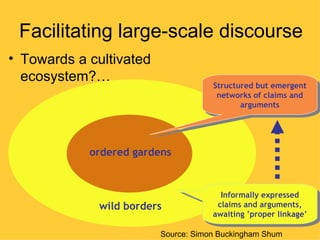
Facilitating large-scale discourse
• Towards a cultivated
  ecosystem?…
                                     Structured but emergent
                                      networks of claims and
                                            arguments


           ordered gardens
            ordered gardens


                                       Informally expressed
             wild borders
              wild borders            claims and arguments,
                                     awaiting ‘proper linkage’

                         Source: Simon Buckingham Shum
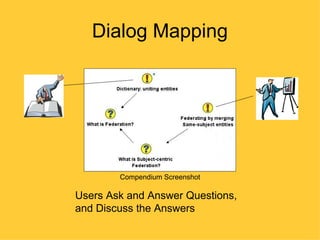
Dialog Mapping


        Compendium Screenshot

Users Ask and Answer Questions,
and Discuss the Answers
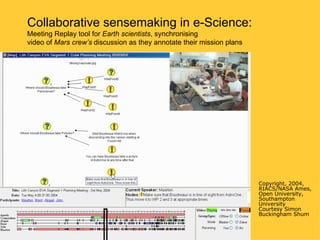
Collaborative sensemaking in e-Science:
Meeting Replay tool for Earth scientists, synchronising
video of Mars crew’s discussion as they annotate their mission plans


                                                                       Copyright, 2004,
                                                                       RIACS/NASA Ames,
                                                                       Open University,
                                                                       Southampton
                                                                       University
                                                                       Courtesy Simon
                                                                       Buckingham Shum
Future prospects for learning
              support
• Global federation of Dynamic Knowledge
  Gardens
• Virtual Learning Environments
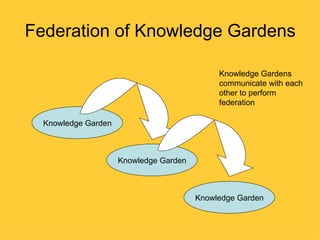
Federation of Knowledge Gardens

                                             Knowledge Gardens
                                             communicate with each
                                             other to perform
                                             federation

  Knowledge Garden


                     Knowledge Garden


                                        Knowledge Garden
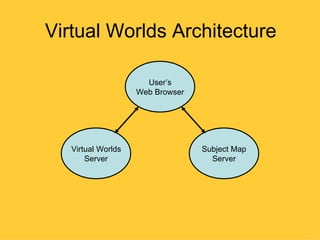
Virtual Worlds Architecture

                      User’s
                    Web Browser


   Virtual Worlds                 Subject Map
       Server                       Server
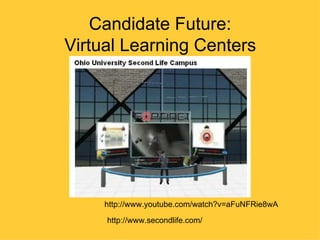
Candidate Future:
Virtual Learning Centers


     http://www.youtube.com/watch?v=aFuNFRie8wA

     http://www.secondlife.com/
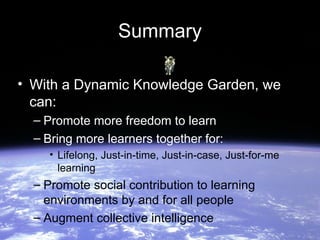
Summary

• With a Dynamic Knowledge Garden, we
  can:
  – Promote more freedom to learn
  – Bring more learners together for:
    • Lifelong, Just-in-time, Just-in-case, Just-for-me
      learning
  – Promote social contribution to learning
    environments by and for all people
  – Augment collective intelligence
Thank You
jack.park@sri.com


    Special thanks to Jerry Glenn, Youngsook Park,
                   and Adam Cheyer

    Final thought: http://www.youtube.com/watch?v=
                      -4CV05HyAbM

A Future for Education: Some Core Thoughts

  • 1.
    A Future ForEducation: Some Core Ideas Jack Park SRI International, Menlo Park, California And Knowledge Media Institute, Open University, Milton Keynes, U.K. National Assembly of South Korea Seoul, Korea 26 October, 2007
  • 2.
    “Discovery consists of seeingwhat everybody has seen and thinking what nobody has thought.” –Albert Szent-Gyorgyi
  • 3.
  • 4.
    Quote “We are whatwe eat, and we think what we practice.” Geoffrey C. Bowker, Memory Practices in the Sciences, p. 229 Let’s talk about practice
  • 5.
    A Story Abouta Future for Education Just-in-time Life-long Collaborative Global
  • 6.
    From Individual Performanceto Collective Sensemaking Individual Group to to Group Groups
  • 7.
    Collective Sensemaking Blooming and buzzing ideas that need collection, deliberation, and organization
  • 8.
    Learning is Sensemaking
  • 9.
    Our story isabout innovation Image courtesy Gail Johnson http://admin-solutions.co.uk/
  • 10.
    What’s Important forUs • Web 17.0* 78% • Integrated life-long learning 76% • Just-in-time knowledge 72% • Public facilities for learning 72% • Individualized education 64% • Improving collective intelligence 62% * We think in terms of Web 3.0 From Figure 23 in 2007 State of the Future
  • 11.
    Education in Society FORMAL EDUCATION EDUCATION EDUCATION FOR FOR LIFE EARNING A LIVING INFORMAL EDUCATION Image Courtesy: Kim, Sun Tae (2005) “Development of VET curriculum”, Korea Research Institute for Vocational Education and Training
  • 12.
    Nature of theUniverse where Events and Learning Occur Simple Complicated Complex Simple Things Machines Living Things Social Systems
  • 13.
    Simple to Complex Simple Complex Paper Pencil Blank paper has Marking on the paper forever potential to say changes what the paper can anything say
  • 14.
    Memory in CulturalKnowledge Growth Belief Space (Memory) Update Accept Influence Population Space Reproduce Evaluate Modify After: Reynolds, R.G.; Stefan, J.M. "Web services, Web searches, and cultural algorithms", IEEE International Conference on Systems, Man and Cybernetics, 2003. Volume 4, 5-8 Oct. 2003, pp. 3982 - 3987
  • 15.
    Gowin’s Vee Where Learning Happens Learning Conceptual Methodological Knowledge Focus Questions Performance Answering Events, Stuff After: Novak, J. D., & D. B. Gowin. (1984). Learning how to learn. Cambridge, UK: Cambridge University Press.
  • 16.
    Hole in thewall • Computer with touch screen and internet • Mounted in “hole in the wall” • No teachers • Children taught themselves to surf the Source: web http://www.hole-in-the-wall.com/
  • 17.
    Approaches to Learning •Individual – Personal research – Mentor schemes • Group – Classrooms – Trade associations – Lectures – Informal (Incidental, Social, everyday)
  • 18.
    Let’s Focus onGroup Learning Image Courtesy Katy Borner
  • 19.
    A Step Towardthe Future • A Modest Proposition – A global learning support infrastructure – Uses collaborative and social opportunities on the Web – Let’s call it a: • Dynamic Knowledge Garden
  • 20.
    Douglas Engelbart’s Dynamic Knowledge Repository (DKR) Learning Communities DKR = People + Tools We will call this a Dynamic Knowledge Garden Software Infrastructure (DKG) Memory, Collaboration
  • 21.
    A Dynamic KnowledgeGarden Content Users Content Builders Applications Subject Map Platform
  • 22.
    Federated Human Knowledge Learning Cancer Cultures Aging Politics Knowledge Garden Addictions History Nutrition Religion Wellness …
  • 23.
  • 24.
    Quote Upon this giftedage, in its dark hour Rains from the sky a meteor shower Of facts…they lie unquestioned, Uncombined. Wisdom enough to leach us of our ill Is daily spun; but there exists no loom To weave it into fabric. Edna St. Vincent Millay
  • 25.
    A Loom: Topic/SubjectMaps Topic Map: Lies above information and weaves that information into a fabric Image Courtesy Steve Pepper
  • 26.
    Some Topic MapsPeople Ann Wrightson (U.K.) Sam Oh (Korea) Steve Newcomb (USA) Steve Pepper (Norway)
  • 27.
    The fabric ofcultural memory
  • 28.
  • 29.
    Enough Theory… • Let’slook at a few examples – Information Design Course – Bay Area Science Collaboratory – Fuzzzy Social Bookmarking – Cohere experimental knowledge portal – Journal of Interactive Media in Education – CALO Semantic Desktop Application
  • 30.
    Information Design Course Source: http://www.ifi.uio.no/info-design/
  • 31.
  • 32.
  • 33.
    Topic Map SocialBookmarking
  • 34.
    Experimental Knowledge Garden Source: Simon Buckingham Shum
  • 35.
    JIME document interface http://www-jime.open.ac.uk/
  • 36.
    CALO Semantic Desktop Application http://caloproject.sri.com Open Source IRIS Platform: http://www.openiris.org
  • 37.
    What can wedo in our garden? • Plant seeds – Create new subjects • Cultivate the garden – Annotate subjects • Annotate by connecting ideas in different subjects • Annotate by tagging • Discuss issues raised as subjects evolve • Harvest the garden – Create learning opportunities
  • 38.
    Annotating By Connecting Semantic Desktop concept “is exemplified by” OpenIris.org A User asserts a relationship between ideas expressed at two different resources
  • 39.
    Annotation by Tagging “Semantic Desktop” A User asserts a Tag on a Resource
  • 40.
    Facilitating large-scale discourse •Towards a cultivated ecosystem?… Structured but emergent networks of claims and arguments ordered gardens ordered gardens Informally expressed wild borders wild borders claims and arguments, awaiting ‘proper linkage’ Source: Simon Buckingham Shum
  • 41.
    Dialog Mapping Compendium Screenshot Users Ask and Answer Questions, and Discuss the Answers
  • 42.
    Collaborative sensemaking ine-Science: Meeting Replay tool for Earth scientists, synchronising video of Mars crew’s discussion as they annotate their mission plans Copyright, 2004, RIACS/NASA Ames, Open University, Southampton University Courtesy Simon Buckingham Shum
  • 43.
    Future prospects forlearning support • Global federation of Dynamic Knowledge Gardens • Virtual Learning Environments
  • 44.
    Federation of KnowledgeGardens Knowledge Gardens communicate with each other to perform federation Knowledge Garden Knowledge Garden Knowledge Garden
  • 45.
    Virtual Worlds Architecture User’s Web Browser Virtual Worlds Subject Map Server Server
  • 46.
    Candidate Future: Virtual LearningCenters http://www.youtube.com/watch?v=aFuNFRie8wA http://www.secondlife.com/
  • 47.
    Summary • With aDynamic Knowledge Garden, we can: – Promote more freedom to learn – Bring more learners together for: • Lifelong, Just-in-time, Just-in-case, Just-for-me learning – Promote social contribution to learning environments by and for all people – Augment collective intelligence
  • 48.
    Thank You jack.park@sri.com Special thanks to Jerry Glenn, Youngsook Park, and Adam Cheyer Final thought: http://www.youtube.com/watch?v= -4CV05HyAbM