Finding Meaning Across
Boundaries
Jack Park, Mark Szpakowski and Marc-Antoine Parent
Transform Conference
May 22-24
San Francisco, CA
© 2019, TopicQuests Foundation
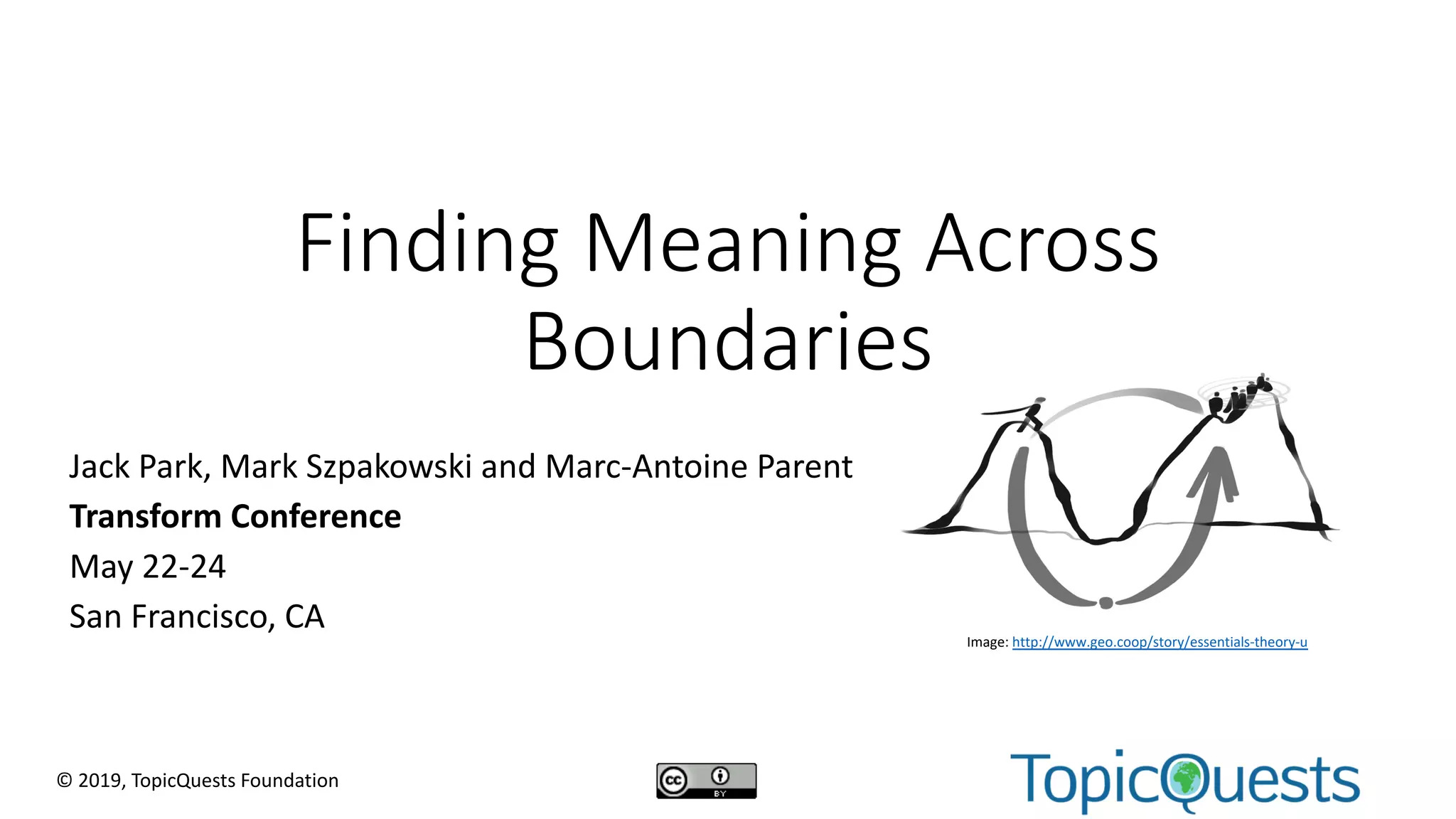
Image: http://www.geo.coop/story/essentials-theory-u
Big Picture
• Refugee issues are made wicked
by partial perspectives on
complex issues
• Conversation mapping and topic
maps tools help weave
perspectives together
• Participatory culture, gamified as
quests, can unify stakeholders
around augmented cognition
processes
Photo by Ray Hennessy on Unsplash
Urgent Challenge
How we can improve our
perception of the complexity
we live within,
so we may improve our
interaction with the world?
-- Nora Bateson
A game-changing
Perception ó Action response
is necessary within the decade.
Refugee issues are made wicked
by partial perspectives on
complex issues
Problem Space: Big Picture
• Signature Question
• How can we have civil conversations online about politics?
• Signature Issues
• Massive Complexity in Refugee Ecosystem
• Massive Complexity does not reduce well to simple
solutions
• Finding Solutions requires
• Increased creative exploration of options
• Increased Trust
Walt Kelly (1971) Image: Wikipedia
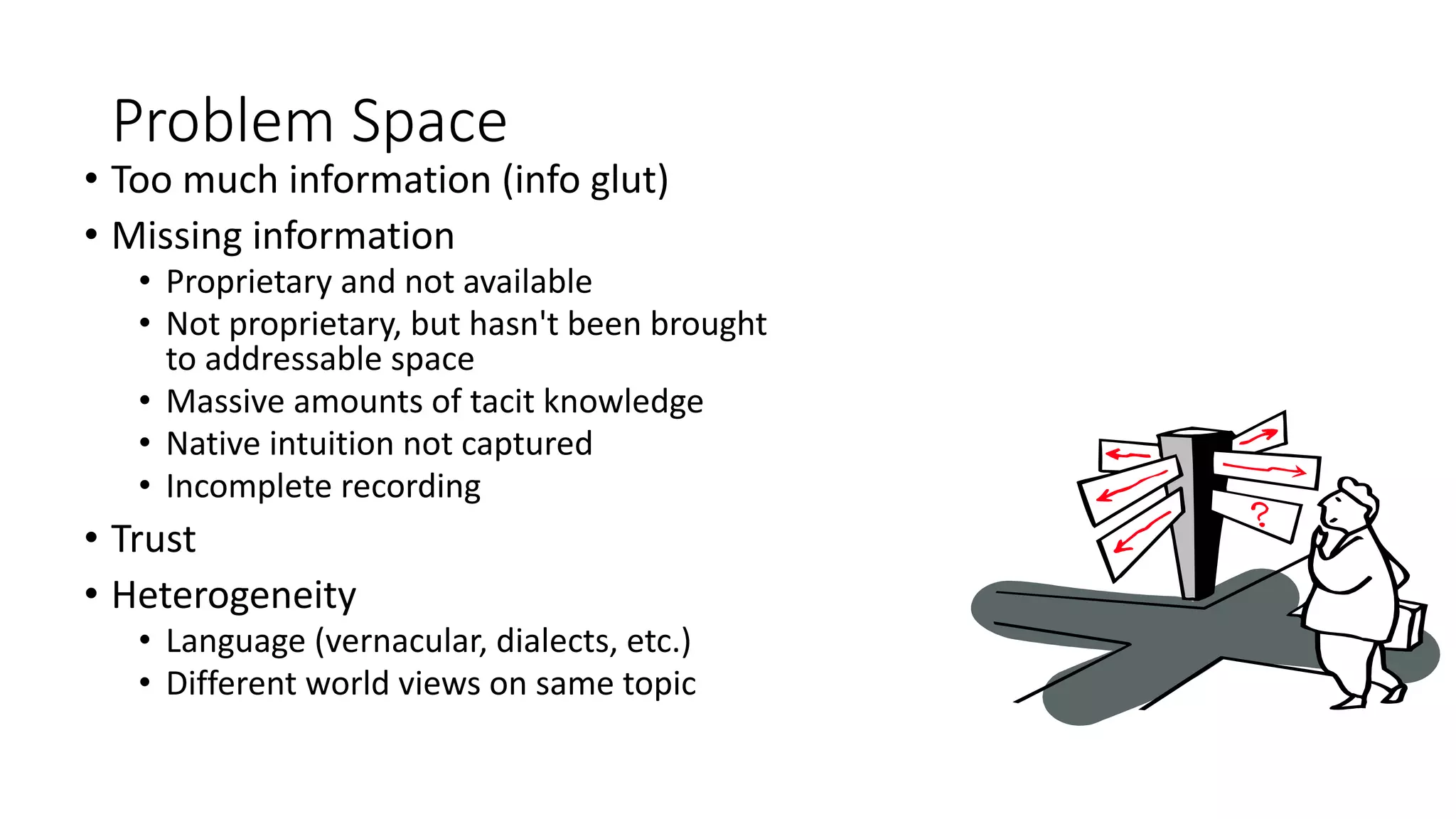
Problem Space
• Too much information (info glut)
• Missing information
• Proprietary and not available
• Not proprietary, but hasn't been brought
to addressable space
• Massive amounts of tacit knowledge
• Native intuition not captured
• Incomplete recording
• Trust
• Heterogeneity
• Language (vernacular, dialects, etc.)
• Different world views on same topic
Differences in World Views
"This is the difference between us Romans and the
Etruscans:
We believe that lightning is caused by clouds
colliding,
whereas they believe that clouds collide in order to
create lightning.
Since they attribute everything to gods, they are led
to believe not that events have a meaning because
they have happened, but that they happen in order to
express a meaning."
—Seneca (Roman Philosopher, first century C.E.)
A Simple Conversation Example
• A proposal: lower taxes (X) to improve economic growth (Y)
Yes or no?
• But what would no mean?
1. No to X
• X also causes an unintended negative side effect, such as underfunding essential
social services
2. No to the X-causes-Y link
• there is no evidence that lowering taxes causes economic growth
3. No to the goal Y
• We should be thinking of de-growth on an exhausted planet
Limits of our Knowledge
• We can open a microbe to
study all the parts
• Opening the microbe kills
it
• Why did opening a
microbe to count all the
parts kill it?
• What is life?
• Did opening the microbe to
count its parts get us any
closer to an answer?
• Answers are bound to the
nature of Complex Systems
Img: Wikipedia
Relations Among the Parts
• Counting parts is a start
• But, everything is intertwingled
• Understanding the relationships
among those parts and between
them and their environment is
the next step
• Relations as complex,
interwoven fabrics
• Use garden tools to augment our
capabilities
Img: © Regents of University of California
Conversation mapping and topic
maps tools help weave
perspectives together
Ecosystem Overview
• Human System
• complex, adaptive, anticipatory, as
individual and as society
• mother and user of Tool System,
animating it with intentionality
• Tool System
• hardware and software for
networked sensemaking and
presencing
• augments & de-augments Human
System capabilities
• Life System
• sustains Human System, both
physically and psychically
• is affected by Human System
amplified by Tool System
Image: Mark Szpakowski (2018)
http://www.topicquests.org/human-tool-and-eco-systems/
Wickedness
Tool System
• Humans guide tools
• (AI) tools train on humans
Human System
Blind spot: humans guide & train
themselves (not!)
• Individual framing & intention
• Group intentionality
In the Anthropogenic Epoch
the humans mapping complexity
are not outside, but inside,
the map.
Knowledge is contextual
to perspectives
held individually and collectively
in warm, emotional bodies.
Challenge Responses I
Knowledge Questing
• Structured conversation flows
• to arrive at sensemaking perspectives
• conducted by teams with ethos
Tool Systems to augment
• Collaborating
• Knowing (extracting & mapping)
An insistence on science
as purely apolitical and technocratic
leaves a blind spot the size of humanity
in how climate impacts will affect us,
and how we might respond and act
proactively.
[https://www.resilience.org/stories/2019-04-25/a-postmortem-for-survival-on-science-
failure-and-action-on-climate-change/]
Challenge Responses II
Human Systems to augment
• Self-aware intentionality
• Of individuals, group, society
Life Systems to augment
• Well-being of mind and body
• Resting attention (not just human)
Mapping Technologies
• MindMaps
• Simple
• Good place to start thinking about
situations
• ConceptMaps
• Adds labeled arcs (relations) to
MindMaps
• TopicMaps
• Turns important relations to topics
• Important relations:
• Have biographies
• Can be the subject of debate
TopicMap Use Cases
• First Use Case
• Index of the back of a book is a
weak topic map
• General Use Case
• Seed with domain ontologies
(vocabularies)
• Grow as important topics are
discovered
• From conversations
• From personal notes
Photo by Sam Goodgame on Unsplash
Discovery in Context: An Example
Information Gathering in a Knowing Garden
Discovery followed by Action
Gardener
connects
concepts
Discovery followed by Action
Gardener creates new
concepts to better
explain “must avoid”
connection
Let the Conversations Begin: a Challenge
Responses Leading to New Concepts
Compromised Host is
new Concept
Gardening Outcome
antioxidants
kill
free radicals
Contraindicates
macrophages use
free radicals to
kill bacteria
Bacterial Infection Antioxidants
Because
Appropriate For
Compromised Host Co-created resource in
the garden
Participatory culture,
played as quests,
can unify stakeholders
around augmented
cognition processes
Opportunity Space: a Public Loom
• Topic based information that is:
• Brought together through federation with relevance
• Freely available
• Recorded, easily found and built upon
• With tacit knowledge and native intuition captured
• Trustworthy
• All sides of the story are covered
• Heterogeneity
• Information is captured in a format
that takes into account vernacular,
dialects, different world views, etc.
From the perspective of
complexity theory, emergence
arises from complex systems
that create new properties
from “autonomous unities
coming together into larger,
more powerful unities”
Augmenting Human Capabilities
Complex Systems
Shared Stories
Collaboration in a Knowing Garden
Img: Olen Gunnlaugson (2011). A Complexity Perspective
on Presencing. Complicity, Vol 9, No 1 (2012). Online at:
http://ejournals.library
The emergence we seek is that of
insight into the nature of and
solutions to complex problems
Barn Raising
Existing Solutions: Social Labs
• Social labs are platforms for addressing complex social
challenges that have three core characteristics.†
• They are social.
• They are experimental.
• They are systemic.
Why Planning is
Killing Us
And Prototyping Will
Save Us
† https://ssir.org/articles/entry/the_social_labs_revolution_a_new_approach_to_solving_our_most_complex_chall#
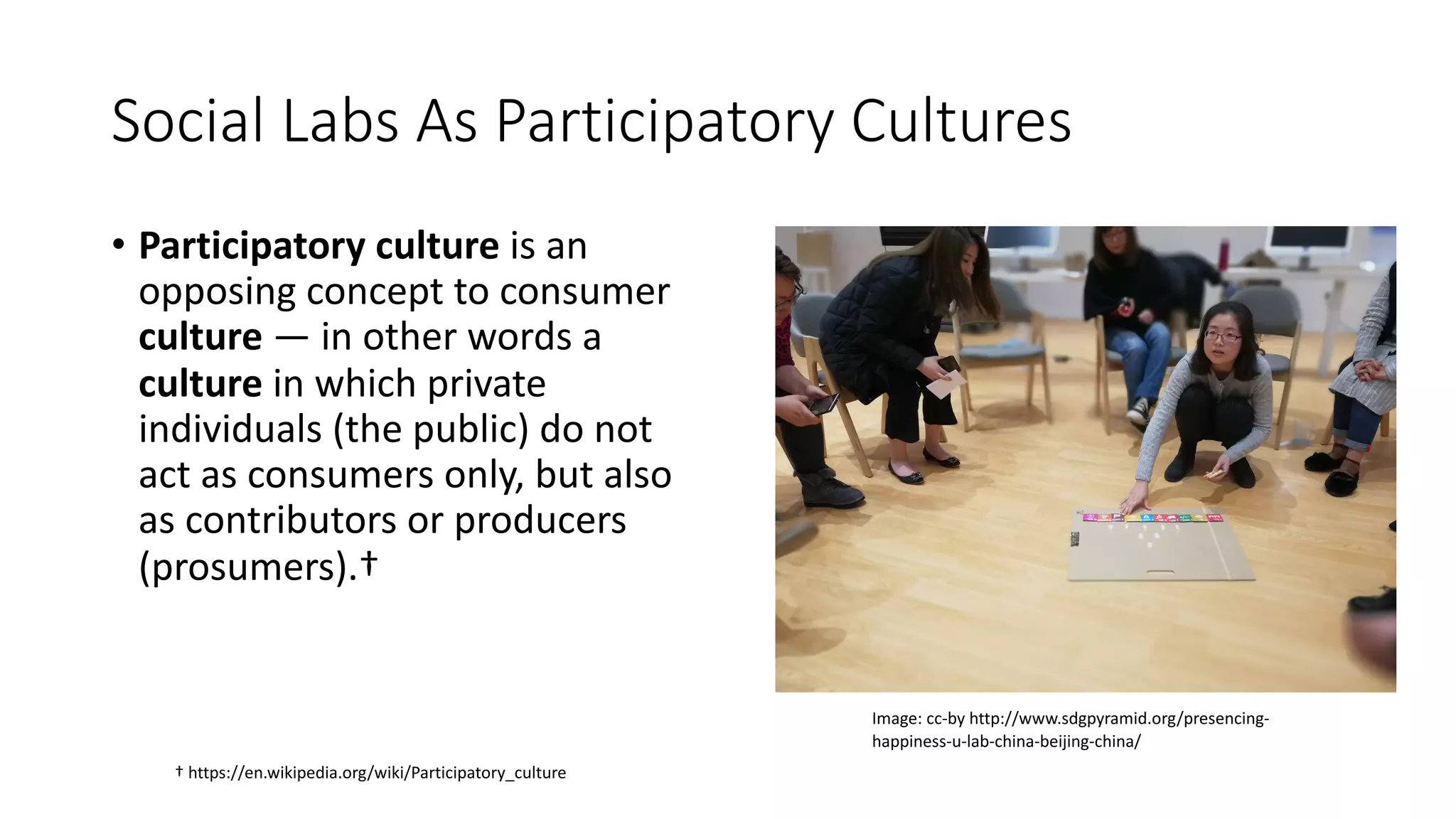
Social Labs As Participatory Cultures
• Participatory culture is an
opposing concept to consumer
culture — in other words a
culture in which private
individuals (the public) do not
act as consumers only, but also
as contributors or producers
(prosumers).†
† https://en.wikipedia.org/wiki/Participatory_culture
Image: cc-by http://www.sdgpyramid.org/presencing-
happiness-u-lab-china-beijing-china/
Role-playing Games as Participatory Culture
• Ability to scale participation
• Quests
• Focus Questions for Collaborative
Research
• Facilitate learning conversations
• Guilds
• Roles to play
• Rules of engagement
• Leveling up to grow skills and knowledge
Never doubt that a small
group of thoughtful,
committed citizens can
change the world; indeed,
it’s the only thing that ever
has.
--Margaret Mead
Avatars Explore Their Intentionality
Roles and Avatars
are ways of exploring and holding
individual and group intentionality
and of re-composing those
toward meeting challenges
from emerging futures
in the human-tool-life ecosystem
Wikipedia
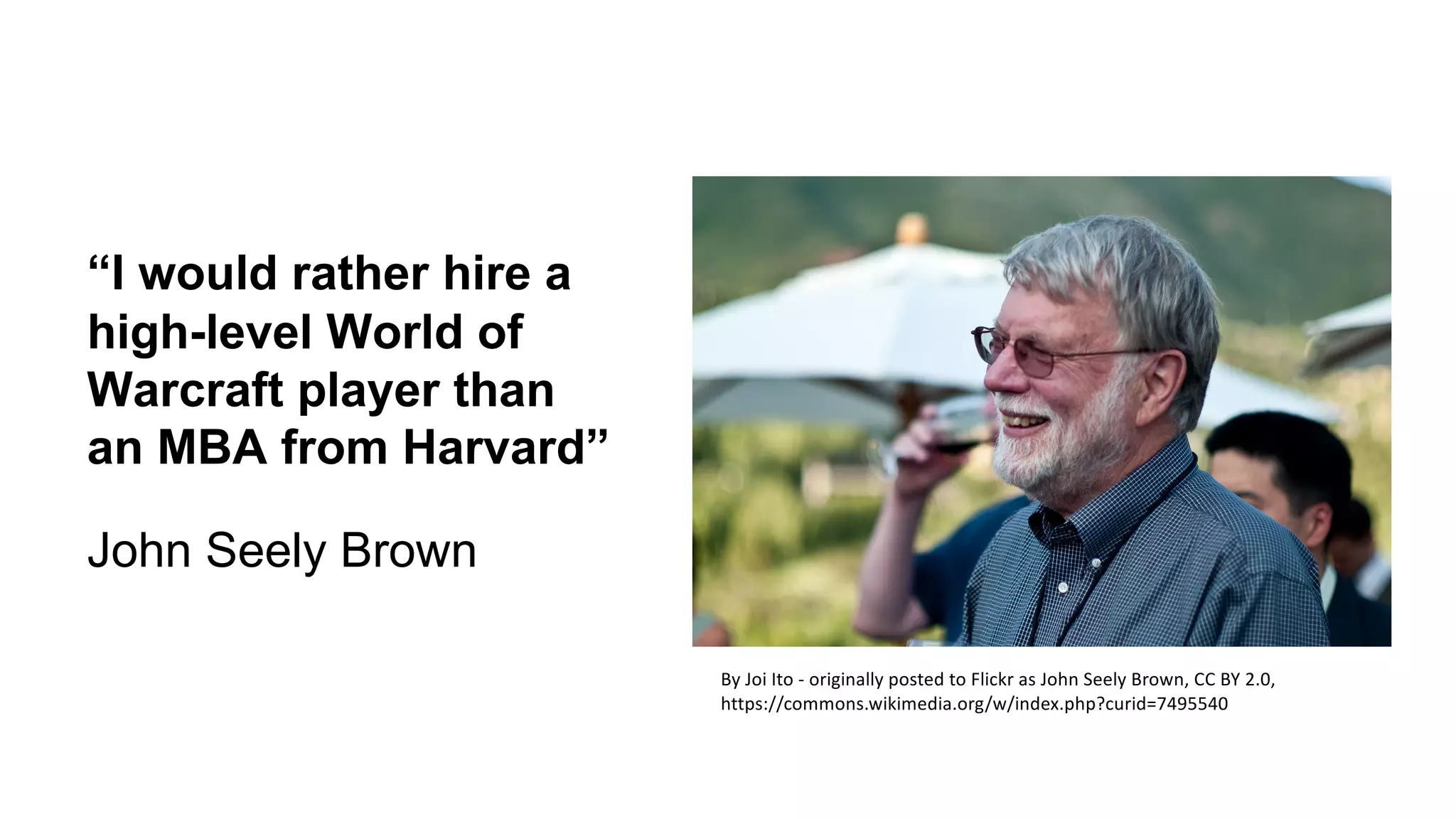
“I would rather hire a
high-level World of
Warcraft player than
an MBA from Harvard”
John Seely Brown
By Joi Ito - originally posted to Flickr as John Seely Brown, CC BY 2.0,
https://commons.wikimedia.org/w/index.php?curid=7495540
The Knowing Garden ecosystem
Tool System:
Building common
knowledge through
mapping
conversations
Human System:
Participation
through guilds
Life System:
new paradigms
to co-create
Ecosystem
Working on knowledge made
accessible as a commons
through topic mapping
Avatar dynamics within guilds
and between guilds make richer
conversations
Attention Ecology
To deal with wicked complexity
individuals & guilds access
their attention/intention,
born from & affected by
the triple Eco-System.
How can we have civil conversations online
about politics?
• Issue
• Political conversation is
• Complex
• Many different dimensions
• Many different world views
• Wicked
• Social behaviors of participants
• Knowing Garden Solution
• Game Mechanics + Guild Social Dynamics
• Issue-based Information Systems
• Quests as Structured Conversations
Knowing garden design for refugee
conversation
• Complex Issues (doughnut has 21)
• Topic-specific knowing hubs
• Ongoing and flash guilds
• Multi -perspectival -disciplinary
• Networked hubs
• Federated knowing hubs
[https://www.kateraworth.com/doughnut/]
Knowing Garden Activities
• Collaborative Discovery and Action
• Quests as truth-seeking journeys
• Outer
• MMORG-like Epic Knowledge Quests
• Federated collections of perspectives
• Inner
• How issues are held
• How intention is formed
• By individuals and by groups
Destination: A Federation of Knowing
Gardens
Completed Representation
antioxidants
kill
free radicals
Contraindicates
macrophages use
free radicals to
kill bacteria
Bacterial Infection Antioxidants
Because
Appropriate For
Compromised Host
Let us co-create Augmented Social labs
jackpark@topicquests.org
szpak@topicquests.org
maparent@topicquests.org
http://www.topicquests.org/
https://slideshare.net/jackpark/
https://github.com/topicquests

Finding Meaning Across Boundaries

  • 1.
    Finding Meaning Across Boundaries JackPark, Mark Szpakowski and Marc-Antoine Parent Transform Conference May 22-24 San Francisco, CA © 2019, TopicQuests Foundation Image: http://www.geo.coop/story/essentials-theory-u
  • 2.
    Big Picture • Refugeeissues are made wicked by partial perspectives on complex issues • Conversation mapping and topic maps tools help weave perspectives together • Participatory culture, gamified as quests, can unify stakeholders around augmented cognition processes Photo by Ray Hennessy on Unsplash
  • 3.
    Urgent Challenge How wecan improve our perception of the complexity we live within, so we may improve our interaction with the world? -- Nora Bateson A game-changing Perception ó Action response is necessary within the decade.
  • 4.
    Refugee issues aremade wicked by partial perspectives on complex issues
  • 5.
    Problem Space: BigPicture • Signature Question • How can we have civil conversations online about politics? • Signature Issues • Massive Complexity in Refugee Ecosystem • Massive Complexity does not reduce well to simple solutions • Finding Solutions requires • Increased creative exploration of options • Increased Trust Walt Kelly (1971) Image: Wikipedia
  • 6.
    Problem Space • Toomuch information (info glut) • Missing information • Proprietary and not available • Not proprietary, but hasn't been brought to addressable space • Massive amounts of tacit knowledge • Native intuition not captured • Incomplete recording • Trust • Heterogeneity • Language (vernacular, dialects, etc.) • Different world views on same topic
  • 7.
    Differences in WorldViews "This is the difference between us Romans and the Etruscans: We believe that lightning is caused by clouds colliding, whereas they believe that clouds collide in order to create lightning. Since they attribute everything to gods, they are led to believe not that events have a meaning because they have happened, but that they happen in order to express a meaning." —Seneca (Roman Philosopher, first century C.E.)
  • 8.
    A Simple ConversationExample • A proposal: lower taxes (X) to improve economic growth (Y) Yes or no? • But what would no mean? 1. No to X • X also causes an unintended negative side effect, such as underfunding essential social services 2. No to the X-causes-Y link • there is no evidence that lowering taxes causes economic growth 3. No to the goal Y • We should be thinking of de-growth on an exhausted planet
  • 9.
    Limits of ourKnowledge • We can open a microbe to study all the parts • Opening the microbe kills it • Why did opening a microbe to count all the parts kill it? • What is life? • Did opening the microbe to count its parts get us any closer to an answer? • Answers are bound to the nature of Complex Systems Img: Wikipedia
  • 10.
    Relations Among theParts • Counting parts is a start • But, everything is intertwingled • Understanding the relationships among those parts and between them and their environment is the next step • Relations as complex, interwoven fabrics • Use garden tools to augment our capabilities Img: © Regents of University of California
  • 11.
    Conversation mapping andtopic maps tools help weave perspectives together
  • 12.
    Ecosystem Overview • HumanSystem • complex, adaptive, anticipatory, as individual and as society • mother and user of Tool System, animating it with intentionality • Tool System • hardware and software for networked sensemaking and presencing • augments & de-augments Human System capabilities • Life System • sustains Human System, both physically and psychically • is affected by Human System amplified by Tool System Image: Mark Szpakowski (2018) http://www.topicquests.org/human-tool-and-eco-systems/
  • 13.
    Wickedness Tool System • Humansguide tools • (AI) tools train on humans Human System Blind spot: humans guide & train themselves (not!) • Individual framing & intention • Group intentionality In the Anthropogenic Epoch the humans mapping complexity are not outside, but inside, the map. Knowledge is contextual to perspectives held individually and collectively in warm, emotional bodies.
  • 14.
    Challenge Responses I KnowledgeQuesting • Structured conversation flows • to arrive at sensemaking perspectives • conducted by teams with ethos Tool Systems to augment • Collaborating • Knowing (extracting & mapping) An insistence on science as purely apolitical and technocratic leaves a blind spot the size of humanity in how climate impacts will affect us, and how we might respond and act proactively. [https://www.resilience.org/stories/2019-04-25/a-postmortem-for-survival-on-science- failure-and-action-on-climate-change/]
  • 15.
    Challenge Responses II HumanSystems to augment • Self-aware intentionality • Of individuals, group, society Life Systems to augment • Well-being of mind and body • Resting attention (not just human)
  • 16.
    Mapping Technologies • MindMaps •Simple • Good place to start thinking about situations • ConceptMaps • Adds labeled arcs (relations) to MindMaps • TopicMaps • Turns important relations to topics • Important relations: • Have biographies • Can be the subject of debate
  • 17.
    TopicMap Use Cases •First Use Case • Index of the back of a book is a weak topic map • General Use Case • Seed with domain ontologies (vocabularies) • Grow as important topics are discovered • From conversations • From personal notes Photo by Sam Goodgame on Unsplash
  • 18.
    Discovery in Context:An Example Information Gathering in a Knowing Garden
  • 19.
    Discovery followed byAction Gardener connects concepts
  • 20.
    Discovery followed byAction Gardener creates new concepts to better explain “must avoid” connection
  • 21.
    Let the ConversationsBegin: a Challenge
  • 22.
    Responses Leading toNew Concepts Compromised Host is new Concept
  • 23.
    Gardening Outcome antioxidants kill free radicals Contraindicates macrophagesuse free radicals to kill bacteria Bacterial Infection Antioxidants Because Appropriate For Compromised Host Co-created resource in the garden
  • 24.
    Participatory culture, played asquests, can unify stakeholders around augmented cognition processes
  • 25.
    Opportunity Space: aPublic Loom • Topic based information that is: • Brought together through federation with relevance • Freely available • Recorded, easily found and built upon • With tacit knowledge and native intuition captured • Trustworthy • All sides of the story are covered • Heterogeneity • Information is captured in a format that takes into account vernacular, dialects, different world views, etc.
  • 26.
    From the perspectiveof complexity theory, emergence arises from complex systems that create new properties from “autonomous unities coming together into larger, more powerful unities” Augmenting Human Capabilities Complex Systems Shared Stories Collaboration in a Knowing Garden Img: Olen Gunnlaugson (2011). A Complexity Perspective on Presencing. Complicity, Vol 9, No 1 (2012). Online at: http://ejournals.library The emergence we seek is that of insight into the nature of and solutions to complex problems Barn Raising
  • 27.
    Existing Solutions: SocialLabs • Social labs are platforms for addressing complex social challenges that have three core characteristics.† • They are social. • They are experimental. • They are systemic. Why Planning is Killing Us And Prototyping Will Save Us † https://ssir.org/articles/entry/the_social_labs_revolution_a_new_approach_to_solving_our_most_complex_chall#
  • 28.
    Social Labs AsParticipatory Cultures • Participatory culture is an opposing concept to consumer culture — in other words a culture in which private individuals (the public) do not act as consumers only, but also as contributors or producers (prosumers).† † https://en.wikipedia.org/wiki/Participatory_culture Image: cc-by http://www.sdgpyramid.org/presencing- happiness-u-lab-china-beijing-china/
  • 29.
    Role-playing Games asParticipatory Culture • Ability to scale participation • Quests • Focus Questions for Collaborative Research • Facilitate learning conversations • Guilds • Roles to play • Rules of engagement • Leveling up to grow skills and knowledge Never doubt that a small group of thoughtful, committed citizens can change the world; indeed, it’s the only thing that ever has. --Margaret Mead
  • 30.
    Avatars Explore TheirIntentionality Roles and Avatars are ways of exploring and holding individual and group intentionality and of re-composing those toward meeting challenges from emerging futures in the human-tool-life ecosystem Wikipedia
  • 31.
    “I would ratherhire a high-level World of Warcraft player than an MBA from Harvard” John Seely Brown By Joi Ito - originally posted to Flickr as John Seely Brown, CC BY 2.0, https://commons.wikimedia.org/w/index.php?curid=7495540
  • 32.
    The Knowing Gardenecosystem Tool System: Building common knowledge through mapping conversations Human System: Participation through guilds Life System: new paradigms to co-create Ecosystem Working on knowledge made accessible as a commons through topic mapping Avatar dynamics within guilds and between guilds make richer conversations
  • 33.
    Attention Ecology To dealwith wicked complexity individuals & guilds access their attention/intention, born from & affected by the triple Eco-System.
  • 34.
    How can wehave civil conversations online about politics? • Issue • Political conversation is • Complex • Many different dimensions • Many different world views • Wicked • Social behaviors of participants • Knowing Garden Solution • Game Mechanics + Guild Social Dynamics • Issue-based Information Systems • Quests as Structured Conversations
  • 35.
    Knowing garden designfor refugee conversation • Complex Issues (doughnut has 21) • Topic-specific knowing hubs • Ongoing and flash guilds • Multi -perspectival -disciplinary • Networked hubs • Federated knowing hubs [https://www.kateraworth.com/doughnut/]
  • 36.
    Knowing Garden Activities •Collaborative Discovery and Action • Quests as truth-seeking journeys • Outer • MMORG-like Epic Knowledge Quests • Federated collections of perspectives • Inner • How issues are held • How intention is formed • By individuals and by groups
  • 37.
    Destination: A Federationof Knowing Gardens
  • 38.
    Completed Representation antioxidants kill free radicals Contraindicates macrophagesuse free radicals to kill bacteria Bacterial Infection Antioxidants Because Appropriate For Compromised Host Let us co-create Augmented Social labs jackpark@topicquests.org szpak@topicquests.org maparent@topicquests.org http://www.topicquests.org/ https://slideshare.net/jackpark/ https://github.com/topicquests