



How we create
bespoke e-learning
Introductions

Deborah Limb
Head of Content Creation

Lindsey Rees
Content Creation Manager
What is Content
      Creation ?
•   Learning Pool Catalogue
•   Learning Pool Quick Builds
•   Module Suites
•   Bespoke Content
http://www.learningpool.com/course-catalogue/
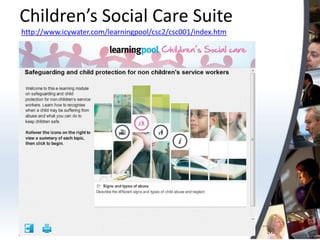
Children’s Social Care Suite
1. Safeguarding and child protection for non children's service workers 40 min
2. Safeguarding and child protection for adults working with children 50 min
3. Common Assessment Framework 30 min
4. Protection Investigation 40 min
5. Child Protection Processes 35 mins
6. The Role of a Social Worker within Child Protection Processes 30 mins
7. Multi Agency Forums 35 mins
8. Children with Disabilities TBC mins
9. Sexual Abuse TBC mins
10. Physical Abuse TBC mins
11. Emotional Abuse TBC mins
12. Neglect TBC mins
Children’s Social Care Suite
http://www.icywater.com/learningpool/csc2/csc001/index.htm
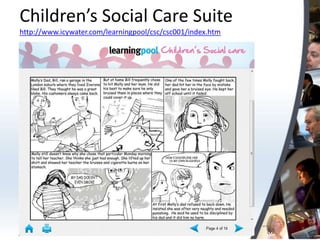
Children’s Social Care Suite
http://www.icywater.com/learningpool/csc/csc001/index.htm
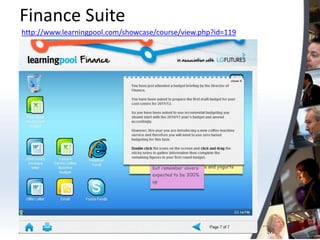
Finance Suite
http://www.learningpool.com/showcase/course/view.php?id=119
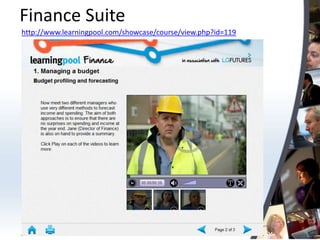
Finance Suite
http://www.learningpool.com/showcase/course/view.php?id=119
Have you considered
instructional design?
Have you used the
 Authoring Tool?
Have you created your
   own graphics?
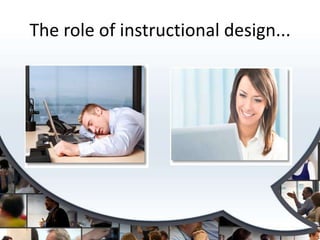
The role of instructional design...
Good instructional design...
• Develops your Knowledge

• Gives you new Skills

• Changes your Attitudes or Behaviours

• Inspires you to Do Things Differently

• Retains your Attention

• Is Memorable
Instructional designers....
• Work with subject matter experts and
  subject content in various formats
• Structure and sequence content to meet the
  needs of the learner and the organisation
• Set the tone of voice through choice of
  language/style
• Design learner interactions and activities
• Identify delivery method and media to be used
• Shape the assessment and evaluation approach
• Consider other support tools
Action Mapping
http://blog.cathy-moore.com/
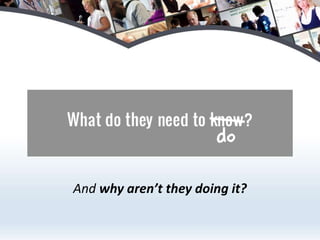
And why aren’t they doing it?
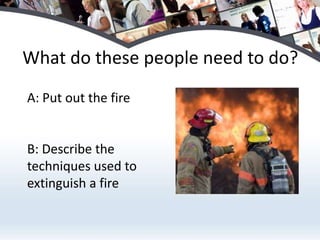
What do these people need to do?
A: Put out the fire


B: Describe the
techniques used to
extinguish a fire
Action Mapping Example
STEP 1: Identify the business goal

Good: Increase widget sales 8% by Q4

Avoid: Salespeople should know all the widget
  features
Action Mapping Steps
STEP 2: Identify what people need to do to
  reach that goal
To increase sales, our salespeople must:
• Ask questions that uncover a customer’s needs.
• Identify the best widget for the customer.
• Emphasize the benefits that will matter most to
• the customer.

These statements describe actions, not knowledge
Action Mapping Steps
STEP 3: Design activities that help people
  practise each behaviour
• A fictional customer appears. The learner chooses
  questions that will reveal the customer’s needs.
• A customer wants to reduce their electricity use. The
  learner identifies the best widget and explains their
  choice.

Avoid fact checks and trivia games. These don’t happen in the real
  world.
Action Mapping Steps
STEP 4: Identify what people (really, really)
  need to know
Identify the information that the learners must
  have to complete each practice activity.
                          We should describe
    We should cover the
                          the supply chain for
    history of widgets!
                          widget parts.
Task: Apply action mapping
  principles to the following…

Content: Dealing with subject
  access requests involving other
  people’s information

Target audience: Contact centre
  staff at Wickstafford Council
Instructional design checklist
•   Think about the learner at all times
•   Use clear, creative language
•   Build in lots of interactivity
•   Use extended scenarios
•   Provide problem solving opportunities
•   Supply examples
•   Ask lots of questions and provide meaningful feedback
•   Use appropriate visuals
•   Design short learning cycles
•   Utilise Whole – Part – Whole learning
•   Reward learners – make the experience fun!
What will you do
 differently?
Any questions?
Subject Access Request Example
STEP 1: Identify the business goal

Call centre staff to be able to correctly decide
  when to disclose information following a
  subject access request
Subject Access Request Example
STEP 2: Identify what people need to do to reach that goal
1.   Identify if the information requested relates to other individuals as well
     as the individual making the request

2.   Identify if it is possible to comply with the request without revealing
     information which relates to and identifies a third party individual

3.   If possible, obtain consent from third party

4.   If not possible, decide whether it would it be reasonable to disclose
     without consent
Subject Access Request Example
STEP 3: Design activities that help people practise each
  behaviour
1.   Identify if the information requested relates to other individuals as well
     as the individual making the request

Show a number of different potential scenarios including the request and the
    associated requested information. Ask the learner to make a judgement
    on whether disclosure would affect a third party. This could be extended
    to an online resource with a variety of scenarios that are available as a
    reference for learners whilst doing their daily role. These could be used if
    they are unsure, to help them compare the current decsion to some
    model answers.
Subject Access Request Example
STEP 4: Identify what people (really, really)
  need to know

In this instance, really very little. If you are
   concerned about launching straight in you could
   give a couple of example scenarios with
   appropriate responses before getting them to
   decide.

Deborah Limb, Learning Pool

  • 1.
  • 2.
    Introductions Deborah Limb Head ofContent Creation Lindsey Rees Content Creation Manager
  • 3.
    What is Content Creation ? • Learning Pool Catalogue • Learning Pool Quick Builds • Module Suites • Bespoke Content http://www.learningpool.com/course-catalogue/
  • 4.
    Children’s Social CareSuite 1. Safeguarding and child protection for non children's service workers 40 min 2. Safeguarding and child protection for adults working with children 50 min 3. Common Assessment Framework 30 min 4. Protection Investigation 40 min 5. Child Protection Processes 35 mins 6. The Role of a Social Worker within Child Protection Processes 30 mins 7. Multi Agency Forums 35 mins 8. Children with Disabilities TBC mins 9. Sexual Abuse TBC mins 10. Physical Abuse TBC mins 11. Emotional Abuse TBC mins 12. Neglect TBC mins
  • 5.
    Children’s Social CareSuite http://www.icywater.com/learningpool/csc2/csc001/index.htm
  • 6.
    Children’s Social CareSuite http://www.icywater.com/learningpool/csc/csc001/index.htm
  • 7.
  • 8.
  • 9.
  • 10.
    Have you usedthe Authoring Tool?
  • 11.
    Have you createdyour own graphics?
  • 12.
    The role ofinstructional design...
  • 13.
    Good instructional design... •Develops your Knowledge • Gives you new Skills • Changes your Attitudes or Behaviours • Inspires you to Do Things Differently • Retains your Attention • Is Memorable
  • 14.
    Instructional designers.... • Workwith subject matter experts and subject content in various formats • Structure and sequence content to meet the needs of the learner and the organisation • Set the tone of voice through choice of language/style • Design learner interactions and activities • Identify delivery method and media to be used • Shape the assessment and evaluation approach • Consider other support tools
  • 15.
  • 16.
    And why aren’tthey doing it?
  • 17.
    What do thesepeople need to do? A: Put out the fire B: Describe the techniques used to extinguish a fire
  • 18.
    Action Mapping Example STEP1: Identify the business goal Good: Increase widget sales 8% by Q4 Avoid: Salespeople should know all the widget features
  • 19.
    Action Mapping Steps STEP2: Identify what people need to do to reach that goal To increase sales, our salespeople must: • Ask questions that uncover a customer’s needs. • Identify the best widget for the customer. • Emphasize the benefits that will matter most to • the customer. These statements describe actions, not knowledge
  • 20.
    Action Mapping Steps STEP3: Design activities that help people practise each behaviour • A fictional customer appears. The learner chooses questions that will reveal the customer’s needs. • A customer wants to reduce their electricity use. The learner identifies the best widget and explains their choice. Avoid fact checks and trivia games. These don’t happen in the real world.
  • 21.
    Action Mapping Steps STEP4: Identify what people (really, really) need to know Identify the information that the learners must have to complete each practice activity. We should describe We should cover the the supply chain for history of widgets! widget parts.
  • 22.
    Task: Apply actionmapping principles to the following… Content: Dealing with subject access requests involving other people’s information Target audience: Contact centre staff at Wickstafford Council
  • 24.
    Instructional design checklist • Think about the learner at all times • Use clear, creative language • Build in lots of interactivity • Use extended scenarios • Provide problem solving opportunities • Supply examples • Ask lots of questions and provide meaningful feedback • Use appropriate visuals • Design short learning cycles • Utilise Whole – Part – Whole learning • Reward learners – make the experience fun!
  • 25.
    What will youdo differently?
  • 26.
  • 27.
    Subject Access RequestExample STEP 1: Identify the business goal Call centre staff to be able to correctly decide when to disclose information following a subject access request
  • 28.
    Subject Access RequestExample STEP 2: Identify what people need to do to reach that goal 1. Identify if the information requested relates to other individuals as well as the individual making the request 2. Identify if it is possible to comply with the request without revealing information which relates to and identifies a third party individual 3. If possible, obtain consent from third party 4. If not possible, decide whether it would it be reasonable to disclose without consent
  • 29.
    Subject Access RequestExample STEP 3: Design activities that help people practise each behaviour 1. Identify if the information requested relates to other individuals as well as the individual making the request Show a number of different potential scenarios including the request and the associated requested information. Ask the learner to make a judgement on whether disclosure would affect a third party. This could be extended to an online resource with a variety of scenarios that are available as a reference for learners whilst doing their daily role. These could be used if they are unsure, to help them compare the current decsion to some model answers.
  • 30.
    Subject Access RequestExample STEP 4: Identify what people (really, really) need to know In this instance, really very little. If you are concerned about launching straight in you could give a couple of example scenarios with appropriate responses before getting them to decide.