Fluid Dynamics
AP Physics B
Fluid Flow
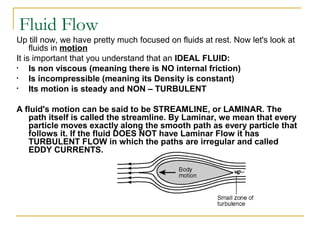
Up till now, we have pretty much focused on fluids at rest. Now let's look at
fluids in motion
It is important that you understand that an IDEAL FLUID:
• Is non viscous (meaning there is NO internal friction)
• Is incompressible (meaning its Density is constant)
• Its motion is steady and NON – TURBULENT
A fluid's motion can be said to be STREAMLINE, or LAMINAR. The
path itself is called the streamline. By Laminar, we mean that every
particle moves exactly along the smooth path as every particle that
follows it. If the fluid DOES NOT have Laminar Flow it has
TURBULENT FLOW in which the paths are irregular and called
EDDY CURRENTS.
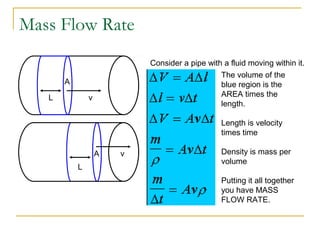
Mass Flow Rate
A
A
v
v
L
L
Consider a pipe with a fluid moving within it.
The volume of the
blue region is the
AREA times the
length.
Length is velocity
times time
Density is mass per
volume
Putting it all together
you have MASS
FLOW RATE.
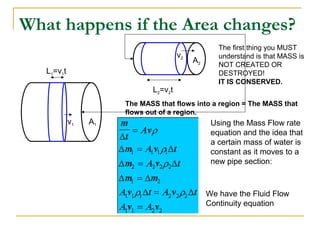
What happens if the Area changes?
A1
A2
v1
v2
L1=v1t
L2=v2t
The first thing you MUST
understand is that MASS is
NOT CREATED OR
DESTROYED!
IT IS CONSERVED.
The MASS that flows into a region = The MASS that
flows out of a region.
Using the Mass Flow rate
equation and the idea that
a certain mass of water is
constant as it moves to a
new pipe section:
We have the Fluid Flow
Continuity equation
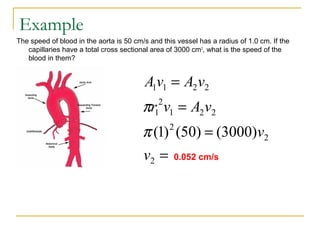
Example
The speed of blood in the aorta is 50 cm/s and this vessel has a radius of 1.0 cm. If the
capillaries have a total cross sectional area of 3000 cm2
, what is the speed of the
blood in them?
=
=
=
=
2
2
2
221
2
1
2211
)3000()50()1(
v
v
vAvr
vAvA
π
π
0.052 cm/s
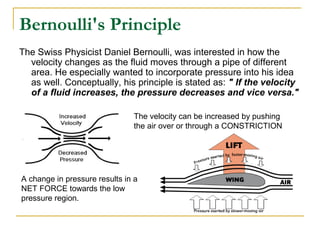
Bernoulli's Principle
The Swiss Physicist Daniel Bernoulli, was interested in how the
velocity changes as the fluid moves through a pipe of different
area. He especially wanted to incorporate pressure into his idea
as well. Conceptually, his principle is stated as: " If the velocity
of a fluid increases, the pressure decreases and vice versa."
The velocity can be increased by pushing
the air over or through a CONSTRICTION
A change in pressure results in a
NET FORCE towards the low
pressure region.
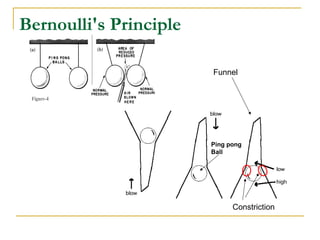
Bernoulli's Principle
Funnel
Ping pong
Ball
Constriction
Bernoulli's Principle
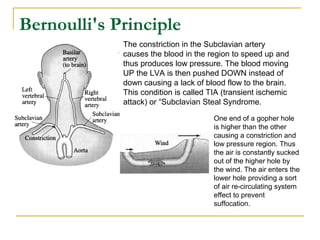
The constriction in the Subclavian artery
causes the blood in the region to speed up and
thus produces low pressure. The blood moving
UP the LVA is then pushed DOWN instead of
down causing a lack of blood flow to the brain.
This condition is called TIA (transient ischemic
attack) or “Subclavian Steal Syndrome.
One end of a gopher hole
is higher than the other
causing a constriction and
low pressure region. Thus
the air is constantly sucked
out of the higher hole by
the wind. The air enters the
lower hole providing a sort
of air re-circulating system
effect to prevent
suffocation.
Bernoulli's Equation
Let’s look at this principle
mathematically.
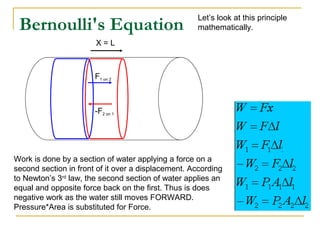
Work is done by a section of water applying a force on a
second section in front of it over a displacement. According
to Newton’s 3rd
law, the second section of water applies an
equal and opposite force back on the first. Thus is does
negative work as the water still moves FORWARD.
Pressure*Area is substituted for Force.
X = L
F1 on 2
-F2 on 1
Bernoulli's Equation
A1
A2
v1
v2
L1=v1t
L2=v2t
y2
ground
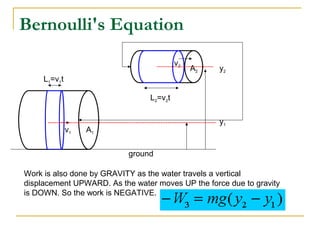
Work is also done by GRAVITY as the water travels a vertical
displacement UPWARD. As the water moves UP the force due to gravity
is DOWN. So the work is NEGATIVE.
y1
Bernoulli's Equation
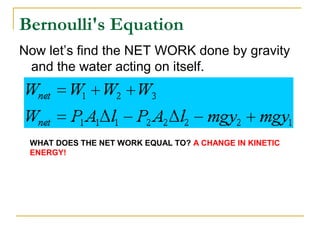
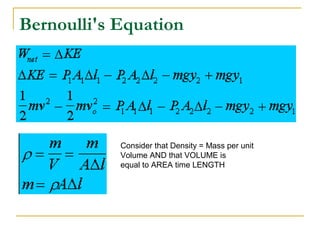
Now let’s find the NET WORK done by gravity
and the water acting on itself.
WHAT DOES THE NET WORK EQUAL TO? A CHANGE IN KINETIC
ENERGY!
Bernoulli's Equation
Consider that Density = Mass per unit
Volume AND that VOLUME is
equal to AREA time LENGTH
Bernoulli's Equation
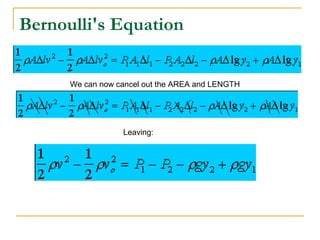
We can now cancel out the AREA and LENGTH
Leaving:
Bernoulli's Equation
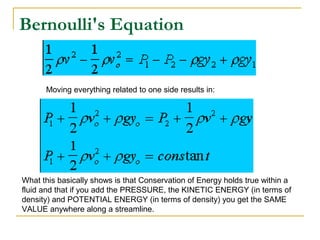
Moving everything related to one side results in:
What this basically shows is that Conservation of Energy holds true within a
fluid and that if you add the PRESSURE, the KINETIC ENERGY (in terms of
density) and POTENTIAL ENERGY (in terms of density) you get the SAME
VALUE anywhere along a streamline.
Example
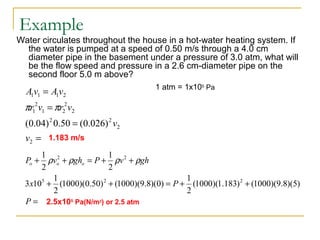
Water circulates throughout the house in a hot-water heating system. If
the water is pumped at a speed of 0.50 m/s through a 4.0 cm
diameter pipe in the basement under a pressure of 3.0 atm, what will
be the flow speed and pressure in a 2.6 cm-diameter pipe on the
second floor 5.0 m above?
=
=
=
=
2
2
22
2
2
21
2
1
2111
)026.0(50.0)04.0(
v
v
vrvr
vAvA
ππ
1.183 m/s
1 atm = 1x10⁵
Pa
=
++=++
++=++
P
Px
ghvPghvP ooo
)5)(8.9)(1000()183.1)(1000(
2
1
)0)(8.9)(1000()50.0)(1000(
2
1
103
2
1
2
1
225
22
ρρρρ
2.5x10⁵
Pa(N/m2
) or 2.5 atm

Fundamental of fluid dynamics

  • 1.
  • 2.
    Fluid Flow Up tillnow, we have pretty much focused on fluids at rest. Now let's look at fluids in motion It is important that you understand that an IDEAL FLUID: • Is non viscous (meaning there is NO internal friction) • Is incompressible (meaning its Density is constant) • Its motion is steady and NON – TURBULENT A fluid's motion can be said to be STREAMLINE, or LAMINAR. The path itself is called the streamline. By Laminar, we mean that every particle moves exactly along the smooth path as every particle that follows it. If the fluid DOES NOT have Laminar Flow it has TURBULENT FLOW in which the paths are irregular and called EDDY CURRENTS.
  • 3.
    Mass Flow Rate A A v v L L Considera pipe with a fluid moving within it. The volume of the blue region is the AREA times the length. Length is velocity times time Density is mass per volume Putting it all together you have MASS FLOW RATE.
  • 4.
    What happens ifthe Area changes? A1 A2 v1 v2 L1=v1t L2=v2t The first thing you MUST understand is that MASS is NOT CREATED OR DESTROYED! IT IS CONSERVED. The MASS that flows into a region = The MASS that flows out of a region. Using the Mass Flow rate equation and the idea that a certain mass of water is constant as it moves to a new pipe section: We have the Fluid Flow Continuity equation
  • 5.
    Example The speed ofblood in the aorta is 50 cm/s and this vessel has a radius of 1.0 cm. If the capillaries have a total cross sectional area of 3000 cm2 , what is the speed of the blood in them? = = = = 2 2 2 221 2 1 2211 )3000()50()1( v v vAvr vAvA π π 0.052 cm/s
  • 6.
    Bernoulli's Principle The SwissPhysicist Daniel Bernoulli, was interested in how the velocity changes as the fluid moves through a pipe of different area. He especially wanted to incorporate pressure into his idea as well. Conceptually, his principle is stated as: " If the velocity of a fluid increases, the pressure decreases and vice versa." The velocity can be increased by pushing the air over or through a CONSTRICTION A change in pressure results in a NET FORCE towards the low pressure region.
  • 7.
  • 8.
    Bernoulli's Principle The constrictionin the Subclavian artery causes the blood in the region to speed up and thus produces low pressure. The blood moving UP the LVA is then pushed DOWN instead of down causing a lack of blood flow to the brain. This condition is called TIA (transient ischemic attack) or “Subclavian Steal Syndrome. One end of a gopher hole is higher than the other causing a constriction and low pressure region. Thus the air is constantly sucked out of the higher hole by the wind. The air enters the lower hole providing a sort of air re-circulating system effect to prevent suffocation.
  • 9.
    Bernoulli's Equation Let’s lookat this principle mathematically. Work is done by a section of water applying a force on a second section in front of it over a displacement. According to Newton’s 3rd law, the second section of water applies an equal and opposite force back on the first. Thus is does negative work as the water still moves FORWARD. Pressure*Area is substituted for Force. X = L F1 on 2 -F2 on 1
  • 10.
    Bernoulli's Equation A1 A2 v1 v2 L1=v1t L2=v2t y2 ground Work isalso done by GRAVITY as the water travels a vertical displacement UPWARD. As the water moves UP the force due to gravity is DOWN. So the work is NEGATIVE. y1
  • 11.
    Bernoulli's Equation Now let’sfind the NET WORK done by gravity and the water acting on itself. WHAT DOES THE NET WORK EQUAL TO? A CHANGE IN KINETIC ENERGY!
  • 12.
    Bernoulli's Equation Consider thatDensity = Mass per unit Volume AND that VOLUME is equal to AREA time LENGTH
  • 13.
    Bernoulli's Equation We cannow cancel out the AREA and LENGTH Leaving:
  • 14.
    Bernoulli's Equation Moving everythingrelated to one side results in: What this basically shows is that Conservation of Energy holds true within a fluid and that if you add the PRESSURE, the KINETIC ENERGY (in terms of density) and POTENTIAL ENERGY (in terms of density) you get the SAME VALUE anywhere along a streamline.
  • 15.
    Example Water circulates throughoutthe house in a hot-water heating system. If the water is pumped at a speed of 0.50 m/s through a 4.0 cm diameter pipe in the basement under a pressure of 3.0 atm, what will be the flow speed and pressure in a 2.6 cm-diameter pipe on the second floor 5.0 m above? = = = = 2 2 22 2 2 21 2 1 2111 )026.0(50.0)04.0( v v vrvr vAvA ππ 1.183 m/s 1 atm = 1x10⁵ Pa = ++=++ ++=++ P Px ghvPghvP ooo )5)(8.9)(1000()183.1)(1000( 2 1 )0)(8.9)(1000()50.0)(1000( 2 1 103 2 1 2 1 225 22 ρρρρ 2.5x10⁵ Pa(N/m2 ) or 2.5 atm