FLUIDDYNAMICS
• Basic terms.
• Ideal Fluid.
• Equation of Continuity.
• Bernoulli'sTheorem.
• Application of Bernoulli’sTheorem.
FLUID:
• A fluid is a substance which can
flows.
• Such as liquids , gases and plasma.
• Example: Water, air etc…
Fluid Dynamics
• Study of fluid in motion.
Viscosity:
• The frictional effect b/w different layers
of a flowing fluid is the viscosity of the
fluid.
Drag Force:
• An object moving through a fluid
experiences a retarding force called a
drag force.
Fluid Flow
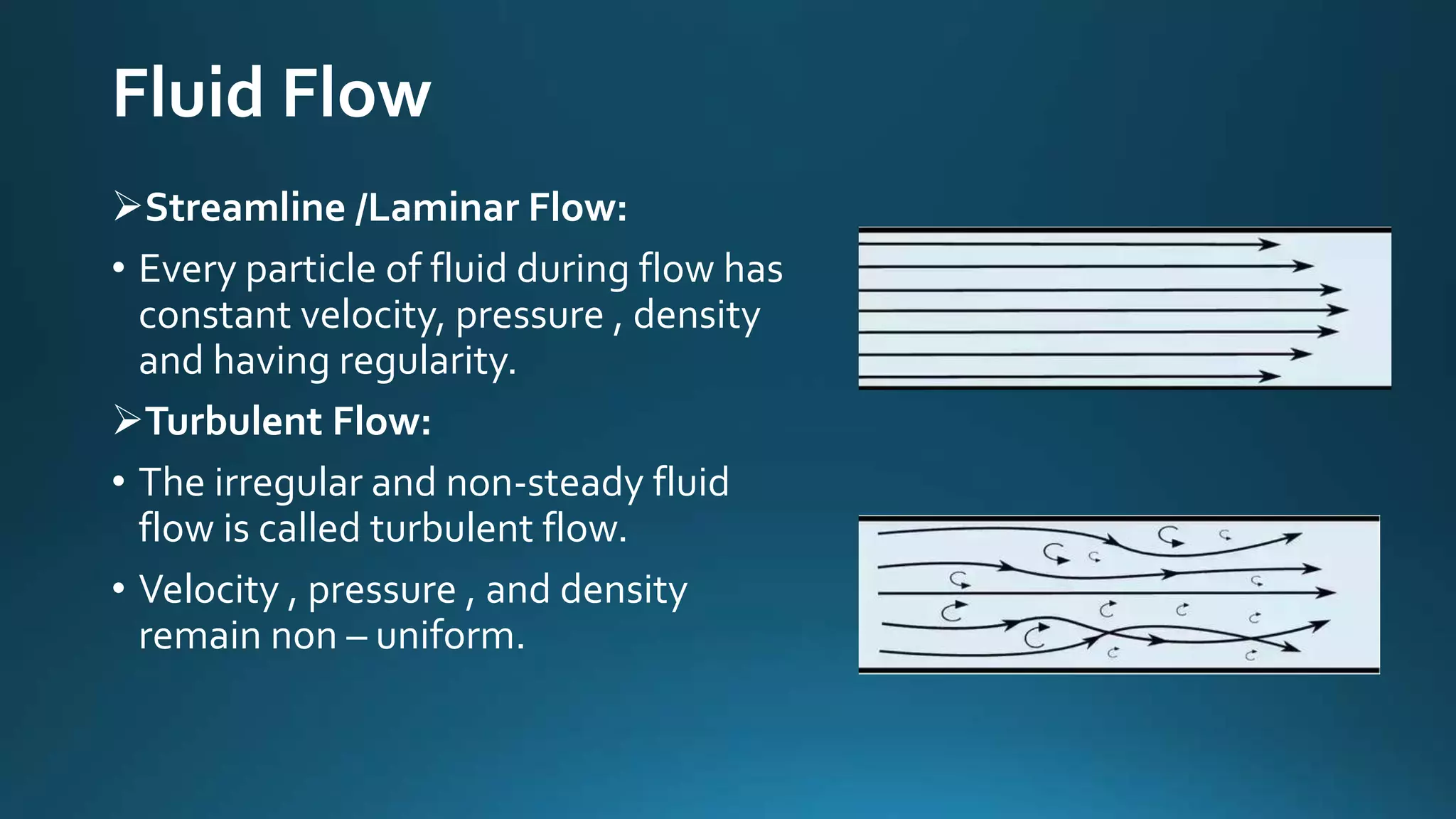
Streamline /Laminar Flow:
• Every particle of fluid during flow has
constant velocity, pressure , density
and having regularity.
Turbulent Flow:
• The irregular and non-steady fluid
flow is called turbulent flow.
• Velocity , pressure , and density
remain non – uniform.
IDEAL FLUID
Properties of Ideal Fluid:
1. Fluid is non-viscous (Internal Friction is neglected).
2. Fluid is incompressible (i.e. Constant Density).
3. Flow is Steady (Laminar).
4. Flow is irrotational (i.e. No angular momentum)
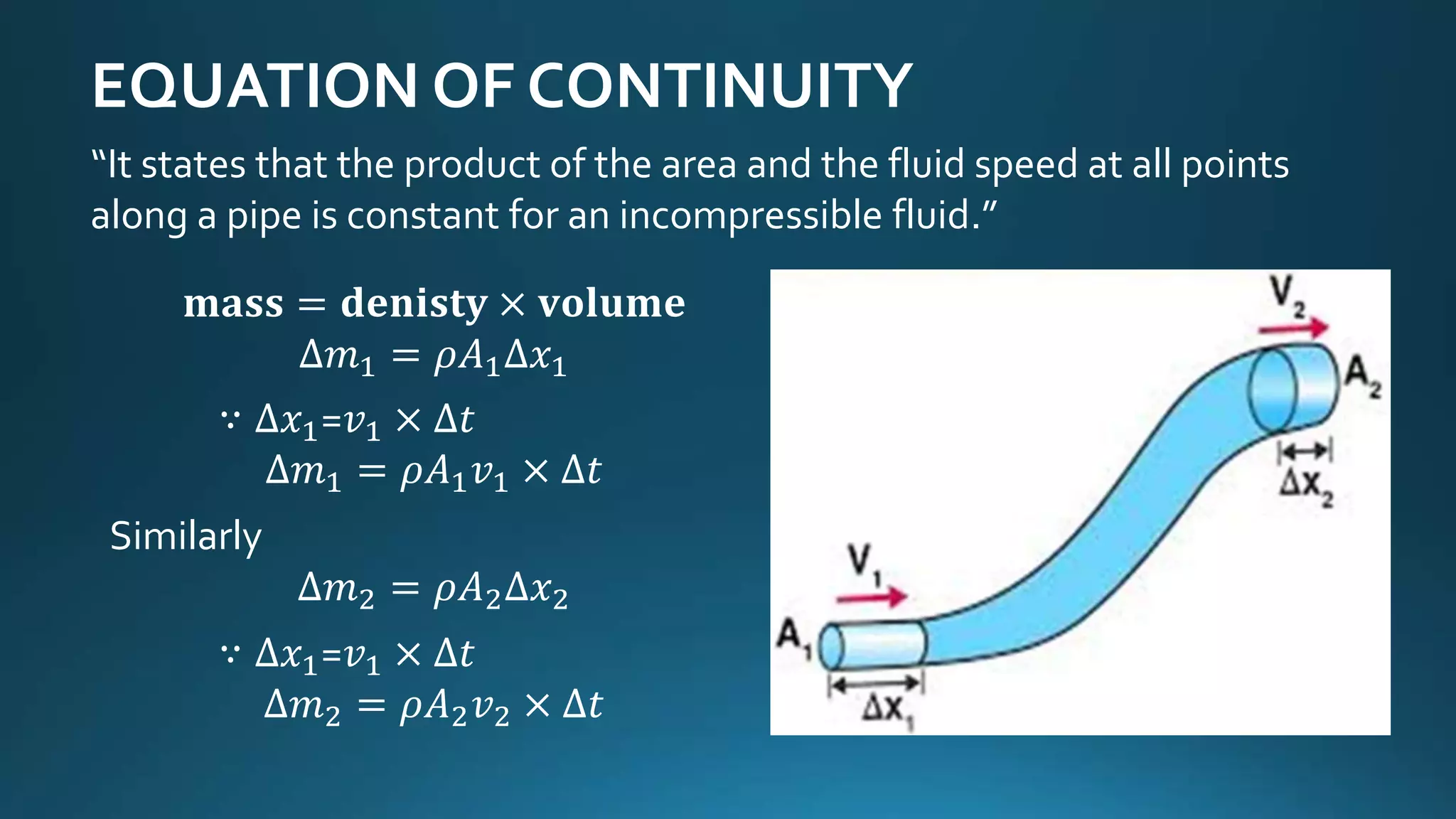
EQUATION OF CONTINUITY
𝐦𝐚𝐬𝐬 = 𝐝𝐞𝐧𝐢𝐬𝐭𝐲 × 𝐯𝐨𝐥𝐮𝐦𝐞
∆𝑚1 = 𝜌𝐴1∆𝑥1
∵ ∆𝑥1=𝑣1 × ∆𝑡
∆𝑚1 = 𝜌𝐴1 𝑣1 × ∆𝑡
Similarly
∆𝑚2 = 𝜌𝐴2∆𝑥2
∵ ∆𝑥1=𝑣1 × ∆𝑡
∆𝑚2 = 𝜌𝐴2 𝑣2 × ∆𝑡
“It states that the product of the area and the fluid speed at all points
along a pipe is constant for an incompressible fluid.”
• Because the fluid is incompressible and the flow is steady, then
∆𝑚1 = ∆𝑚2
𝜌𝐴1 𝑣1 × ∆𝑡 = 𝜌𝐴2 𝑣2 × ∆𝑡
𝐴1 𝑣1 = 𝐴2 𝑣2
So the product:
𝐴𝑣 = 𝑐𝑜𝑛𝑠𝑡𝑎𝑛𝑡
It has Dimensions:
𝐴 ×
∆𝑥
∆𝑡
=
𝑉𝑜𝑙𝑢𝑚𝑒
𝑡𝑖𝑚𝑒
It is either called Volume Flux or Flow Rate
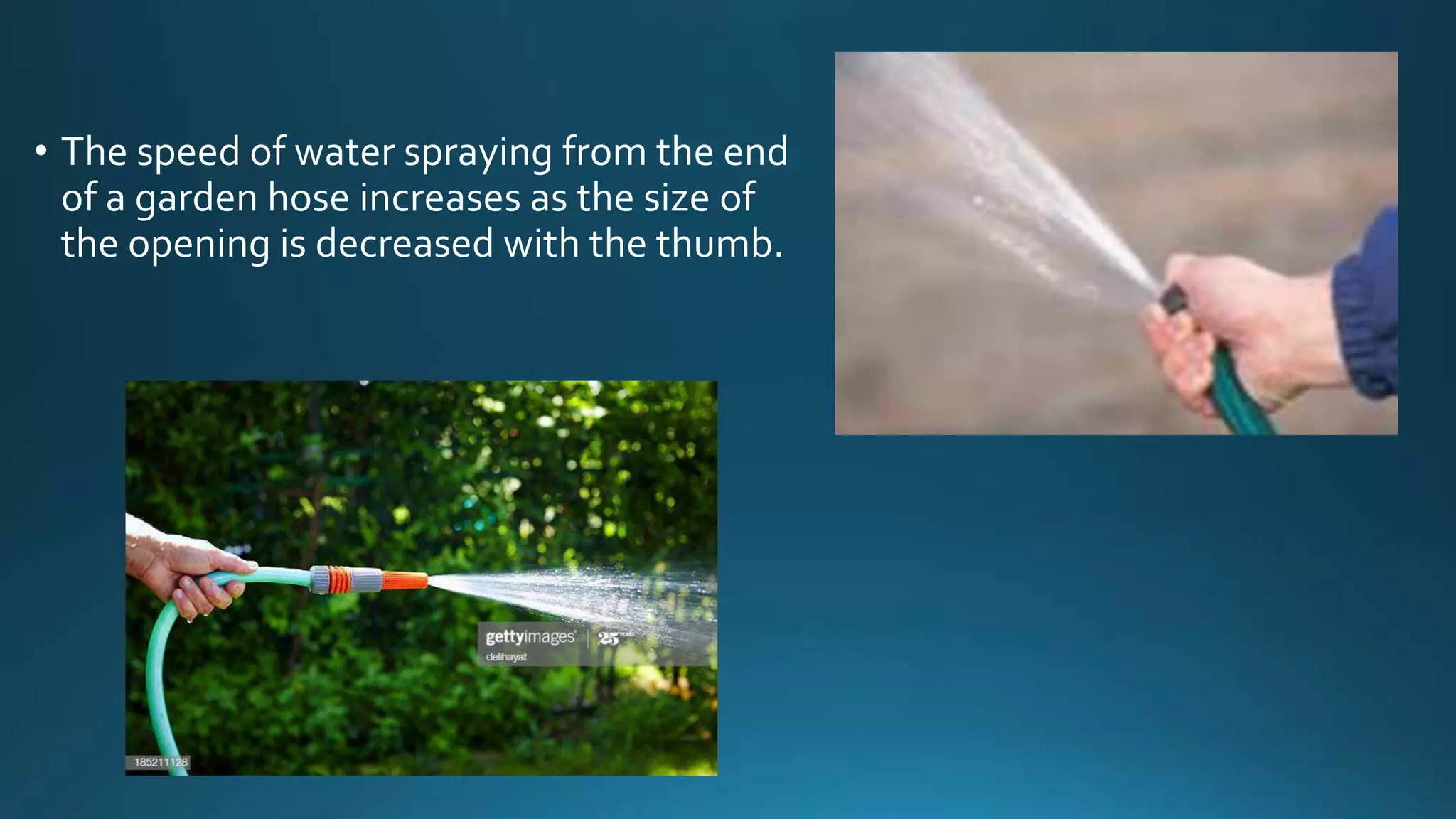
• The speed of water spraying from the end
of a garden hose increases as the size of
the opening is decreased with the thumb.
Bernoulli’sTheorem
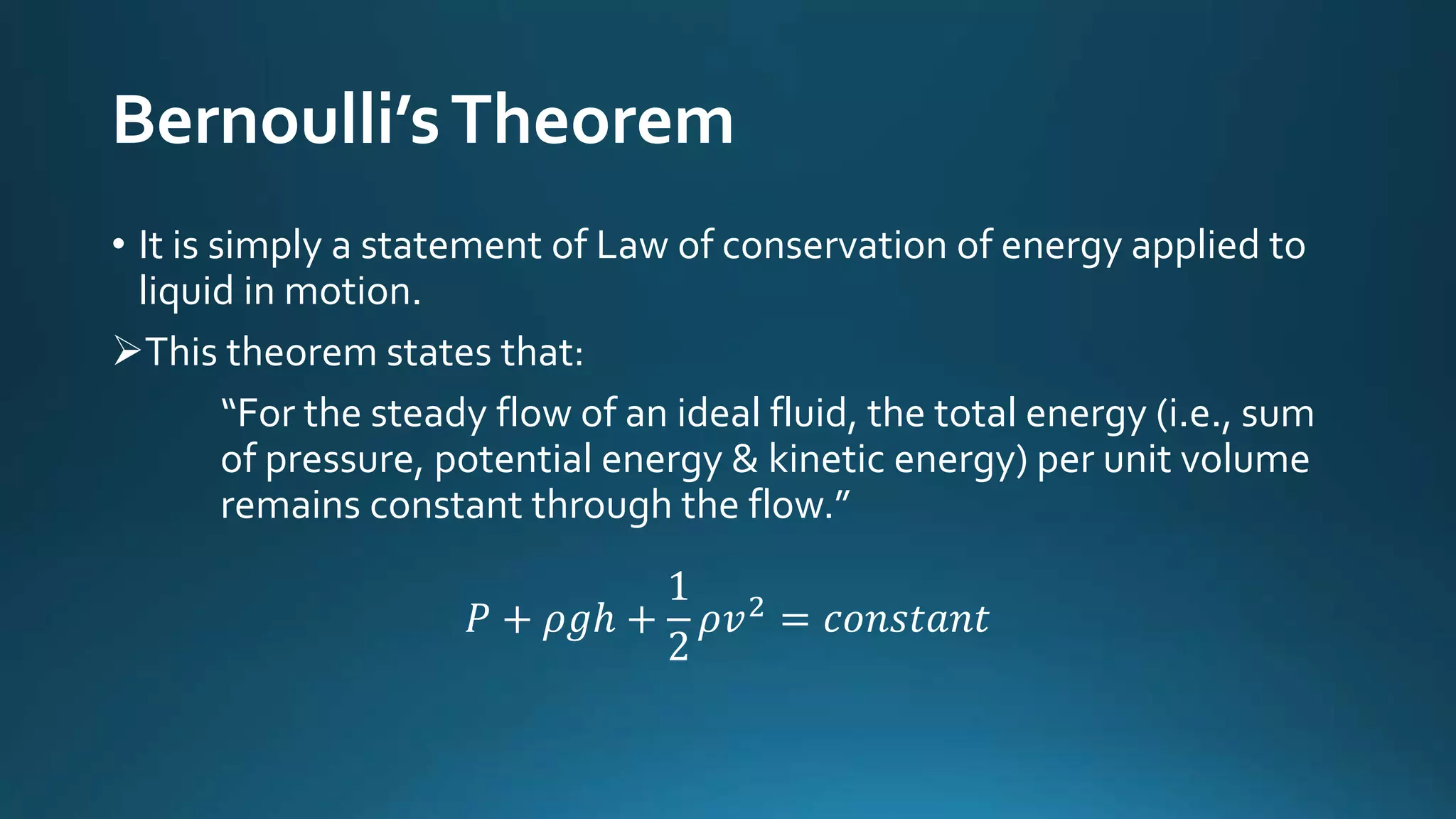
• It is simply a statement of Law of conservation of energy applied to
liquid in motion.
This theorem states that:
“For the steady flow of an ideal fluid, the total energy (i.e., sum
of pressure, potential energy & kinetic energy) per unit volume
remains constant through the flow.”
𝑃 + 𝜌𝑔ℎ +
1
2
𝜌𝑣2 = 𝑐𝑜𝑛𝑠𝑡𝑎𝑛𝑡
Proof:
The force exerted on lower segment:
𝐹1 = 𝑃1 𝐴1
TheWork Done by force on this
segment is:
𝑊1 = 𝐹1∆𝑥1
𝑊1 = 𝑃1 𝐴1∆𝑥1
• Similarly on the upper segment:
𝑊2 = −𝑃2 𝐴2∆𝑥2
This work done is negative because
the it is against Fluid Fow
The Force 𝐹1 moves the Liquid a distance
∆𝑥1 & the liquid moves a distance ∆𝑥2
against the Force 𝐹2.
Therefore, the net work done on liquid is:
𝑊 = 𝑃1 𝐴1∆𝑥1 − 𝑃2 𝐴2∆𝑥2
𝑊 = 𝑃1(𝐴1∆𝑥1) − 𝑃2(𝐴2∆𝑥2)
∵ 𝐴1∆𝑥1= 𝐴2∆𝑥2= m/ρ
𝑊 = 𝑃1 − 𝑃2 V
Part of thisWork is utilized by the fluid in changing its Kinetic Energy & a
part is used in changing its Gravitational Potential Energy:
∆𝐾. 𝐸 =
1
2
𝑚𝑣2
2
−
1
2
𝑚𝑣1
2
∆𝑃. 𝐸 = 𝑚𝑔ℎ2 − 𝑚𝑔ℎ1
None of theWork Done on the liquid has been used to overcome the internal
friction because the liquid is non-viscous.
• According to Law of Conservation of Energy:
𝑊 = ∆𝐾. 𝐸 + ∆𝑃. 𝐸
𝑃1 − 𝑃2 V =
1
2
𝑚𝑣2
2
−
1
2
𝑚𝑣1
2
+ 𝑚𝑔ℎ2 − 𝑚𝑔ℎ1
𝑃1 − 𝑃2 m/ρ =
1
2
𝑚𝑣2
2
−
1
2
𝑚𝑣1
2
+ 𝑚𝑔ℎ2 − 𝑚𝑔ℎ1
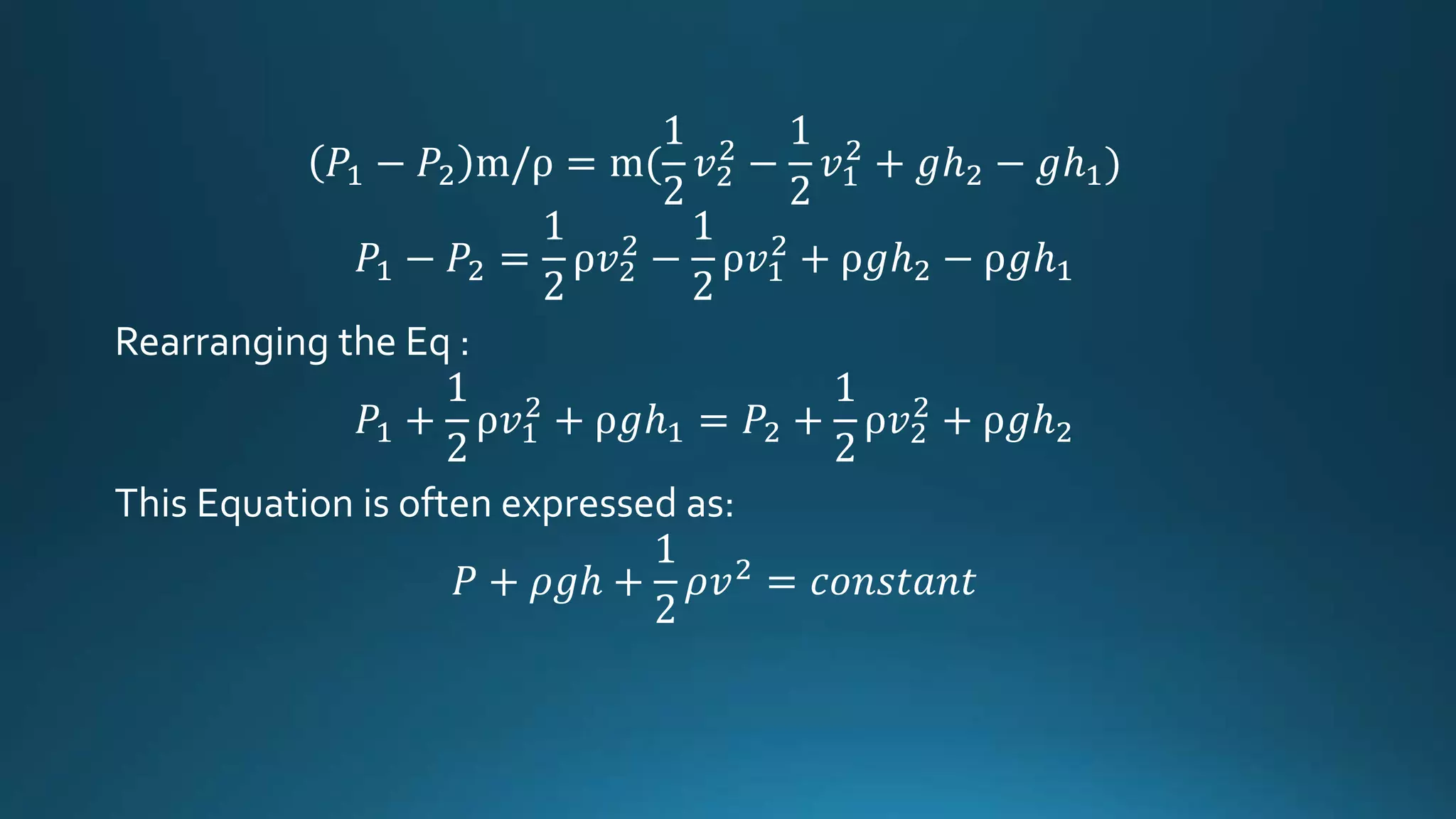
𝑃1 − 𝑃2 m/ρ = m(
1
2
𝑣2
2
−
1
2
𝑣1
2
+ 𝑔ℎ2 − 𝑔ℎ1)
𝑃1 − 𝑃2 =
1
2
ρ𝑣2
2
−
1
2
ρ𝑣1
2
+ ρ𝑔ℎ2 − ρ𝑔ℎ1
Rearranging the Eq :
𝑃1 +
1
2
ρ𝑣1
2
+ ρ𝑔ℎ1 = 𝑃2 +
1
2
ρ𝑣2
2
+ ρ𝑔ℎ2
This Equation is often expressed as:
𝑃 + 𝜌𝑔ℎ +
1
2
𝜌𝑣2 = 𝑐𝑜𝑛𝑠𝑡𝑎𝑛𝑡
Bernoulli’s equation shows that the pressure of a fluid decreases as
the speed of the fluid increases.
Fluid Dynamics
Fluid Dynamics

Fluid Dynamics

  • 2.
    FLUIDDYNAMICS • Basic terms. •Ideal Fluid. • Equation of Continuity. • Bernoulli'sTheorem. • Application of Bernoulli’sTheorem.
  • 3.
    FLUID: • A fluidis a substance which can flows. • Such as liquids , gases and plasma. • Example: Water, air etc…
  • 4.
    Fluid Dynamics • Studyof fluid in motion. Viscosity: • The frictional effect b/w different layers of a flowing fluid is the viscosity of the fluid. Drag Force: • An object moving through a fluid experiences a retarding force called a drag force.
  • 5.
    Fluid Flow Streamline /LaminarFlow: • Every particle of fluid during flow has constant velocity, pressure , density and having regularity. Turbulent Flow: • The irregular and non-steady fluid flow is called turbulent flow. • Velocity , pressure , and density remain non – uniform.
  • 6.
    IDEAL FLUID Properties ofIdeal Fluid: 1. Fluid is non-viscous (Internal Friction is neglected). 2. Fluid is incompressible (i.e. Constant Density). 3. Flow is Steady (Laminar). 4. Flow is irrotational (i.e. No angular momentum)
  • 7.
    EQUATION OF CONTINUITY 𝐦𝐚𝐬𝐬= 𝐝𝐞𝐧𝐢𝐬𝐭𝐲 × 𝐯𝐨𝐥𝐮𝐦𝐞 ∆𝑚1 = 𝜌𝐴1∆𝑥1 ∵ ∆𝑥1=𝑣1 × ∆𝑡 ∆𝑚1 = 𝜌𝐴1 𝑣1 × ∆𝑡 Similarly ∆𝑚2 = 𝜌𝐴2∆𝑥2 ∵ ∆𝑥1=𝑣1 × ∆𝑡 ∆𝑚2 = 𝜌𝐴2 𝑣2 × ∆𝑡 “It states that the product of the area and the fluid speed at all points along a pipe is constant for an incompressible fluid.”
  • 8.
    • Because thefluid is incompressible and the flow is steady, then ∆𝑚1 = ∆𝑚2 𝜌𝐴1 𝑣1 × ∆𝑡 = 𝜌𝐴2 𝑣2 × ∆𝑡 𝐴1 𝑣1 = 𝐴2 𝑣2 So the product: 𝐴𝑣 = 𝑐𝑜𝑛𝑠𝑡𝑎𝑛𝑡 It has Dimensions: 𝐴 × ∆𝑥 ∆𝑡 = 𝑉𝑜𝑙𝑢𝑚𝑒 𝑡𝑖𝑚𝑒 It is either called Volume Flux or Flow Rate
  • 9.
    • The speedof water spraying from the end of a garden hose increases as the size of the opening is decreased with the thumb.
  • 10.
    Bernoulli’sTheorem • It issimply a statement of Law of conservation of energy applied to liquid in motion. This theorem states that: “For the steady flow of an ideal fluid, the total energy (i.e., sum of pressure, potential energy & kinetic energy) per unit volume remains constant through the flow.” 𝑃 + 𝜌𝑔ℎ + 1 2 𝜌𝑣2 = 𝑐𝑜𝑛𝑠𝑡𝑎𝑛𝑡
  • 11.
    Proof: The force exertedon lower segment: 𝐹1 = 𝑃1 𝐴1 TheWork Done by force on this segment is: 𝑊1 = 𝐹1∆𝑥1 𝑊1 = 𝑃1 𝐴1∆𝑥1 • Similarly on the upper segment: 𝑊2 = −𝑃2 𝐴2∆𝑥2 This work done is negative because the it is against Fluid Fow
  • 12.
    The Force 𝐹1moves the Liquid a distance ∆𝑥1 & the liquid moves a distance ∆𝑥2 against the Force 𝐹2. Therefore, the net work done on liquid is: 𝑊 = 𝑃1 𝐴1∆𝑥1 − 𝑃2 𝐴2∆𝑥2 𝑊 = 𝑃1(𝐴1∆𝑥1) − 𝑃2(𝐴2∆𝑥2) ∵ 𝐴1∆𝑥1= 𝐴2∆𝑥2= m/ρ 𝑊 = 𝑃1 − 𝑃2 V
  • 13.
    Part of thisWorkis utilized by the fluid in changing its Kinetic Energy & a part is used in changing its Gravitational Potential Energy: ∆𝐾. 𝐸 = 1 2 𝑚𝑣2 2 − 1 2 𝑚𝑣1 2 ∆𝑃. 𝐸 = 𝑚𝑔ℎ2 − 𝑚𝑔ℎ1 None of theWork Done on the liquid has been used to overcome the internal friction because the liquid is non-viscous. • According to Law of Conservation of Energy: 𝑊 = ∆𝐾. 𝐸 + ∆𝑃. 𝐸 𝑃1 − 𝑃2 V = 1 2 𝑚𝑣2 2 − 1 2 𝑚𝑣1 2 + 𝑚𝑔ℎ2 − 𝑚𝑔ℎ1 𝑃1 − 𝑃2 m/ρ = 1 2 𝑚𝑣2 2 − 1 2 𝑚𝑣1 2 + 𝑚𝑔ℎ2 − 𝑚𝑔ℎ1
  • 14.
    𝑃1 − 𝑃2m/ρ = m( 1 2 𝑣2 2 − 1 2 𝑣1 2 + 𝑔ℎ2 − 𝑔ℎ1) 𝑃1 − 𝑃2 = 1 2 ρ𝑣2 2 − 1 2 ρ𝑣1 2 + ρ𝑔ℎ2 − ρ𝑔ℎ1 Rearranging the Eq : 𝑃1 + 1 2 ρ𝑣1 2 + ρ𝑔ℎ1 = 𝑃2 + 1 2 ρ𝑣2 2 + ρ𝑔ℎ2 This Equation is often expressed as: 𝑃 + 𝜌𝑔ℎ + 1 2 𝜌𝑣2 = 𝑐𝑜𝑛𝑠𝑡𝑎𝑛𝑡
  • 15.
    Bernoulli’s equation showsthat the pressure of a fluid decreases as the speed of the fluid increases.