FunctionalismBy: Aurrora Greening & Christina WattCallum helped I guess
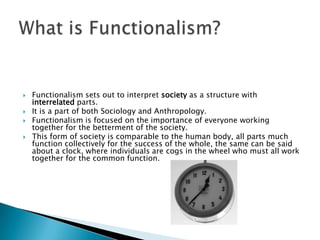
Functionalism sets out to interpret society as a structure with interrelated parts.It is a part of both Sociology and Anthropology.Functionalism is focused on the importance of everyone working together for the betterment of the society. This form of society is comparable to the human body, all parts much function collectively for the success of the whole, the same can be said about a clock, where individuals are cogs in the wheel who must all work together for the common function.What is Functionalism?
Basics Of Funtionalism and Purpose of InstitutionsLaw, Crime, Institution, Education, Religion
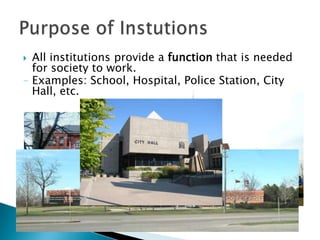
All institutions provide a function that is needed for society to work.– Examples: School, Hospital, Police Station, City Hall, etc.Purpose of Instutions
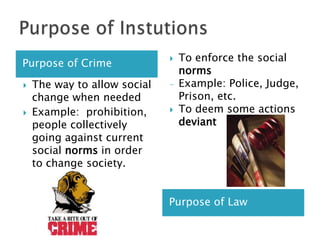
Purpose of InstutionsPurpose of CrimePurpose of LawThe way to allow social change when needed Example:  prohibition, people collectively going against current social norms in order to change society. To enforce the social norms Example: Police, Judge, Prison, etc. To deem some actions deviant
Purpose of InstutionsPurpose Of EducationTo socialize children according to current social norms.- Teaching everyone in society to pledge allegianceTo maintain social role- Trains the young to fulfill rolesTo create division of labour - Sorts students into skill groups
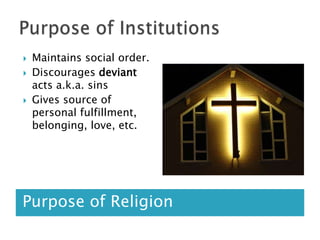
Purpose of InstitutionsPurpose of ReligionMaintains social order. Discourages deviant acts a.k.a. sinsGives source of personal fulfillment, belonging, love, etc.
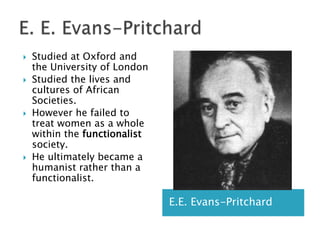
E. E. Evans-PritchardE.E. Evans-PritchardStudied at Oxford and the University of LondonStudied the lives and cultures of African Societies.However he failed to treat women as a whole within the functionalist society.He ultimately became a humanist rather than a functionalist.
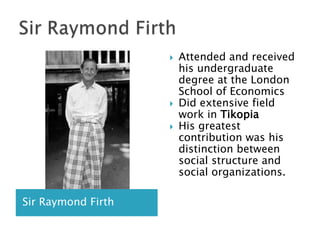
Sir Raymond FirthSir Raymond FirthAttended and received his undergraduate degree at the London School of EconomicsDid extensive field work in TikopiaHis greatest contribution was his distinction between social structure and social organizations.
Social organization has tended to be used loosely to refer to the sum total of activities performed in a given social context. Social structure has usually been used for the social context itself, or more accurately for the set of social relations which link individuals in a society.Distinction Between Social Structure and Social Organization
Lucy MairLucy MairAttended the London School of Economics.Mair’s fieldwork was in UgandaHer studies focussed on social change and  public affairsHer most notable work was the contemporary processes of Colonization.
http://www2.lse.ac.uk/library/archive/online_resources/anthropology_at_lse/Firth.jpghttp://www.greatarchaeology.com/archaeologist/EE-Evans-Pritchard.jpghttp://www.bookrags.com/tandf/social-structure-and-social-1-tf/http://farm3.static.flickr.com/2525/3983645756_35205dea37_m.jpghttp://businesslaw.newark.rutgers.edu/images/BooksandGavelA.jpghttp://www.iep.utm.edu/natlaw/http://www.helium.com/items/828793-crime-according-to-marxism-and-functionalismhttp://classof2014.blogs.wesleyan.edu/files/2010/08/crime-prevention.jpgWorks Cited/Consulted
Functionalism

Functionalism