
FUNCTIONAL PROTEINS
Submitted by:
Gausia Sumbul
14PFT005
WHAT ARE PROTEINS ?
 Proteins are long chains of amino acids put together
in a specific sequence to perform a particular
function in the body.
 The amino acid sequence of proteins, and the
subsequent three-dimensional structure of the
protein, are incredibly complex and responsible for
all their actions in the body.
PROTEINS CLASSIFIED BY
FUNCTION
 CATALYTIC: Enzymes.
 STORAGE: Ovalbumin (in eggs), Casein (in milk),
Zein (in maize).
 TRANSPORT: Haemoglobin.
 COMMUNICATION: Hormones (eg insulin) and
Neurotransmitters.
 CONTRACTILE: Actin, Myosin, Dynein (in
microtubules).
 PROTECTIVE: Immunoglobulin, Fibrinogen, Blood
clotting factors.
 TOXINS: Snake venom.
 STRUCTURAL: Cell membrane proteins, Keratin
(hair), Collagen.
FUNCTIONAL PROTEIN: MORE THAN
JUST BUILDING BLOCKS.
 Functional Proteins are a complex mixture of
biologically active proteins that help support and
maintain normal immune function.
 Functional proteins carry out a function in the body
unlike structual proteins which produce structures
(eg bones and muscles).
 However, evidence clearly indicates that proteins
have important biological effects in the animal. In
other words, they perform some biological function
in the body. Proteins that have biological activity
can be referred to as “Functional proteins.”
THERE ARE MANY EXAMPLES OF
FUNCTIONAL PROTEINS IN ANIMAL
NUTRITION:
 Lactoferrin: Lactoferrin is a protein found in cow
milk and human milk. Colostrum, the first milk
produced after a baby is born, contains high levels of
lactoferrin. Lactoferrin is used for
treating stomach and intestinal ulcers, diarrhea,
and hepatitis C. It is also used as an antioxidant and
to protect against bacterial and viral infections.
 Avidin: Avidin is a biotin-binding protein produced in
the oviducts of birds, reptiles and amphibians and
deposited in the whites of their eggs.
The natural function of avidin in eggs is not known,
although it has been postulated to be made in the
oviduct as a bacterial growth-inhibitor.
 Hemoglobin: Hemoglobin in the blood carries
oxygen from the respiratory organs (lungs or gills) to
the rest of the body (i.e. the tissues) where it
releases the oxygen to burn nutrients to provide
energy to power the functions of the organism in the
process called metabolism.
 Immunoglobulins(Ig): Some functional proteins
provide great benefit to the animal, particularly
during periods of stress. Immunoglobulins (Ig),
found in plasma proteins, colostrum and eggs,
can positively impact the animal’s immune
system, improving health, reducing the effects of
pathogenic bacteria and viruses.
 Natural antibodies: Antibodies are proteins with
special shapes that recognize and bind to
foreign substances, such as bacteria or viruses,
surrounding them so that scavenger cells can
destroy them and flush them out of the body.
LIFELINE CALF CARE SOLUTIONS
 They derive functional protiens from bovine
serum, and similar components those found in
milk and colostrum.
 More than 300 species including swine, poultry,
ruminant, aquaculture animal have been
conducted to test the action of functional proteins.
RESULTS:
 Consistent results show that anytime
animals are under stress, bioactive proteins
ease the effects of this stress.
 Functional proteins have been given to
millions of animals around the world with
proven beneficial effects for more than 30
years.
ESSENTIAL & NON-ESSENTIAL
AMINO ACIDS
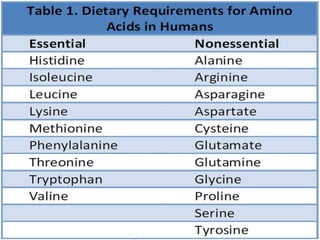
 Nine of the 20 amino acids
needed by adults cannot be
synthesized in the body; they
must be obtained from dietary
sources. Although we do not have
to consume these amino acids on
a daily basis. They are recycled,
to some extent. We cannot remain
healthy if we are deprived of them
for very long.
ESSENTIAL AMINO ACIDS
NON-ESSENTIAL AMINO ACIDS
 Non-essential amino acids are those that can be
synthesized by the body. The term 'non essential'
does not infer that those amino acids are any less
important, however the body is simply capable of
creating them on its own; therefore it is not
necessary for it to attain them from an outside
source.
SOURCES OF PROTIENS
 WHEAT: Wheat proteins contain
four basic protiens i.e.albumins,
globulins, gliadins and glutenins,
depending on their varied
solubility in different solvents.
 Two of these proteins are of
maximum value in terms of food
processing and food quality, and
they are gliadins and glutenins.
Corn: Zein is a class of prolamine protein found
in maize (corn). It is usually manufactured as a powder
from corn gluten meal. Zein is one of the best understood
plant proteins. Pure zein is clear, odorless, tasteless, hard,
water-insoluble, and edible, and it has a variety of industrial
and food uses.
Fish: Fish are an excellent source of high-quality protein.
The proteins found in fish are essentially the same as those
found in the meat derived from other animals—that is, the
sarcoplasmic proteins (e.g., enzymes and myoglobin), the
contractile or myofibrillar proteins (e.g., actin and myosin),
and the connective tissue proteins (i.e., collagen).
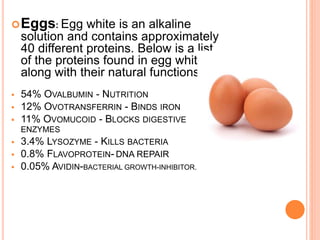
Eggs: Egg white is an alkaline
solution and contains approximately
40 different proteins. Below is a list
of the proteins found in egg whites
along with their natural functions:
 54% OVALBUMIN - NUTRITION
 12% OVOTRANSFERRIN - BINDS IRON
 11% OVOMUCOID - BLOCKS DIGESTIVE
ENZYMES
 3.4% LYSOZYME - KILLS BACTERIA
 0.8% FLAVOPROTEIN- DNA REPAIR
 0.05% AVIDIN-BACTERIAL GROWTH-INHIBITOR.
 Yoghurt: The protein casein,
present in yogurt tends to be
more readily digested than the
proteins present in milk. The
milk proteins in yogurt also
have a higher content of the
amino acids proline and
glycine compared with milk
and these proteins have
additional functions in the
body including enhancing
calcium absorption and
boosting the immune system.
INCOMPLETE PROTIENS
 Incomplete proteins are foods containing low
protein or only some of the nine amino acids that
you need in your diet. Usually, vegetable protein
(plant-based proteins) is considered incomplete as
it lacks one or more of the nine essential amino
acids.
 Incomplete proteins can be combined to make
available all of the essential amino acids and
form a complete protein.
Incomplete protiens include:
 Nuts
 Seeds
 Legumes
 Grains
 Vegetables.
 It is important to have a variety of foods to make
certain that the body gets all of the essential amino
acids. There are various ways to make protein
complete:
 By combining plant and animal foods.
 By combining plant proteins from a variety of
cereals and grains.
INCOMPLETE PROTIEN LIST
 1. Combine Grains and Legumes
 2. Combine Grains and Nuts/Seeds
 3. Combine Legumes and Nuts/Seeds
 In addition to the above, by combining small
amounts of animal protein – such as meat, milk,
eggs or cheese – to any of the grains, legumes,
nuts/seeds groups, we can create a complete
protein. That includes salad with beans and a hard
cooked egg; milk and wheat cereal; cereal with
milk; pasta with milk or cheese; bread with milk or
cheese;macaroni and cheese; oatmeal with milk
etc.
FORTIFICATION
 Food fortification or enrichment is the process of
adding micronutrients (essential trace elements and
vitamins) to food.
As outlined by the FAO, the most common fortified
foods are:
 Cereals and cereal based products
 Milk and Milk products
 Fats and oils
 Accessory food items
 Tea and other beverages.
Functional proteins 2 (1) (1)

Functional proteins 2 (1) (1)

  • 1.
  • 2.
    WHAT ARE PROTEINS?  Proteins are long chains of amino acids put together in a specific sequence to perform a particular function in the body.  The amino acid sequence of proteins, and the subsequent three-dimensional structure of the protein, are incredibly complex and responsible for all their actions in the body.
  • 3.
    PROTEINS CLASSIFIED BY FUNCTION CATALYTIC: Enzymes.  STORAGE: Ovalbumin (in eggs), Casein (in milk), Zein (in maize).  TRANSPORT: Haemoglobin.  COMMUNICATION: Hormones (eg insulin) and Neurotransmitters.  CONTRACTILE: Actin, Myosin, Dynein (in microtubules).  PROTECTIVE: Immunoglobulin, Fibrinogen, Blood clotting factors.  TOXINS: Snake venom.  STRUCTURAL: Cell membrane proteins, Keratin (hair), Collagen.
  • 4.
    FUNCTIONAL PROTEIN: MORETHAN JUST BUILDING BLOCKS.  Functional Proteins are a complex mixture of biologically active proteins that help support and maintain normal immune function.  Functional proteins carry out a function in the body unlike structual proteins which produce structures (eg bones and muscles).  However, evidence clearly indicates that proteins have important biological effects in the animal. In other words, they perform some biological function in the body. Proteins that have biological activity can be referred to as “Functional proteins.”
  • 5.
    THERE ARE MANYEXAMPLES OF FUNCTIONAL PROTEINS IN ANIMAL NUTRITION:  Lactoferrin: Lactoferrin is a protein found in cow milk and human milk. Colostrum, the first milk produced after a baby is born, contains high levels of lactoferrin. Lactoferrin is used for treating stomach and intestinal ulcers, diarrhea, and hepatitis C. It is also used as an antioxidant and to protect against bacterial and viral infections.
  • 6.
     Avidin: Avidinis a biotin-binding protein produced in the oviducts of birds, reptiles and amphibians and deposited in the whites of their eggs. The natural function of avidin in eggs is not known, although it has been postulated to be made in the oviduct as a bacterial growth-inhibitor.  Hemoglobin: Hemoglobin in the blood carries oxygen from the respiratory organs (lungs or gills) to the rest of the body (i.e. the tissues) where it releases the oxygen to burn nutrients to provide energy to power the functions of the organism in the process called metabolism.
  • 7.
     Immunoglobulins(Ig): Somefunctional proteins provide great benefit to the animal, particularly during periods of stress. Immunoglobulins (Ig), found in plasma proteins, colostrum and eggs, can positively impact the animal’s immune system, improving health, reducing the effects of pathogenic bacteria and viruses.  Natural antibodies: Antibodies are proteins with special shapes that recognize and bind to foreign substances, such as bacteria or viruses, surrounding them so that scavenger cells can destroy them and flush them out of the body.
  • 8.
    LIFELINE CALF CARESOLUTIONS  They derive functional protiens from bovine serum, and similar components those found in milk and colostrum.  More than 300 species including swine, poultry, ruminant, aquaculture animal have been conducted to test the action of functional proteins.
  • 9.
    RESULTS:  Consistent resultsshow that anytime animals are under stress, bioactive proteins ease the effects of this stress.  Functional proteins have been given to millions of animals around the world with proven beneficial effects for more than 30 years.
  • 10.
    ESSENTIAL & NON-ESSENTIAL AMINOACIDS  Nine of the 20 amino acids needed by adults cannot be synthesized in the body; they must be obtained from dietary sources. Although we do not have to consume these amino acids on a daily basis. They are recycled, to some extent. We cannot remain healthy if we are deprived of them for very long. ESSENTIAL AMINO ACIDS
  • 11.
    NON-ESSENTIAL AMINO ACIDS Non-essential amino acids are those that can be synthesized by the body. The term 'non essential' does not infer that those amino acids are any less important, however the body is simply capable of creating them on its own; therefore it is not necessary for it to attain them from an outside source.
  • 13.
    SOURCES OF PROTIENS WHEAT: Wheat proteins contain four basic protiens i.e.albumins, globulins, gliadins and glutenins, depending on their varied solubility in different solvents.  Two of these proteins are of maximum value in terms of food processing and food quality, and they are gliadins and glutenins.
  • 14.
    Corn: Zein isa class of prolamine protein found in maize (corn). It is usually manufactured as a powder from corn gluten meal. Zein is one of the best understood plant proteins. Pure zein is clear, odorless, tasteless, hard, water-insoluble, and edible, and it has a variety of industrial and food uses. Fish: Fish are an excellent source of high-quality protein. The proteins found in fish are essentially the same as those found in the meat derived from other animals—that is, the sarcoplasmic proteins (e.g., enzymes and myoglobin), the contractile or myofibrillar proteins (e.g., actin and myosin), and the connective tissue proteins (i.e., collagen).
  • 15.
    Eggs: Egg whiteis an alkaline solution and contains approximately 40 different proteins. Below is a list of the proteins found in egg whites along with their natural functions:  54% OVALBUMIN - NUTRITION  12% OVOTRANSFERRIN - BINDS IRON  11% OVOMUCOID - BLOCKS DIGESTIVE ENZYMES  3.4% LYSOZYME - KILLS BACTERIA  0.8% FLAVOPROTEIN- DNA REPAIR  0.05% AVIDIN-BACTERIAL GROWTH-INHIBITOR.
  • 16.
     Yoghurt: Theprotein casein, present in yogurt tends to be more readily digested than the proteins present in milk. The milk proteins in yogurt also have a higher content of the amino acids proline and glycine compared with milk and these proteins have additional functions in the body including enhancing calcium absorption and boosting the immune system.
  • 17.
    INCOMPLETE PROTIENS  Incompleteproteins are foods containing low protein or only some of the nine amino acids that you need in your diet. Usually, vegetable protein (plant-based proteins) is considered incomplete as it lacks one or more of the nine essential amino acids.  Incomplete proteins can be combined to make available all of the essential amino acids and form a complete protein.
  • 18.
    Incomplete protiens include: Nuts  Seeds  Legumes  Grains  Vegetables.  It is important to have a variety of foods to make certain that the body gets all of the essential amino acids. There are various ways to make protein complete:  By combining plant and animal foods.  By combining plant proteins from a variety of cereals and grains.
  • 19.
    INCOMPLETE PROTIEN LIST 1. Combine Grains and Legumes  2. Combine Grains and Nuts/Seeds  3. Combine Legumes and Nuts/Seeds  In addition to the above, by combining small amounts of animal protein – such as meat, milk, eggs or cheese – to any of the grains, legumes, nuts/seeds groups, we can create a complete protein. That includes salad with beans and a hard cooked egg; milk and wheat cereal; cereal with milk; pasta with milk or cheese; bread with milk or cheese;macaroni and cheese; oatmeal with milk etc.
  • 20.
    FORTIFICATION  Food fortificationor enrichment is the process of adding micronutrients (essential trace elements and vitamins) to food. As outlined by the FAO, the most common fortified foods are:  Cereals and cereal based products  Milk and Milk products  Fats and oils  Accessory food items  Tea and other beverages.