EQUIPMENT AND EXPERIMENTAL
TECHNIQUES USED IN NCF
EXTRACTION & INDUSTRIAL
APPLICATION
Presented by- Anjum Ayoub
14/PFT/013
Near Critical Fluid
 A near critical fluid (NCF) is characterized by physical &
thermal properties that are between those of the pure liquid
and gas.
 The fluid density is a strong function of the temperature and
pressure.
 The diffusivity of NCF is much higher than for a liquid.
 NCF readily penetrates porous & fibrous solids.
 Consequently, NCF can offer good catalytic activity.
Equipment
 Although there is some degree of overlap, distinction will be
made between equipment that has been designed for use in
either fractionation & extraction processes.
 A description of large scale commercial scale plant is also
omitted since accurate information of plant operating in the
commercial sector is often difficult to obtain & highly
process specific.
 Relevant design features of large scale NCF extraction
equipment are available in specialist reviews, conference
proceedings & directly from manufacturers.
NearCritical Fluid Extraction (NCFE)
 NCFE is based on the fact that, near the critical point of
the solvent, its properties change rapidly with only slight
variations of pressure.
 NCF can be used to extract analytes from samples.
 Main advantages of using NCF for extractions is that they
are inexpensive, extract the analytes faster & more
environmentally friendly than organic solvents.
 For these reasons NCF, CO2 is the reagent widely used as
the near critical solvent.
Extraction
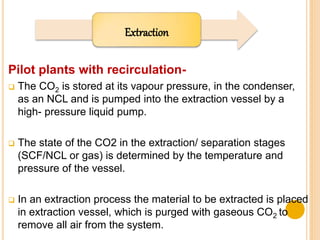
Pilot plants with recirculation-
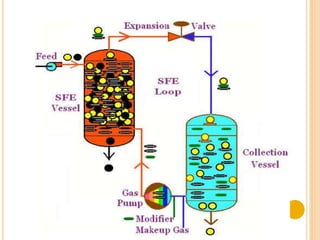
 The CO2 is stored at its vapour pressure, in the condenser,
as an NCL and is pumped into the extraction vessel by a
high- pressure liquid pump.
 The state of the CO2 in the extraction/ separation stages
(SCF/NCL or gas) is determined by the temperature and
pressure of the vessel.
 In an extraction process the material to be extracted is placed
in extraction vessel, which is purged with gaseous CO2 to
remove all air from the system.
CONTD.
 Extraction is then started by pumping the liquid CO2 through
a heat exchanger into the extraction vessel.
 Flow rate, which is determined by the pump, is usually set to
allow sufficient residence time in the extraction vessel for
equilibrium solubility to be attained.
 Solution then passes to the separation vessel, where
conditions are set to minimise the solubility of the extracted
components.
 If the extract is a liquid it can be periodically removed from
the separation vessel by a drain valve, but if is a solid it is
necessary to halt the extraction to remove the deposits by
washing.
INSTRUMENTATION
Near critical Fluid Extractors
NCF Extraction
 It is the process of separating one component from another
using NCF as the extracting solvent.
 Based on the fact that, near the critical point of the solvent, its
properties change rapidly with only slight variations of pressure.
 Near critical combines desirable properties of gases and liquids
 Solubility of liquids
 Penetration power of gases
 Process flexibility density of NC and solubility
of a solute in it can be changed in a continuous
manner by change of pressure.
 Environmental perspective innocuous substances
such as water and CO2 can be used as
extracting solvents instead of organics.
PROCEDURE
 Main components of the NCFE instrument are a pump, an
extraction chamber, a recovery chamber and a collection
device.
 In order to generate a NCF, CO2 is pressurized above its
critical pressure in a pump.
 Mixture to be separated is placed in the extraction chamber
and put in contact with the near critical fluid.
 One of the elements in the mixture dissolves better in the
critical fluid and leaves the residue enriched in the other
components.
 The loaded solvent is then transferred to a recovery
chamber, where earlier component is recovered by lowering
the solvent's density.
 This density can be achieved by raising the temperature at
constant pressure but more often it is achieve by reducing
the pressure at constant temperature.
 After depressurizing, two methods have been adopted for
collection of the extracted analyses, these are on-line or off-
line NCFE.
PROCEDURE
 In on-line NCFE, the extracted analytes are directly coupled
to a chromatographic separation system such as NCF, gas
chromatography (GC) or high performance liquid
chromatography (HPLC) with appropriate detection.
 In off-line NCFE, it allows direct collection of the extracted
analytes either in a solvent or passing the NCF through a
column packed with Chromatography adsorbent or can be
collected in a cryogenic vessel for subsequent analysis.
PROCEDURE
NCF extraction types
 Liquid-NCF extraction
 Similar to liquid-liquid extraction
 Examples
Increasing ethanol concentration in aqueous
solution
Removal of alcohol from beer
 Solid-NCF extraction
 Similar to solid-liquid extraction
 Examples
Removal of caffeine from coffee beans
Polymer fractionation
Extraction of flavours from rose petals
Industrial applications
 Near critical fluid extraction
 NCF decomposition
 Dry-cleaning
 Chromatography
 Chemical reactions
 Impregnation and dyeing
 Nano and micro particle formation
 Generation of pharmaceutical co-crystals
 Near critical drying
 Near critical water oxidation, hydrolysis and gasification
CONTD.
 NCF in power generation
 Biodiesel production
 Enhanced oil recovery and carbon capture and
storage
 Enhanced geothermal system
 NCF deposition
 Antimicrobial properties
CONCLUSION
Extraction by means of near critical carbon dioxide
can be expected to improve efficiency, including
shorter extraction times and simplified procedures
when compared with extraction techniques that
employ organic solvents
References
 www.google.com
 en.wikipedia.org
 PDF files
 Separation Processes in the Food and
Biotechnology Industries
By A.S. Grandison
Ncf anjum

Ncf anjum

  • 1.
    EQUIPMENT AND EXPERIMENTAL TECHNIQUESUSED IN NCF EXTRACTION & INDUSTRIAL APPLICATION Presented by- Anjum Ayoub 14/PFT/013
  • 2.
    Near Critical Fluid A near critical fluid (NCF) is characterized by physical & thermal properties that are between those of the pure liquid and gas.  The fluid density is a strong function of the temperature and pressure.  The diffusivity of NCF is much higher than for a liquid.  NCF readily penetrates porous & fibrous solids.  Consequently, NCF can offer good catalytic activity.
  • 4.
    Equipment  Although thereis some degree of overlap, distinction will be made between equipment that has been designed for use in either fractionation & extraction processes.  A description of large scale commercial scale plant is also omitted since accurate information of plant operating in the commercial sector is often difficult to obtain & highly process specific.  Relevant design features of large scale NCF extraction equipment are available in specialist reviews, conference proceedings & directly from manufacturers.
  • 5.
    NearCritical Fluid Extraction(NCFE)  NCFE is based on the fact that, near the critical point of the solvent, its properties change rapidly with only slight variations of pressure.  NCF can be used to extract analytes from samples.  Main advantages of using NCF for extractions is that they are inexpensive, extract the analytes faster & more environmentally friendly than organic solvents.  For these reasons NCF, CO2 is the reagent widely used as the near critical solvent.
  • 6.
    Extraction Pilot plants withrecirculation-  The CO2 is stored at its vapour pressure, in the condenser, as an NCL and is pumped into the extraction vessel by a high- pressure liquid pump.  The state of the CO2 in the extraction/ separation stages (SCF/NCL or gas) is determined by the temperature and pressure of the vessel.  In an extraction process the material to be extracted is placed in extraction vessel, which is purged with gaseous CO2 to remove all air from the system.
  • 8.
    CONTD.  Extraction isthen started by pumping the liquid CO2 through a heat exchanger into the extraction vessel.  Flow rate, which is determined by the pump, is usually set to allow sufficient residence time in the extraction vessel for equilibrium solubility to be attained.  Solution then passes to the separation vessel, where conditions are set to minimise the solubility of the extracted components.  If the extract is a liquid it can be periodically removed from the separation vessel by a drain valve, but if is a solid it is necessary to halt the extraction to remove the deposits by washing.
  • 10.
  • 11.
    NCF Extraction  Itis the process of separating one component from another using NCF as the extracting solvent.  Based on the fact that, near the critical point of the solvent, its properties change rapidly with only slight variations of pressure.  Near critical combines desirable properties of gases and liquids  Solubility of liquids  Penetration power of gases  Process flexibility density of NC and solubility of a solute in it can be changed in a continuous manner by change of pressure.  Environmental perspective innocuous substances such as water and CO2 can be used as extracting solvents instead of organics.
  • 12.
    PROCEDURE  Main componentsof the NCFE instrument are a pump, an extraction chamber, a recovery chamber and a collection device.  In order to generate a NCF, CO2 is pressurized above its critical pressure in a pump.  Mixture to be separated is placed in the extraction chamber and put in contact with the near critical fluid.  One of the elements in the mixture dissolves better in the critical fluid and leaves the residue enriched in the other components.
  • 13.
     The loadedsolvent is then transferred to a recovery chamber, where earlier component is recovered by lowering the solvent's density.  This density can be achieved by raising the temperature at constant pressure but more often it is achieve by reducing the pressure at constant temperature.  After depressurizing, two methods have been adopted for collection of the extracted analyses, these are on-line or off- line NCFE. PROCEDURE
  • 14.
     In on-lineNCFE, the extracted analytes are directly coupled to a chromatographic separation system such as NCF, gas chromatography (GC) or high performance liquid chromatography (HPLC) with appropriate detection.  In off-line NCFE, it allows direct collection of the extracted analytes either in a solvent or passing the NCF through a column packed with Chromatography adsorbent or can be collected in a cryogenic vessel for subsequent analysis. PROCEDURE
  • 15.
    NCF extraction types Liquid-NCF extraction  Similar to liquid-liquid extraction  Examples Increasing ethanol concentration in aqueous solution Removal of alcohol from beer  Solid-NCF extraction  Similar to solid-liquid extraction  Examples Removal of caffeine from coffee beans Polymer fractionation Extraction of flavours from rose petals
  • 16.
    Industrial applications  Nearcritical fluid extraction  NCF decomposition  Dry-cleaning  Chromatography  Chemical reactions  Impregnation and dyeing  Nano and micro particle formation  Generation of pharmaceutical co-crystals  Near critical drying  Near critical water oxidation, hydrolysis and gasification
  • 17.
    CONTD.  NCF inpower generation  Biodiesel production  Enhanced oil recovery and carbon capture and storage  Enhanced geothermal system  NCF deposition  Antimicrobial properties
  • 18.
    CONCLUSION Extraction by meansof near critical carbon dioxide can be expected to improve efficiency, including shorter extraction times and simplified procedures when compared with extraction techniques that employ organic solvents
  • 19.
    References  www.google.com  en.wikipedia.org PDF files  Separation Processes in the Food and Biotechnology Industries By A.S. Grandison