ROLE OF NUTRIENTS
aafaq9797@gmail.com1
©2002 Learning Zone Express2
Nutrients
 The food we eat is a source of
nutrients. Nutrients are defined as
the substances found in food that keep our
body functioning.
 Our body needs nutrients to…
 Fuel our energy.
 Help our grow.
 Repair itself.
 Maintain basic bodily functions.
aafaq9797@gmail.com3
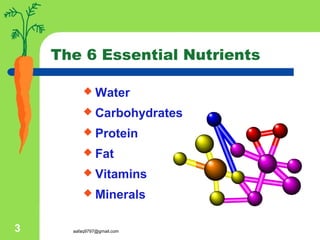
The 6 Essential Nutrients
 Water
 Carbohydrates
 Protein
 Fat
 Vitamins
 Minerals
aafaq9797@gmail.com
4
Water
 Did you know?
 1/2 to 3/4 of the human body consists of water!
 Functions in the Body:
 Water carries nutrients to cells and carries waste from
our body.
 Regulates body temperature.
 Dissolves vitamins, minerals, amino acids and other
nutrients.
 Lubricates joints.
aafaq9797@gmail.com5
Carbohydrates
 Food Sources:
 Pasta, breads, cereals, grains, rice, fruits,
milk, yogurt and sweets.
 Two types of Carbohydrates:
 Starches or Complex Carbohydrates
 Simple Carbohydrates
Carbohydrates are the body’s main source of energy
6
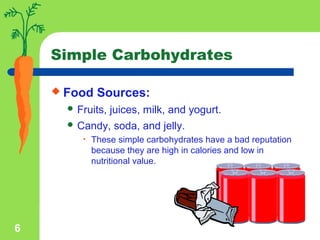
Simple Carbohydrates
 Food Sources:
 Fruits, juices, milk, and yogurt.
 Candy, soda, and jelly.
• These simple carbohydrates have a bad reputation
because they are high in calories and low in
nutritional value.
aafaq9797@gmail.com7
Starches or
Complex Carbohydrates
 Food Sources:
 Whole grain breads and cereals,
pasta, vegetables, rice, and legumes.
 Function in the Body:
 An excellent source of fuel (energy)
for the body.
 Rich in vitamins, minerals and fiber.
aafaq9797@gmail.com8
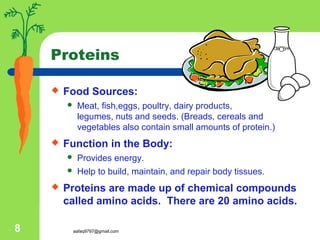
Proteins
 Food Sources:
 Meat, fish,eggs, poultry, dairy products,
legumes, nuts and seeds. (Breads, cereals and
vegetables also contain small amounts of protein.)
 Function in the Body:
 Provides energy.
 Help to build, maintain, and repair body tissues.
 Proteins are made up of chemical compounds
called amino acids. There are 20 amino acids.
©2002 Learning Zone Express9
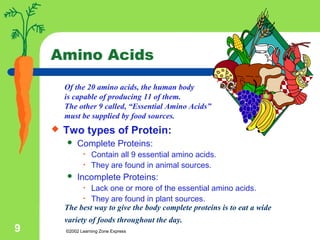
Of the 20 amino acids, the human body
is capable of producing 11 of them.
The other 9 called, “Essential Amino Acids”
must be supplied by food sources.
Amino Acids
 Two types of Protein:
 Complete Proteins:
• Contain all 9 essential amino acids.
• They are found in animal sources.
 Incomplete Proteins:
• Lack one or more of the essential amino acids.
• They are found in plant sources.
The best way to give the body complete proteins is to eat a wide
variety of foods throughout the day.
aafaq9797@gmail.com10
Fat
- The most concentrated form of food energy (calories).
 Food Sources:
 Butter, vegetable oils, salad dressings, nuts and
seeds, dairy products made with whole milk
or cream, and meats.
 Function in the Body:
 Provide substances needed for growth and healthy skin.
 Enhance the taste and texture of food.
 Required to carry “fat-soluble”
vitamins throughout the body.
 Provide energy.
©2002 Learning Zone Express11
Types of Fat
 Saturated Fat:
 Fats that are usually solid at room temperature.
 Food Sources: Animal foods and tropical oils.
 The type of fat most strongly linked to high cholesterol and
increased risk of heart disease.
 Unsaturated Fat:
 Fats that are liquid at room temperature.
 Polyunsaturated Fat:
• Food Sources: Vegetables and fish oils.
• Provide two essential fatty acids necessary for bodily functions.
 Monounsaturated Fat:
• Food Sources: Olive oil, canola oil, nuts, seeds.
• May play a role in reducing the risk of heart disease.
• xxxxxxxxxxxx
aafaq9797@gmail.com12
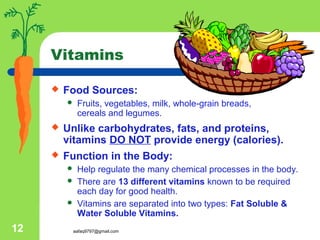
Vitamins
 Food Sources:
 Fruits, vegetables, milk, whole-grain breads,
cereals and legumes.
 Unlike carbohydrates, fats, and proteins,
vitamins DO NOT provide energy (calories).
 Function in the Body:
 Help regulate the many chemical processes in the body.
 There are 13 different vitamins known to be required
each day for good health.
 Vitamins are separated into two types: Fat Soluble &
Water Soluble Vitamins.
aafaq9797@gmail.com13
Fat/Water Soluble Vitamins
 Fat Soluble Vitamins
 Vitamins A, D, E, K
 Require fat for the stomach to allow them to be carried
into the blood stream for use (absorption).
 Can be stored in the body for later use.
 Water Soluble Vitamins
 Vitamins C and B-complex
 Require water for absorption.
 Easily absorbed and passed through the body as
waste.
aafaq9797@gmail.com14
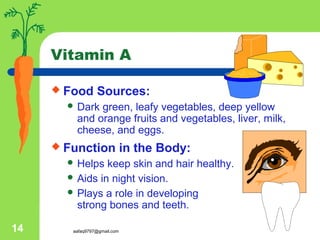
Vitamin A
 Food Sources:
 Dark green, leafy vegetables, deep yellow
and orange fruits and vegetables, liver, milk,
cheese, and eggs.
 Function in the Body:
 Helps keep skin and hair healthy.
 Aids in night vision.
 Plays a role in developing
strong bones and teeth.
aafaq9797@gmail.com15
Vitamin D
 Food Sources:
 Vitamin D fortified milk, egg yolk, salmon,
and liver.
 Nonfood Source: the sun.
 Function in the Body:
 Helps the body use calcium and phosphorus.
 Plays a role in building strong bones
and teeth.
aafaq9797@gmail.com16
Vitamin E
 Food Sources:
 Whole-grain breads and cereals; dark green,
leafy vegetables; dry beans and peas; nuts
and seeds; vegetable oils; margarine; liver.
 Function in the Body:
 Helps form red blood cells, muscles, and
other tissues.
aafaq9797@gmail.com17
Vitamin K
 Food Sources:
 Dark green and leafy vegetables (such as
spinach, lettuce, kale, collard greens), and
cabbage.
 Function in the Body:
 Helps blood to clot.
©2002 Learning Zone Express18
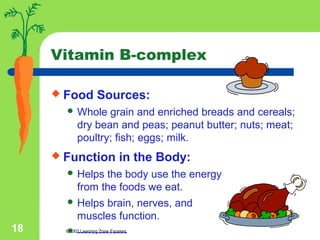
Vitamin B-complex
 Food Sources:
 Whole grain and enriched breads and cereals;
dry bean and peas; peanut butter; nuts; meat;
poultry; fish; eggs; milk.
 Function in the Body:
 Helps the body use the energy
from the foods we eat.
 Helps brain, nerves, and
muscles function.
 --------------
aafaq9797@gmail.com19
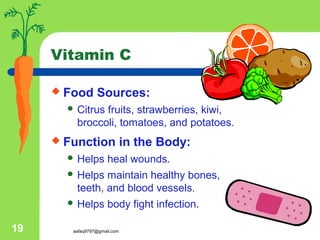
Vitamin C
 Food Sources:
 Citrus fruits, strawberries, kiwi,
broccoli, tomatoes, and potatoes.
 Function in the Body:
 Helps heal wounds.
 Helps maintain healthy bones,
teeth, and blood vessels.
 Helps body fight infection.
aafaq9797@gmail.com20
Minerals
 Food Sources:
 Meats, beans, nuts, fruits, vegetables, dairy
products, and grains.
 Functions in the Body:
 The body depends on minerals for practically
every process necessary for life.
 Minerals actually become part of the body.
 The body requires 16 minerals daily.
aafaq9797@gmail.com21
Minerals
 Calcium
 Phosphorus
 Magnesium
 Sodium
 Potassium
 Iron
 Others include:
 Iodine, Zinc, Copper, Sulfur, Chloride, etc.
aafaq9797@gmail.com22
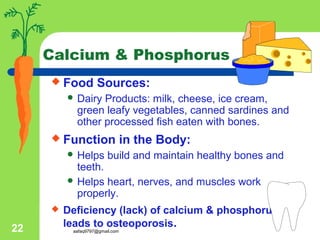
Calcium & Phosphorus
 Food Sources:
 Dairy Products: milk, cheese, ice cream,
green leafy vegetables, canned sardines and
other processed fish eaten with bones.
 Function in the Body:
 Helps build and maintain healthy bones and
teeth.
 Helps heart, nerves, and muscles work
properly.
 Deficiency (lack) of calcium & phosphorus
leads to osteoporosis.
aafaq9797@gmail.com23
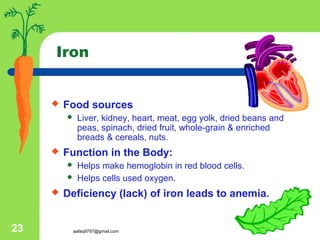
Iron
 Food sources
 Liver, kidney, heart, meat, egg yolk, dried beans and
peas, spinach, dried fruit, whole-grain & enriched
breads & cereals, nuts.
 Function in the Body:
 Helps make hemoglobin in red blood cells.
 Helps cells used oxygen.
 Deficiency (lack) of iron leads to anemia.
aafaq9797@gmail.com24
Sodium
 Food sources
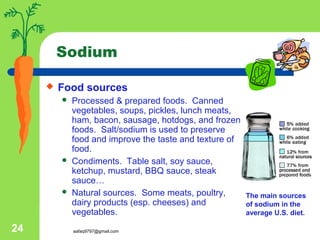
 Processed & prepared foods. Canned
vegetables, soups, pickles, lunch meats,
ham, bacon, sausage, hotdogs, and frozen
foods. Salt/sodium is used to preserve
food and improve the taste and texture of
food.
 Condiments. Table salt, soy sauce,
ketchup, mustard, BBQ sauce, steak
sauce…
 Natural sources. Some meats, poultry,
dairy products (esp. cheeses) and
vegetables.
The main sources
of sodium in the
average U.S. diet.
aafaq9797@gmail.com25
Sodium
 Function in the Body:
 Helps maintain the right balance of fluids in your body.
 Helps transmit nerve impulses.
 Influences the contraction and relaxation of muscles.
 Excess sodium can lead to hypertension
(high blood pressure), a condition that can
lead to cardiovascular and kidney diseases.
aafaq9797@gmail.com26

Nutrient

  • 1.
  • 2.
    ©2002 Learning ZoneExpress2 Nutrients  The food we eat is a source of nutrients. Nutrients are defined as the substances found in food that keep our body functioning.  Our body needs nutrients to…  Fuel our energy.  Help our grow.  Repair itself.  Maintain basic bodily functions.
  • 3.
    aafaq9797@gmail.com3 The 6 EssentialNutrients  Water  Carbohydrates  Protein  Fat  Vitamins  Minerals
  • 4.
    aafaq9797@gmail.com 4 Water  Did youknow?  1/2 to 3/4 of the human body consists of water!  Functions in the Body:  Water carries nutrients to cells and carries waste from our body.  Regulates body temperature.  Dissolves vitamins, minerals, amino acids and other nutrients.  Lubricates joints.
  • 5.
    aafaq9797@gmail.com5 Carbohydrates  Food Sources: Pasta, breads, cereals, grains, rice, fruits, milk, yogurt and sweets.  Two types of Carbohydrates:  Starches or Complex Carbohydrates  Simple Carbohydrates Carbohydrates are the body’s main source of energy
  • 6.
    6 Simple Carbohydrates  FoodSources:  Fruits, juices, milk, and yogurt.  Candy, soda, and jelly. • These simple carbohydrates have a bad reputation because they are high in calories and low in nutritional value.
  • 7.
    aafaq9797@gmail.com7 Starches or Complex Carbohydrates Food Sources:  Whole grain breads and cereals, pasta, vegetables, rice, and legumes.  Function in the Body:  An excellent source of fuel (energy) for the body.  Rich in vitamins, minerals and fiber.
  • 8.
    aafaq9797@gmail.com8 Proteins  Food Sources: Meat, fish,eggs, poultry, dairy products, legumes, nuts and seeds. (Breads, cereals and vegetables also contain small amounts of protein.)  Function in the Body:  Provides energy.  Help to build, maintain, and repair body tissues.  Proteins are made up of chemical compounds called amino acids. There are 20 amino acids.
  • 9.
    ©2002 Learning ZoneExpress9 Of the 20 amino acids, the human body is capable of producing 11 of them. The other 9 called, “Essential Amino Acids” must be supplied by food sources. Amino Acids  Two types of Protein:  Complete Proteins: • Contain all 9 essential amino acids. • They are found in animal sources.  Incomplete Proteins: • Lack one or more of the essential amino acids. • They are found in plant sources. The best way to give the body complete proteins is to eat a wide variety of foods throughout the day.
  • 10.
    aafaq9797@gmail.com10 Fat - The mostconcentrated form of food energy (calories).  Food Sources:  Butter, vegetable oils, salad dressings, nuts and seeds, dairy products made with whole milk or cream, and meats.  Function in the Body:  Provide substances needed for growth and healthy skin.  Enhance the taste and texture of food.  Required to carry “fat-soluble” vitamins throughout the body.  Provide energy.
  • 11.
    ©2002 Learning ZoneExpress11 Types of Fat  Saturated Fat:  Fats that are usually solid at room temperature.  Food Sources: Animal foods and tropical oils.  The type of fat most strongly linked to high cholesterol and increased risk of heart disease.  Unsaturated Fat:  Fats that are liquid at room temperature.  Polyunsaturated Fat: • Food Sources: Vegetables and fish oils. • Provide two essential fatty acids necessary for bodily functions.  Monounsaturated Fat: • Food Sources: Olive oil, canola oil, nuts, seeds. • May play a role in reducing the risk of heart disease. • xxxxxxxxxxxx
  • 12.
    aafaq9797@gmail.com12 Vitamins  Food Sources: Fruits, vegetables, milk, whole-grain breads, cereals and legumes.  Unlike carbohydrates, fats, and proteins, vitamins DO NOT provide energy (calories).  Function in the Body:  Help regulate the many chemical processes in the body.  There are 13 different vitamins known to be required each day for good health.  Vitamins are separated into two types: Fat Soluble & Water Soluble Vitamins.
  • 13.
    aafaq9797@gmail.com13 Fat/Water Soluble Vitamins Fat Soluble Vitamins  Vitamins A, D, E, K  Require fat for the stomach to allow them to be carried into the blood stream for use (absorption).  Can be stored in the body for later use.  Water Soluble Vitamins  Vitamins C and B-complex  Require water for absorption.  Easily absorbed and passed through the body as waste.
  • 14.
    aafaq9797@gmail.com14 Vitamin A  FoodSources:  Dark green, leafy vegetables, deep yellow and orange fruits and vegetables, liver, milk, cheese, and eggs.  Function in the Body:  Helps keep skin and hair healthy.  Aids in night vision.  Plays a role in developing strong bones and teeth.
  • 15.
    aafaq9797@gmail.com15 Vitamin D  FoodSources:  Vitamin D fortified milk, egg yolk, salmon, and liver.  Nonfood Source: the sun.  Function in the Body:  Helps the body use calcium and phosphorus.  Plays a role in building strong bones and teeth.
  • 16.
    aafaq9797@gmail.com16 Vitamin E  FoodSources:  Whole-grain breads and cereals; dark green, leafy vegetables; dry beans and peas; nuts and seeds; vegetable oils; margarine; liver.  Function in the Body:  Helps form red blood cells, muscles, and other tissues.
  • 17.
    aafaq9797@gmail.com17 Vitamin K  FoodSources:  Dark green and leafy vegetables (such as spinach, lettuce, kale, collard greens), and cabbage.  Function in the Body:  Helps blood to clot.
  • 18.
    ©2002 Learning ZoneExpress18 Vitamin B-complex  Food Sources:  Whole grain and enriched breads and cereals; dry bean and peas; peanut butter; nuts; meat; poultry; fish; eggs; milk.  Function in the Body:  Helps the body use the energy from the foods we eat.  Helps brain, nerves, and muscles function.  --------------
  • 19.
    aafaq9797@gmail.com19 Vitamin C  FoodSources:  Citrus fruits, strawberries, kiwi, broccoli, tomatoes, and potatoes.  Function in the Body:  Helps heal wounds.  Helps maintain healthy bones, teeth, and blood vessels.  Helps body fight infection.
  • 20.
    aafaq9797@gmail.com20 Minerals  Food Sources: Meats, beans, nuts, fruits, vegetables, dairy products, and grains.  Functions in the Body:  The body depends on minerals for practically every process necessary for life.  Minerals actually become part of the body.  The body requires 16 minerals daily.
  • 21.
    aafaq9797@gmail.com21 Minerals  Calcium  Phosphorus Magnesium  Sodium  Potassium  Iron  Others include:  Iodine, Zinc, Copper, Sulfur, Chloride, etc.
  • 22.
    aafaq9797@gmail.com22 Calcium & Phosphorus Food Sources:  Dairy Products: milk, cheese, ice cream, green leafy vegetables, canned sardines and other processed fish eaten with bones.  Function in the Body:  Helps build and maintain healthy bones and teeth.  Helps heart, nerves, and muscles work properly.  Deficiency (lack) of calcium & phosphorus leads to osteoporosis.
  • 23.
    aafaq9797@gmail.com23 Iron  Food sources Liver, kidney, heart, meat, egg yolk, dried beans and peas, spinach, dried fruit, whole-grain & enriched breads & cereals, nuts.  Function in the Body:  Helps make hemoglobin in red blood cells.  Helps cells used oxygen.  Deficiency (lack) of iron leads to anemia.
  • 24.
    aafaq9797@gmail.com24 Sodium  Food sources Processed & prepared foods. Canned vegetables, soups, pickles, lunch meats, ham, bacon, sausage, hotdogs, and frozen foods. Salt/sodium is used to preserve food and improve the taste and texture of food.  Condiments. Table salt, soy sauce, ketchup, mustard, BBQ sauce, steak sauce…  Natural sources. Some meats, poultry, dairy products (esp. cheeses) and vegetables. The main sources of sodium in the average U.S. diet.
  • 25.
    aafaq9797@gmail.com25 Sodium  Function inthe Body:  Helps maintain the right balance of fluids in your body.  Helps transmit nerve impulses.  Influences the contraction and relaxation of muscles.  Excess sodium can lead to hypertension (high blood pressure), a condition that can lead to cardiovascular and kidney diseases.
  • 26.