Modelling Biological Systems
with Differential Equations
Rainer Breitling
(R.Breitling@bio.gla.ac.uk)
Bioinformatics Research Centre
February 2005
Outline
• Part 1: Why modelling?
• Part 2: The statistical physics of modelling:
A  B
(where do differential equations come from?)
• Part 3: Translating biology to mathematics
(finding the right differential equations)
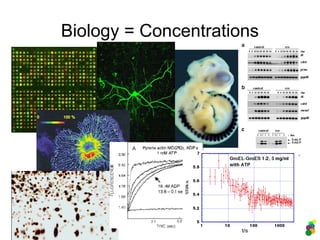
Biology = Concentrations
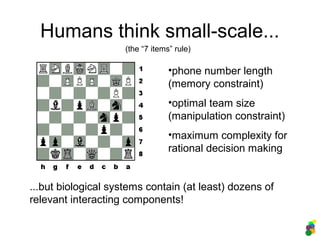
Humans think small-scale...
(the “7 items” rule)
...but biological systems contain (at least) dozens of
relevant interacting components!
•phone number length
(memory constraint)
•optimal team size
(manipulation constraint)
•maximum complexity for
rational decision making
Humans think linear...
...but biological systems contain:
• non-linear interaction between components
• positive and negative feedback loops
• complex cross-talk phenomena
The simplest chemical reaction
A  B
• irreversible, one-molecule reaction
• examples: all sorts of decay processes, e.g. radioactive,
fluorescence, activated receptor returning to inactive
state
• any metabolic pathway can be described by a
combination of processes of this type (including
reversible reactions and, in some respects, multi-
molecule reactions)
The simplest chemical reaction
A  B
various levels of description:
• homogeneous system, large numbers of molecules =
ordinary differential equations, kinetics
• small numbers of molecules = probabilistic equations,
stochastics
• spatial heterogeneity = partial differential equations,
diffusion
• small number of heterogeneously distributed molecules
= single-molecule tracking (e.g. cytoskeleton modelling)
Kinetics Description
• Imagine a box containing N molecules.
How many will decay during time t? k*N
• Imagine two boxes containing N/2
molecules each.
How many decay? k*N
• Imagine two boxes containing N
molecules each.
How many decay? 2k*N
• In general:
)(*
)(
tn
dt
tdn
λ=−
Main idea: Molecules don’t talk
t
eNtn λ−
= 0)(⇔
differential equation (ordinary,
linear, first-order)
exact solution (in more
complex cases replaced by a
numerical approximation)
Kinetics Description
If you know the concentration
at one time, you can calculate it
for any other time! (and this
really works)
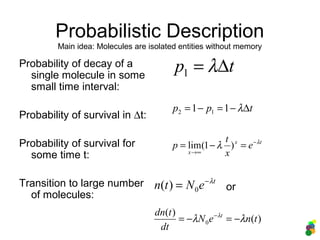
Probabilistic Description
Probability of decay of a
single molecule in some
small time interval:
Probability of survival in ∆t:
Probability of survival for
some time t:
Transition to large number
of molecules:
tp ∆= λ1
tpp ∆−=−= λ11 12
tx
x
e
x
t
p λ
λ −
∞→
=−= )1(lim
t
eNtn λ−
= 0)(
)(
)(
0 tneN
dt
tdn t
λλ λ
−=−= −
or
Main idea: Molecules are isolated entities without memory
Probabilistic Description – 2
Probability of survival of
a single molecule for
some time t:
Probability that exactly x
molecules survive for
some time t:
Most likely number to
survive to time t:
tx
x
e
x
t
p λ
λ −
∞→
=−= )1(lim






−= −−−
x
N
eep xNtxt
x
00
)1()( λλ
t
x eNpx λ−
= 0)|max(
Probabilistic Description – 3
Markov Model (pure death!)
Decay rate:
Probability of decay:
Probability distribution of n
surviving molecules at
time t:
Description:
Time: t -> wait dt ->
t+dt
Molecules:
n -> no decay -> n
n+1 -> one decay -> n
λntn =Λ ),(
dttnp ),(Λ=
),( tnP
]),(1)[,(
),1(),1(
),(
dttntnP
dttntnP
dttnP
Λ−+
+Λ+
=+
Final Result (after some calculating): The same as in the
previous probabilistic description
Spatial heterogeneity
• concentrations are different in different places,
n = f(t,x,y,z)
• diffusion superimposed on chemical reactions:
• partial differential equation
diffusion)(
)(
±−=
∂
∂
xyz
xyz
tn
t
tn
λ
Spatial heterogeneity
• one-dimensional case
(diffusion only, and
conservation of mass)
x
n(t,x)
K
x
xxtn
K
x
t
xtn
∂
∂
−=
∂
∆+∂
−=
−=∆
∂
∂
inflow
),(
outflow
outflowinflow
),(
Spatial heterogeneity – 2
)()(
)(
:reactionchemicaln withCombinatio
),,,(
),,,(
:dimensionsfor threeShorthand
),(),(
:equationdiffusiongetoequation taldifferentitoTransition
),(),(),(
2
2
2
2
tnKtn
t
tn
zyxtnK
t
zyxtn
x
xtn
K
t
xtn
x
xtn
K
x
xxtn
Kx
t
xtn
∇+−=
∂
∂
∇=
∂
∂
∂
∂
=
∂
∂
∂
∂
−
∂
∆+∂
=∆
∂
∂
λ
Summary of Physical Chemistry
• Simple reactions are easy to model accurately
• Kinetic, probabilistic, Markovian approaches lead to
the same basic description
• Diffusion leads only to slightly more complexity
• Next step: Everything is decay...
t
eNtntn
dt
tdn λ
λ −
=⇔−= 0)()(
)(
Some (Bio)Chemical Conventions
Concentration of Molecule A = [A], usually in
units mol/litre (molar)
Rate constant = k, with indices indicating
constants for various reactions (k1, k2...)
Therefore:
AB
][
][][
1 Ak
dt
Bd
dt
Ad
−=−=
Description in MATLAB:
1. Simple Decay Reaction
M-file (description of the model)
function dydt = decay(t, y)
% A -> B or y(1) -> y(2)
k = 1;
dydt = [-k*y(1)
k*y(1)];
Analysis of the model
>> [t y] = ode45(@decay, [0 10], [5 1]);
>> plot (t, y);
>> legend ('[A]', '[B]');
Decay Reaction in MATLAB
Reversible, Single-Molecule
Reaction
A  B, or A  B || B  A, or
Differential equations:
][][
][
][][
][
21
21
BkAk
dt
Bd
BkAk
dt
Ad
−=
+−=
forward reverse
Main principle: Partial reactions are independent!
Reversible, single-molecule
reaction – 2
Differential Equation:
Equilibrium (=steady-
state):
equi
equi
equi
equiequi
equiequi
K
k
k
B
A
BkAk
dt
Bd
dt
Ad
==
=+−
==
1
2
21
][
][
0][][
0
][][
][][
][
][][
][
21
21
BkAk
dt
Bd
BkAk
dt
Ad
−=
+−=
Description in MATLAB:
2. Reversible Reaction
M-file (description of the model)
function dydt = isomerisation(t, y)
% A <-> B or y(1) <-> y(2)
k1 = 1;
k2 = 0.5;
dydt = [-k1*y(1)+k2*y(2) % d[A]/dt
k1*y(1)-k2*y(2) % d[B]/dt
];
Analysis of the model
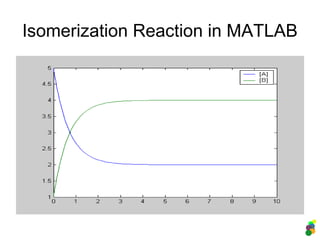
>> [t y] = ode45(@isomerisation, [0 10], [5
1]);
>> plot (t, y);
>> legend ('[A]', '[B]');
Isomerization Reaction in MATLAB
If you know the concentration at
one time, you can calculate it for
any other time... so what would be
the algorithm for that?
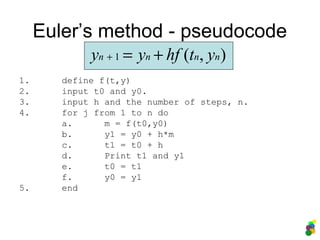
Euler’s method - pseudocode
1. define f(t,y)
2. input t0 and y0.
3. input h and the number of steps, n.
4. for j from 1 to n do
a. m = f(t0,y0)
b. y1 = y0 + h*m
c. t1 = t0 + h
d. Print t1 and y1
e. t0 = t1
f. y0 = y1
5. end
),(1 nnnn ythfyy +=+
Euler’s method in Perl
sub ode_euler {
my ($t0, $t_end, $h, $yref, $dydt_ref) = @_;
my @y = @$yref;
my @solution;
for (my $t = $t0; $t < $t_end; $t += $h) {
push @solution, [@y];
my @dydt = &$dydt_ref(@y, $t);
foreach my $i (0..$#y) {
$y[$i] += ( $h * $dydt[$i] );
}
}
push @solution, [@y];
return @solution;
}
),(1 nnnn ythfyy +=+
Euler’s method in Perl
#!/usr/bin/perl -w
use strict;
my @initial_values = (5, 1);
my @result = ode_euler (0, 10, 0.01, @initial_values, &dydt);
foreach (@result) {
print join " ", @$_, "n";
}
exit;
% simple A <-> B reversible mono-molecular reaction
sub dydt {
my $yref = shift;
my @y = @$yref;
my @dydt = ( -$y[0] + 0.5*$y[1],
+$y[0] - 0.5*$y[1]
);
return @dydt;
}
....
Improving Euler’s method
)),(,( 2
1
2
1
1 nnnnnn ythfyhthfyy +++=+
),(1 nnnn ythfyy +=+
(second-order Runge-Kutta method)
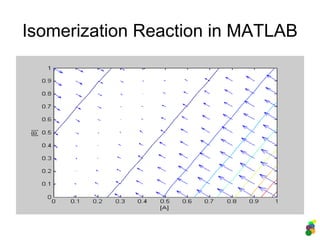
Isomerization Reaction in MATLAB
Irreversible, two-molecule reaction
A+BC
Differential equations:
]][[
][
][][][
BAk
dt
Ad
dt
Cd
dt
Bd
dt
Ad
−=
−==
Underlying idea: Reaction probability = Combined probability that both
[A] and [B] are in a “reactive mood”:
]][[][][)()()( *
2
*
1 BAkBkAkBpApABp ===
The last piece of the puzzle
Non-linear!
A simple metabolic pathway
ABC+D
Differential equations:
d/dt decay forward reverse
[A]= -k1[A]
[B]= +k1[A] -k2[B] +k3[C][D]
[C]= +k2[B] -k3[C][D]
[D]= +k2[B] -k3[C][D]
Metabolic Networks as Bigraphs
ABC+D
d/dt decay forward reverse
[A] -k1[A]
[B] +k1[A] -k2[B] +k3[C][D]
[C] +k2[B] -k3[C][D]
[D] +k2[B] -k3[C][D]
k1 k2 k3
A -1 0 0
B 1 -1 1
C 0 1 -1
D 0 1 -1
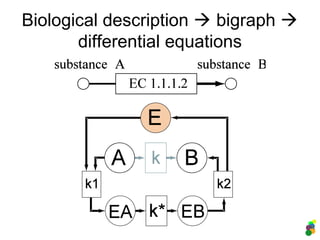
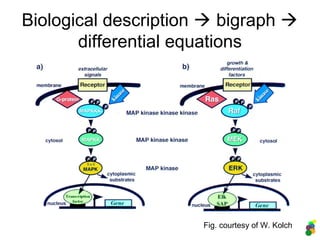
Biological description  bigraph 
differential equations
KEGG
Biological description  bigraph 
differential equations
Biological description  bigraph 
differential equations
Biological description  bigraph 
differential equations
Biological description  bigraph 
differential equations
Fig. courtesy of W. Kolch
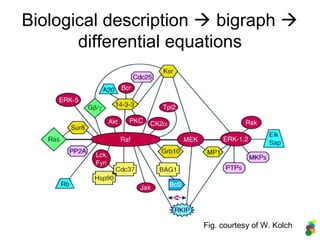
Biological description  bigraph 
differential equations
Fig. courtesy of W. Kolch
Biological description  bigraph 
differential equations
Fig. courtesy of W. Kolch
The Raf-1/RKIP/ERK pathway
Can you model it?
(11x11 table, 34 entries)
Description in MATLAB:
3. The RKIP/ERK pathway
function dydt = erk_pathway_wolkenhauer(t, y)
% from Kwang-Hyun Cho et al., Mathematical
Modeling...
k1 = 0.53;
k2 = 0.0072;
k3 = 0.625;
k4 = 0.00245;
k5 = 0.0315;
k6 = 0.8;
k7 = 0.0075;
k8 = 0.071;
k9 = 0.92;
k10 = 0.00122;
k11 = 0.87;
% continued on next slide...
Description in MATLAB:
3. The RKIP/ERK pathway
dydt = [
-k1*y(1)*y(2) + k2*y(3) + k5*y(4)
-k1*y(1)*y(2) + k2*y(3) + k11*y(11)
k1*y(1)*y(2) - k2*y(3) - k3*y(3)*y(9) + k4*y(4)
k3*y(3)*y(9) - k4*y(4) - k5*y(4)
k5*y(4) - k6*y(5)*y(7) + k7*y(8)
k5*y(4) - k9*y(6)*y(10) + k10*y(11)
-k6*y(5)*y(7) + k7*y(8) + k8*y(8)
k6*y(5)*y(7) - k7*y(8) - k8*y(8)
-k3*y(3)*y(9) + k4*y(4) + k8*y(8)
-k9*y(6)*y(10) + k10*y(11) + k11*y(11)
k9*y(6)*y(10) - k10*y(11) - k11*y(11)
];
Description in MATLAB:
3. The RKIP/ERK pathway
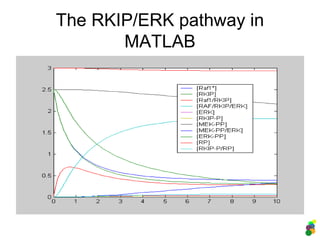
Analysis of the model:
>> [t y] =
ode45(@erk_pathway_wolkenhauer, [0
10], [2.5 2.5 0 0 0 0 2.5 0 2.5 3
0]); %(initial values!)
>> plot (t, y);
>> legend ('[Raf1*]', '[RKIP]',
'[Raf1/RKIP]', '[RAF/RKIP/ERK]',
'[ERK]', '[RKIP-P]', '[MEK-PP]',
'[MEK-PP/ERK]', '[ERK-PP]', '[RP]',
'[RKIP-P/RP]' );
The RKIP/ERK pathway in
MATLAB
Further Analyses in MATLAB et al.
All initial concentrations can be varied at will, e.g.
to test a concentration series of one component
(sensitivity analysis)
Effect of slightly different k-values can be tested
(stability of the model with respect to
measurement/estimation errors)
Effect of inhibitors of each reaction (changed k-
values) can be predicted
Concentrations at each time-point are predicted
exactly and can be tested experimentally
Example of Sensitivity Analysis
function [tt,yy] = sensitivity(f, range, initvec,
which_stuff_vary, ep, step, which_stuff_show,
timeres);
timevec = range(1):timeres:range(2);
vec = [initvec];
[tt y] = ode45(f, timevec, vec);
yy = y(:,which_stuff_show);
for i=initvec(which_stuff_vary)+step:step:ep;
vec(which_stuff_vary) = i;
[t y] = ode45(f, timevec, vec);
tt = [t];
yy = [yy y(:,which_stuff_show)];
end
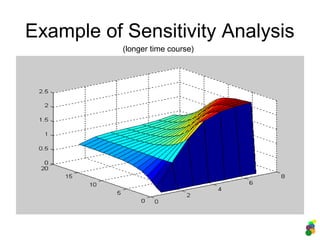
Example of Sensitivity Analysis
>> [t y] =
sensitivity(@erk_pathway_wolken
hauer, [0 1], [2.5 2.5 0 0 0 0
2.5 0 2.5 3 0], 5, 6, 1, 8,
0.05);
>> surf (y);
varies concentration of m5 (ERK-PP) from
0..6, outputs concentration of m8
(ERK/MEK-PP), time range [0 1], steps of
0.05. Then plots a surface map.
Example of Sensitivity Analysis
after Cho et al. (2003) CSMB
Example of Sensitivity Analysis
(longer time course)
Conclusions and Outlook
• differential equations allow exact predictions of systems
behaviour in a unified formalism
• modelling = in silico experimentation
• difficulties:
– translation from biology
• modular model building interfaces, e.g. Gepasi/COPASI, Genomic
Object Net, E-cell, Ingeneue
– managing complexity explosion
• pathway visualization and construction software
• standardized description language, e.g. Systems Biology Markup
Language (SBML)
– lack of biological data
• perturbation-based parameter estimation, e.g. metabolic control
analysis (MCA)
• constraints-based modelling, e.g. flux balance analysis (FBA)
• semi-quantitative differential equations for inexact knowledge

M sc it_modelling_biological_systems2005

  • 1.
    Modelling Biological Systems withDifferential Equations Rainer Breitling (R.Breitling@bio.gla.ac.uk) Bioinformatics Research Centre February 2005
  • 2.
    Outline • Part 1:Why modelling? • Part 2: The statistical physics of modelling: A  B (where do differential equations come from?) • Part 3: Translating biology to mathematics (finding the right differential equations)
  • 3.
  • 4.
    Humans think small-scale... (the“7 items” rule) ...but biological systems contain (at least) dozens of relevant interacting components! •phone number length (memory constraint) •optimal team size (manipulation constraint) •maximum complexity for rational decision making
  • 5.
    Humans think linear... ...butbiological systems contain: • non-linear interaction between components • positive and negative feedback loops • complex cross-talk phenomena
  • 6.
    The simplest chemicalreaction A  B • irreversible, one-molecule reaction • examples: all sorts of decay processes, e.g. radioactive, fluorescence, activated receptor returning to inactive state • any metabolic pathway can be described by a combination of processes of this type (including reversible reactions and, in some respects, multi- molecule reactions)
  • 7.
    The simplest chemicalreaction A  B various levels of description: • homogeneous system, large numbers of molecules = ordinary differential equations, kinetics • small numbers of molecules = probabilistic equations, stochastics • spatial heterogeneity = partial differential equations, diffusion • small number of heterogeneously distributed molecules = single-molecule tracking (e.g. cytoskeleton modelling)
  • 8.
    Kinetics Description • Imaginea box containing N molecules. How many will decay during time t? k*N • Imagine two boxes containing N/2 molecules each. How many decay? k*N • Imagine two boxes containing N molecules each. How many decay? 2k*N • In general: )(* )( tn dt tdn λ=− Main idea: Molecules don’t talk t eNtn λ− = 0)(⇔ differential equation (ordinary, linear, first-order) exact solution (in more complex cases replaced by a numerical approximation)
  • 9.
    Kinetics Description If youknow the concentration at one time, you can calculate it for any other time! (and this really works)
  • 10.
    Probabilistic Description Probability ofdecay of a single molecule in some small time interval: Probability of survival in ∆t: Probability of survival for some time t: Transition to large number of molecules: tp ∆= λ1 tpp ∆−=−= λ11 12 tx x e x t p λ λ − ∞→ =−= )1(lim t eNtn λ− = 0)( )( )( 0 tneN dt tdn t λλ λ −=−= − or Main idea: Molecules are isolated entities without memory
  • 11.
    Probabilistic Description –2 Probability of survival of a single molecule for some time t: Probability that exactly x molecules survive for some time t: Most likely number to survive to time t: tx x e x t p λ λ − ∞→ =−= )1(lim       −= −−− x N eep xNtxt x 00 )1()( λλ t x eNpx λ− = 0)|max(
  • 12.
    Probabilistic Description –3 Markov Model (pure death!) Decay rate: Probability of decay: Probability distribution of n surviving molecules at time t: Description: Time: t -> wait dt -> t+dt Molecules: n -> no decay -> n n+1 -> one decay -> n λntn =Λ ),( dttnp ),(Λ= ),( tnP ]),(1)[,( ),1(),1( ),( dttntnP dttntnP dttnP Λ−+ +Λ+ =+ Final Result (after some calculating): The same as in the previous probabilistic description
  • 13.
    Spatial heterogeneity • concentrationsare different in different places, n = f(t,x,y,z) • diffusion superimposed on chemical reactions: • partial differential equation diffusion)( )( ±−= ∂ ∂ xyz xyz tn t tn λ
  • 14.
    Spatial heterogeneity • one-dimensionalcase (diffusion only, and conservation of mass) x n(t,x) K x xxtn K x t xtn ∂ ∂ −= ∂ ∆+∂ −= −=∆ ∂ ∂ inflow ),( outflow outflowinflow ),(
  • 15.
    Spatial heterogeneity –2 )()( )( :reactionchemicaln withCombinatio ),,,( ),,,( :dimensionsfor threeShorthand ),(),( :equationdiffusiongetoequation taldifferentitoTransition ),(),(),( 2 2 2 2 tnKtn t tn zyxtnK t zyxtn x xtn K t xtn x xtn K x xxtn Kx t xtn ∇+−= ∂ ∂ ∇= ∂ ∂ ∂ ∂ = ∂ ∂ ∂ ∂ − ∂ ∆+∂ =∆ ∂ ∂ λ
  • 16.
    Summary of PhysicalChemistry • Simple reactions are easy to model accurately • Kinetic, probabilistic, Markovian approaches lead to the same basic description • Diffusion leads only to slightly more complexity • Next step: Everything is decay... t eNtntn dt tdn λ λ − =⇔−= 0)()( )(
  • 17.
    Some (Bio)Chemical Conventions Concentrationof Molecule A = [A], usually in units mol/litre (molar) Rate constant = k, with indices indicating constants for various reactions (k1, k2...) Therefore: AB ][ ][][ 1 Ak dt Bd dt Ad −=−=
  • 18.
    Description in MATLAB: 1.Simple Decay Reaction M-file (description of the model) function dydt = decay(t, y) % A -> B or y(1) -> y(2) k = 1; dydt = [-k*y(1) k*y(1)]; Analysis of the model >> [t y] = ode45(@decay, [0 10], [5 1]); >> plot (t, y); >> legend ('[A]', '[B]');
  • 19.
  • 20.
    Reversible, Single-Molecule Reaction A B, or A  B || B  A, or Differential equations: ][][ ][ ][][ ][ 21 21 BkAk dt Bd BkAk dt Ad −= +−= forward reverse Main principle: Partial reactions are independent!
  • 21.
    Reversible, single-molecule reaction –2 Differential Equation: Equilibrium (=steady- state): equi equi equi equiequi equiequi K k k B A BkAk dt Bd dt Ad == =+− == 1 2 21 ][ ][ 0][][ 0 ][][ ][][ ][ ][][ ][ 21 21 BkAk dt Bd BkAk dt Ad −= +−=
  • 22.
    Description in MATLAB: 2.Reversible Reaction M-file (description of the model) function dydt = isomerisation(t, y) % A <-> B or y(1) <-> y(2) k1 = 1; k2 = 0.5; dydt = [-k1*y(1)+k2*y(2) % d[A]/dt k1*y(1)-k2*y(2) % d[B]/dt ]; Analysis of the model >> [t y] = ode45(@isomerisation, [0 10], [5 1]); >> plot (t, y); >> legend ('[A]', '[B]');
  • 23.
  • 24.
    Isomerization Reaction inMATLAB If you know the concentration at one time, you can calculate it for any other time... so what would be the algorithm for that?
  • 25.
    Euler’s method -pseudocode 1. define f(t,y) 2. input t0 and y0. 3. input h and the number of steps, n. 4. for j from 1 to n do a. m = f(t0,y0) b. y1 = y0 + h*m c. t1 = t0 + h d. Print t1 and y1 e. t0 = t1 f. y0 = y1 5. end ),(1 nnnn ythfyy +=+
  • 26.
    Euler’s method inPerl sub ode_euler { my ($t0, $t_end, $h, $yref, $dydt_ref) = @_; my @y = @$yref; my @solution; for (my $t = $t0; $t < $t_end; $t += $h) { push @solution, [@y]; my @dydt = &$dydt_ref(@y, $t); foreach my $i (0..$#y) { $y[$i] += ( $h * $dydt[$i] ); } } push @solution, [@y]; return @solution; } ),(1 nnnn ythfyy +=+
  • 27.
    Euler’s method inPerl #!/usr/bin/perl -w use strict; my @initial_values = (5, 1); my @result = ode_euler (0, 10, 0.01, @initial_values, &dydt); foreach (@result) { print join " ", @$_, "n"; } exit; % simple A <-> B reversible mono-molecular reaction sub dydt { my $yref = shift; my @y = @$yref; my @dydt = ( -$y[0] + 0.5*$y[1], +$y[0] - 0.5*$y[1] ); return @dydt; } ....
  • 28.
    Improving Euler’s method )),(,(2 1 2 1 1 nnnnnn ythfyhthfyy +++=+ ),(1 nnnn ythfyy +=+ (second-order Runge-Kutta method)
  • 29.
  • 30.
  • 31.
    Irreversible, two-molecule reaction A+BC Differentialequations: ]][[ ][ ][][][ BAk dt Ad dt Cd dt Bd dt Ad −= −== Underlying idea: Reaction probability = Combined probability that both [A] and [B] are in a “reactive mood”: ]][[][][)()()( * 2 * 1 BAkBkAkBpApABp === The last piece of the puzzle Non-linear!
  • 32.
    A simple metabolicpathway ABC+D Differential equations: d/dt decay forward reverse [A]= -k1[A] [B]= +k1[A] -k2[B] +k3[C][D] [C]= +k2[B] -k3[C][D] [D]= +k2[B] -k3[C][D]
  • 33.
    Metabolic Networks asBigraphs ABC+D d/dt decay forward reverse [A] -k1[A] [B] +k1[A] -k2[B] +k3[C][D] [C] +k2[B] -k3[C][D] [D] +k2[B] -k3[C][D] k1 k2 k3 A -1 0 0 B 1 -1 1 C 0 1 -1 D 0 1 -1
  • 34.
    Biological description bigraph  differential equations KEGG
  • 35.
    Biological description bigraph  differential equations
  • 36.
    Biological description bigraph  differential equations
  • 37.
    Biological description bigraph  differential equations
  • 38.
    Biological description bigraph  differential equations Fig. courtesy of W. Kolch
  • 39.
    Biological description bigraph  differential equations Fig. courtesy of W. Kolch
  • 40.
    Biological description bigraph  differential equations Fig. courtesy of W. Kolch
  • 41.
    The Raf-1/RKIP/ERK pathway Canyou model it? (11x11 table, 34 entries)
  • 42.
    Description in MATLAB: 3.The RKIP/ERK pathway function dydt = erk_pathway_wolkenhauer(t, y) % from Kwang-Hyun Cho et al., Mathematical Modeling... k1 = 0.53; k2 = 0.0072; k3 = 0.625; k4 = 0.00245; k5 = 0.0315; k6 = 0.8; k7 = 0.0075; k8 = 0.071; k9 = 0.92; k10 = 0.00122; k11 = 0.87; % continued on next slide...
  • 43.
    Description in MATLAB: 3.The RKIP/ERK pathway dydt = [ -k1*y(1)*y(2) + k2*y(3) + k5*y(4) -k1*y(1)*y(2) + k2*y(3) + k11*y(11) k1*y(1)*y(2) - k2*y(3) - k3*y(3)*y(9) + k4*y(4) k3*y(3)*y(9) - k4*y(4) - k5*y(4) k5*y(4) - k6*y(5)*y(7) + k7*y(8) k5*y(4) - k9*y(6)*y(10) + k10*y(11) -k6*y(5)*y(7) + k7*y(8) + k8*y(8) k6*y(5)*y(7) - k7*y(8) - k8*y(8) -k3*y(3)*y(9) + k4*y(4) + k8*y(8) -k9*y(6)*y(10) + k10*y(11) + k11*y(11) k9*y(6)*y(10) - k10*y(11) - k11*y(11) ];
  • 44.
    Description in MATLAB: 3.The RKIP/ERK pathway Analysis of the model: >> [t y] = ode45(@erk_pathway_wolkenhauer, [0 10], [2.5 2.5 0 0 0 0 2.5 0 2.5 3 0]); %(initial values!) >> plot (t, y); >> legend ('[Raf1*]', '[RKIP]', '[Raf1/RKIP]', '[RAF/RKIP/ERK]', '[ERK]', '[RKIP-P]', '[MEK-PP]', '[MEK-PP/ERK]', '[ERK-PP]', '[RP]', '[RKIP-P/RP]' );
  • 45.
  • 46.
    Further Analyses inMATLAB et al. All initial concentrations can be varied at will, e.g. to test a concentration series of one component (sensitivity analysis) Effect of slightly different k-values can be tested (stability of the model with respect to measurement/estimation errors) Effect of inhibitors of each reaction (changed k- values) can be predicted Concentrations at each time-point are predicted exactly and can be tested experimentally
  • 47.
    Example of SensitivityAnalysis function [tt,yy] = sensitivity(f, range, initvec, which_stuff_vary, ep, step, which_stuff_show, timeres); timevec = range(1):timeres:range(2); vec = [initvec]; [tt y] = ode45(f, timevec, vec); yy = y(:,which_stuff_show); for i=initvec(which_stuff_vary)+step:step:ep; vec(which_stuff_vary) = i; [t y] = ode45(f, timevec, vec); tt = [t]; yy = [yy y(:,which_stuff_show)]; end
  • 48.
    Example of SensitivityAnalysis >> [t y] = sensitivity(@erk_pathway_wolken hauer, [0 1], [2.5 2.5 0 0 0 0 2.5 0 2.5 3 0], 5, 6, 1, 8, 0.05); >> surf (y); varies concentration of m5 (ERK-PP) from 0..6, outputs concentration of m8 (ERK/MEK-PP), time range [0 1], steps of 0.05. Then plots a surface map.
  • 49.
    Example of SensitivityAnalysis after Cho et al. (2003) CSMB
  • 50.
    Example of SensitivityAnalysis (longer time course)
  • 51.
    Conclusions and Outlook •differential equations allow exact predictions of systems behaviour in a unified formalism • modelling = in silico experimentation • difficulties: – translation from biology • modular model building interfaces, e.g. Gepasi/COPASI, Genomic Object Net, E-cell, Ingeneue – managing complexity explosion • pathway visualization and construction software • standardized description language, e.g. Systems Biology Markup Language (SBML) – lack of biological data • perturbation-based parameter estimation, e.g. metabolic control analysis (MCA) • constraints-based modelling, e.g. flux balance analysis (FBA) • semi-quantitative differential equations for inexact knowledge

Editor's Notes

  • #5 castling = example of complexity reduction by pattern recognition 12 apostles = maximum team size; software development teams 8-12 core members; start-up companies most successful with 3 members
  • #11 MAIN POINT of this extended discussion: Differential equation models are governed by principles that are more fundamental than the laws of gravity! Very, very different from usual biology
  • #16 Taylor expansion about x in step (1)
  • #33 One row for each molecular species; one column for each arrowhead (=rate constant = elementary reaction)