2 LEARNING OBJECTIVES
1. Identify foods sources of protein and the health
benefits and challenges associated with them.
2.Classify the amino acids and their importance to the
body, describe the digestion of protein, absorption and
transport of amino acids in the body.
3.Explain the role of proteins and amino acids in the
body.
4. Deliberate on the potential physical problems from
eating very little or too much protein.
3.
3
What are Proteins?
Proteins are made up of carbon, hydrogen, oxygen, and
nitrogen atoms that are formed into basic units called
amino acids.
proteins are Important group of the macronutrients
Proteins are substances found in every cell.
The body needs proteins to build and repair all body
tissues
Protein is an important part of blood cells.
4.
4 The Structureof Proteins
Proteins contain nitrogen in addition to carbon,
hydrogen and oxygen unlike CHO and fat.
It is the NITROGEN which makes protein unique.
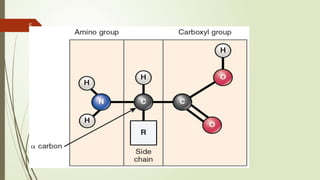
Amino acids are the building blocks of proteins.
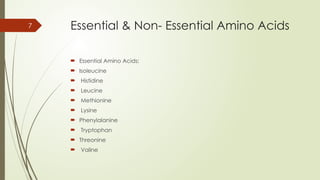
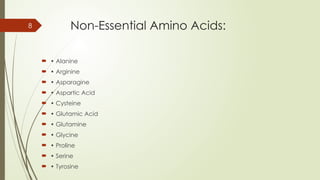
There are 20 different amino acids that are important in
human nutrition
6 Amino acids
The amino acids are classified into three main groups
9 amino acids are essential
11 amino acids are non-essential
Under special circumstances, a nonessential amino acid
can become essential-conditionally essential amino
acids
Essential means it must be present in the diet since the
body cannot make it.
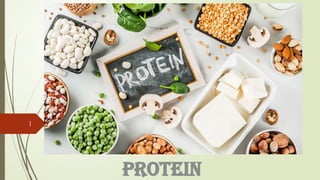
9 SOURCES OFPROTEIN
Protein can be categorized into two (2) based on their
sources.They are
Animal protein /First class protein
Plant protein /second class protein
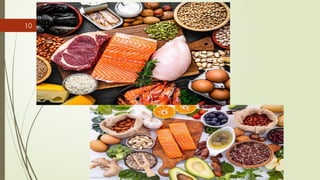
Examples of animals proteins;
Animal proteins (meat, fish, eggs and poultry) are considered
good sources
Plant proteins
Do not have enough of one or more of the essential amino acids
Plant proteins include (grains, legumes, nuts, seeds and other
vegetables) are incomplete proteins
11 CLASSIFICATION OFPROTEIN BASED ON THEIR COMPOSITION
Protein can be classified into two based on their
composition
Complete protein and
Incomplete protein
12.
12 Complete protein
foundin animal products like meat, fish, poultry, eggs,
and dairy, as A complete protein contains all nine essential
amino acids that the body cannot produce on its own and
must obtain from food. These amino acids are essential for
various bodily functions, including muscle repair, hormone
production, and immune system support. Complete
proteins are typically well as in some plant-based sources
such as quinoa, soy, chia seeds, and buckwheat.
13.
13
Incomplete protein
Incomplete proteinsare those that lack one or more of the essential
amino acids, the building blocks of protein that our bodies can't
produce on their own. When a protein source is incomplete, it
means it doesn't provide all the necessary amino acids in sufficient
Common sources of incomplete proteins include plant-based foods
like beans, grains, nuts, and seeds. While these foods are valuable
sources of protein, they may not contain all the essential amino
acids in the right proportions.
14.
14
Complementary protein
Complementary proteinsare two or more incomplete proteins that,
when combined, provide all essential amino acids in adequate
amounts. They are typically found in plant-based foods and can be
combined to form a complete protein source. This concept is
important for individuals following vegetarian or vegan diets to
ensure they receive all essential amino acids necessary for proper
nutrition. Examples include combining beans with rice or lentils with
grains
15.
15 Functions ofprotein.
Enzymes:
Proteins act as enzymes, speeding up biochemical
reactions in the body. Enzymes play a critical role in
digestion, metabolism, and numerous other biological
processes by facilitating chemical reactions. Examples of
such proteins are Amylase, catalase, lipase etc
Structural Support:
- Proteins like collagen, actin, and tubulin provide
structural support to cells and tissues. Collagen, for
example, is a crucial protein in connective tissues,
providing strength and elasticity to skin, tendons, and
bones.
16.
16 Con’t
Transport:
Proteins are involved in transporting essential molecules throughout
the body. For instance, hemoglobin transports oxygen in the blood,
ensuring that oxygen reaches all the cells in the body.
Hormones:
Some proteins serve as hormones that regulate various physiological
functions. For example, insulin is a protein hormone that plays a key
role in regulating blood sugar levels.
Immune Response:
Proteins such as antibodies are vital components of the immune
system. Antibodies recognize and neutralize foreign substances like
viruses and bacteria, helping the body defend against infections.
17.
17
Muscle Contraction:
Proteins likeactin and myosin are crucial for muscle contraction. These
proteins interact to generate the force required for muscle movement.
Signal Transduction:
- Proteins are involved in signal transduction pathways that regulate cellular
responses to various stimuli. They help cells communicate and respond to
changes in their environment.
Gene Expression:
Proteins play a role in gene expression by regulating the transcription and
translation of genetic information. Transcription factors, for example, are
proteins that control the expression of specific genes.
Metabolism:
- Many proteins are enzymes involved in metabolic pathways, breaking down
nutrients, generating energy, and synthesizing essential molecules needed for
18.
18 Protein digestion
The digestion of proteins involves two main processes:
mechanical digestion and chemical digestion.
Mechanical digestion involves physically breaking down
food substances into smaller particles whiles
Chemical digestion of proteins is the process through
which large protein molecules are broken down into
smaller peptides and individual amino acids by digestive
enzymes, allowing for their absorption and utilization by
the body.
19.
19 HOW THEBODY BREAKS DOWN PROTEIN
Mechanical digestion of protein begins in the mouth and
continues in the stomach and small intestine.
Chemical digestion of protein begins in the stomach and ends in
the small intestine. The body recycles amino acids to make more
proteins.
In the mouth, proteins are mechanically broken down through
chewing.
In the stomach, pepsin secreted by stomach cells breaks down
proteins into large polypeptides. Pepsin is activated by
hydrochloric acid.
Large polypeptides enter the small intestine where trypsin,
chymotrypsin, and carboxypeptidase from the pancreas further
break them down.
20.
20
Trypsin activatesmore trypsin and also activates
chymotrypsin and carboxypeptidase.
Brush border enzymes on intestinal cells break
polypeptides down into tripeptides, dipeptides and
amino acids.
Tripeptides, dipeptides and amino acids are absorbed
into intestinal cells and their blood vessels.
Amino acids then travel to the liver via the
bloodstream to be used for protein synthesis.
21.
21
PROBLEMS WITH EATINGTOO MUCH OR
TOO LITTLE PROTEIN
Overeating protein is not a major problem in Ghana
Not eating enough protein is however a major problem
especially in children
When children do not get enough protein, they may develop a
disease called Kwashiorkor and also
Marasmus occurs when children do not get enough protein and
energy
Marasmic - kwashiorkor is a bridge between the marasmus and
Kwashiorkor. The child therefore shows some the features of both
disorders
22.
22
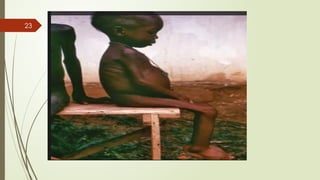
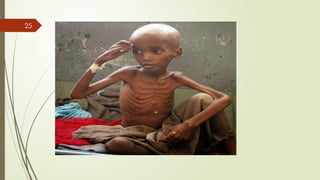
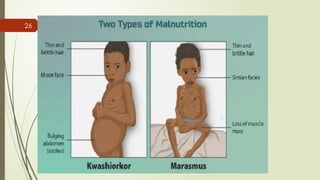
KWASHIORKOR
Kwashiorkor isa disease marked by severe protein malnutrition
and bilateral extremity swelling.
It usually affects infants and children, most often around the age
of weaning through age 5.
Kwashiorkor, also known as “edematous malnutrition” because of
its association with edema (fluid retention), is a nutritional disorder
most often seen in regions experiencing famine.
It is a form of malnutrition caused by a), especially in the ankles,
feet, and legs.
24
MARASMUS
Marasmus isa severeform of malnutrition that results from
a die deficient in both calories and protein. It is
characterized by extreme wasting of fat and muscle
mass, leading to significant weight loss and weakness.
This is particularly known in areas where there is lack of
access to an adequate and balanced diet
27 SYMPTOMS
1.Loss of body fat and muscle wasting
2. Edema (swelling skin and hair changes (thinness, sparse,
change in color).
3. Fatigue, weakness, and irritability.
4. Poor growth and delayed development.
5. Changes in hair (dry, brittle, change in color) and nails
(thin, brittle, ridges, spoon-shaped deformities).
6. Weakened immune system, leading to increased
susceptibility to infections.
28.
28
NURSING MANAGEMENT OFPROTEIN
DEFICIENY
Assessment of nutritional status and symptoms.
Collaboration with healthcare team to address underlying causes.
Providing education on protein-rich foods and personalized nutrition plans.
Monitoring progress and adjusting care as needed.
Offering wound care for those with impaired healing.
Addressing psychosocial factors affecting nutrition.
Educating patients and families on long-term dietary changes.
Scheduling regular follow-up appointments for ongoing support and
monitoring.
29.
29 REFERENCES
1. Alberts,B., Johnson, A., Lewis, J., Raff, M., Roberts, K., &
Walter, P. (2022). Molecular Biology of the Cell (4th ed.).
Garland Science.
-
2. Berg, J. M., Tymoczko, J. L., & Gatto, G. J. (2021). Stryer's
Biochemistry (8th ed.). .
-
3. Nelson, D. L., Cox, M. M. (2020). Lehninger Principles of
Biochemistry (7th ed.). W.H. Freeman and Company.
-
30.
30 Group Members
OPOKU STEVE ANNAN ……………. UEB3014922
BRENYA IVY ……………… UEB3008022
SARFO EMMANUELLA ………..UEB3007422
TINGBARI JANET……………..UEB3016322
EWURADJOA AMOAH …………….. UEB3016522
ACHEAMPONG EMMANUELLA ……….. UEB3010622
ABDUL RASHID RUWEIDA ……………… UEB3014222
BOAKYE PRINCESS……………………. UEB3014122


![Cells and Organs of immune system [Autosaved].pptx](https://cdn.slidesharecdn.com/ss_thumbnails/cellsandorgansofimmunesystemautosaved-260123152717-ea0cb261-thumbnail.jpg?width=640&height=640&fit=bounds)


