“Multifunctionality of Lactoferrin Protein ”
Karmveer Yadav
Ph.D. Scholar_ABC_NDRI
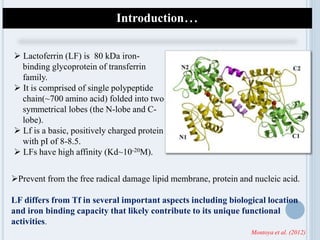
 Lactoferrin (LF) is 80 kDa iron-
binding glycoprotein of transferrin
family.
 It is comprised of single polypeptide
chain(~700 amino acid) folded into two
symmetrical lobes (the N-lobe and C-
lobe).
 Lf is a basic, positively charged protein
with pI of 8-8.5.
 LFs have high affinity (Kd~10-20M).
Montoya et al. (2012)
Prevent from the free radical damage lipid membrane, protein and nucleic acid.
LF differs from Tf in several important aspects including biological location
and iron binding capacity that likely contribute to its unique functional
activities.
Introduction…
Introduction…
S. Farnaud et al (2003)
In the current scenario of increasing resistance to antibiotics, there is a need
for the discovery of novel antimicrobial drugs.
In neurodegenerative disease development of an efficient gene vector or gene
therapy is a key-limiting factor of blood-brain barrier (BBB).
Continuous chemotherapy- very painful for the patients.
Nanoparticles need to be effective as well as exhibit minimum cytotoxicity
when used in the long run, as this is a major difficulty faced with most metal
based NPs.
bLF as a food ingredient is thought to be safe, because there is a long dietary
history of its use.
Current Therapeutic Options- Its Limitations…
Lactoferrin: Beyond nutritional significance
Rogan et al.( 2006)
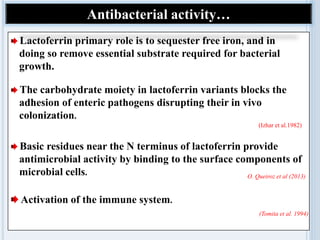
Lactoferrin primary role is to sequester free iron, and in
doing so remove essential substrate required for bacterial
growth.
The carbohydrate moiety in lactoferrin variants blocks the
adhesion of enteric pathogens disrupting their in vivo
colonization.
(Izhar et al.1982)
Basic residues near the N terminus of lactoferrin provide
antimicrobial activity by binding to the surface components of
microbial cells.
Activation of the immune system.
O. Queiroz et al (2013)
(Tomita et al. 1994)
Antibacterial activity…
Chávez et al (2009)
Antibacterial Activity Mechanism…
Montoya et al.(2012)
Bacteria against which Lf reported effect…
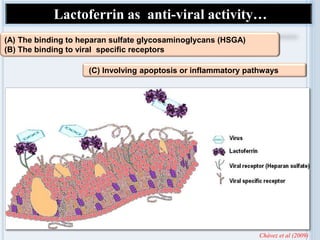
(C) Involving apoptosis or inflammatory pathways
Chávez et al (2009)
Lactoferrin as anti-viral activity…
(A) The binding to heparan sulfate glycosaminoglycans (HSGA)
(B) The binding to viral specific receptors
Virus (Enveloped) Protein Proposed action
HIV LF
Milk
bLF & hLF block HIV-1 adsorption to target
cells
Inhibits binding of HIV-1 to CD4 receptor
HSV-1 & 2 LF bLF & hLF bind to virus particles & Synergistic
effect with acyclovir
HCMV LF o Interfere with virus into target cells
o Up regulation of killer cells
o Synergistic antiviral effect with cidofovir
HCV LF o Binds to viral envelop proteins E1 & E2
o bLF administrated orally may be the effective
in combination in interferon
Alphavirus LF hLF inhibits interaction of virus with heparan
sulphate receptors
Hantavirus LF o Synergistic effect with ribavirin on viral
replication
o bLF administered orally may be effective in
combination with interferon
HPV LF Interferes with internalisation of virus into host
cells
Virus (Non-Enveloped) Protein Proposed action
PV LF Binds to target cells
Human influenza virus LF Inhibits haem agglutination by the virus
FCV LF bLF interfers with adsorption of virus to target
cells
Adenovirus LF bLF & hLF compete with virus for common
membrane receptors
S. Farnaud et al (2003)
A. Degranulation of Neutrophil
B. Phagocytosis
C. Neutrophil extracellular traps (NETs)
D. Proteolytic enzymes secretation
Immunoregulatory activities of lactoferrin
Hans J. Vogel (2012)
Lactoferrin defense mechanism of innate immunity
www.google.com
Spadaro et al. (2008)
Lactoferrin noval maturation factor for DCs
CD83, CD80 and CD86 = Costimulatory molecule
CXCR4 and CCR7 = Chemokine receptor
bLF could be a potent therapeutic agent for inflammatory diseases associated
with bone destruction, such as periodontitis and rheumatoid arthritis
bLF is a potent anti-inflammatory agent
T. Inubush et. al (2012)
Lactoferrin
Increase p27 protein
Decreased phosphorylation
of retinoblastoma protein
Suppression of cyclin E
Lactoferrin Down-Regulates G1 Cyclin-Dependent Kinases during Growth Arrest of Head
and Neck Cancer Cells
Yan Xiao (2004)
Behavioral Observation…
Five parameters were measured in this experiment:
Line crossing (number of lines crossed)
Rearing(number of rears)
Active sitting (time in seconds)
Head dipping(number of dips)
Inactive sitting (time in seconds)
Multiple injections of Lf-modified NPs obtained higher GDNF expression and this
gene expression was maintained for a longer time than the one with a single
injection.
Multiple dosing intravenous administration of Lf-modified NPs could significantly
improve locomotor activity, reduce dopaminergic neuronal loss, and enhance
monoamine neurotransmitter levels on rotenone-induced PD rats, which indicates
its powerful neuroprotective effects.
Result
L. Rodrigues et al. 2008
Summary
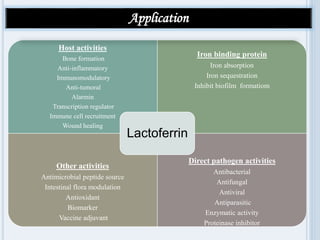
Host activities
Bone formation
Anti-inflammatory
Immunomodulatory
Anti-tumoral
Alarmin
Transcription regulator
Immune cell recruitment
Wound healing
Iron binding protein
Iron absorption
Iron sequestration
Inhibit biofilm formatiom
Other activities
Antimicrobial peptide source
Intestinal flora modulation
Antioxidant
Biomarker
Vaccine adjuvant
Direct pathogen activities
Antibacterial
Antifungal
Antiviral
Antiparasitic
Enzymatic activity
Proteinase inhibitor
Lactoferrin
Application
Recombinant human lactoferrin is produced by Aspergillus niger, transgenic cows, and
rice, and its efficacy is being evaluated.
Natural antimicrobials can provide opportunity for advancing the field of
food preservation and safety; however, additional research is needed to
optimize their applications.
Application of natural antimicrobials in foods that require further research
on their antimicrobial efficacy, consumer acceptability, and cost.
Large-scale production of these compounds from their natural sources
without losing their functional activity, and the approval of their use by
regulatory agencies.
The large potential applications of Lf have led scientists to develop this
nutriceutical protein for use in feed, food and pharmaceutical applications.
Future Prospective…
.
.
Thank you

Lactoferrin

  • 1.
    “Multifunctionality of LactoferrinProtein ” Karmveer Yadav Ph.D. Scholar_ABC_NDRI
  • 2.
     Lactoferrin (LF)is 80 kDa iron- binding glycoprotein of transferrin family.  It is comprised of single polypeptide chain(~700 amino acid) folded into two symmetrical lobes (the N-lobe and C- lobe).  Lf is a basic, positively charged protein with pI of 8-8.5.  LFs have high affinity (Kd~10-20M). Montoya et al. (2012) Prevent from the free radical damage lipid membrane, protein and nucleic acid. LF differs from Tf in several important aspects including biological location and iron binding capacity that likely contribute to its unique functional activities. Introduction…
  • 3.
  • 4.
    In the currentscenario of increasing resistance to antibiotics, there is a need for the discovery of novel antimicrobial drugs. In neurodegenerative disease development of an efficient gene vector or gene therapy is a key-limiting factor of blood-brain barrier (BBB). Continuous chemotherapy- very painful for the patients. Nanoparticles need to be effective as well as exhibit minimum cytotoxicity when used in the long run, as this is a major difficulty faced with most metal based NPs. bLF as a food ingredient is thought to be safe, because there is a long dietary history of its use. Current Therapeutic Options- Its Limitations…
  • 5.
    Lactoferrin: Beyond nutritionalsignificance Rogan et al.( 2006)
  • 6.
    Lactoferrin primary roleis to sequester free iron, and in doing so remove essential substrate required for bacterial growth. The carbohydrate moiety in lactoferrin variants blocks the adhesion of enteric pathogens disrupting their in vivo colonization. (Izhar et al.1982) Basic residues near the N terminus of lactoferrin provide antimicrobial activity by binding to the surface components of microbial cells. Activation of the immune system. O. Queiroz et al (2013) (Tomita et al. 1994) Antibacterial activity…
  • 7.
    Chávez et al(2009) Antibacterial Activity Mechanism…
  • 8.
    Montoya et al.(2012) Bacteriaagainst which Lf reported effect…
  • 9.
    (C) Involving apoptosisor inflammatory pathways Chávez et al (2009) Lactoferrin as anti-viral activity… (A) The binding to heparan sulfate glycosaminoglycans (HSGA) (B) The binding to viral specific receptors
  • 10.
    Virus (Enveloped) ProteinProposed action HIV LF Milk bLF & hLF block HIV-1 adsorption to target cells Inhibits binding of HIV-1 to CD4 receptor HSV-1 & 2 LF bLF & hLF bind to virus particles & Synergistic effect with acyclovir HCMV LF o Interfere with virus into target cells o Up regulation of killer cells o Synergistic antiviral effect with cidofovir HCV LF o Binds to viral envelop proteins E1 & E2 o bLF administrated orally may be the effective in combination in interferon Alphavirus LF hLF inhibits interaction of virus with heparan sulphate receptors Hantavirus LF o Synergistic effect with ribavirin on viral replication o bLF administered orally may be effective in combination with interferon HPV LF Interferes with internalisation of virus into host cells Virus (Non-Enveloped) Protein Proposed action PV LF Binds to target cells Human influenza virus LF Inhibits haem agglutination by the virus FCV LF bLF interfers with adsorption of virus to target cells Adenovirus LF bLF & hLF compete with virus for common membrane receptors S. Farnaud et al (2003)
  • 11.
    A. Degranulation ofNeutrophil B. Phagocytosis C. Neutrophil extracellular traps (NETs) D. Proteolytic enzymes secretation Immunoregulatory activities of lactoferrin Hans J. Vogel (2012)
  • 12.
    Lactoferrin defense mechanismof innate immunity www.google.com
  • 13.
    Spadaro et al.(2008) Lactoferrin noval maturation factor for DCs CD83, CD80 and CD86 = Costimulatory molecule CXCR4 and CCR7 = Chemokine receptor
  • 14.
    bLF could bea potent therapeutic agent for inflammatory diseases associated with bone destruction, such as periodontitis and rheumatoid arthritis bLF is a potent anti-inflammatory agent T. Inubush et. al (2012)
  • 15.
    Lactoferrin Increase p27 protein Decreasedphosphorylation of retinoblastoma protein Suppression of cyclin E Lactoferrin Down-Regulates G1 Cyclin-Dependent Kinases during Growth Arrest of Head and Neck Cancer Cells Yan Xiao (2004)
  • 18.
    Behavioral Observation… Five parameterswere measured in this experiment: Line crossing (number of lines crossed) Rearing(number of rears) Active sitting (time in seconds) Head dipping(number of dips) Inactive sitting (time in seconds) Multiple injections of Lf-modified NPs obtained higher GDNF expression and this gene expression was maintained for a longer time than the one with a single injection. Multiple dosing intravenous administration of Lf-modified NPs could significantly improve locomotor activity, reduce dopaminergic neuronal loss, and enhance monoamine neurotransmitter levels on rotenone-induced PD rats, which indicates its powerful neuroprotective effects. Result
  • 20.
    L. Rodrigues etal. 2008 Summary
  • 21.
    Host activities Bone formation Anti-inflammatory Immunomodulatory Anti-tumoral Alarmin Transcriptionregulator Immune cell recruitment Wound healing Iron binding protein Iron absorption Iron sequestration Inhibit biofilm formatiom Other activities Antimicrobial peptide source Intestinal flora modulation Antioxidant Biomarker Vaccine adjuvant Direct pathogen activities Antibacterial Antifungal Antiviral Antiparasitic Enzymatic activity Proteinase inhibitor Lactoferrin Application
  • 22.
    Recombinant human lactoferrinis produced by Aspergillus niger, transgenic cows, and rice, and its efficacy is being evaluated.
  • 23.
    Natural antimicrobials canprovide opportunity for advancing the field of food preservation and safety; however, additional research is needed to optimize their applications. Application of natural antimicrobials in foods that require further research on their antimicrobial efficacy, consumer acceptability, and cost. Large-scale production of these compounds from their natural sources without losing their functional activity, and the approval of their use by regulatory agencies. The large potential applications of Lf have led scientists to develop this nutriceutical protein for use in feed, food and pharmaceutical applications. Future Prospective…
  • 24.