
GOVERNMENT
ACCOUNTING
AND
AUDITING
GOVERNMENT
AUDITING
TITLE II
GOVERNMENT AUDITING
CHAPTER 1
BASIC POLICIES AND STANDARDS
Section 53. Definition of government auditing.
• Government auditing is the analytical and
systematic examination and verification of
financial transactions, operations, accounts,
and reports of any government agency for the
purpose of determining their accuracy,
integrity, and authenticity, and satisfying the
requirements of law, rules and regulations.
GOVERNMENT
Section 54.
General standards.
(1) The audit shall be performed by a
person possessed with adequate
technical training and proficiency as
auditor.
GOVERNMENT
Section 54.
General standards.
(2) In all matters relating to the audit work,
the auditor shall maintain complete
independence, impartiality and objectivity
and shall avoid any possible compromise of
his independence or any act which may
create a presumption of lack of
independence or the possibility of undue
influence in the performance of his duties.
GOVERNMENT
Section 54.
General standards.
(3) The auditor shall exercise due
professional care and be guided by
applicable laws, regulations and the
generally accepted principles of
accounting in the performance of the
audit work as well as in the preparation of
audit and financial reports.
GOVERNMENT
Section 55.
Examination and evaluation
standards.
• The audit work shall be adequately
planned and assistants shall be properly
supervised.
• A review shall be made of compliance
with legal and regulatory requirements.
GOVERNMENT
Section 55.
Examination and evaluation
standards.
• An evaluation shall be made of the system
of internal control and related
administrative practices to determine the
extent they can be relied upon to ensure
compliance with laws and regulations and
to provide for efficient, economical and
effective operations.
GOVERNMENT
Section 55.
Examination and evaluation
standards.
• The auditor shall obtain through
inspections, observation, inquiries,
confirmation and other techniques,
sufficient competent evidential matter to
afford himself a reasonable basis for his
opinions, judgments, conclusions, and
recommendations.
GOVERNMENT
 Section 55.
Examination and evaluation
standards.
• An evaluation shall be made of the system of internal
control and related administrative practices to
determine the extent they can be relied upon to
ensure compliance with laws and regulations and to
provide for efficient, economical and effective
operations.
• The auditor shall obtain through inspections,
observation, inquiries, confirmation and other
techniques, sufficient competent evidential matter to
afford himself a reasonable basis for his opinions,
judgments, conclusions, and recommendations.
GOVERNMENT
Section 56. Reporting standards.
(1) Audit reports shall be dated, signed
manually and shall be issued and distributed
in the manner provided by regulations of the
Commission.
(2) Audit reports shall contain basically the
transmittal statement, scope and objectives
of the audit and time period examined
highlights, financial information, findings,
recommendations, and conclusions
GOVERNMENT
Section 56.
Reporting standards.
• (3) Audit reports shall meet the following
reporting criteria:
(a) Factual matter must be accurately, completely and
fairly presented
(b) Findings must be presented objectively
(c) Findings must be adequately supported by evidence
in the audit working papers
(d) Reports must be concise
(e) Information on underlying causes of problems must
be included
GOVERNMENT
Section 56.
Reporting standards.
• (3) Audit reports shall meet the following
reporting criteria:
(a) Factual matter must be accurately, completely and
fairly presented
(b) Findings must be presented objectively
(c) Findings must be adequately supported by evidence
in the audit working papers
(d) Reports must be concise
(e) Information on underlying causes of problems must
be included
GOVERNMENT
Section 56.
Reporting standards.
• (4) Audit reports shall:
(a) Put primary emphasis on improvement
(b) Identify and explain issues and questions needing
further study
(c) Include recognition of note worthy
accomplishments
(d) Include recognition of the views of responsible
officials of the agency audited
(e) State whether any significant pertinent information
has been omitted
GOVERNMENT
 Section 56.
Reporting standards.
• (5) Audit reports accompanying
financial reports shall:
(a) State whether the audit was made in accordance
with generally accepted auditing standards
(b) Express the auditor’s opinion with respect
(c) Identify any matter to which he takes exception
(d) Contain appropriate supplementary explanatory
information about the contents of the financial
report
(e) Explain violations of legal or other regulatory
requirements, including instances of non
compliance.
GOVERNMENT
CHAPTER 2
AUDIT OBJECTIVES
Section 57.
Determination of audit procedures.
In the determination of auditing procedures
and techniques to be followed and the extent of
examination of vouchers and other documents by
government auditors, the Commission shall give
due regard to generally accepted principles of
auditing and accounting organizations and
systems, including consideration of the
effectiveness of internal control and related
administrative practices of the audited agencies.
GOVERNMENT
CHAPTER 2
AUDIT OBJECTIVES
Section 58. Audit of assets.
The examination and audit of assets shall be
performed with a view to ascertaining their
existence, ownership, valuation and
encumbrances as well as the propriety of items
composing the respective asset accounts,
determining their agreement with records;
proving the accuracy of such records; ascertaining
if the assets were utilized economically, efficiently
and effectively; and evaluating the adequacy of
controls over the accounts.
GOVERNMENT
CHAPTER 2
AUDIT OBJECTIVES
Section 59.
Audit of liabilities.
In his audit of liabilities, the auditor shall seek to
established that all obligations of the agency have
been accurately recorded; only bonafide
obligations of the agency have been included; the
obligations incurred are properly authorized; all
provisions of trust indentures or mortgages are
complied with; and mortgages and other
encumbrances are fully disclosed.
GOVERNMENT
CHAPTER 2
AUDIT OBJECTIVES
Section 60.
Audit of revenue accounts.
The examination and audit of revenue
accounts shall be performed with a view to
ascertaining that all earned revenues have
been duly recorded; and all recorded
revenues have been earned and appropriate
classifications of revenues have been
consistently followed.
GOVERNMENT
CHAPTER 2
AUDIT OBJECTIVES
Section 61.
Audit of expense accounts.
The examination of expense accounts shall
be undertaken to ascertain that all expense
incurred have been duly authorized;
adequately funded and documented;
properly recorded; all recorded expenses
have been actually incurred; and the
classifications of expenses are appropriate
and have been consistently followed.
GOVERNMENT
CHAPTER 2
AUDIT OBJECTIVES
Section 62.
Audit of surplus or networth.
The audit of surplus or networth shall
seek to determine the nature of the surplus,
whether current or invested surplus; the amount
of current surplus available to cover
appropriations for the operational expenses of
the government; the propriety of the ledger
accounts and balance sheet presentation account;
and the proper authority and recording of
changes in the capital structure made during the
period under audit.
GOVERNMENT
CHAPTER 3
RECEIPT AND DISPOSITION
OF FUNDS AND PROPERTY
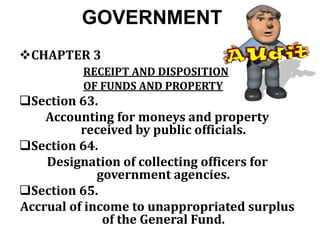
Section 63.
Accounting for moneys and property
received by public officials.
Section 64.
Designation of collecting officers for
government agencies.
Section 65.
Accrual of income to unappropriated surplus
of the General Fund.
GOVERNMENT
CHAPTER 3
RECEIPT AND DISPOSITION
OF FUNDS AND PROPERTY
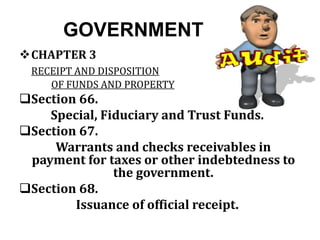
Section 66.
Special, Fiduciary and Trust Funds.
Section 67.
Warrants and checks receivables in
payment for taxes or other indebtedness to
the government.
Section 68.
Issuance of official receipt.
GOVERNMENT
 CHAPTER 3
RECEIPT AND DISPOSITION OF FUNDS AND PROPERTY
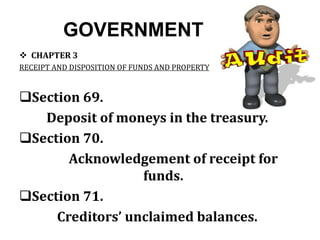
Section 69.
Deposit of moneys in the treasury.
Section 70.
Acknowledgement of receipt for
funds.
Section 71.
Creditors’ unclaimed balances.
GOVERNMENT
 CHAPTER 3
RECEIPT AND DISPOSITION OF FUNDS AND PROPERTY
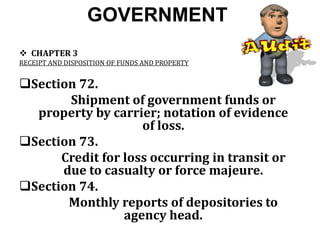
Section 72.
Shipment of government funds or
property by carrier; notation of evidence
of loss.
Section 73.
Credit for loss occurring in transit or
due to casualty or force majeure.
Section 74.
Monthly reports of depositories to
agency head.
GOVERNMENT
 CHAPTER 3
RECEIPT AND DISPOSITION OF FUNDS AND PROPERTY
 Section 75.
Transfer of funds from one officer to another.
 Section 76.
Transfer of property between government
agencies.
 Section 77.
Invoice and receipt upon transfer of funds or
property.
 Section 78.
Disposition of funds or property held by
deceased, incapacitated, absconding, or superseded
accountable officer.
GOVERNMENT
CHAPTER 3
RECEIPT AND DISPOSITION OF FUNDS AND PROPERTY
Section 79.
Destruction or sale of unserviceable
property.
Section 80.
Final report of accountable officers.
Section 81.
Auditor’s certificate of balance.
Section 82.
Auditor’s notice to accountable officer
of balance shown upon settlement.
GOVERNMENT
AUDIT ING
CHAPTER 4
APPLICATION OF
APPROPRIATED FUNDS
Section 84. Disbursement of government
funds.
Section 85. Appropriation before entering
into contract.
Section 86. Certificate showing
appropriation to meet contract.
Section 87. Void contract and liability of officer.
GOVERNMENT
AUDITING
CHAPTER 4
APPLICATION OF
APPROPRIATED FUNDS
Section 88. Prohibition against advance
payment on government contracts.
Section 89. Limitations on cash advance.
Section 90. Payment of rewards.
Section 91. Payments to creditors.
GOVERNMENT
AUDITING
CHAPTER 4
APPLICATION OF
APPROPRIATED FUNDS
Section 92. Persons authorized to draw warrants
or checks for payment out of government
funds.
Section 93. To whom warrants or checks payable.
Section 94. Countersigning of warrants or checks
by auditor.
Section 95. Treasurer’s responsibility for
indorsements.
GOVERNMENT
AUDITING
 CHAPTER 4
APPLICATION OF
APPROPRIATED FUNDS
 Section 96. Payment of lost or fraudulently
encashed treasury warrants or checks.
 Section 97. Disposition of stale warrants or
checks.
 Section 98. Reversion of unliquidated balances of
accounts payable.
 Section 99. Transfer of unexpended balances to the
general fund.
 Section 100. Reports of disbursing officers in a
government agency.
GOVERNMENT
ACCOUNTING
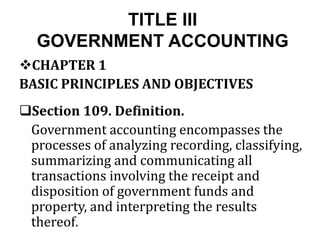
TITLE III
GOVERNMENT ACCOUNTING
CHAPTER 1
BASIC PRINCIPLES AND OBJECTIVES
Section 109. Definition.
Government accounting encompasses the
processes of analyzing recording, classifying,
summarizing and communicating all
transactions involving the receipt and
disposition of government funds and
property, and interpreting the results
thereof.
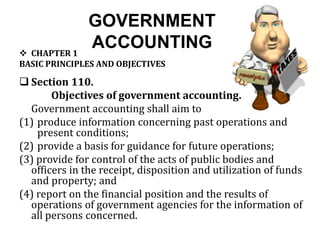
GOVERNMENT
ACCOUNTING CHAPTER 1
BASIC PRINCIPLES AND OBJECTIVES
 Section 110.
Objectives of government accounting.
Government accounting shall aim to
(1) produce information concerning past operations and
present conditions;
(2) provide a basis for guidance for future operations;
(3) provide for control of the acts of public bodies and
officers in the receipt, disposition and utilization of funds
and property; and
(4) report on the financial position and the results of
operations of government agencies for the information of
all persons concerned.
GOVERNMENT
ACCOUNTING
 CHAPTER 2
ACCOUNTS AND ACCOUNTING
 Section 111. Keeping of accounts.
(1) The accounts of an agency shall be kept in such detail as is
necessary to meet the needs of the agency and at the same time be
adequate to furnish the information needed by fiscal or control
agencies of the government.
(2) The highest standards of honesty, objectivity and consistency shall
be observed in the keeping of accounts to safeguard against
inaccurate or misleading information.
GOVERNMENT
ACCOUNTING
 CHAPTER 2
ACCOUNTS AND ACCOUNTING
 Section 112.
Recording of financial transactions.
Each government agency shall record its financial
transactions and operations conformably with
generally accepted accounting principles and in
accordance with pertinent laws and regulations.
GOVERNMENT
ACCOUNTING
 CHAPTER 2
ACCOUNTS AND ACCOUNTING
 Section 112.
Recording of financial transactions.
Each government agency shall record its financial
transactions and operations conformably with
generally accepted accounting principles and in
accordance with pertinent laws and regulations.
GOVERNMENT
ACCOUNTING
 CHAPTER 2
ACCOUNTS AND ACCOUNTING
 Section 113.
Chart of accounts.
The chart of accounts for government agencies shall be
prescribed by the Commission and shall be so designed as to
permit agency heads.
 Section 114. The general ledger.
(1) The government accounting system shall be on a double
entry basis with a general ledger in which all financial
transactions are recorded.
(2) Subsidiary records shall be kept where necessary.
GOVERNMENT
ACCOUNTING
 CHAPTER 2
ACCOUNTS AND ACCOUNTING
 Section 115.
Terminology and classification.
A common terminology and classification shall be used
consistently throughout the budget, the accounts and the
financial reports.
 Section 116.
Accounts classification.
To permit effective budgetary control and to establish
uniformity in financial reports, accounts shall be classified
in balanced fund groups.
GOVERNMENT
ACCOUNTING
 CHAPTER 2
ACCOUNTS AND ACCOUNTING
 Section 117.
Budgetary control accounts.
The general accounting system shall include budgetary control accounts
for revenues, expenditures and debt, as provided by P.D. No. 1177.
 Section 118. Accounting for unrealized revenues.
Estimated revenues which remain unrealized at the close of the fiscal
year shall not be booked or credited to the unappropriated surplus or
any other account.
 Section 119. Accounting for obligations and expenditures.
All lawful expenditures and obligations incurred during the year shall be
taken up in the accounts of that year.
GOVERNMENT
ACCOUNTING
 CHAPTER 3
ACCOUNTING REPORTS
Section 120.
Reporting requirements.
The Commission shall issue the pertinent
accounting rules and regulations whenever the
reporting requirements to be prescribed by the
Budget Commission pursuant to the budget law
affect accounting functions of the various agencies
of the government.
GOVERNMENT
ACCOUNTING
 CHAPTER 3
ACCOUNTING REPORTS
Section 121.
Financial reports and statements.
(1) The financial reports prepared by the agencies shall
comply with the specific requirements of applicable
laws and regulations as to nature, accounting basis,
content, frequency, and distribution as well as with all
applicable restrictions pertaining to information that
is classified for national security purposes.
(2) The financial statements shall be based on official
accounting records kept in accordance with law and the
generally accepted accounting principles and
standards.
GOVERNMENT
ACCOUNTING
 CHAPTER 3
ACCOUNTING REPORTS
Section 122.
Submission of reports.
THANKYOU!

Government Accounting and Auditing

  • 1.
  • 2.
  • 3.
    TITLE II GOVERNMENT AUDITING CHAPTER1 BASIC POLICIES AND STANDARDS Section 53. Definition of government auditing. • Government auditing is the analytical and systematic examination and verification of financial transactions, operations, accounts, and reports of any government agency for the purpose of determining their accuracy, integrity, and authenticity, and satisfying the requirements of law, rules and regulations.
  • 4.
    GOVERNMENT Section 54. General standards. (1)The audit shall be performed by a person possessed with adequate technical training and proficiency as auditor.
  • 5.
    GOVERNMENT Section 54. General standards. (2)In all matters relating to the audit work, the auditor shall maintain complete independence, impartiality and objectivity and shall avoid any possible compromise of his independence or any act which may create a presumption of lack of independence or the possibility of undue influence in the performance of his duties.
  • 6.
    GOVERNMENT Section 54. General standards. (3)The auditor shall exercise due professional care and be guided by applicable laws, regulations and the generally accepted principles of accounting in the performance of the audit work as well as in the preparation of audit and financial reports.
  • 7.
    GOVERNMENT Section 55. Examination andevaluation standards. • The audit work shall be adequately planned and assistants shall be properly supervised. • A review shall be made of compliance with legal and regulatory requirements.
  • 8.
    GOVERNMENT Section 55. Examination andevaluation standards. • An evaluation shall be made of the system of internal control and related administrative practices to determine the extent they can be relied upon to ensure compliance with laws and regulations and to provide for efficient, economical and effective operations.
  • 9.
    GOVERNMENT Section 55. Examination andevaluation standards. • The auditor shall obtain through inspections, observation, inquiries, confirmation and other techniques, sufficient competent evidential matter to afford himself a reasonable basis for his opinions, judgments, conclusions, and recommendations.
  • 10.
    GOVERNMENT  Section 55. Examinationand evaluation standards. • An evaluation shall be made of the system of internal control and related administrative practices to determine the extent they can be relied upon to ensure compliance with laws and regulations and to provide for efficient, economical and effective operations. • The auditor shall obtain through inspections, observation, inquiries, confirmation and other techniques, sufficient competent evidential matter to afford himself a reasonable basis for his opinions, judgments, conclusions, and recommendations.
  • 11.
    GOVERNMENT Section 56. Reportingstandards. (1) Audit reports shall be dated, signed manually and shall be issued and distributed in the manner provided by regulations of the Commission. (2) Audit reports shall contain basically the transmittal statement, scope and objectives of the audit and time period examined highlights, financial information, findings, recommendations, and conclusions
  • 12.
    GOVERNMENT Section 56. Reporting standards. •(3) Audit reports shall meet the following reporting criteria: (a) Factual matter must be accurately, completely and fairly presented (b) Findings must be presented objectively (c) Findings must be adequately supported by evidence in the audit working papers (d) Reports must be concise (e) Information on underlying causes of problems must be included
  • 13.
    GOVERNMENT Section 56. Reporting standards. •(3) Audit reports shall meet the following reporting criteria: (a) Factual matter must be accurately, completely and fairly presented (b) Findings must be presented objectively (c) Findings must be adequately supported by evidence in the audit working papers (d) Reports must be concise (e) Information on underlying causes of problems must be included
  • 14.
    GOVERNMENT Section 56. Reporting standards. •(4) Audit reports shall: (a) Put primary emphasis on improvement (b) Identify and explain issues and questions needing further study (c) Include recognition of note worthy accomplishments (d) Include recognition of the views of responsible officials of the agency audited (e) State whether any significant pertinent information has been omitted
  • 15.
    GOVERNMENT  Section 56. Reportingstandards. • (5) Audit reports accompanying financial reports shall: (a) State whether the audit was made in accordance with generally accepted auditing standards (b) Express the auditor’s opinion with respect (c) Identify any matter to which he takes exception (d) Contain appropriate supplementary explanatory information about the contents of the financial report (e) Explain violations of legal or other regulatory requirements, including instances of non compliance.
  • 16.
    GOVERNMENT CHAPTER 2 AUDIT OBJECTIVES Section57. Determination of audit procedures. In the determination of auditing procedures and techniques to be followed and the extent of examination of vouchers and other documents by government auditors, the Commission shall give due regard to generally accepted principles of auditing and accounting organizations and systems, including consideration of the effectiveness of internal control and related administrative practices of the audited agencies.
  • 17.
    GOVERNMENT CHAPTER 2 AUDIT OBJECTIVES Section58. Audit of assets. The examination and audit of assets shall be performed with a view to ascertaining their existence, ownership, valuation and encumbrances as well as the propriety of items composing the respective asset accounts, determining their agreement with records; proving the accuracy of such records; ascertaining if the assets were utilized economically, efficiently and effectively; and evaluating the adequacy of controls over the accounts.
  • 18.
    GOVERNMENT CHAPTER 2 AUDIT OBJECTIVES Section59. Audit of liabilities. In his audit of liabilities, the auditor shall seek to established that all obligations of the agency have been accurately recorded; only bonafide obligations of the agency have been included; the obligations incurred are properly authorized; all provisions of trust indentures or mortgages are complied with; and mortgages and other encumbrances are fully disclosed.
  • 19.
    GOVERNMENT CHAPTER 2 AUDIT OBJECTIVES Section60. Audit of revenue accounts. The examination and audit of revenue accounts shall be performed with a view to ascertaining that all earned revenues have been duly recorded; and all recorded revenues have been earned and appropriate classifications of revenues have been consistently followed.
  • 20.
    GOVERNMENT CHAPTER 2 AUDIT OBJECTIVES Section61. Audit of expense accounts. The examination of expense accounts shall be undertaken to ascertain that all expense incurred have been duly authorized; adequately funded and documented; properly recorded; all recorded expenses have been actually incurred; and the classifications of expenses are appropriate and have been consistently followed.
  • 21.
    GOVERNMENT CHAPTER 2 AUDIT OBJECTIVES Section62. Audit of surplus or networth. The audit of surplus or networth shall seek to determine the nature of the surplus, whether current or invested surplus; the amount of current surplus available to cover appropriations for the operational expenses of the government; the propriety of the ledger accounts and balance sheet presentation account; and the proper authority and recording of changes in the capital structure made during the period under audit.
  • 22.
    GOVERNMENT CHAPTER 3 RECEIPT ANDDISPOSITION OF FUNDS AND PROPERTY Section 63. Accounting for moneys and property received by public officials. Section 64. Designation of collecting officers for government agencies. Section 65. Accrual of income to unappropriated surplus of the General Fund.
  • 23.
    GOVERNMENT CHAPTER 3 RECEIPT ANDDISPOSITION OF FUNDS AND PROPERTY Section 66. Special, Fiduciary and Trust Funds. Section 67. Warrants and checks receivables in payment for taxes or other indebtedness to the government. Section 68. Issuance of official receipt.
  • 24.
    GOVERNMENT  CHAPTER 3 RECEIPTAND DISPOSITION OF FUNDS AND PROPERTY Section 69. Deposit of moneys in the treasury. Section 70. Acknowledgement of receipt for funds. Section 71. Creditors’ unclaimed balances.
  • 25.
    GOVERNMENT  CHAPTER 3 RECEIPTAND DISPOSITION OF FUNDS AND PROPERTY Section 72. Shipment of government funds or property by carrier; notation of evidence of loss. Section 73. Credit for loss occurring in transit or due to casualty or force majeure. Section 74. Monthly reports of depositories to agency head.
  • 26.
    GOVERNMENT  CHAPTER 3 RECEIPTAND DISPOSITION OF FUNDS AND PROPERTY  Section 75. Transfer of funds from one officer to another.  Section 76. Transfer of property between government agencies.  Section 77. Invoice and receipt upon transfer of funds or property.  Section 78. Disposition of funds or property held by deceased, incapacitated, absconding, or superseded accountable officer.
  • 27.
    GOVERNMENT CHAPTER 3 RECEIPT ANDDISPOSITION OF FUNDS AND PROPERTY Section 79. Destruction or sale of unserviceable property. Section 80. Final report of accountable officers. Section 81. Auditor’s certificate of balance. Section 82. Auditor’s notice to accountable officer of balance shown upon settlement.
  • 28.
    GOVERNMENT AUDIT ING CHAPTER 4 APPLICATIONOF APPROPRIATED FUNDS Section 84. Disbursement of government funds. Section 85. Appropriation before entering into contract. Section 86. Certificate showing appropriation to meet contract. Section 87. Void contract and liability of officer.
  • 29.
    GOVERNMENT AUDITING CHAPTER 4 APPLICATION OF APPROPRIATEDFUNDS Section 88. Prohibition against advance payment on government contracts. Section 89. Limitations on cash advance. Section 90. Payment of rewards. Section 91. Payments to creditors.
  • 30.
    GOVERNMENT AUDITING CHAPTER 4 APPLICATION OF APPROPRIATEDFUNDS Section 92. Persons authorized to draw warrants or checks for payment out of government funds. Section 93. To whom warrants or checks payable. Section 94. Countersigning of warrants or checks by auditor. Section 95. Treasurer’s responsibility for indorsements.
  • 31.
    GOVERNMENT AUDITING  CHAPTER 4 APPLICATIONOF APPROPRIATED FUNDS  Section 96. Payment of lost or fraudulently encashed treasury warrants or checks.  Section 97. Disposition of stale warrants or checks.  Section 98. Reversion of unliquidated balances of accounts payable.  Section 99. Transfer of unexpended balances to the general fund.  Section 100. Reports of disbursing officers in a government agency.
  • 32.
  • 33.
    TITLE III GOVERNMENT ACCOUNTING CHAPTER1 BASIC PRINCIPLES AND OBJECTIVES Section 109. Definition. Government accounting encompasses the processes of analyzing recording, classifying, summarizing and communicating all transactions involving the receipt and disposition of government funds and property, and interpreting the results thereof.
  • 34.
    GOVERNMENT ACCOUNTING CHAPTER 1 BASICPRINCIPLES AND OBJECTIVES  Section 110. Objectives of government accounting. Government accounting shall aim to (1) produce information concerning past operations and present conditions; (2) provide a basis for guidance for future operations; (3) provide for control of the acts of public bodies and officers in the receipt, disposition and utilization of funds and property; and (4) report on the financial position and the results of operations of government agencies for the information of all persons concerned.
  • 35.
    GOVERNMENT ACCOUNTING  CHAPTER 2 ACCOUNTSAND ACCOUNTING  Section 111. Keeping of accounts. (1) The accounts of an agency shall be kept in such detail as is necessary to meet the needs of the agency and at the same time be adequate to furnish the information needed by fiscal or control agencies of the government. (2) The highest standards of honesty, objectivity and consistency shall be observed in the keeping of accounts to safeguard against inaccurate or misleading information.
  • 36.
    GOVERNMENT ACCOUNTING  CHAPTER 2 ACCOUNTSAND ACCOUNTING  Section 112. Recording of financial transactions. Each government agency shall record its financial transactions and operations conformably with generally accepted accounting principles and in accordance with pertinent laws and regulations.
  • 37.
    GOVERNMENT ACCOUNTING  CHAPTER 2 ACCOUNTSAND ACCOUNTING  Section 112. Recording of financial transactions. Each government agency shall record its financial transactions and operations conformably with generally accepted accounting principles and in accordance with pertinent laws and regulations.
  • 38.
    GOVERNMENT ACCOUNTING  CHAPTER 2 ACCOUNTSAND ACCOUNTING  Section 113. Chart of accounts. The chart of accounts for government agencies shall be prescribed by the Commission and shall be so designed as to permit agency heads.  Section 114. The general ledger. (1) The government accounting system shall be on a double entry basis with a general ledger in which all financial transactions are recorded. (2) Subsidiary records shall be kept where necessary.
  • 39.
    GOVERNMENT ACCOUNTING  CHAPTER 2 ACCOUNTSAND ACCOUNTING  Section 115. Terminology and classification. A common terminology and classification shall be used consistently throughout the budget, the accounts and the financial reports.  Section 116. Accounts classification. To permit effective budgetary control and to establish uniformity in financial reports, accounts shall be classified in balanced fund groups.
  • 40.
    GOVERNMENT ACCOUNTING  CHAPTER 2 ACCOUNTSAND ACCOUNTING  Section 117. Budgetary control accounts. The general accounting system shall include budgetary control accounts for revenues, expenditures and debt, as provided by P.D. No. 1177.  Section 118. Accounting for unrealized revenues. Estimated revenues which remain unrealized at the close of the fiscal year shall not be booked or credited to the unappropriated surplus or any other account.  Section 119. Accounting for obligations and expenditures. All lawful expenditures and obligations incurred during the year shall be taken up in the accounts of that year.
  • 41.
    GOVERNMENT ACCOUNTING  CHAPTER 3 ACCOUNTINGREPORTS Section 120. Reporting requirements. The Commission shall issue the pertinent accounting rules and regulations whenever the reporting requirements to be prescribed by the Budget Commission pursuant to the budget law affect accounting functions of the various agencies of the government.
  • 42.
    GOVERNMENT ACCOUNTING  CHAPTER 3 ACCOUNTINGREPORTS Section 121. Financial reports and statements. (1) The financial reports prepared by the agencies shall comply with the specific requirements of applicable laws and regulations as to nature, accounting basis, content, frequency, and distribution as well as with all applicable restrictions pertaining to information that is classified for national security purposes. (2) The financial statements shall be based on official accounting records kept in accordance with law and the generally accepted accounting principles and standards.
  • 43.
    GOVERNMENT ACCOUNTING  CHAPTER 3 ACCOUNTINGREPORTS Section 122. Submission of reports.
  • 44.