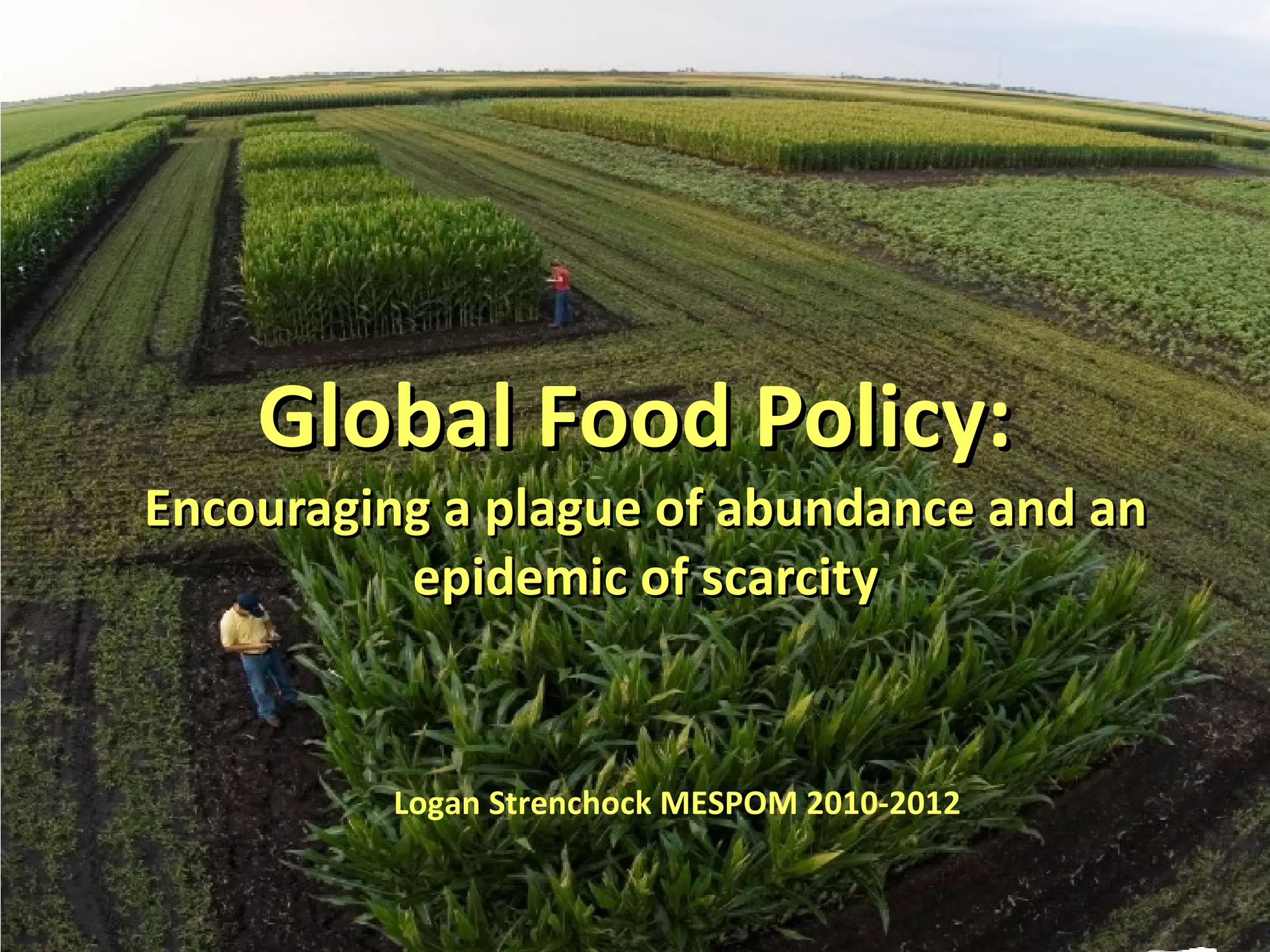
Global Food Policy:  Encouraging a plague of abundance and an epidemic of scarcity Logan Strenchock MESPOM 2010-2012
Aims: Identify social, environmental, economic costs of current system Highlight disparity in global food system Describe what lead us here Highlight what can be done to reduce hunger, support food sovereignty, and sustainably feed the world Make suggestions at a global, regional and personal level
Let’s take a trip around the world….
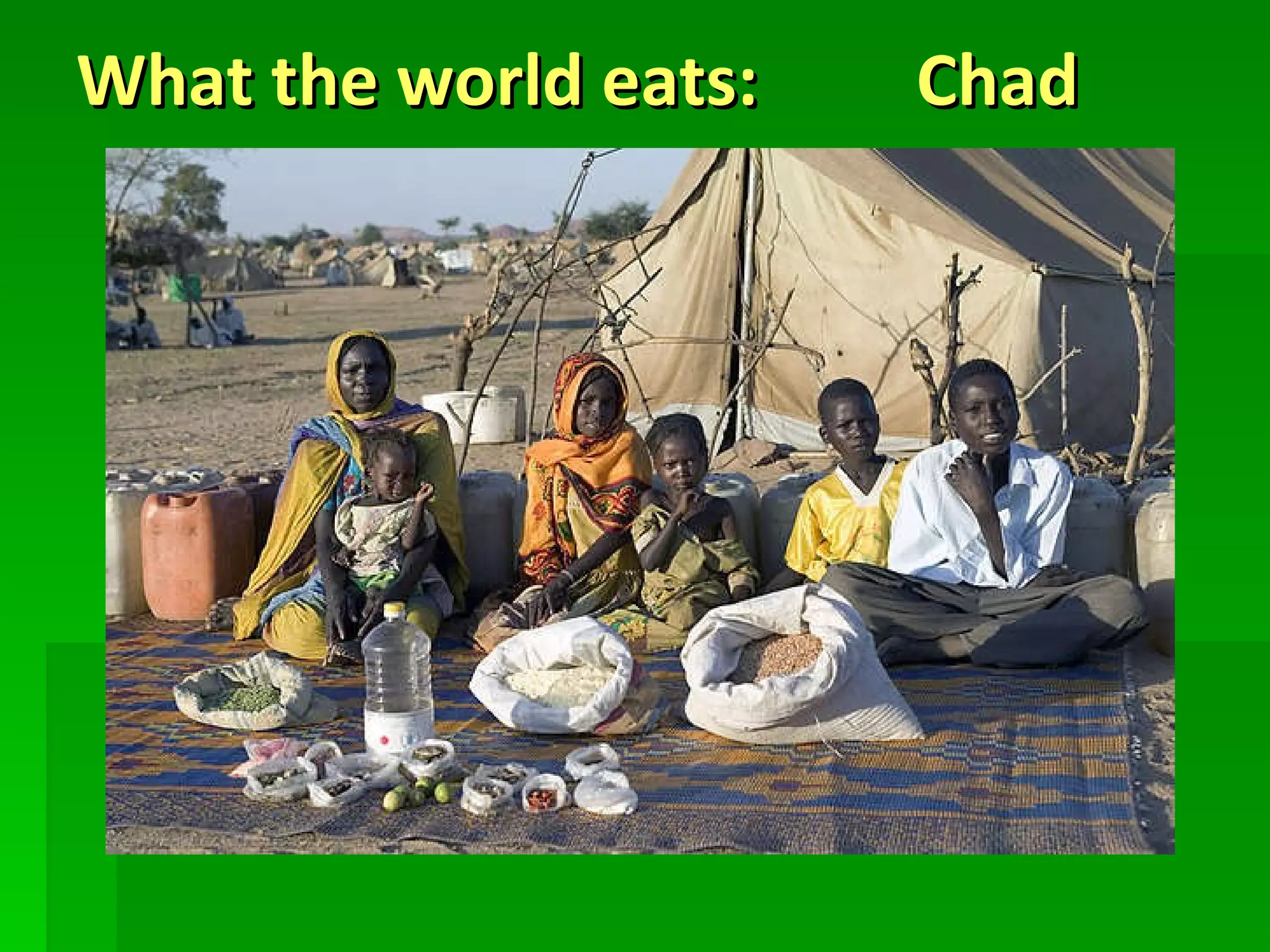
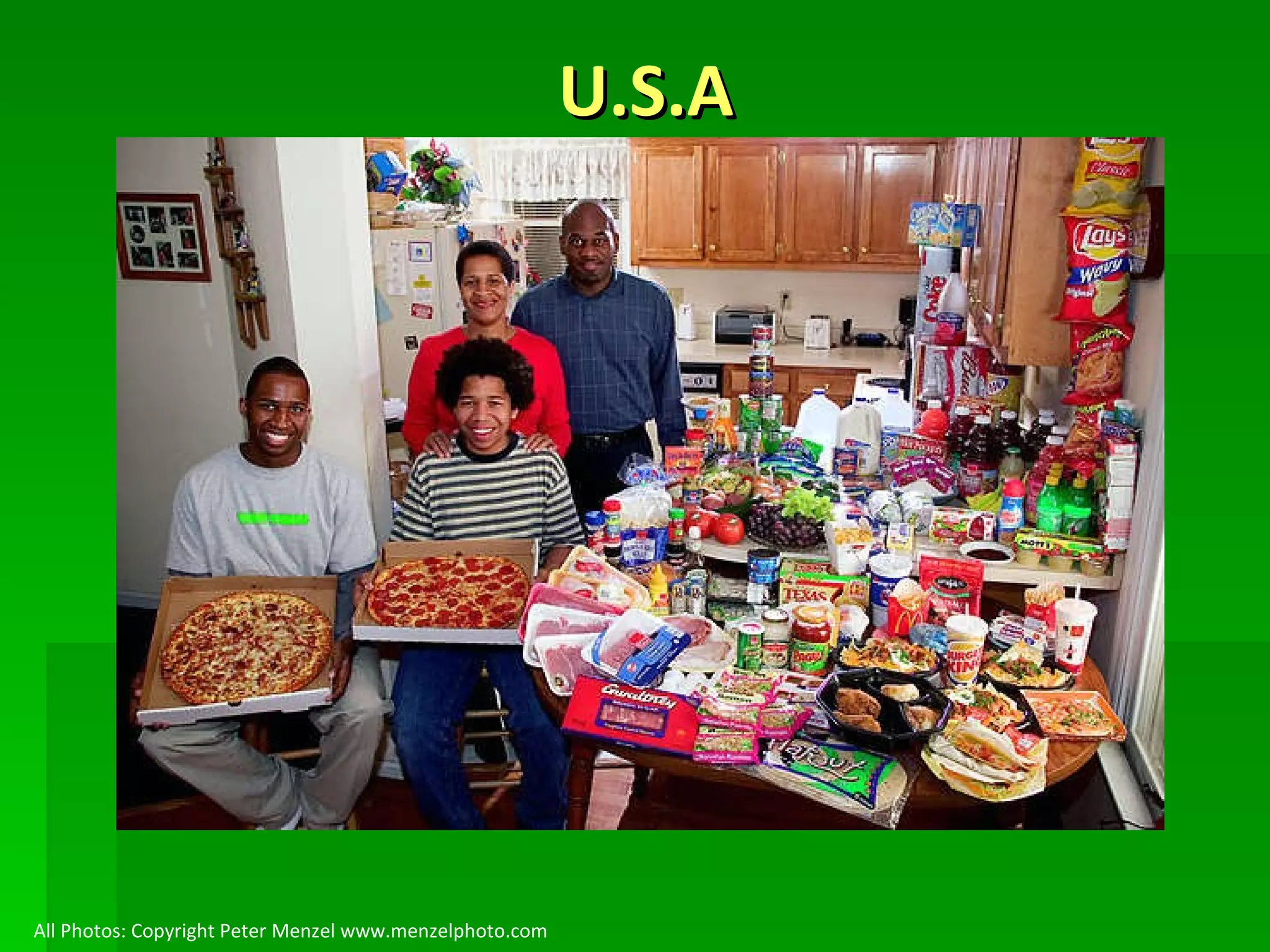
What the world eats:  Chad
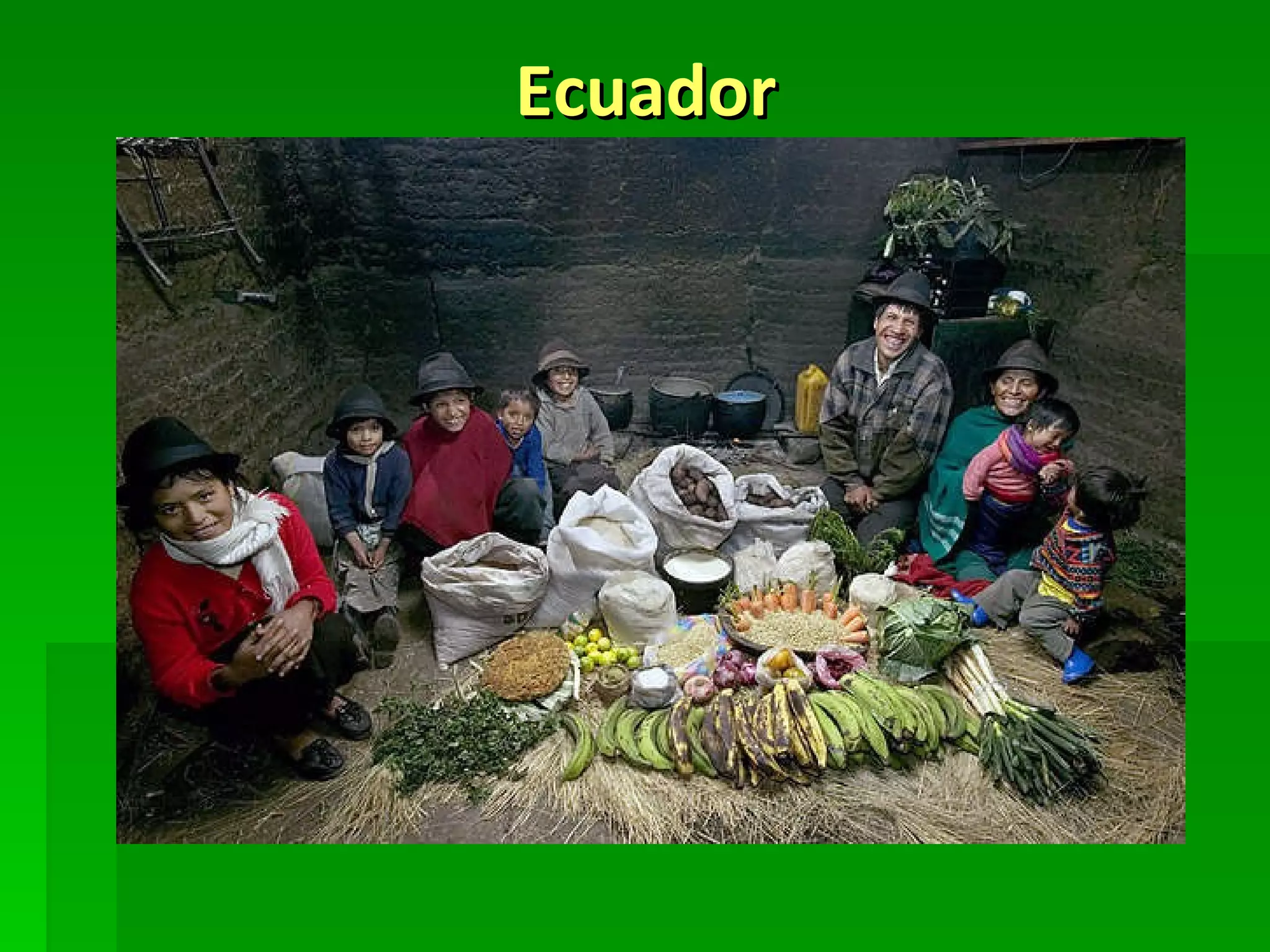
Ecuador
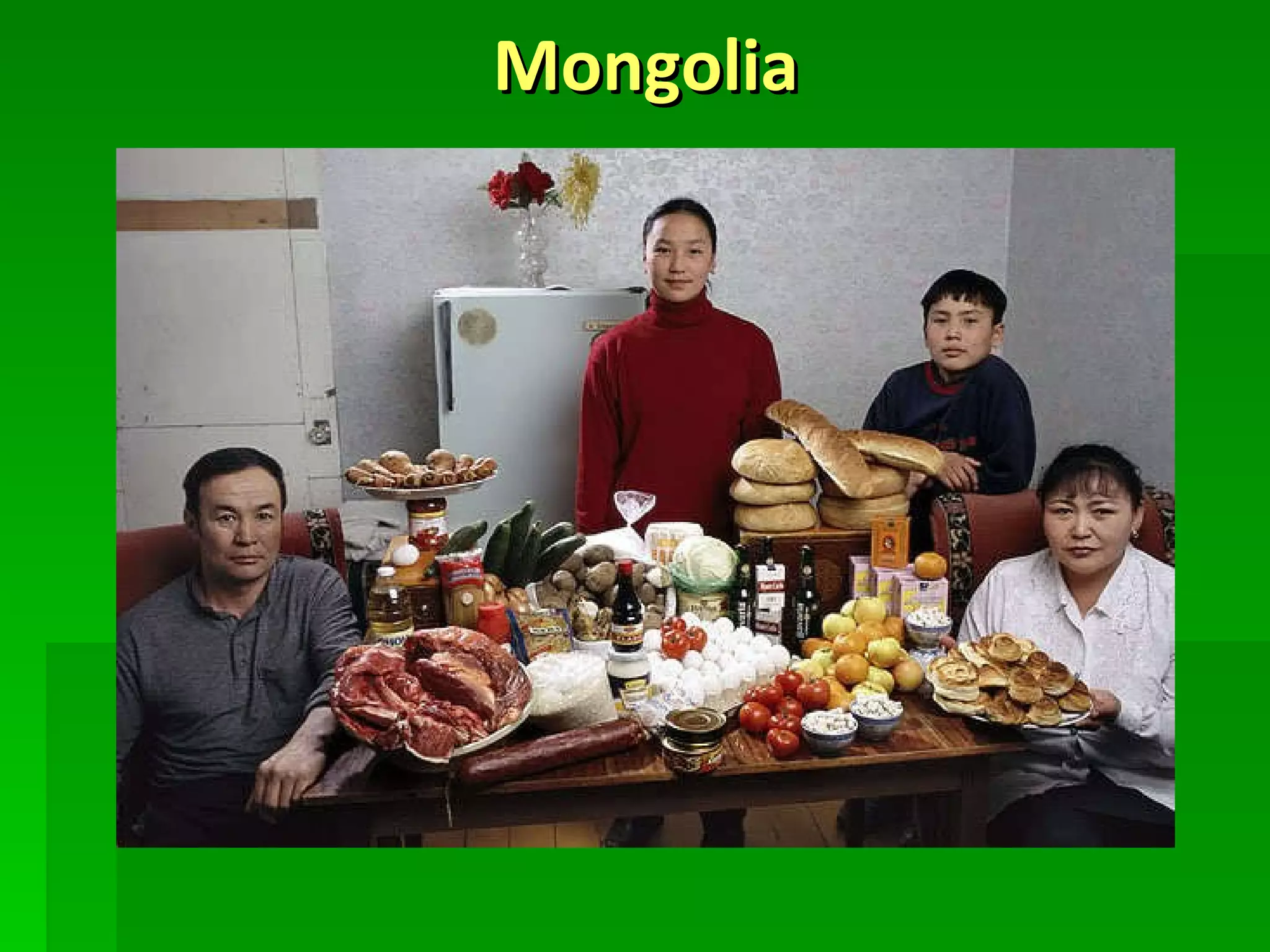
Mongolia
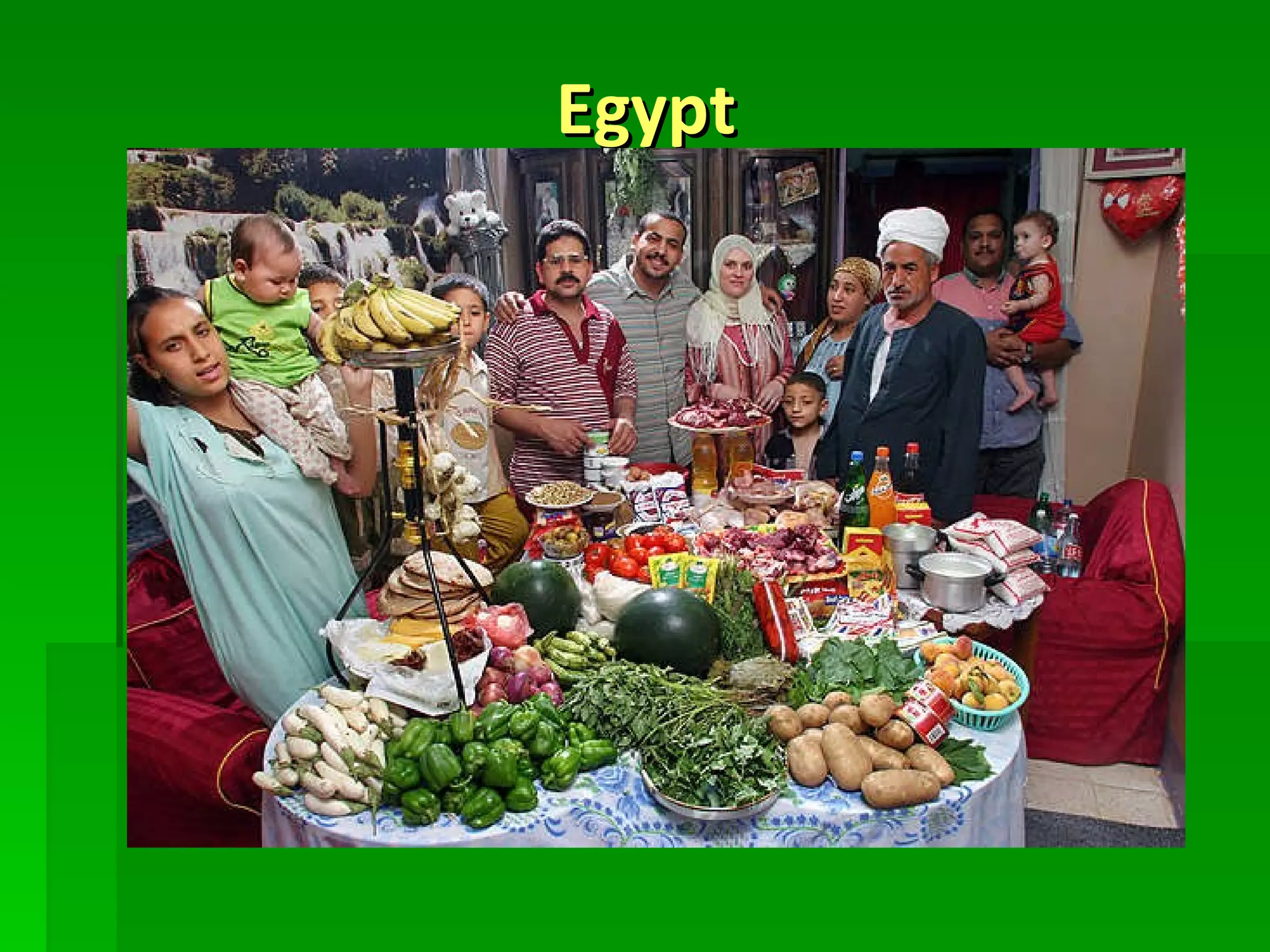
Egypt
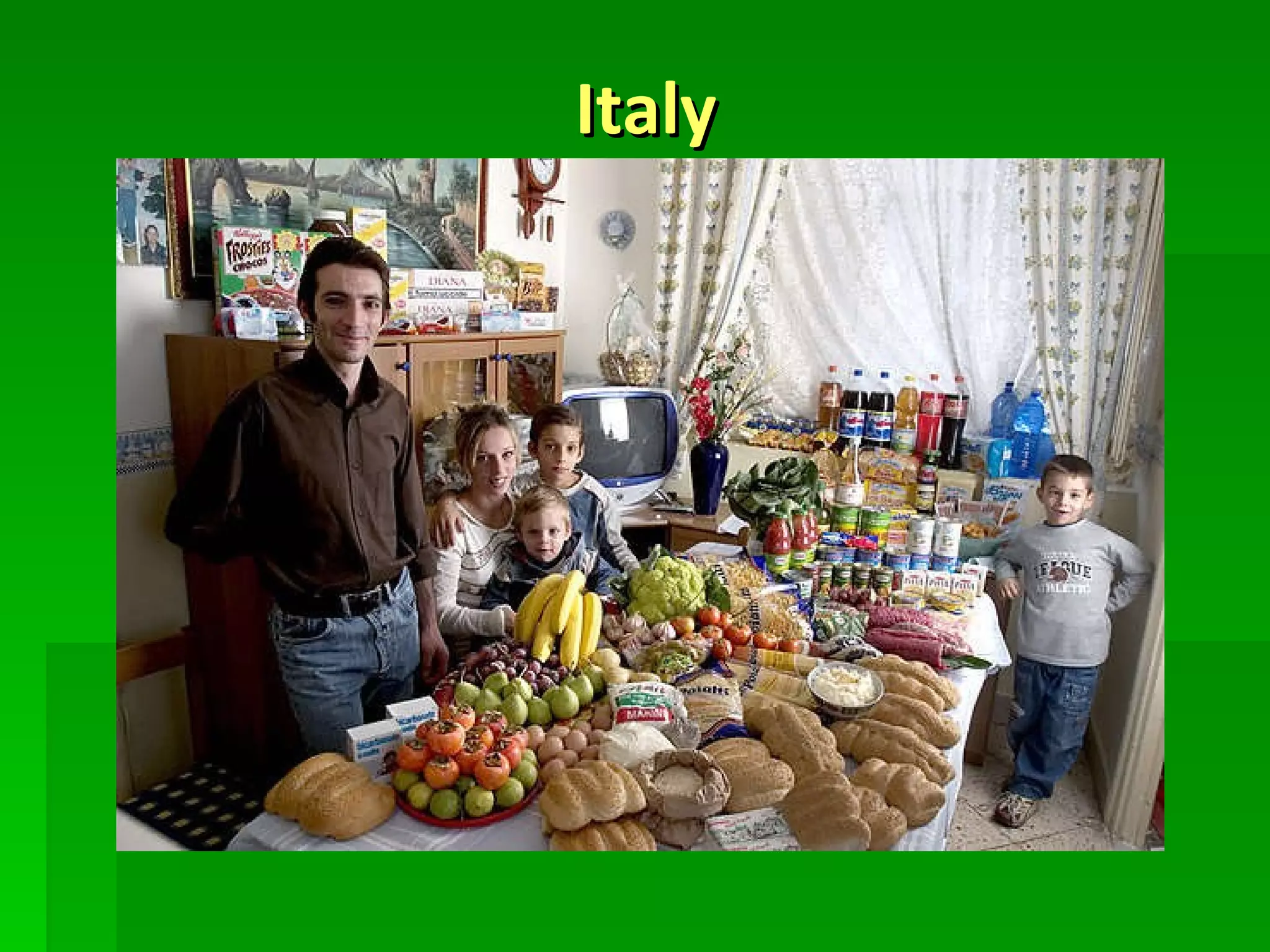
Italy
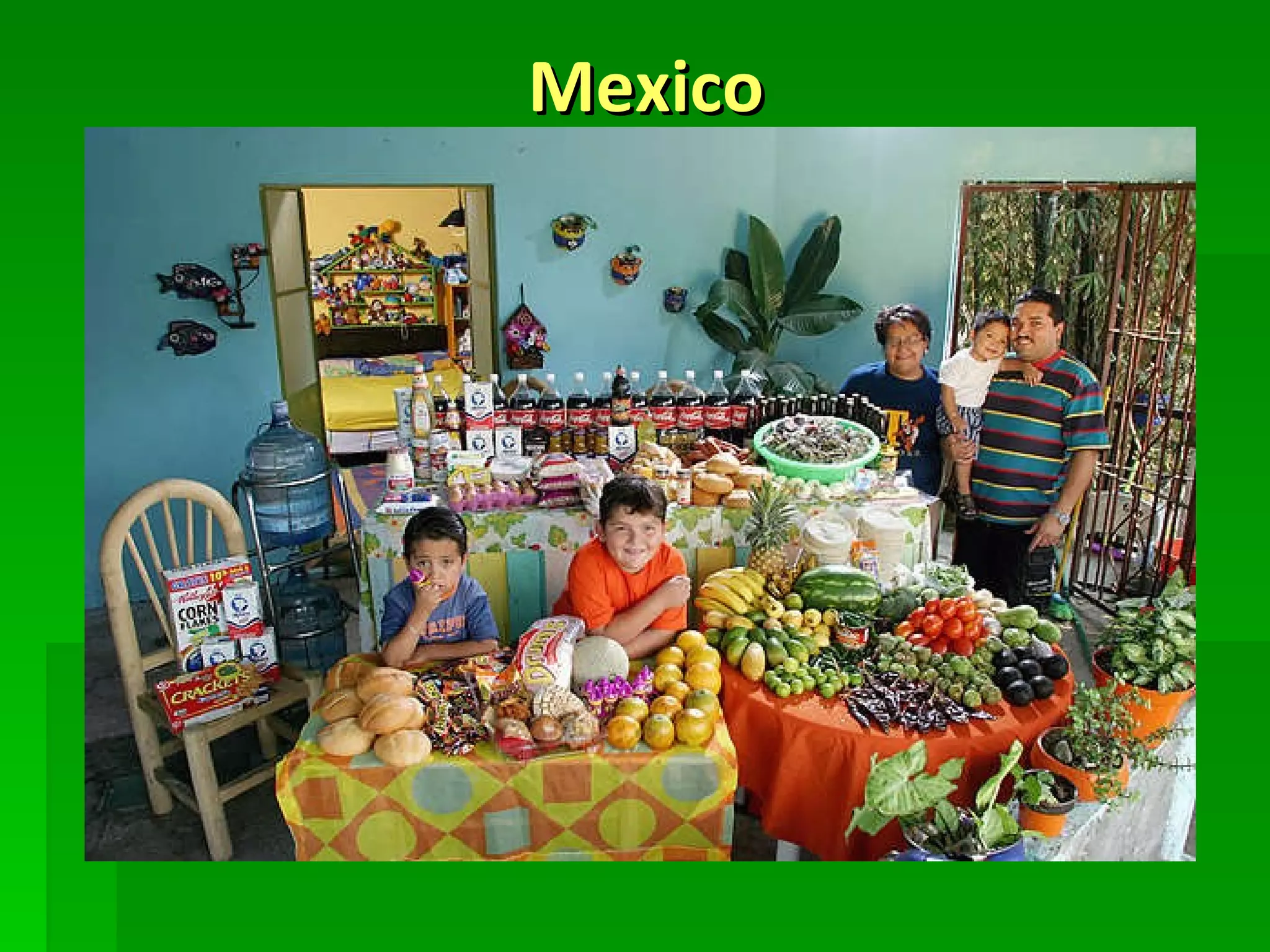
Mexico
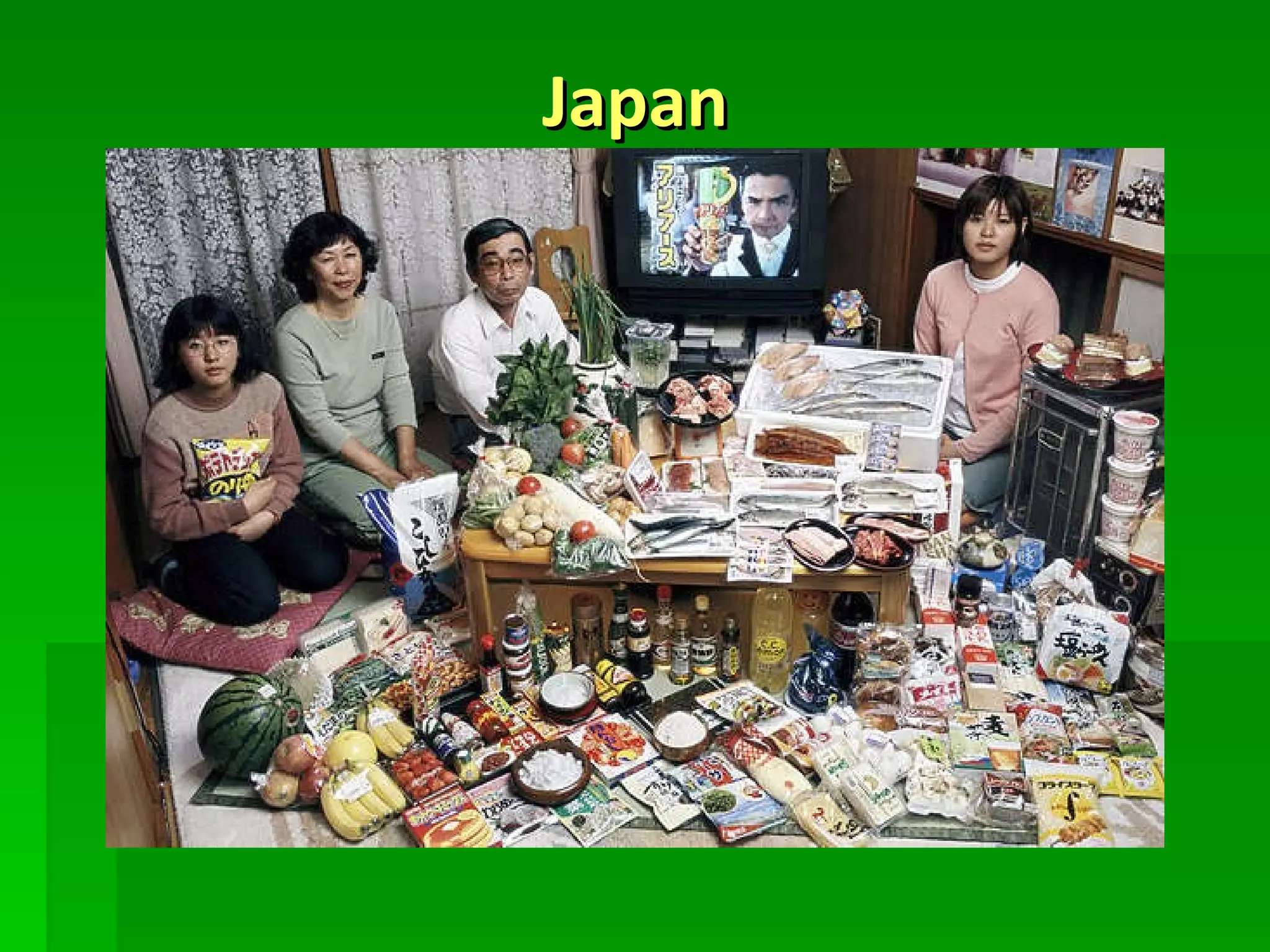
Japan
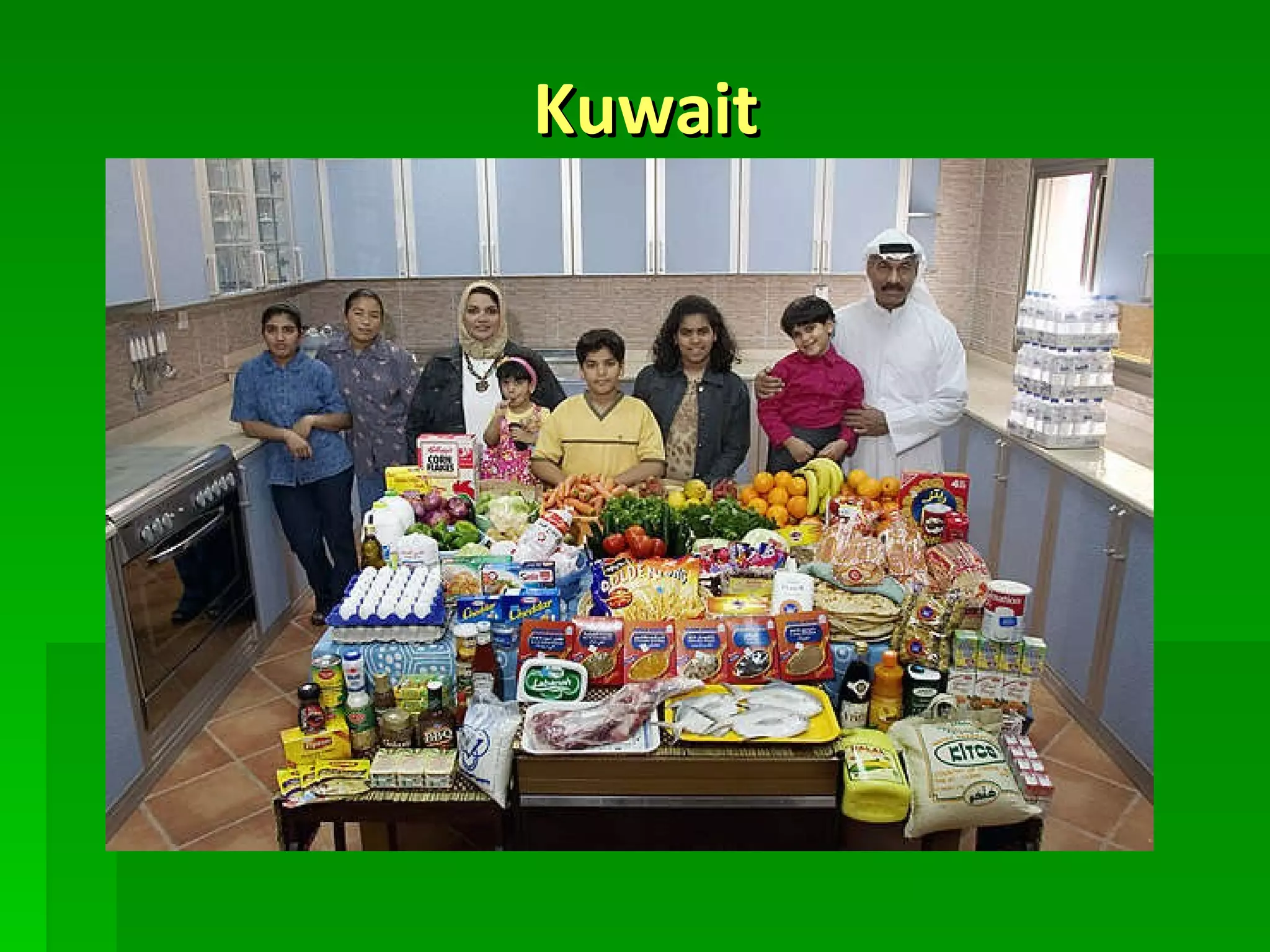
Kuwait
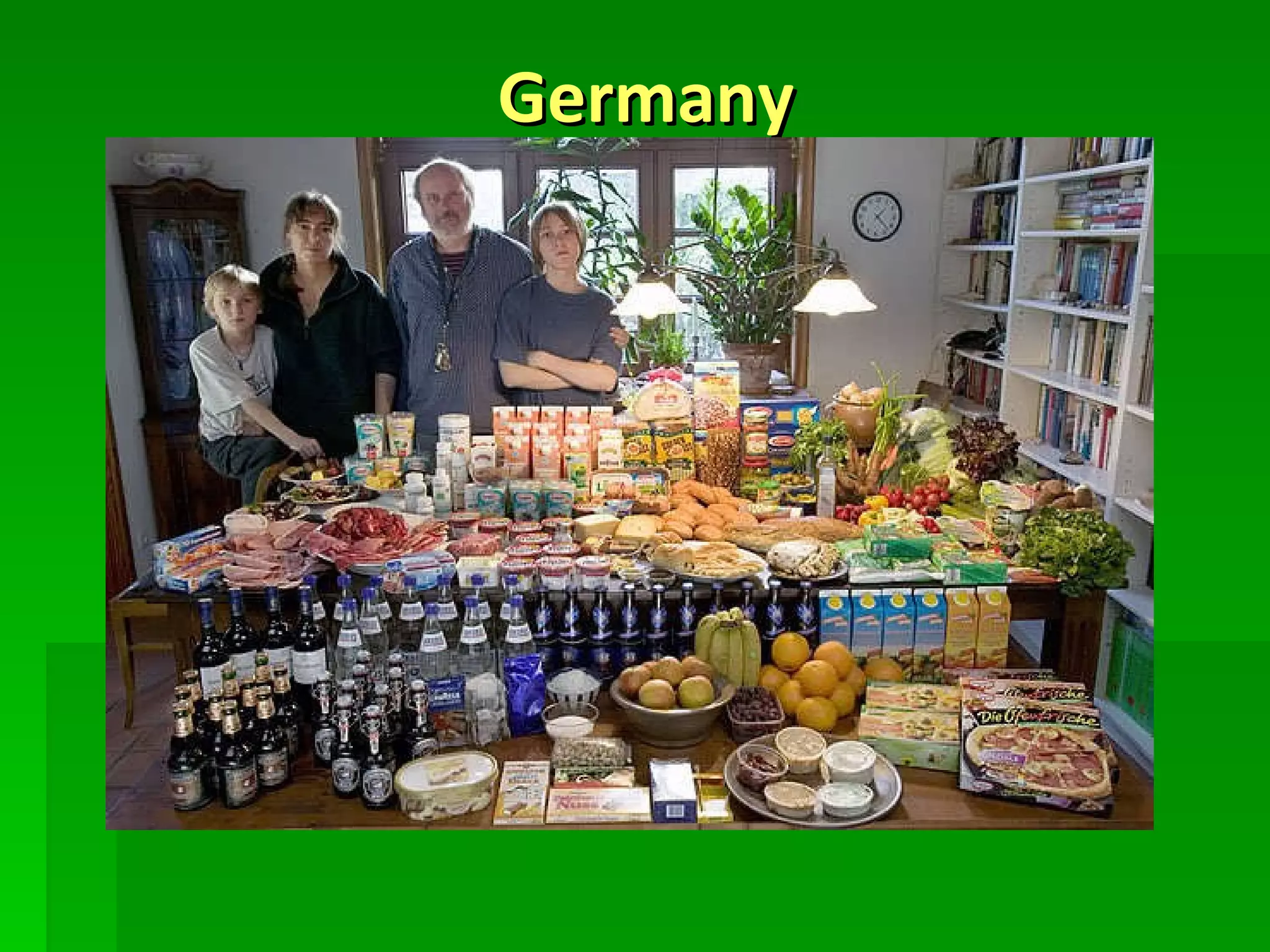
Germany
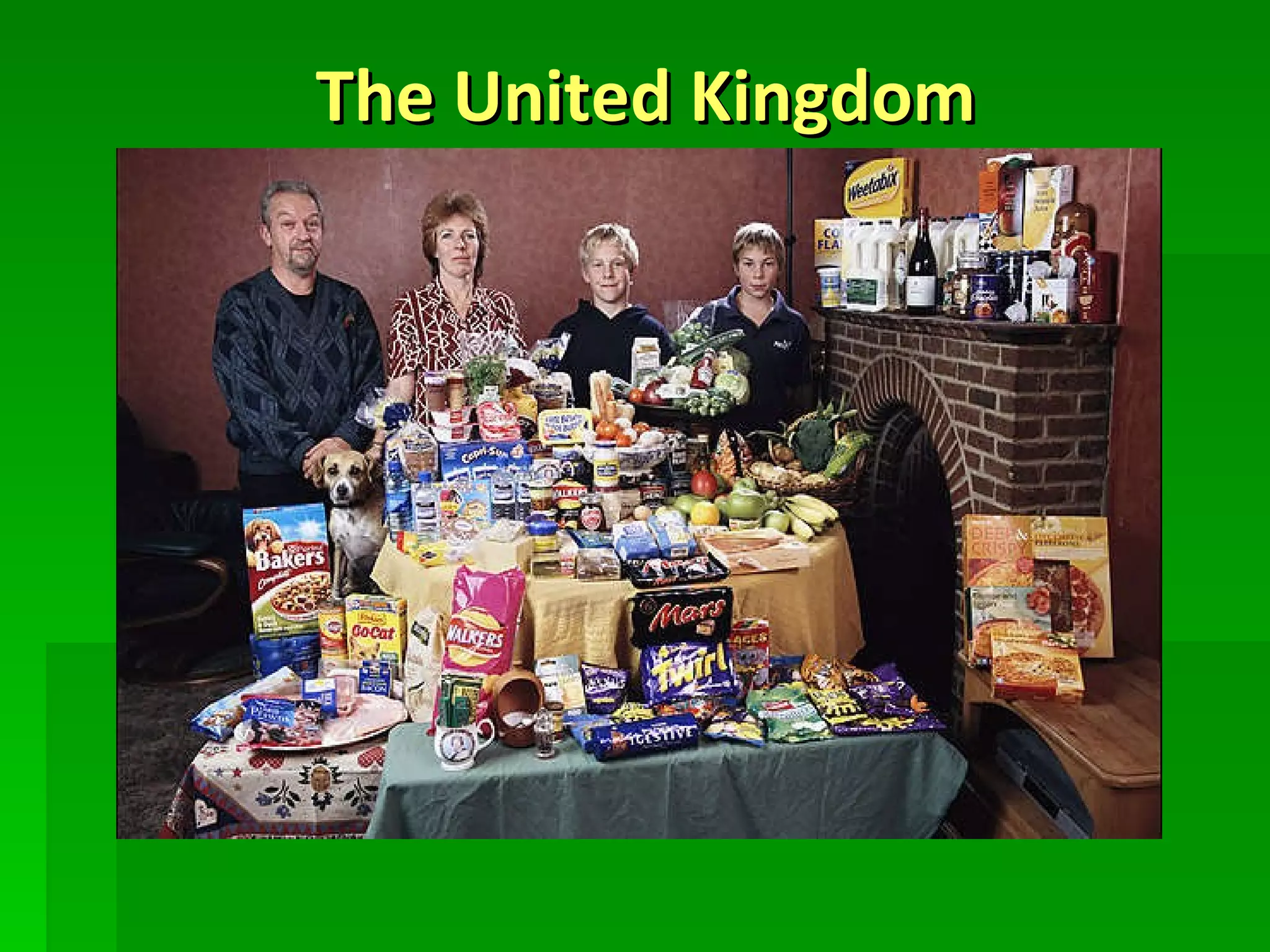
The United Kingdom
U.S.A All Photos: Copyright Peter Menzel www.menzelphoto.com
Can   you identify any trends? 3 P’s: Processing, Packaging, Prepared Industrial agriculture based products “ Food like items” delivered Fast Eating high on the food chain, high energy consumption How do you work this avocado? Food Disconnection
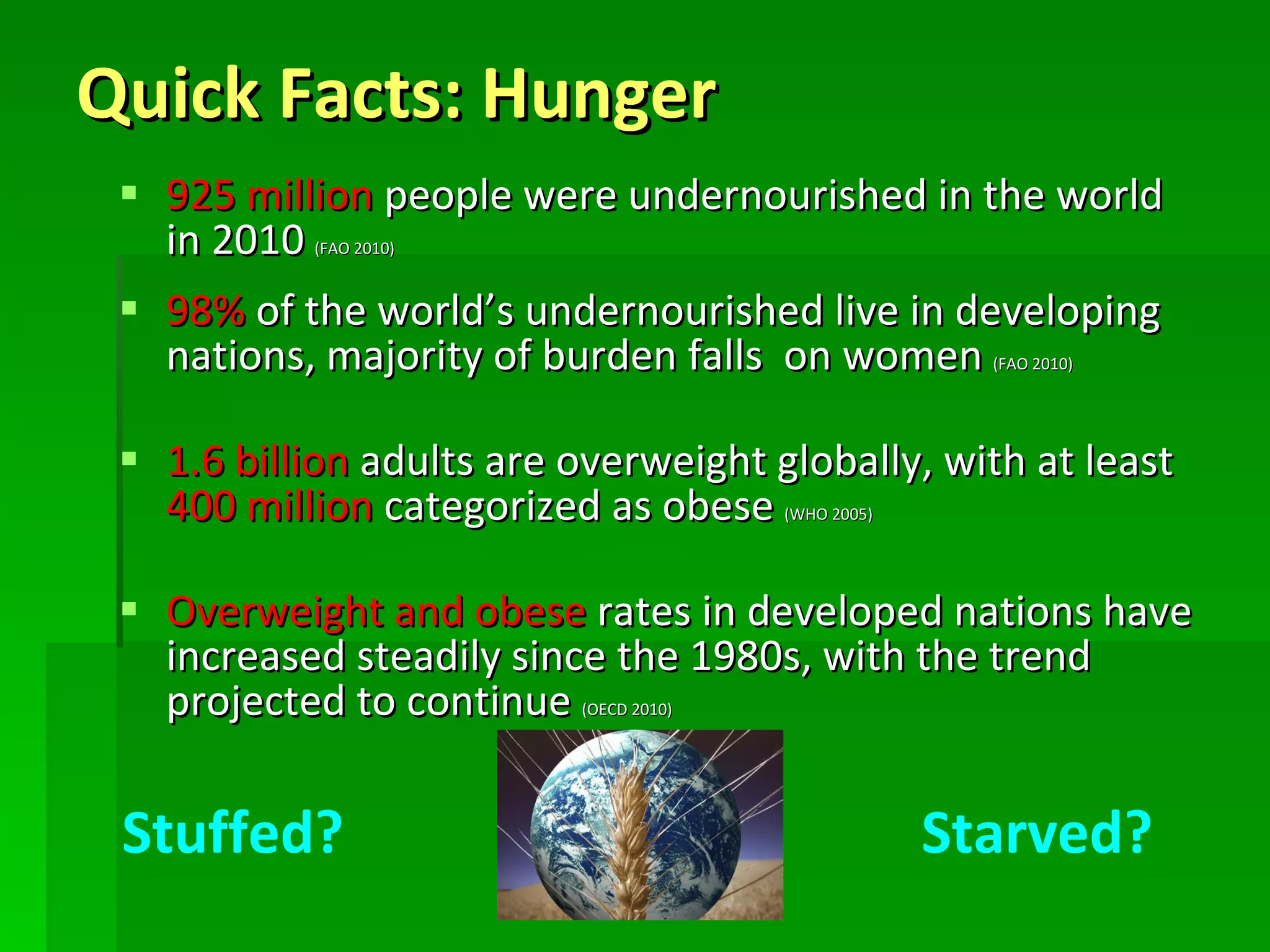
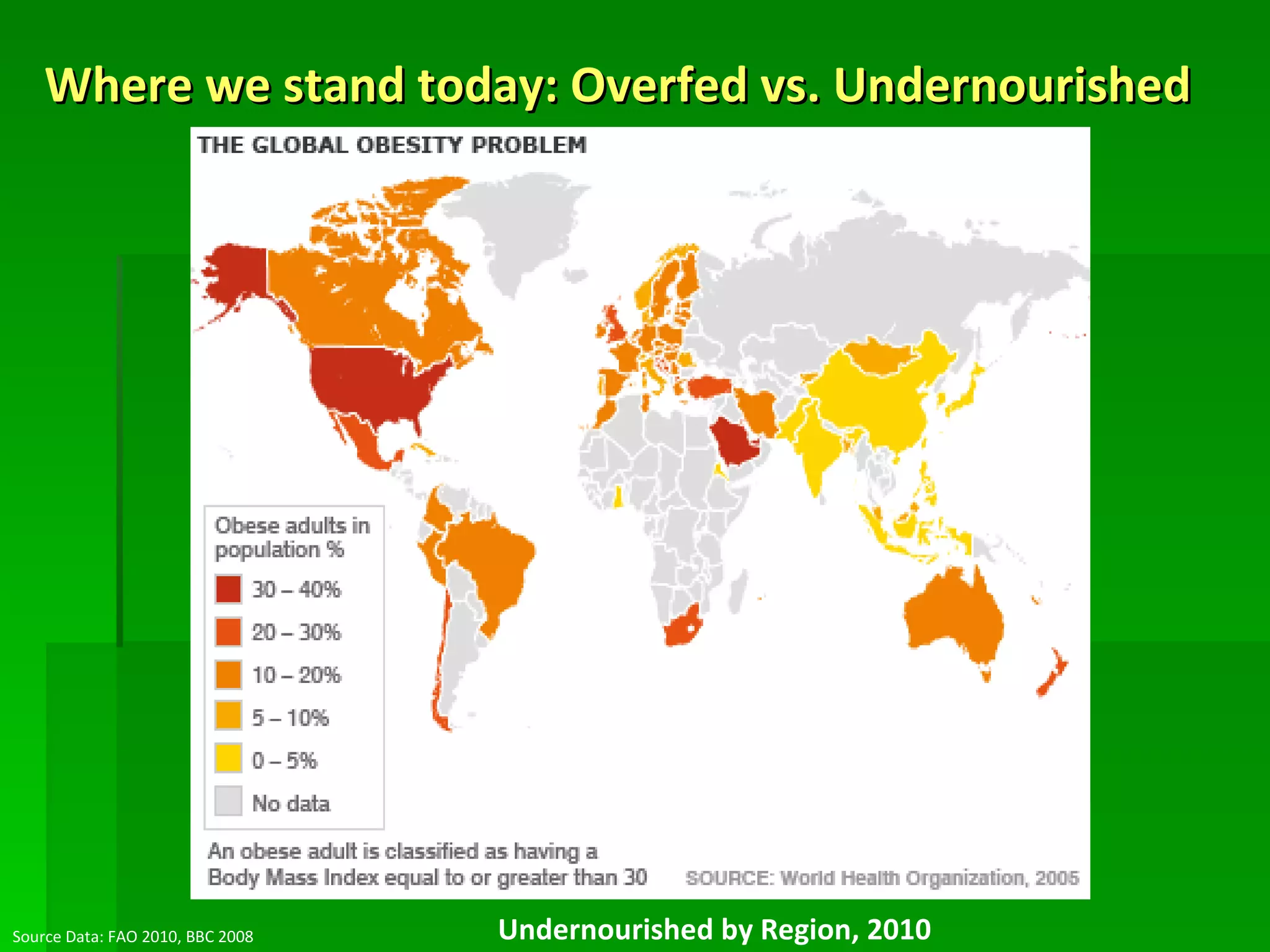
Quick Facts: Hunger 925 million  people were undernourished in the world in 2010  (FAO 2010) 98%  of the world’s undernourished live in developing nations, majority of burden falls  on women  (FAO 2010) 1.6 billion  adults are overweight globally, with at least  400 million  categorized as obese  (WHO 2005) Overweight and obese  rates in developed nations have increased steadily since the 1980s, with the trend projected to continue  (OECD 2010) Stuffed? Starved?
Quick Facts: Environment 13-18%  of the world’s greenhouse gas emissions are created by industrial agriculture  (Steinfeld et al. 2006) 50%  of all agricultural fertilizers end up in the atmosphere or local waterways  (Patel and Holt-Giminez 2009) 18%  of global greenhouse gas emissions are connected to agricultural deforestation  (Stern 2007) 60-70%  of our fresh water supply is used for agriculture  (FAO 2008) 26%  of land mass is utilized for agricultural production and pasture grazing  (BBC 2008) ¾  of genetic diversity of crops has been lost in the last 100 years  (IRIN  2009)
Where we stand today: Overfed vs. Undernourished   Source Data: FAO 2010, BBC 2008 Undernourished by Region, 2010
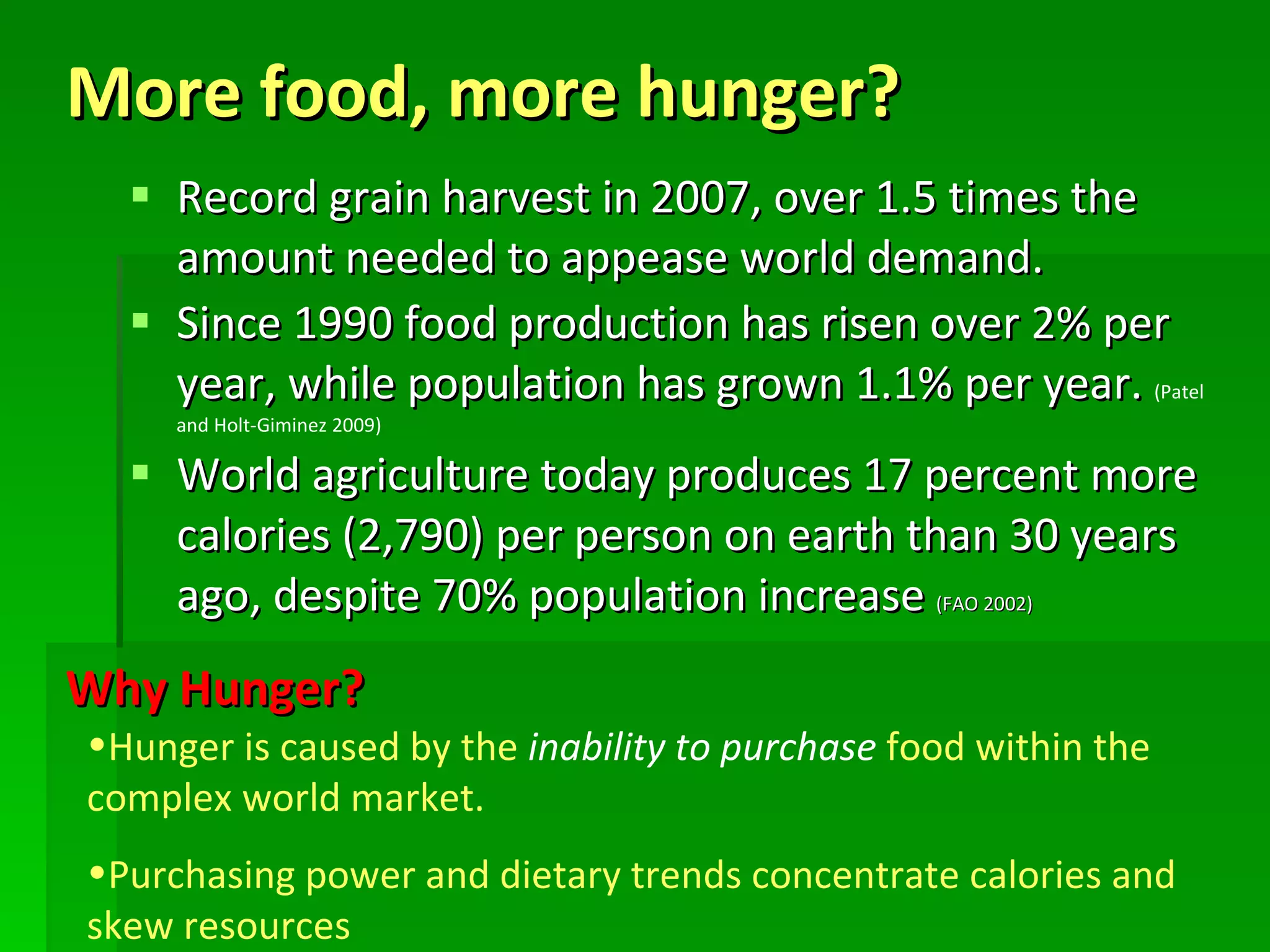
More food, more hunger?  Record grain harvest in 2007, over 1.5 times the amount needed to appease world demand. Since 1990 food production has risen over 2% per year, while population has grown 1.1% per year.  (Patel and Holt-Giminez 2009) World agriculture today produces 17 percent more calories (2,790) per person on earth than 30 years ago, despite 70% population increase  (FAO 2002) Hunger is caused by the  inability to purchase  food within the complex world market.  Purchasing power and dietary trends concentrate calories and skew resources Why Hunger?
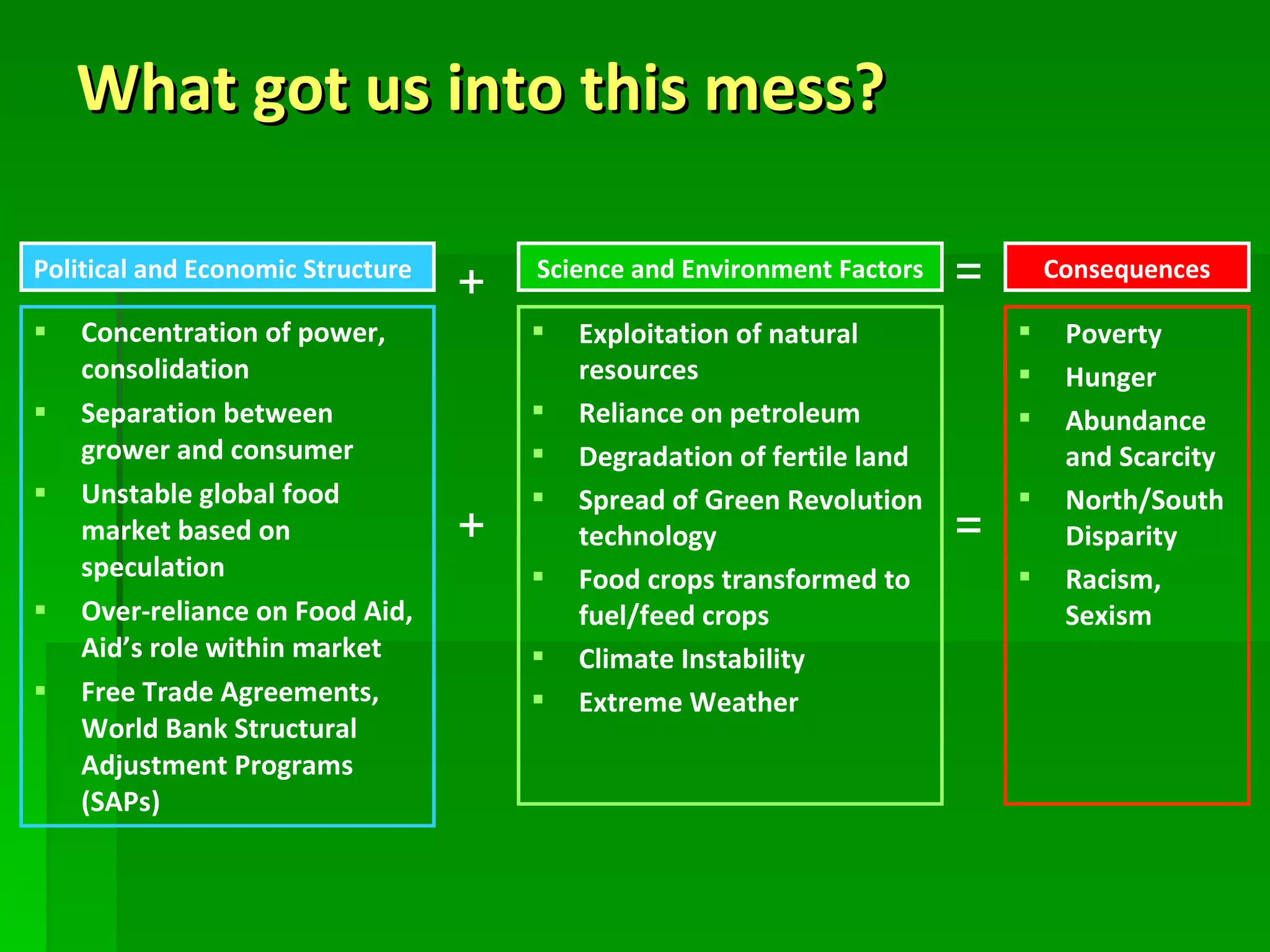
What got us into this mess? Concentration of power, consolidation Separation between grower and consumer Unstable global food market based on speculation Over-reliance on Food Aid, Aid’s role within market Free Trade Agreements, World Bank Structural Adjustment Programs (SAPs) Political and Economic Structure Exploitation of natural resources Reliance on petroleum Degradation of fertile land Spread of Green Revolution technology Food crops transformed to fuel/feed crops Climate Instability Extreme Weather Science and Environment Factors Consequences Poverty Hunger Abundance and Scarcity North/South Disparity Racism, Sexism + + = =
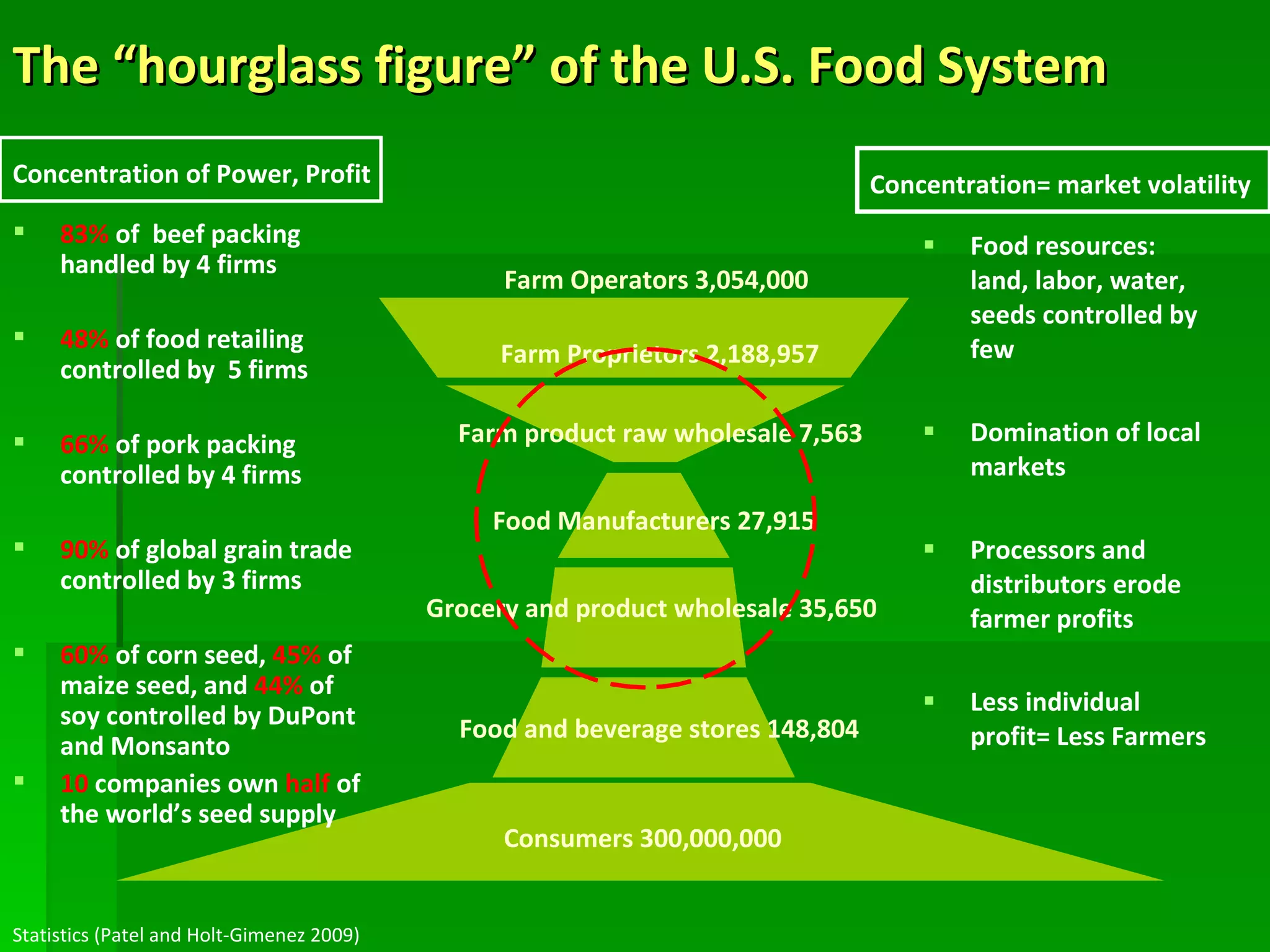
The “hourglass figure” of the U.S. Food System Food resources: land, labor, water, seeds controlled by few Domination of local markets Processors and distributors erode farmer profits Less individual profit= Less Farmers Farm Operators 3,054,000 Farm Proprietors 2,188,957 Consumers 300,000,000 Grocery and product wholesale 35,650 Food Manufacturers 27,915 Farm product raw wholesale 7,563 Food and beverage stores 148,804 Statistics (Patel and Holt-Gimenez 2009) 83%  of  beef packing handled by 4 firms 48%  of food retailing controlled by  5 firms 66%  of pork packing controlled by 4 firms 90%  of global grain trade controlled by 3 firms 60%  of corn seed,  45%  of maize seed, and  44%  of soy controlled by DuPont and Monsanto 10  companies own  half  of the world’s seed supply Concentration of Power, Profit Concentration= market volatility
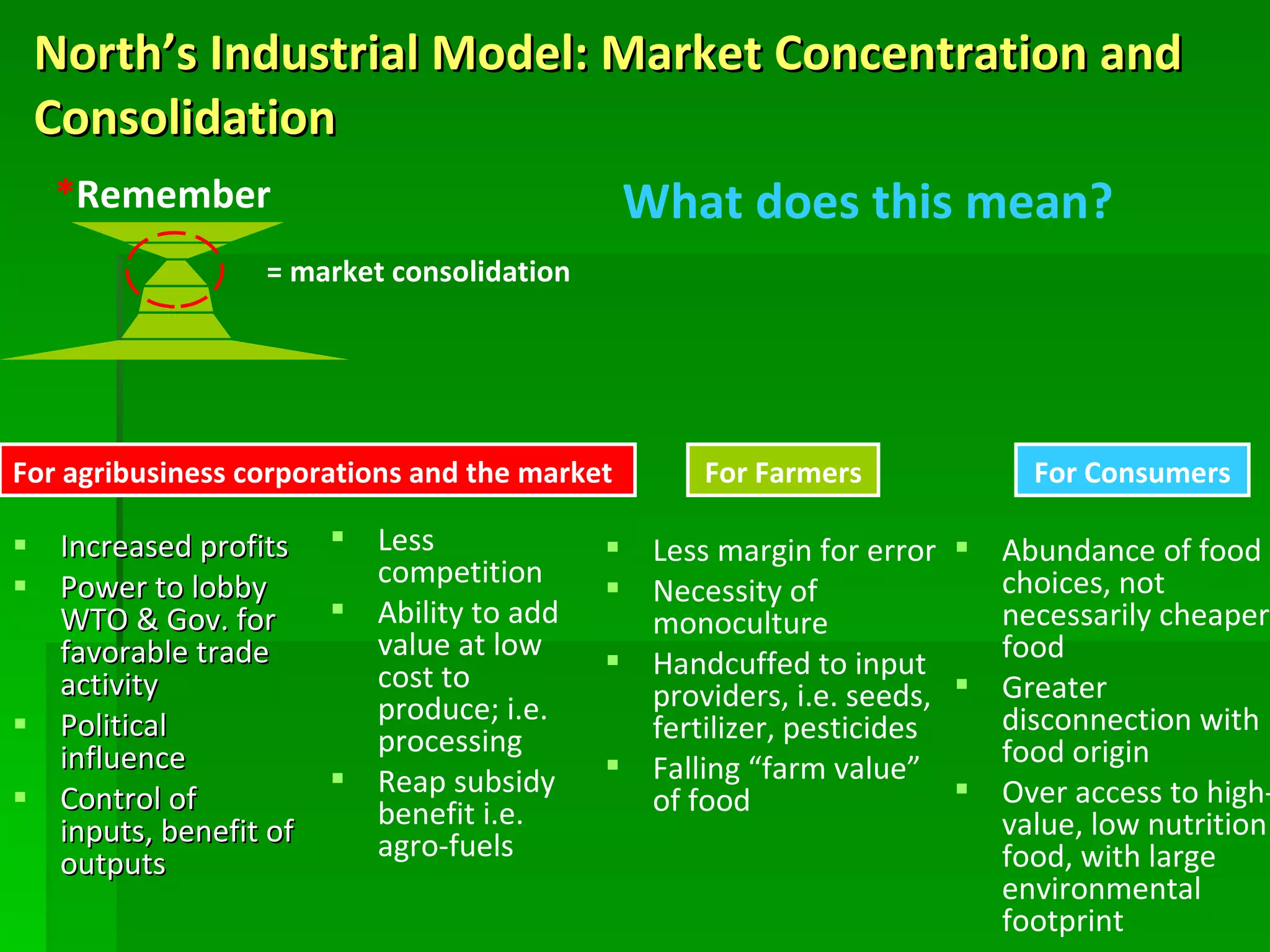
North’s Industrial Model: Market Concentration and Consolidation Increased profits Power to lobby WTO & Gov. for favorable trade activity Political influence Control of inputs, benefit of outputs Less competition Ability to add value at low cost to produce; i.e. processing Reap subsidy benefit i.e. agro-fuels Less margin for error Necessity of monoculture Handcuffed to input providers, i.e. seeds, fertilizer, pesticides Falling “farm value” of food Abundance of food choices, not necessarily cheaper food Greater disconnection with food origin Over access to high-value, low nutrition food, with large environmental footprint What does this mean? For agribusiness corporations and the market For Farmers For Consumers * Remember = market consolidation
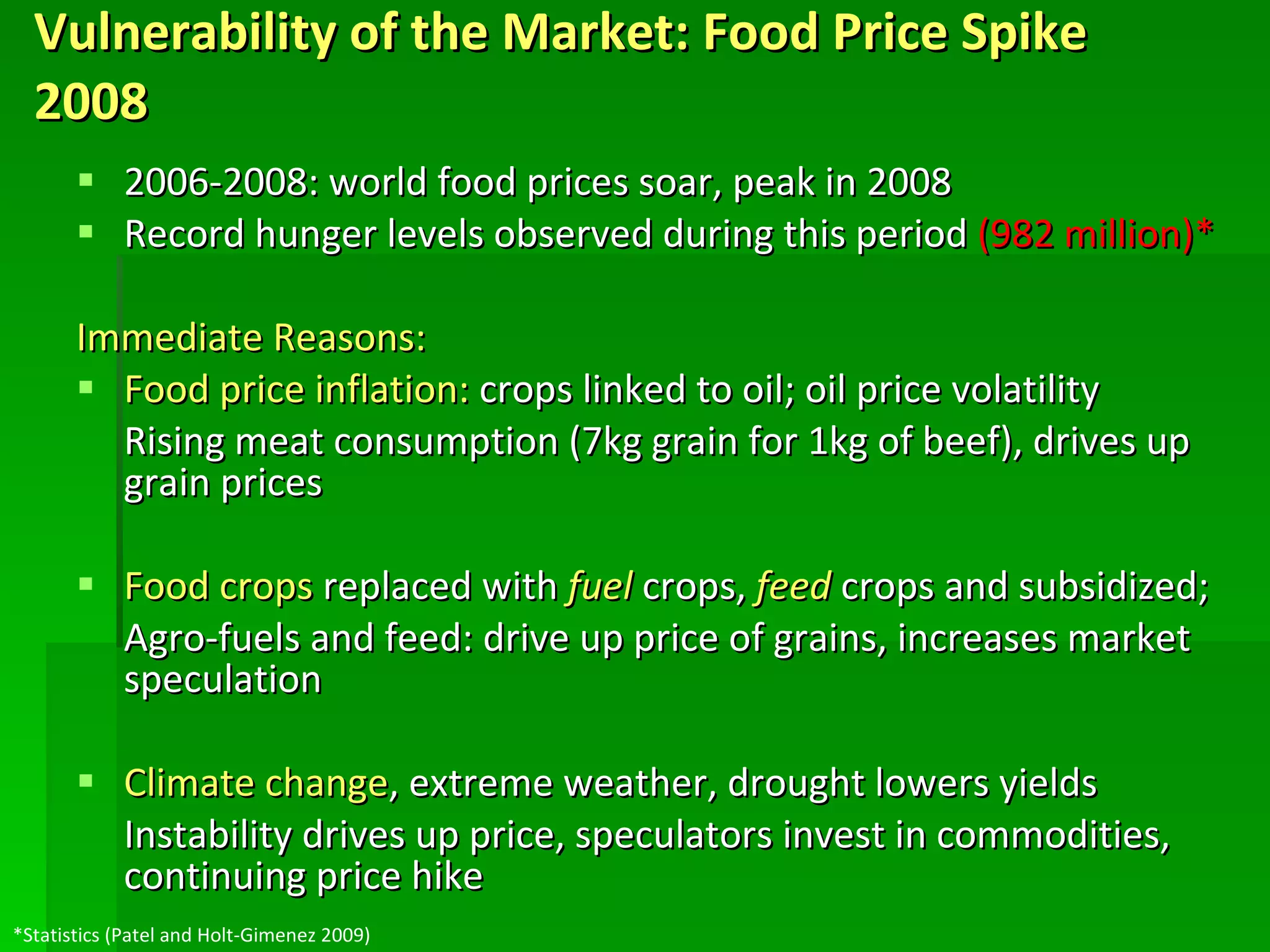
Vulnerability of the Market: Food Price Spike 2008   2006-2008: world food prices soar, peak in 2008 Record hunger levels observed during this period  (982 million)* Immediate Reasons: Food price inflation:  crops linked to oil; oil price volatility  Rising meat consumption (7kg grain for 1kg of beef), drives up grain prices Food crops  replaced with  fuel  crops,  feed  crops and subsidized; Agro-fuels and feed: drive up price of grains, increases market speculation Climate change , extreme weather, drought lowers yields Instability drives up price, speculators invest in commodities, continuing price hike *Statistics (Patel and Holt-Gimenez 2009)
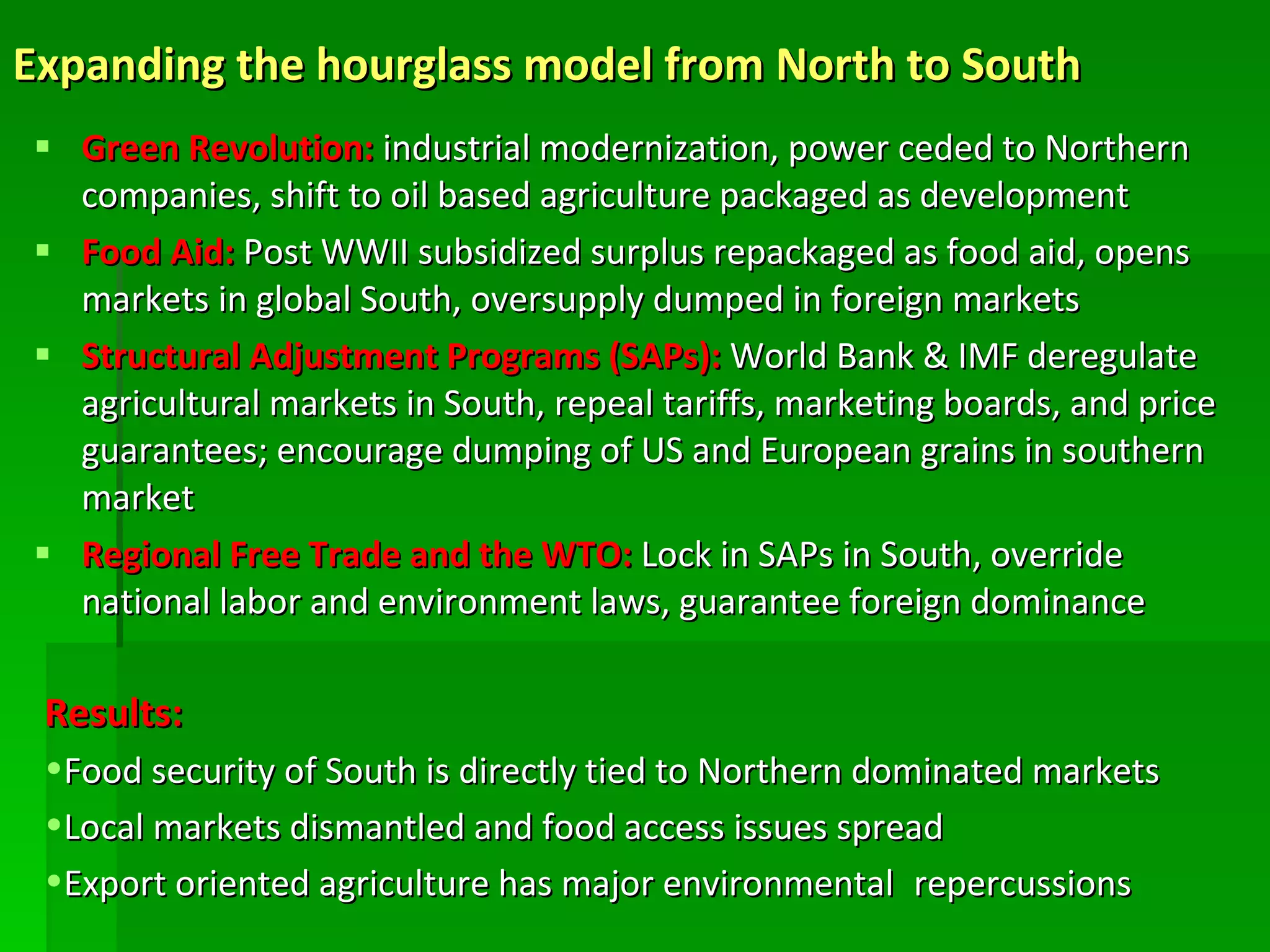
Expanding the hourglass model from North to South   Green Revolution:  industrial modernization, power ceded to Northern companies, shift to oil based agriculture packaged as development Food Aid:  Post WWII subsidized surplus repackaged as food aid, opens markets in global South, oversupply dumped in foreign markets Structural Adjustment Programs (SAPs):  World Bank & IMF deregulate agricultural markets in South, repeal tariffs, marketing boards, and price guarantees; encourage dumping of US and European grains in southern market Regional Free Trade and the WTO:   Lock in SAPs in South, override national labor and environment laws, guarantee foreign dominance Results: Food security of South is directly tied to Northern dominated markets Local markets dismantled and food access issues spread  Export oriented agriculture has major environmental   repercussions
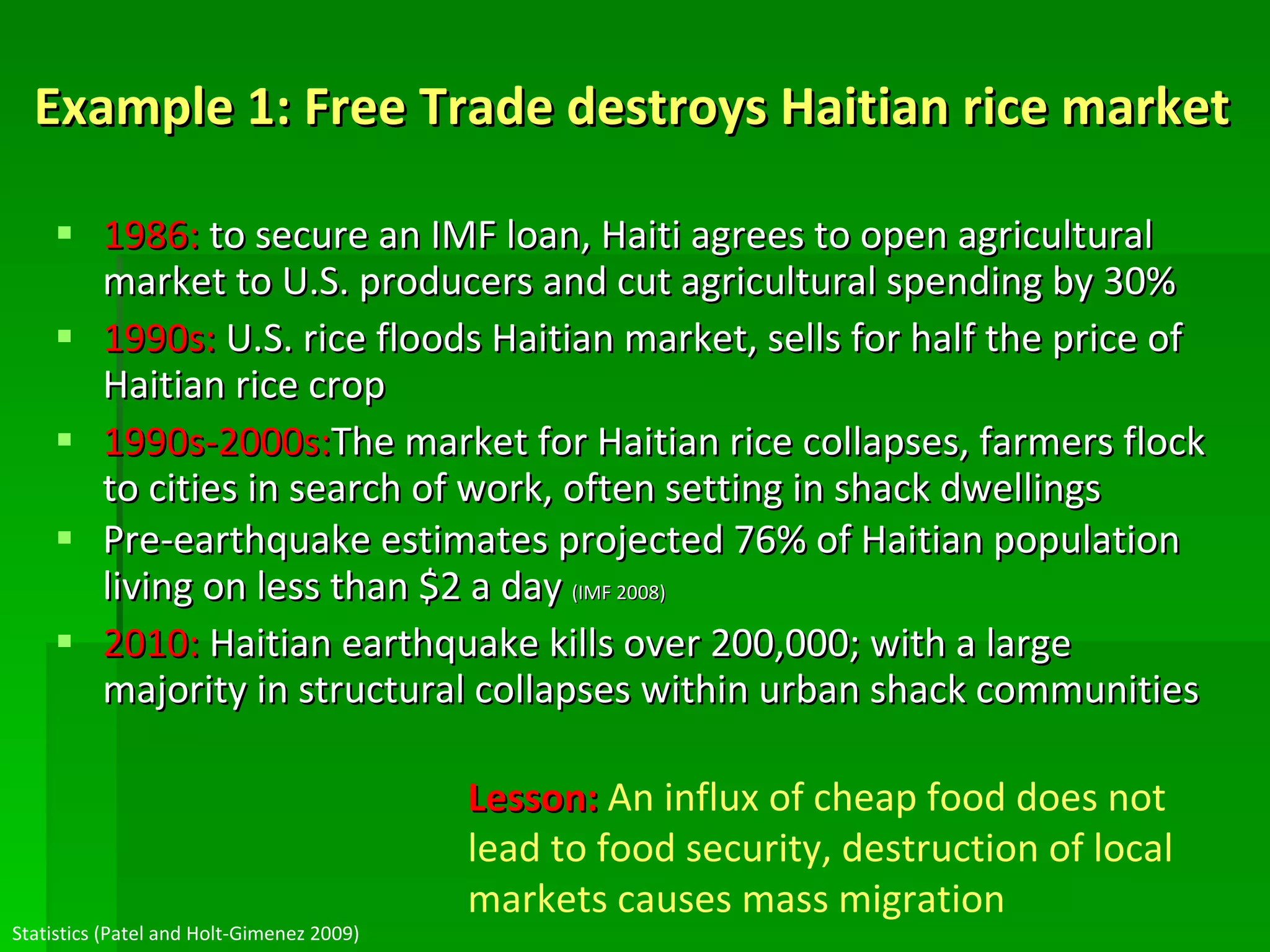
Example 1: Free Trade destroys Haitian rice market 1986:  to secure an IMF loan, Haiti agrees to open agricultural market to U.S. producers and cut agricultural spending by 30% 1990s:  U.S. rice floods Haitian market, sells for half the price of Haitian rice crop 1990s-2000s: The market for Haitian rice collapses, farmers flock to cities in search of work, often setting in shack dwellings Pre-earthquake estimates projected 76% of Haitian population living on less than $2 a day  (IMF 2008) 2010:  Haitian earthquake kills over 200,000; with a large majority in structural collapses within urban shack communities Statistics (Patel and Holt-Gimenez 2009) Lesson:   An influx of cheap food does not lead to food security, destruction of local markets causes mass migration
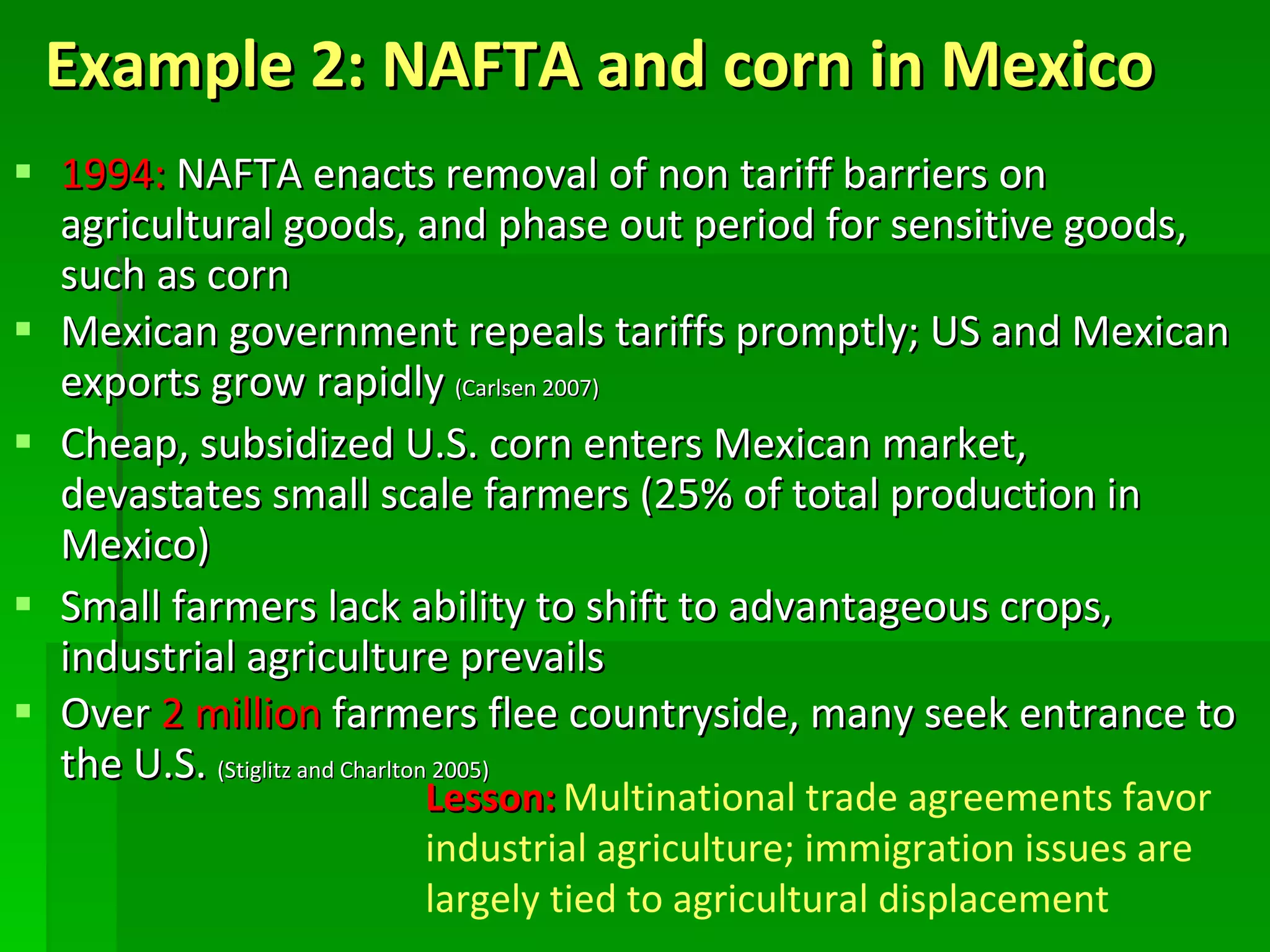
Example 2: NAFTA and corn in Mexico 1994:  NAFTA enacts removal of non tariff barriers on agricultural goods, and phase out period for sensitive goods, such as corn Mexican government repeals tariffs promptly; US and Mexican exports grow rapidly  (Carlsen 2007) Cheap, subsidized U.S. corn enters Mexican market, devastates small scale farmers (25% of total production in Mexico) Small farmers lack ability to shift to advantageous crops, industrial agriculture prevails Over  2 million  farmers flee countryside, many seek entrance to the U.S.  (Stiglitz and Charlton 2005) Lesson:   Multinational trade agreements favor industrial agriculture; immigration issues are largely tied to agricultural displacement
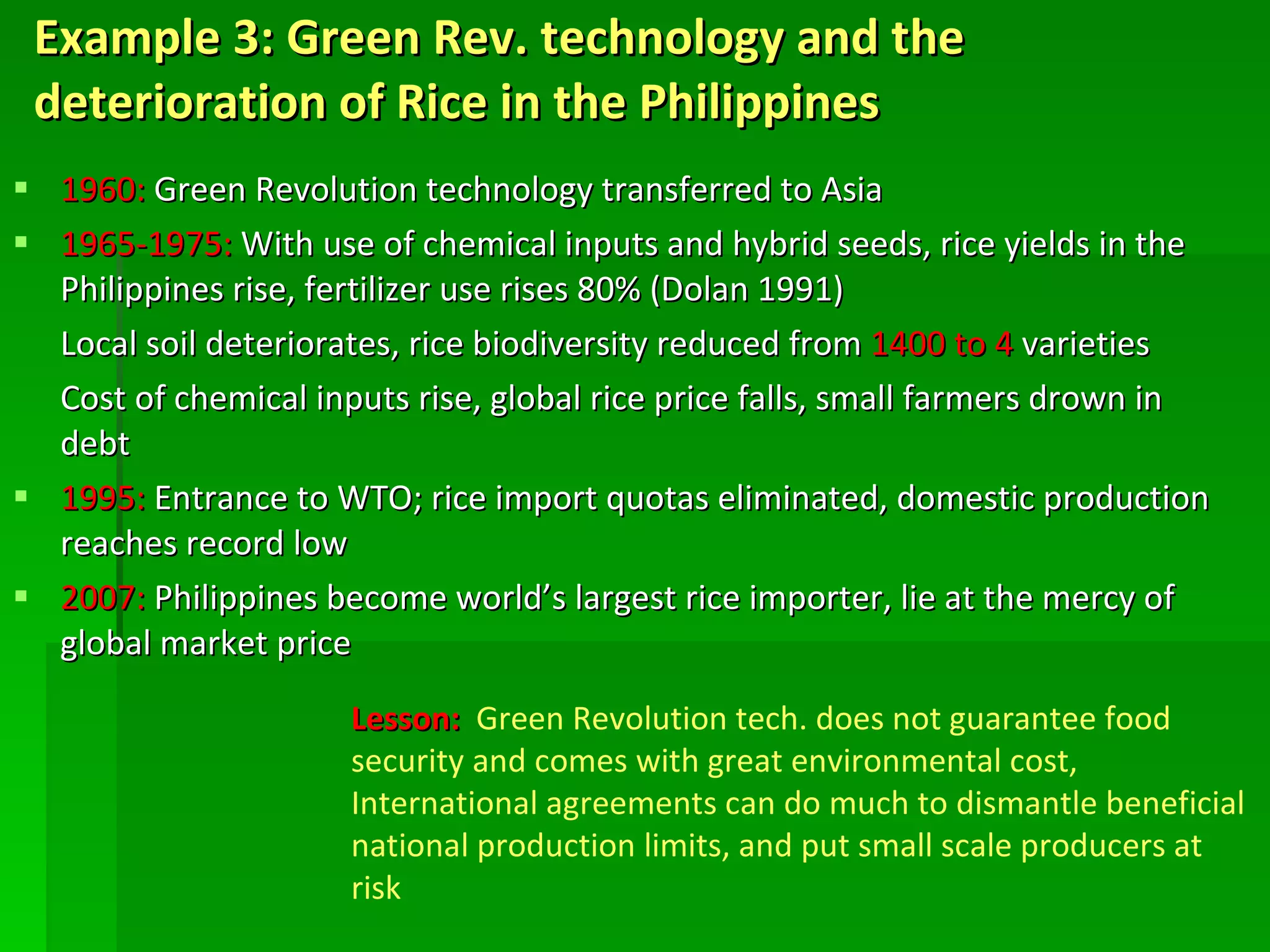
Example 3: Green Rev. technology and the deterioration of Rice in the Philippines  1960:  Green Revolution technology transferred to Asia 1965-1975:  With use of chemical inputs and hybrid seeds, rice yields in the Philippines rise, fertilizer use rises 80% (Dolan 1991) Local soil deteriorates, rice biodiversity reduced from  1400 to 4  varieties Cost of chemical inputs rise, global rice price falls, small farmers drown in debt 1995:  Entrance to WTO; rice import quotas eliminated, domestic production reaches record low 2007:  Philippines become world’s largest rice importer, lie at the mercy of global market price   Lesson:  Green Revolution tech. does not guarantee food security and comes with great environmental cost, International agreements can do much to dismantle beneficial national production limits, and put small scale producers at risk
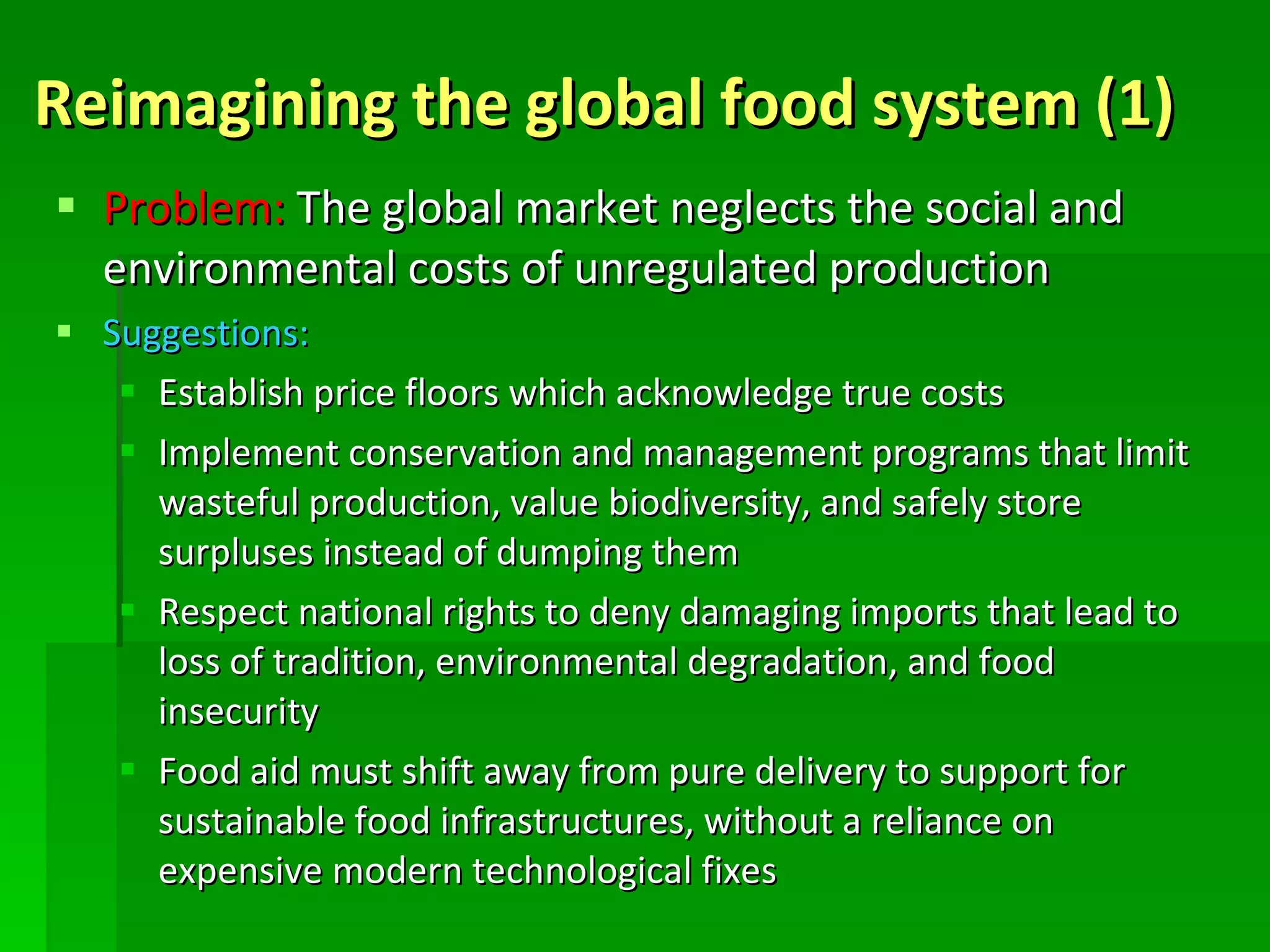
Reimagining the global food system (1) Problem:  The global market neglects the social and environmental costs of unregulated production Suggestions:   Establish price floors which acknowledge true costs Implement conservation and management programs that limit wasteful production, value biodiversity, and safely store surpluses instead of dumping them  Respect national rights to deny damaging imports that lead to loss of tradition, environmental degradation, and food insecurity  Food aid must shift away from pure delivery to support for sustainable food infrastructures, without a reliance on expensive modern technological fixes
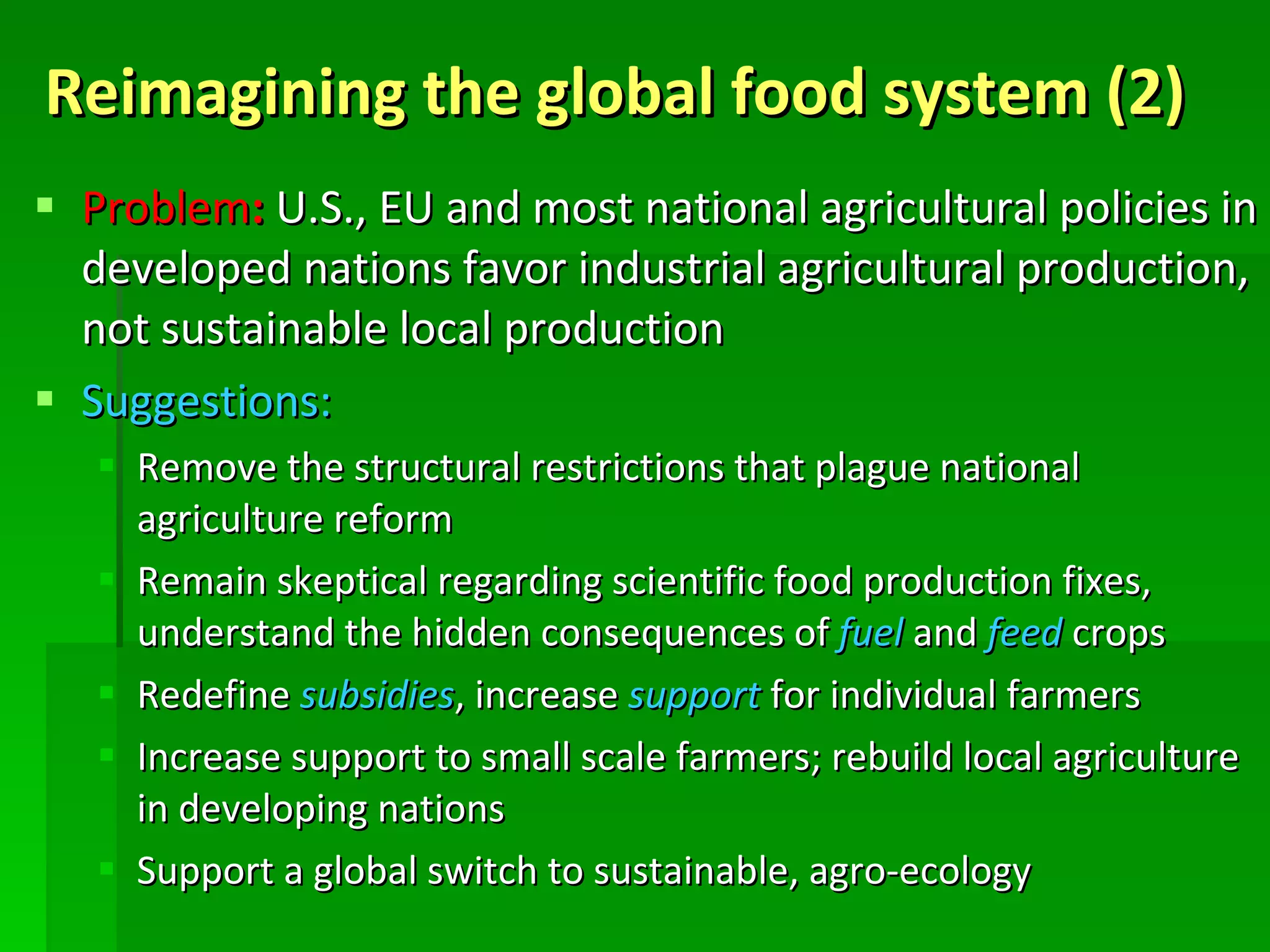
Reimagining the global food system (2) Problem :  U.S., EU and most national agricultural policies in developed nations favor industrial agricultural production, not sustainable local production Suggestions: Remove the structural restrictions that plague national agriculture reform Remain skeptical regarding scientific food production fixes, understand the hidden consequences of  fuel  and  feed  crops Redefine  subsidies , increase  support  for individual farmers Increase support to small scale farmers; rebuild local agriculture in developing nations Support a global switch to sustainable, agro-ecology
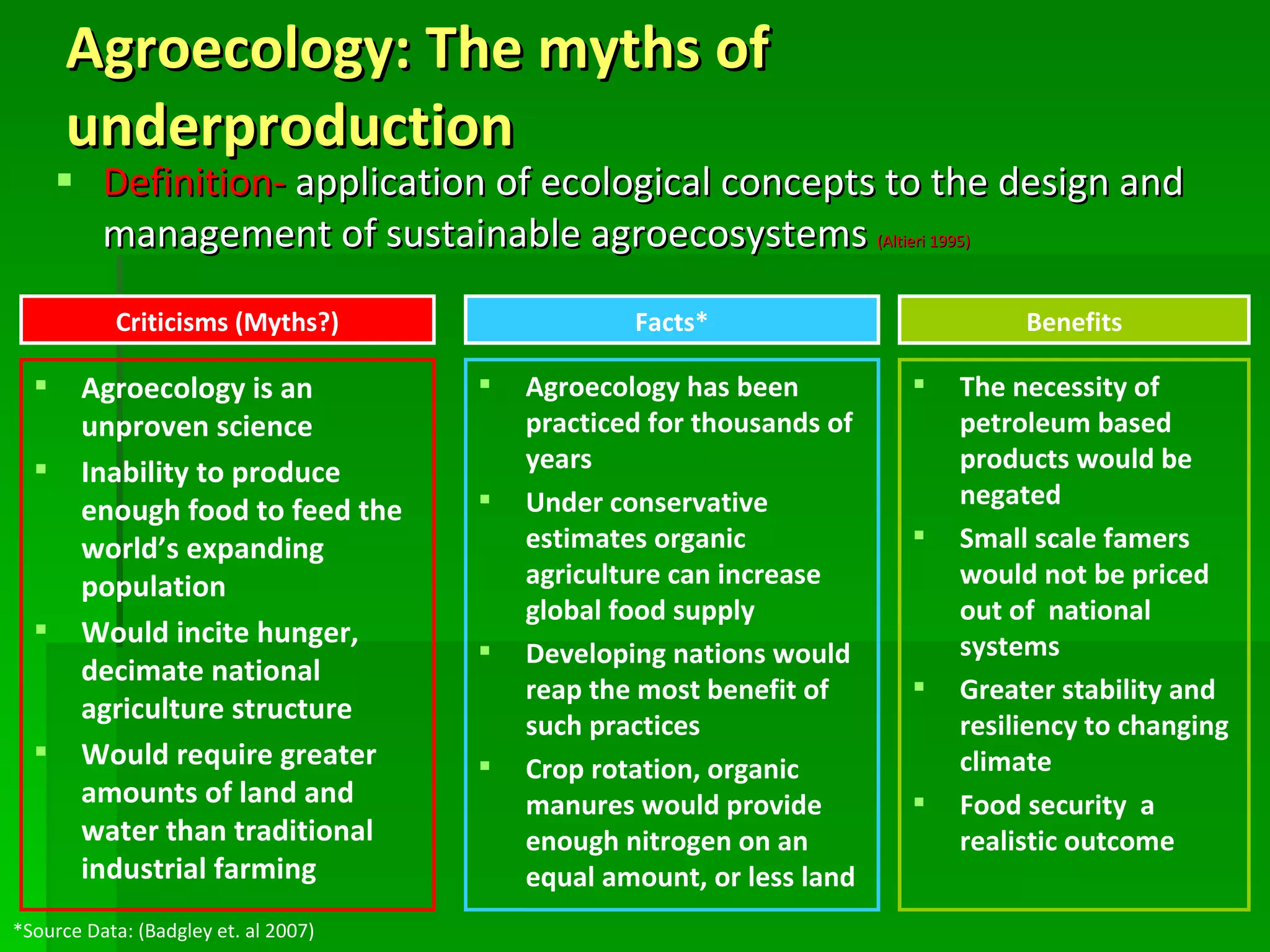
Agroecology: The myths of underproduction Definition-  application of ecological concepts to the design and management of sustainable agroecosystems  (Altieri 1995) Agroecology is an unproven science Inability to produce enough food to feed the world’s expanding population Would incite hunger, decimate national agriculture structure Would require greater amounts of land and water than traditional industrial farming Criticisms (Myths?) Facts* Agroecology has been practiced for thousands of years Under conservative estimates organic agriculture can increase global food supply Developing nations would reap the most benefit of such practices Crop rotation, organic manures would provide enough nitrogen on an equal amount, or less land Benefits The necessity of petroleum based products would be negated Small scale famers would not be priced out of  national systems Greater stability and resiliency to changing climate Food security  a realistic outcome *Source Data: (Badgley et. al 2007)
The benefits of small farms Higher yields per item while harvesting polycultures than industrial farms producing monocultures of each product Adapt better to climate change, and can thrive while supporting the local environment Serve as havens of biodiversity Reduce the overall impacts of climate change Empower indigenous, poor, and uneducated citizens in developing and developed nations Promote food security in developing nations *Source data (Patel and Holt-Giminez 2009)
Food sovereignty, not security The key point to recall is that we must strive for conditions that support one’s ability to have democratic control over their local, regional, and national food systems. Not solely  access , but  control  over food systems at all levels.  Small farmers distributing healthy food at local levels are the keys to world food   security .
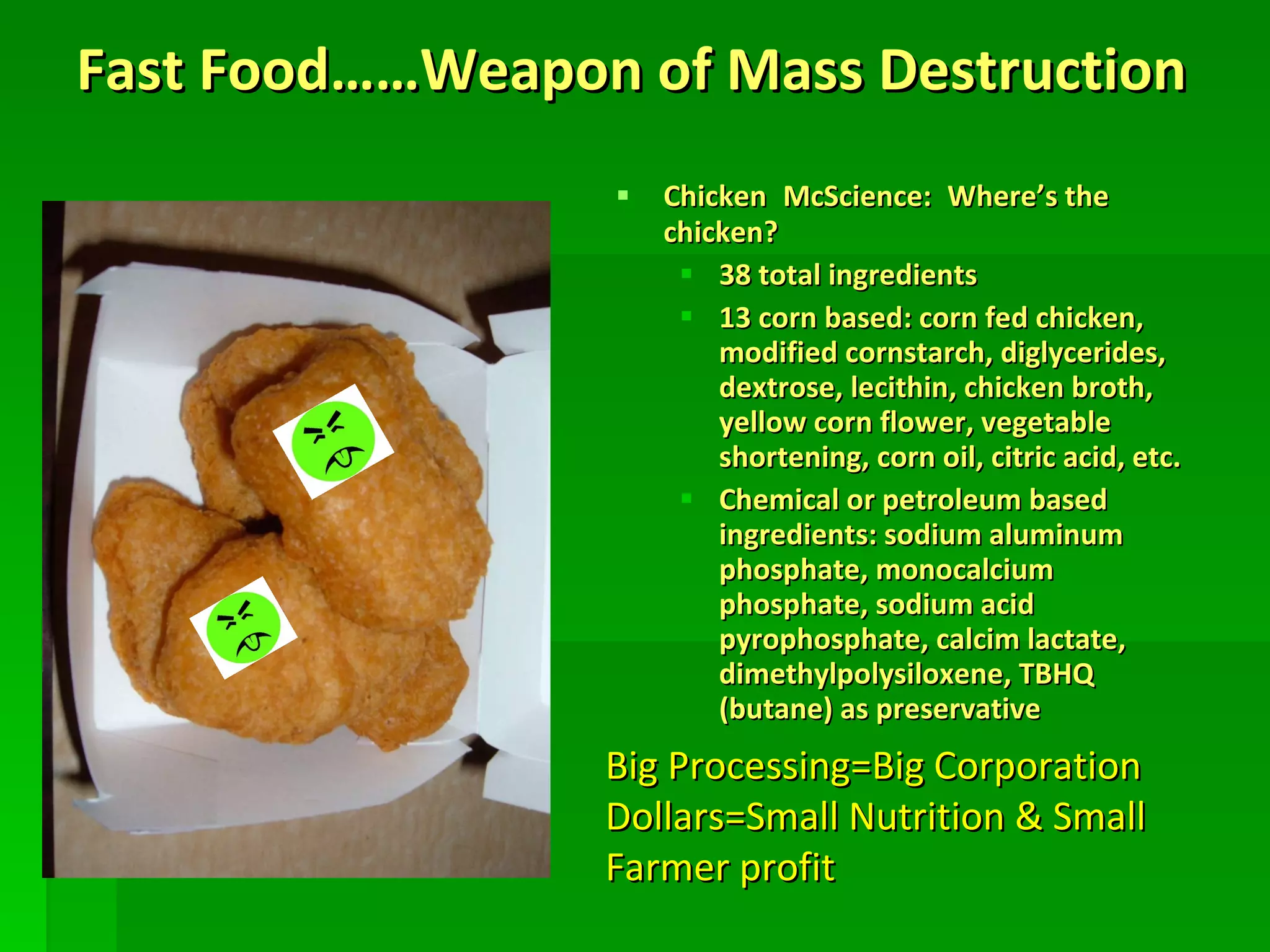
Fast Food……Weapon of Mass Destruction Chicken   McScience:   Where’s the chicken? 38 total ingredients 13 corn based: corn fed chicken, modified cornstarch, diglycerides, dextrose, lecithin, chicken broth, yellow corn flower, vegetable shortening, corn oil, citric acid, etc. Chemical or petroleum based ingredients: sodium aluminum phosphate, monocalcium phosphate, sodium acid pyrophosphate, calcim lactate, dimethylpolysiloxene, TBHQ (butane) as preservative Big Processing=Big Corporation Dollars=Small Nutrition & Small Farmer profit
Personal Reflections…eating three times a day…or four…or five…where do you fit into all of this? What did you eat today? Where did it originate, can you find out? Where did you buy it? What did it cost you, what did it cost the environment? How much did you pay for it, how much of this went to the producer, processor, manufacturer, distributor? How does this make you feel?
Back to you, What can  You  do? Understand the power of consumer demand, release yourself from the grips of agribusiness: Support  Fair  Trade, not  Free Eat FOOD in its natural form Try to eat a plant based, locally sourced diet (Yes, vegetarians/vegans get more than enough protein!!) If you don’t know where to find local food, ask someone Ask questions where you buy (restaurants and supermarkets) Support local growers and CSAs Visit the Budapest Bio-Market, meet a producer! Beware of  “ green-washing”
Suggested Reading  Stuffed and Starved-  Raj Patel Food Rebellions: Crisis and the Hunger for Justice-   E. Holt-Gimenez, R. Patel World Hunger: 12 Myths-  F. M. Lappe The Way We Eat: Why our Food Choices Matter-  P. Singer, J. Mason The Omnivore’s Dilemma, In Defense of Food-  M. Pollan Thank You!
Sources (1) Altieri, M. 1995. Agroecology: the Science of Sustainable Agriculture. Boulder: Westview Press. Badgley, C., Moghtader, J.K., Quintero, E., Zakem, E., Chappell, M.J., Aviles, K.R., Samulon, A., and Perfecto, I. 2007. Organic Agriculture and the Global Food Supply.  Renewable Agriculture and Food Systems  22 (2): 86-108.  British Broadcasting Company (BBC) 2008. Obesity in statistics. URL:  http://news.bbc.co.uk/2/hi/health/7151813.stm [Consulted 13 January 2011] Carlsen, L. 2007. NAFTA Inequality and Immigration: Americas Policy Program. Mexico City: Interhemispheric Resources Center. Dolan, R.E., 1991. Philippines: A Country Study. Washington DC: GPO for the Library of Congress. Integrated Regional Information Networks (IRIN) 2009. Global: Feeding the world without harming it. URL:  http:// www.irinnews.org/report.aspx?ReportID =86857 [Consulted 13 January 2011] International Monetary Fund (IMF) 2008.  Haiti: Joint Staff Advisory Note of the Poverty Reduction Strategy Paper. IMF Country Report 08/114. Washington DC: International Monetary Fund Organization for Economic Co-operation and Development (OECD) 2010.  Obesity and the Economics of Prevention: Fit not Fat. URL:  http://www.oecd.org/document/31/0,3343,en_2649_33929_45999775_1_1_1_37407,00.html [Consulted 13 January 2011] Patel, R. 2007. Stuffed and Starved: The Hidden Battle for the World Food System. New York: Melville House Publishing
Sources (2) Patel, R., and Holt-Giminez, E. 2009. Food Rebellions! Crisis and the Hunger for Justice. Cape Town: Pambazuka Press Steinfeld, H., Gerber, P., Wassenaar, T., Castel, V., Rosales, M., and de Haan, C. 2006. Livestock’s Long Shadow; Environmental Issues and Options. Edited by LEAD. Rome: Food and Agriculture Organization.  Stiglitz, J. and Charlton, A. 2005. Fair Trade for All: How Trade Can Promote Development. New York: Oxford University Press. United Nations Food and Agriculture Organization (FAO) 2002. Reducing poverty and hunger: The critical role of financing for food, agriculture and rural development. URL:  http://www.fao.org/docrep/003/Y6265e/y6265e00.htm [Consulted 13 January 2011] ____2008. Estimated World Water Use.  URL:  http://www.fao.org/nr/water/art/2008/wateruse.htm [Consulted 13 January 2011] ____ 2010. Global hunger declining, but still unacceptably high: Internation hunger targets still difficult to reach. URL:  http://www.fao.org/docrep/012/al390e/al390e00.pdf [Consulted 13 January 2011]

Scifood lecture

  • 1.
    Global Food Policy: Encouraging a plague of abundance and an epidemic of scarcity Logan Strenchock MESPOM 2010-2012
  • 2.
    Aims: Identify social,environmental, economic costs of current system Highlight disparity in global food system Describe what lead us here Highlight what can be done to reduce hunger, support food sovereignty, and sustainably feed the world Make suggestions at a global, regional and personal level
  • 3.
    Let’s take atrip around the world….
  • 4.
    What the worldeats: Chad
  • 5.
  • 6.
  • 7.
  • 8.
  • 9.
  • 10.
  • 11.
  • 12.
  • 13.
  • 14.
    U.S.A All Photos:Copyright Peter Menzel www.menzelphoto.com
  • 15.
    Can you identify any trends? 3 P’s: Processing, Packaging, Prepared Industrial agriculture based products “ Food like items” delivered Fast Eating high on the food chain, high energy consumption How do you work this avocado? Food Disconnection
  • 16.
    Quick Facts: Hunger925 million people were undernourished in the world in 2010 (FAO 2010) 98% of the world’s undernourished live in developing nations, majority of burden falls on women (FAO 2010) 1.6 billion adults are overweight globally, with at least 400 million categorized as obese (WHO 2005) Overweight and obese rates in developed nations have increased steadily since the 1980s, with the trend projected to continue (OECD 2010) Stuffed? Starved?
  • 17.
    Quick Facts: Environment13-18% of the world’s greenhouse gas emissions are created by industrial agriculture (Steinfeld et al. 2006) 50% of all agricultural fertilizers end up in the atmosphere or local waterways (Patel and Holt-Giminez 2009) 18% of global greenhouse gas emissions are connected to agricultural deforestation (Stern 2007) 60-70% of our fresh water supply is used for agriculture (FAO 2008) 26% of land mass is utilized for agricultural production and pasture grazing (BBC 2008) ¾ of genetic diversity of crops has been lost in the last 100 years (IRIN 2009)
  • 18.
    Where we standtoday: Overfed vs. Undernourished Source Data: FAO 2010, BBC 2008 Undernourished by Region, 2010
  • 19.
    More food, morehunger? Record grain harvest in 2007, over 1.5 times the amount needed to appease world demand. Since 1990 food production has risen over 2% per year, while population has grown 1.1% per year. (Patel and Holt-Giminez 2009) World agriculture today produces 17 percent more calories (2,790) per person on earth than 30 years ago, despite 70% population increase (FAO 2002) Hunger is caused by the inability to purchase food within the complex world market. Purchasing power and dietary trends concentrate calories and skew resources Why Hunger?
  • 20.
    What got usinto this mess? Concentration of power, consolidation Separation between grower and consumer Unstable global food market based on speculation Over-reliance on Food Aid, Aid’s role within market Free Trade Agreements, World Bank Structural Adjustment Programs (SAPs) Political and Economic Structure Exploitation of natural resources Reliance on petroleum Degradation of fertile land Spread of Green Revolution technology Food crops transformed to fuel/feed crops Climate Instability Extreme Weather Science and Environment Factors Consequences Poverty Hunger Abundance and Scarcity North/South Disparity Racism, Sexism + + = =
  • 21.
    The “hourglass figure”of the U.S. Food System Food resources: land, labor, water, seeds controlled by few Domination of local markets Processors and distributors erode farmer profits Less individual profit= Less Farmers Farm Operators 3,054,000 Farm Proprietors 2,188,957 Consumers 300,000,000 Grocery and product wholesale 35,650 Food Manufacturers 27,915 Farm product raw wholesale 7,563 Food and beverage stores 148,804 Statistics (Patel and Holt-Gimenez 2009) 83% of beef packing handled by 4 firms 48% of food retailing controlled by 5 firms 66% of pork packing controlled by 4 firms 90% of global grain trade controlled by 3 firms 60% of corn seed, 45% of maize seed, and 44% of soy controlled by DuPont and Monsanto 10 companies own half of the world’s seed supply Concentration of Power, Profit Concentration= market volatility
  • 22.
    North’s Industrial Model:Market Concentration and Consolidation Increased profits Power to lobby WTO & Gov. for favorable trade activity Political influence Control of inputs, benefit of outputs Less competition Ability to add value at low cost to produce; i.e. processing Reap subsidy benefit i.e. agro-fuels Less margin for error Necessity of monoculture Handcuffed to input providers, i.e. seeds, fertilizer, pesticides Falling “farm value” of food Abundance of food choices, not necessarily cheaper food Greater disconnection with food origin Over access to high-value, low nutrition food, with large environmental footprint What does this mean? For agribusiness corporations and the market For Farmers For Consumers * Remember = market consolidation
  • 23.
    Vulnerability of theMarket: Food Price Spike 2008 2006-2008: world food prices soar, peak in 2008 Record hunger levels observed during this period (982 million)* Immediate Reasons: Food price inflation: crops linked to oil; oil price volatility Rising meat consumption (7kg grain for 1kg of beef), drives up grain prices Food crops replaced with fuel crops, feed crops and subsidized; Agro-fuels and feed: drive up price of grains, increases market speculation Climate change , extreme weather, drought lowers yields Instability drives up price, speculators invest in commodities, continuing price hike *Statistics (Patel and Holt-Gimenez 2009)
  • 24.
    Expanding the hourglassmodel from North to South Green Revolution: industrial modernization, power ceded to Northern companies, shift to oil based agriculture packaged as development Food Aid: Post WWII subsidized surplus repackaged as food aid, opens markets in global South, oversupply dumped in foreign markets Structural Adjustment Programs (SAPs): World Bank & IMF deregulate agricultural markets in South, repeal tariffs, marketing boards, and price guarantees; encourage dumping of US and European grains in southern market Regional Free Trade and the WTO: Lock in SAPs in South, override national labor and environment laws, guarantee foreign dominance Results: Food security of South is directly tied to Northern dominated markets Local markets dismantled and food access issues spread Export oriented agriculture has major environmental repercussions
  • 25.
    Example 1: FreeTrade destroys Haitian rice market 1986: to secure an IMF loan, Haiti agrees to open agricultural market to U.S. producers and cut agricultural spending by 30% 1990s: U.S. rice floods Haitian market, sells for half the price of Haitian rice crop 1990s-2000s: The market for Haitian rice collapses, farmers flock to cities in search of work, often setting in shack dwellings Pre-earthquake estimates projected 76% of Haitian population living on less than $2 a day (IMF 2008) 2010: Haitian earthquake kills over 200,000; with a large majority in structural collapses within urban shack communities Statistics (Patel and Holt-Gimenez 2009) Lesson: An influx of cheap food does not lead to food security, destruction of local markets causes mass migration
  • 26.
    Example 2: NAFTAand corn in Mexico 1994: NAFTA enacts removal of non tariff barriers on agricultural goods, and phase out period for sensitive goods, such as corn Mexican government repeals tariffs promptly; US and Mexican exports grow rapidly (Carlsen 2007) Cheap, subsidized U.S. corn enters Mexican market, devastates small scale farmers (25% of total production in Mexico) Small farmers lack ability to shift to advantageous crops, industrial agriculture prevails Over 2 million farmers flee countryside, many seek entrance to the U.S. (Stiglitz and Charlton 2005) Lesson: Multinational trade agreements favor industrial agriculture; immigration issues are largely tied to agricultural displacement
  • 27.
    Example 3: GreenRev. technology and the deterioration of Rice in the Philippines 1960: Green Revolution technology transferred to Asia 1965-1975: With use of chemical inputs and hybrid seeds, rice yields in the Philippines rise, fertilizer use rises 80% (Dolan 1991) Local soil deteriorates, rice biodiversity reduced from 1400 to 4 varieties Cost of chemical inputs rise, global rice price falls, small farmers drown in debt 1995: Entrance to WTO; rice import quotas eliminated, domestic production reaches record low 2007: Philippines become world’s largest rice importer, lie at the mercy of global market price Lesson: Green Revolution tech. does not guarantee food security and comes with great environmental cost, International agreements can do much to dismantle beneficial national production limits, and put small scale producers at risk
  • 28.
    Reimagining the globalfood system (1) Problem: The global market neglects the social and environmental costs of unregulated production Suggestions: Establish price floors which acknowledge true costs Implement conservation and management programs that limit wasteful production, value biodiversity, and safely store surpluses instead of dumping them Respect national rights to deny damaging imports that lead to loss of tradition, environmental degradation, and food insecurity Food aid must shift away from pure delivery to support for sustainable food infrastructures, without a reliance on expensive modern technological fixes
  • 29.
    Reimagining the globalfood system (2) Problem : U.S., EU and most national agricultural policies in developed nations favor industrial agricultural production, not sustainable local production Suggestions: Remove the structural restrictions that plague national agriculture reform Remain skeptical regarding scientific food production fixes, understand the hidden consequences of fuel and feed crops Redefine subsidies , increase support for individual farmers Increase support to small scale farmers; rebuild local agriculture in developing nations Support a global switch to sustainable, agro-ecology
  • 30.
    Agroecology: The mythsof underproduction Definition- application of ecological concepts to the design and management of sustainable agroecosystems (Altieri 1995) Agroecology is an unproven science Inability to produce enough food to feed the world’s expanding population Would incite hunger, decimate national agriculture structure Would require greater amounts of land and water than traditional industrial farming Criticisms (Myths?) Facts* Agroecology has been practiced for thousands of years Under conservative estimates organic agriculture can increase global food supply Developing nations would reap the most benefit of such practices Crop rotation, organic manures would provide enough nitrogen on an equal amount, or less land Benefits The necessity of petroleum based products would be negated Small scale famers would not be priced out of national systems Greater stability and resiliency to changing climate Food security a realistic outcome *Source Data: (Badgley et. al 2007)
  • 31.
    The benefits ofsmall farms Higher yields per item while harvesting polycultures than industrial farms producing monocultures of each product Adapt better to climate change, and can thrive while supporting the local environment Serve as havens of biodiversity Reduce the overall impacts of climate change Empower indigenous, poor, and uneducated citizens in developing and developed nations Promote food security in developing nations *Source data (Patel and Holt-Giminez 2009)
  • 32.
    Food sovereignty, notsecurity The key point to recall is that we must strive for conditions that support one’s ability to have democratic control over their local, regional, and national food systems. Not solely access , but control over food systems at all levels. Small farmers distributing healthy food at local levels are the keys to world food security .
  • 33.
    Fast Food……Weapon ofMass Destruction Chicken McScience: Where’s the chicken? 38 total ingredients 13 corn based: corn fed chicken, modified cornstarch, diglycerides, dextrose, lecithin, chicken broth, yellow corn flower, vegetable shortening, corn oil, citric acid, etc. Chemical or petroleum based ingredients: sodium aluminum phosphate, monocalcium phosphate, sodium acid pyrophosphate, calcim lactate, dimethylpolysiloxene, TBHQ (butane) as preservative Big Processing=Big Corporation Dollars=Small Nutrition & Small Farmer profit
  • 34.
    Personal Reflections…eating threetimes a day…or four…or five…where do you fit into all of this? What did you eat today? Where did it originate, can you find out? Where did you buy it? What did it cost you, what did it cost the environment? How much did you pay for it, how much of this went to the producer, processor, manufacturer, distributor? How does this make you feel?
  • 35.
    Back to you,What can You do? Understand the power of consumer demand, release yourself from the grips of agribusiness: Support Fair Trade, not Free Eat FOOD in its natural form Try to eat a plant based, locally sourced diet (Yes, vegetarians/vegans get more than enough protein!!) If you don’t know where to find local food, ask someone Ask questions where you buy (restaurants and supermarkets) Support local growers and CSAs Visit the Budapest Bio-Market, meet a producer! Beware of “ green-washing”
  • 36.
    Suggested Reading Stuffed and Starved- Raj Patel Food Rebellions: Crisis and the Hunger for Justice- E. Holt-Gimenez, R. Patel World Hunger: 12 Myths- F. M. Lappe The Way We Eat: Why our Food Choices Matter- P. Singer, J. Mason The Omnivore’s Dilemma, In Defense of Food- M. Pollan Thank You!
  • 37.
    Sources (1) Altieri,M. 1995. Agroecology: the Science of Sustainable Agriculture. Boulder: Westview Press. Badgley, C., Moghtader, J.K., Quintero, E., Zakem, E., Chappell, M.J., Aviles, K.R., Samulon, A., and Perfecto, I. 2007. Organic Agriculture and the Global Food Supply. Renewable Agriculture and Food Systems 22 (2): 86-108. British Broadcasting Company (BBC) 2008. Obesity in statistics. URL: http://news.bbc.co.uk/2/hi/health/7151813.stm [Consulted 13 January 2011] Carlsen, L. 2007. NAFTA Inequality and Immigration: Americas Policy Program. Mexico City: Interhemispheric Resources Center. Dolan, R.E., 1991. Philippines: A Country Study. Washington DC: GPO for the Library of Congress. Integrated Regional Information Networks (IRIN) 2009. Global: Feeding the world without harming it. URL: http:// www.irinnews.org/report.aspx?ReportID =86857 [Consulted 13 January 2011] International Monetary Fund (IMF) 2008. Haiti: Joint Staff Advisory Note of the Poverty Reduction Strategy Paper. IMF Country Report 08/114. Washington DC: International Monetary Fund Organization for Economic Co-operation and Development (OECD) 2010. Obesity and the Economics of Prevention: Fit not Fat. URL: http://www.oecd.org/document/31/0,3343,en_2649_33929_45999775_1_1_1_37407,00.html [Consulted 13 January 2011] Patel, R. 2007. Stuffed and Starved: The Hidden Battle for the World Food System. New York: Melville House Publishing
  • 38.
    Sources (2) Patel,R., and Holt-Giminez, E. 2009. Food Rebellions! Crisis and the Hunger for Justice. Cape Town: Pambazuka Press Steinfeld, H., Gerber, P., Wassenaar, T., Castel, V., Rosales, M., and de Haan, C. 2006. Livestock’s Long Shadow; Environmental Issues and Options. Edited by LEAD. Rome: Food and Agriculture Organization. Stiglitz, J. and Charlton, A. 2005. Fair Trade for All: How Trade Can Promote Development. New York: Oxford University Press. United Nations Food and Agriculture Organization (FAO) 2002. Reducing poverty and hunger: The critical role of financing for food, agriculture and rural development. URL: http://www.fao.org/docrep/003/Y6265e/y6265e00.htm [Consulted 13 January 2011] ____2008. Estimated World Water Use. URL: http://www.fao.org/nr/water/art/2008/wateruse.htm [Consulted 13 January 2011] ____ 2010. Global hunger declining, but still unacceptably high: Internation hunger targets still difficult to reach. URL: http://www.fao.org/docrep/012/al390e/al390e00.pdf [Consulted 13 January 2011]

Editor's Notes

  • #25 -Green Revolution: 1960-1990 shift away from traditional methods to industrialized methods, package as development, modernization, shift to oil base agriculture, inputs controlled by Northern companies