FUEL CELL TECHNOLOGY
PRESENTED BY
RAHUL KUMAR SAH
20125108
MECHANICAL ENGINEERING
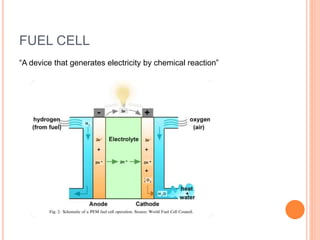
FUEL CELL
“A device that generates electricity by chemical reaction”
A VERY BRIEF HISTORY
Considered a curiosity in the 1800’s. The first fuel cell was built in 1839
by Sir William Grove, a lawyer and gentleman scientist. Serious interest
in the fuel cell as a practical generator did not begin until the 1960's,
when the U.S. space program chose fuel cells over riskier nuclear
power and more expensive solar energy. Fuel cells furnished power for
the Gemini and Apollo spacecraft, and still provide electricity and water
for the space shuttle.
TYPES OF FUEL CELLS
The five most common types –
1. Alkali (70% efficient)
2. Molten carbonate (60-80% efficient)
3. Phosphoric acid (40-80% efficient)
4. Proton exchange membrane (40-50% efficient)
5. Solid oxide (60% efficient)
BENEFITS
 Efficient: in theory and in practice
 Portable: modular units
 Reliable: few moving parts to wear out or break
 Fuel Flexible: With a fuel reformer, fuels such as natural gas,
ethanol, methanol, propane, gasoline, diesel, landfill gas,waste
water, treatment digester gas, or even ammonia can be used
 Environmental: produces heat and water (less than combustion
in both cases) near zero emission of CO and NOx
reduced emission of CO2 (zero emission if pure H2 fuel)
APPLICATIONS OF FUEL CELL
TECHNOLOGY
 Cars
 Buses
 Space Travel & Exploration
 Airplanes
 Submarines
 Off-grid Power Supply
 Combined Heat & Power
HYDROGEN FUEL CELL VEHICLES
A HYDROGEN VEHICLE IS A VEHICLE THAT USES HYDROGEN AS ITS ON BOARD
FUEL FOR MOTIVE POWER.
STORAGE & EFFICIENCY
 Two storage options
1. Produce the hydrogen on the ground and then store it
onboard the vehicle (the direct hydrogen option)
2. Produce the hydrogen on the vehicle by means of a tiny
onboard hydrogen plant (the onboard fuel processor
option)
 Hydrogen FC’s 2 times as efficient as internal combustion
 Internal combustion efficiency – 20-30%
 Hydrogen FC’s – 50-60%
 Estimates that FC Vehicles can achieve equivalent of 80
miles/gallon gasoline.
HYDROGEN FUEL CELL VEHICLE ISSUES
 Storage is complicated
 Limited range
 Expensive fuel
 Still a fossil fuel?
 Energy carrier, not energy source
HYDROGEN SOURCES
ENVIRONMENT
Why we are pursuing Hydrogen FCVs(?)
 produces heat and water (less than combustion in both cases)
 nearzero emission of CO and Nox
 reducedemission of CO2 (zero emission if pure H2 fuel)
THANK YOU!!

Fuel cell technology

  • 1.
    FUEL CELL TECHNOLOGY PRESENTEDBY RAHUL KUMAR SAH 20125108 MECHANICAL ENGINEERING
  • 2.
    FUEL CELL “A devicethat generates electricity by chemical reaction”
  • 3.
    A VERY BRIEFHISTORY Considered a curiosity in the 1800’s. The first fuel cell was built in 1839 by Sir William Grove, a lawyer and gentleman scientist. Serious interest in the fuel cell as a practical generator did not begin until the 1960's, when the U.S. space program chose fuel cells over riskier nuclear power and more expensive solar energy. Fuel cells furnished power for the Gemini and Apollo spacecraft, and still provide electricity and water for the space shuttle.
  • 4.
    TYPES OF FUELCELLS The five most common types – 1. Alkali (70% efficient) 2. Molten carbonate (60-80% efficient) 3. Phosphoric acid (40-80% efficient) 4. Proton exchange membrane (40-50% efficient) 5. Solid oxide (60% efficient)
  • 5.
    BENEFITS  Efficient: intheory and in practice  Portable: modular units  Reliable: few moving parts to wear out or break  Fuel Flexible: With a fuel reformer, fuels such as natural gas, ethanol, methanol, propane, gasoline, diesel, landfill gas,waste water, treatment digester gas, or even ammonia can be used  Environmental: produces heat and water (less than combustion in both cases) near zero emission of CO and NOx reduced emission of CO2 (zero emission if pure H2 fuel)
  • 6.
    APPLICATIONS OF FUELCELL TECHNOLOGY  Cars  Buses  Space Travel & Exploration  Airplanes  Submarines  Off-grid Power Supply  Combined Heat & Power
  • 7.
  • 8.
    A HYDROGEN VEHICLEIS A VEHICLE THAT USES HYDROGEN AS ITS ON BOARD FUEL FOR MOTIVE POWER.
  • 9.
    STORAGE & EFFICIENCY Two storage options 1. Produce the hydrogen on the ground and then store it onboard the vehicle (the direct hydrogen option) 2. Produce the hydrogen on the vehicle by means of a tiny onboard hydrogen plant (the onboard fuel processor option)  Hydrogen FC’s 2 times as efficient as internal combustion  Internal combustion efficiency – 20-30%  Hydrogen FC’s – 50-60%  Estimates that FC Vehicles can achieve equivalent of 80 miles/gallon gasoline.
  • 10.
    HYDROGEN FUEL CELLVEHICLE ISSUES  Storage is complicated  Limited range  Expensive fuel  Still a fossil fuel?  Energy carrier, not energy source
  • 11.
  • 12.
    ENVIRONMENT Why we arepursuing Hydrogen FCVs(?)  produces heat and water (less than combustion in both cases)  nearzero emission of CO and Nox  reducedemission of CO2 (zero emission if pure H2 fuel)
  • 13.