An ejector refrigeration cycle
powered by an internal combustion engine
Reporter: Chenliang
Professor : Sumin Jin
CONTENT
Part One
Introduction
Part Two
Working principle
Part Three
Performance of an
ejector refrigeration
Part Four
References
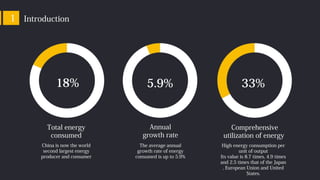
Total energy
consumed
China is now the world
second largest energy
producer and consumer
Annual
growth rate
The average annual
growth rate of energy
consumed is up to 5.9%
Comprehensive
utilization of energy
High energy consumption per
unit of output
Its value is 8.7 times, 4.9 times
and 2.5 times that of the Japan
, European Union and United
States.
18% 5.9% 33%
Introduction1
1
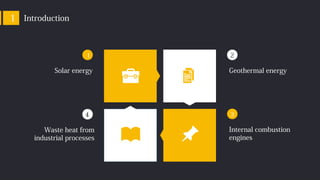
Solar energy
2
Geothermal energy
3
Internal combustion
engines
4
Waste heat from
industrial processes
Introduction1
Introduction1
Thermodynamic analysis
Computational fluid dynamics (CFD)
analysis
experimental research
Predict the performance of ejector , different refrigerant, structure parameters of ejector ,
nozzle position, multistage injection system
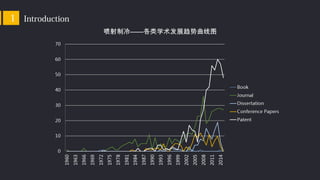
喷射制冷——各类学术发展趋势曲线图
Introduction1
CONTENT
Part One
Introduction
Part Two
Working principle
Part Three
Performance of an
ejector refrigeration
Part Four
References
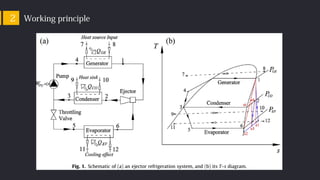
Working principle2
Working principle2
1
2
3
These systems are more reliable
because there have almost no
moving part.
They have more potential to be
environmental friendly.
Especially, water can be used as
refrigerant.
They are relatively inefficient.
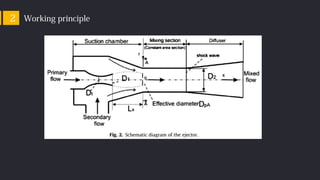
In an ejector refrigeration cycle, the
key problem is the ejector design.
Working principle2
CONTENT
Part One
Introduction
Part Two
Working principle
Part Three
Performance of an
ejector refrigeration
Part Four
References
Performance of an ejector refrigeration3
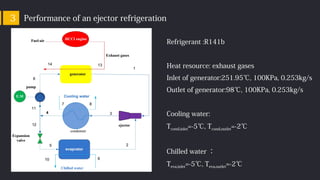
Refrigerant :R141b
Heat resource: exhaust gases
Inlet of generator:251.95℃, 100KPa, 0.253kg/s
Outlet of generator:98℃, 100KPa, 0.253kg/s
Cooling water:
Tcond,inlet=-5℃, Tcond,outlet=-2℃
Chilled water :
Teva,inlet=-5℃, Teva,outlet=-2℃
Performance of an ejector refrigeration3
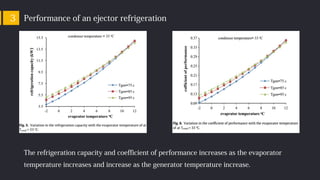
The refrigeration capacity and coefficient of performance increases as the evaporator
temperature increases and increase as the generator temperature increase.
Performance of an ejector refrigeration3
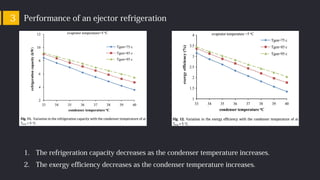
1. The refrigeration capacity decreases as the condenser temperature increases.
2. The exergy efficiency decreases as the condenser temperature increases.
Performance of an ejector refrigeration3
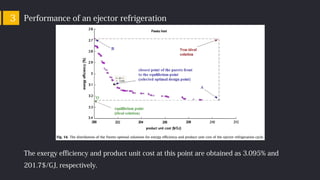
The exergy efficiency and product unit cost at this point are obtained as 3.095% and
201.7$/GJ, respectively.
Performance of an ejector refrigeration3
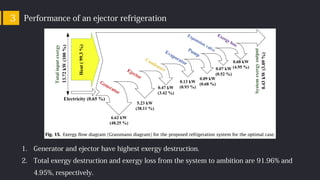
1. Generator and ejector have highest exergy destruction.
2. Total exergy destruction and exergy loss from the system to ambition are 91.96% and
4.95%, respectively.
Performance of an ejector refrigeration3
Conclusions
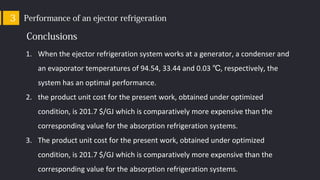
1. When the ejector refrigeration system works at a generator, a condenser and
an evaporator temperatures of 94.54, 33.44 and 0.03 , respectively, the℃
system has an optimal performance.
2. the product unit cost for the present work, obtained under optimized
condition, is 201.7 $/GJ which is comparatively more expensive than the
corresponding value for the absorption refrigeration systems.
3. The product unit cost for the present work, obtained under optimized
condition, is 201.7 $/GJ which is comparatively more expensive than the
corresponding value for the absorption refrigeration systems.
CONTENT
Part One
Introduction
Part Two
Working principle
Part Three
Performance of an
ejector refrigeration
Part Four
References
References4
1. 房煦峰 . 潜 回收型 射式制冷性能分析及 射器数 模热 喷 喷 值 拟 [D]. 大 海事大连
学 , 2014.
2. 董景明 . 高效 射式制冷系 性能的理 与 研究喷 统 论 实验 [D]. 大 海事大学连 ,
2012.
3. Chen J, Havtun H, Palm B. Conventional and advanced exergy analysis of
an ejector refrigeration system[J]. Applied Energy, 2015,144:139-151.
4. Sadeghi M, Mahmoudi S M S, Khoshbakhti Saray R. Exergoeconomic
analysis and multi-objective optimization of an ejector refrigeration cycle
powered by an internal combustion (HCCI) engine[J]. Energy Conversion
and Management, 2015,96:403-417.
Thank you for watching
Reporter: Chenliang
Professor : Sumin Jin

An ejector refrigeration cycle

  • 1.
    An ejector refrigerationcycle powered by an internal combustion engine Reporter: Chenliang Professor : Sumin Jin
  • 2.
    CONTENT Part One Introduction Part Two Workingprinciple Part Three Performance of an ejector refrigeration Part Four References
  • 3.
    Total energy consumed China isnow the world second largest energy producer and consumer Annual growth rate The average annual growth rate of energy consumed is up to 5.9% Comprehensive utilization of energy High energy consumption per unit of output Its value is 8.7 times, 4.9 times and 2.5 times that of the Japan , European Union and United States. 18% 5.9% 33% Introduction1
  • 4.
    1 Solar energy 2 Geothermal energy 3 Internalcombustion engines 4 Waste heat from industrial processes Introduction1
  • 5.
    Introduction1 Thermodynamic analysis Computational fluiddynamics (CFD) analysis experimental research Predict the performance of ejector , different refrigerant, structure parameters of ejector , nozzle position, multistage injection system
  • 6.
  • 7.
    CONTENT Part One Introduction Part Two Workingprinciple Part Three Performance of an ejector refrigeration Part Four References
  • 8.
  • 9.
  • 10.
    1 2 3 These systems aremore reliable because there have almost no moving part. They have more potential to be environmental friendly. Especially, water can be used as refrigerant. They are relatively inefficient. In an ejector refrigeration cycle, the key problem is the ejector design. Working principle2
  • 11.
    CONTENT Part One Introduction Part Two Workingprinciple Part Three Performance of an ejector refrigeration Part Four References
  • 12.
    Performance of anejector refrigeration3 Refrigerant :R141b Heat resource: exhaust gases Inlet of generator:251.95℃, 100KPa, 0.253kg/s Outlet of generator:98℃, 100KPa, 0.253kg/s Cooling water: Tcond,inlet=-5℃, Tcond,outlet=-2℃ Chilled water : Teva,inlet=-5℃, Teva,outlet=-2℃
  • 13.
    Performance of anejector refrigeration3 The refrigeration capacity and coefficient of performance increases as the evaporator temperature increases and increase as the generator temperature increase.
  • 14.
    Performance of anejector refrigeration3 1. The refrigeration capacity decreases as the condenser temperature increases. 2. The exergy efficiency decreases as the condenser temperature increases.
  • 15.
    Performance of anejector refrigeration3 The exergy efficiency and product unit cost at this point are obtained as 3.095% and 201.7$/GJ, respectively.
  • 16.
    Performance of anejector refrigeration3 1. Generator and ejector have highest exergy destruction. 2. Total exergy destruction and exergy loss from the system to ambition are 91.96% and 4.95%, respectively.
  • 17.
    Performance of anejector refrigeration3 Conclusions 1. When the ejector refrigeration system works at a generator, a condenser and an evaporator temperatures of 94.54, 33.44 and 0.03 , respectively, the℃ system has an optimal performance. 2. the product unit cost for the present work, obtained under optimized condition, is 201.7 $/GJ which is comparatively more expensive than the corresponding value for the absorption refrigeration systems. 3. The product unit cost for the present work, obtained under optimized condition, is 201.7 $/GJ which is comparatively more expensive than the corresponding value for the absorption refrigeration systems.
  • 18.
    CONTENT Part One Introduction Part Two Workingprinciple Part Three Performance of an ejector refrigeration Part Four References
  • 19.
    References4 1. 房煦峰 .潜 回收型 射式制冷性能分析及 射器数 模热 喷 喷 值 拟 [D]. 大 海事大连 学 , 2014. 2. 董景明 . 高效 射式制冷系 性能的理 与 研究喷 统 论 实验 [D]. 大 海事大学连 , 2012. 3. Chen J, Havtun H, Palm B. Conventional and advanced exergy analysis of an ejector refrigeration system[J]. Applied Energy, 2015,144:139-151. 4. Sadeghi M, Mahmoudi S M S, Khoshbakhti Saray R. Exergoeconomic analysis and multi-objective optimization of an ejector refrigeration cycle powered by an internal combustion (HCCI) engine[J]. Energy Conversion and Management, 2015,96:403-417.
  • 20.
    Thank you forwatching Reporter: Chenliang Professor : Sumin Jin