z
F - test
Dr. R. MUTHUKRISHNAVENI
SAIVA BHANU KSHATRIYA COLLEGE,
ARUPPUKOTTAI
z
F – test
 The F-test(Variance Ratio Test) is developed by
Statistician R.A. Fisher
 The object of the test is find out whether the two
random independent samples variance differ
significantly or not
 Formula for F-test , F =
𝑆1
2
𝑆2
2 ; 𝑆1
2
> 𝑆2
2
 Table value for degrees of freedom(v1,v2) at 5% or 1
% level of significance
z
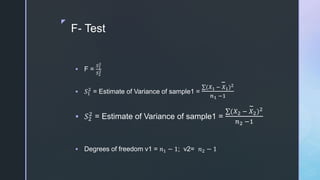
F- Test
 F =
𝑆1
2
𝑆2
2
 𝑆1
2
= Estimate of Variance of sample1 =
(𝑋1 − 𝑋1)2
𝑛1 −1
 𝑆2
2
= Estimate of Variance of sample1 =
(𝑋2 − 𝑋2)2
𝑛2 −1
 Degrees of freedom v1 = 𝑛1 − 1; v2= 𝑛2 − 1
z
Assumptions
 Normality – Data are normally distributed
 Homogeneity – variance within each group are equal
 Independence of error –the error is independent for each group
z
Illustration - 1
 In a sample of 8 observations, the sum of squared deviations of
items from the mean was 84.4. In another samples of 10
observations, the value was found to be 102.6. Test whether the
difference is significant at 5% level.
V1 = 7 & V2 = 9 degrees of
freedom at 5% level of
significance F0.05 = 3.29
z
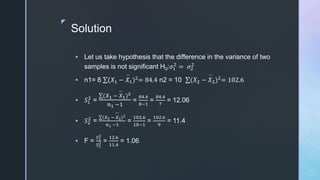
Solution
 Let us take hypothesis that the difference in the variance of two
samples is not significant H0:𝜎1
2
= 𝜎2
2
 n1= 8 (𝑋1 − 𝑋1)2
= 84.4 n2 = 10 (𝑋2 − 𝑋2)2
= 102.6
 𝑆1
2
=
(𝑋1 − 𝑋1)2
𝑛1 −1
=
84.4
8−1
=
84.4
7
= 12.06
 𝑆2
2
=
(𝑋2 − 𝑋2)2
𝑛1 −1
=
102.6
10−1
=
102.6
9
= 11.4
 F =
𝑆1
2
𝑆2
2 =
12.6
11.4
= 1.06
z
Solution - continue
 Calculated value of F = 1.06
 Table value of F = 3.29 (v1 = 7
and v2 = 9 at 5% level of
significance)
 Inference
 CV < TV, hence we accept the
null hypothesis and conclude
that the difference in the
variance of two samples is not
significant at 5%
z
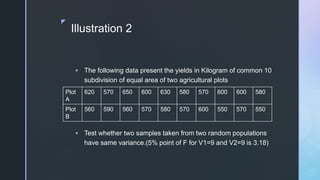
Illustration 2
 The following data present the yields in Kilogram of common 10
subdivision of equal area of two agricultural plots
 Test whether two samples taken from two random populations
have same variance.(5% point of F for V1=9 and V2=9 is 3.18)
Plot
A
620 570 650 600 630 580 570 600 600 580
Plot
B
560 590 560 570 580 570 600 550 570 550
z
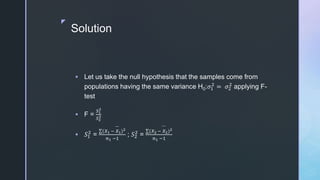
Solution
 Let us take the null hypothesis that the samples come from
populations having the same variance H0:𝜎1
2
= 𝜎2
2
applying F-
test
 F =
𝑆1
2
𝑆2
2
 𝑆1
2
=
(𝑋1 − 𝑋1)2
𝑛1 −1
; 𝑆2
2
=
(𝑋2 − 𝑋2)2
𝑛1 −1
z
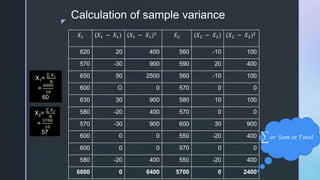
Calculation of sample variance
𝑋1 (𝑋1 − 𝑋1) (𝑋1 − 𝑋1)2 𝑋2 (𝑋2 − 𝑋2) (𝑋2 − 𝑋2)2
620 20 400 560 -10 100
570 -30 900 590 20 400
650 50 2500 560 -10 100
600 O 0 570 0 0
630 30 900 580 10 100
580 -20 400 570 0 0
570 -30 900 600 30 900
600 0 0 550 -20 400
600 0 0 570 0 0
580 -20 400 550 -20 400
6000 0 6400 5700 0 2400
X1=
𝑋1
𝑁
=
6000
10
60
X2=
𝑋2
𝑁
=
5700
10
57
𝑜𝑟 𝑆𝑢𝑚 𝑜𝑟 𝑇𝑜𝑡𝑎𝑙
z
Solution - Continue
 𝑆1
2
=
(𝑋1 − 𝑋1)2
𝑛1 −1
=
6400
10−1
= 711.11
 𝑆2
2
=
(𝑋2 − 𝑋2)2
𝑛1 −1
=
2400
10 −1
= 266.67
 F =
𝑆1
2
𝑆2
2 =
711.11
266.27
= 2.67
z
Solution - continue
 Calculated value of F = 2. 67
 Table value of F = 3.18 (v1 = 9
and v2 = 9 at 5% level of
significance)
 Inference
 CV < TV, hence we accept the
null hypothesis and conclude
that the samples come from
populations having the same
variance at 5%

f-test-200513110014 (1).pdf

  • 1.
    z F - test Dr.R. MUTHUKRISHNAVENI SAIVA BHANU KSHATRIYA COLLEGE, ARUPPUKOTTAI
  • 2.
    z F – test The F-test(Variance Ratio Test) is developed by Statistician R.A. Fisher  The object of the test is find out whether the two random independent samples variance differ significantly or not  Formula for F-test , F = 𝑆1 2 𝑆2 2 ; 𝑆1 2 > 𝑆2 2  Table value for degrees of freedom(v1,v2) at 5% or 1 % level of significance
  • 3.
    z F- Test  F= 𝑆1 2 𝑆2 2  𝑆1 2 = Estimate of Variance of sample1 = (𝑋1 − 𝑋1)2 𝑛1 −1  𝑆2 2 = Estimate of Variance of sample1 = (𝑋2 − 𝑋2)2 𝑛2 −1  Degrees of freedom v1 = 𝑛1 − 1; v2= 𝑛2 − 1
  • 4.
    z Assumptions  Normality –Data are normally distributed  Homogeneity – variance within each group are equal  Independence of error –the error is independent for each group
  • 5.
    z Illustration - 1 In a sample of 8 observations, the sum of squared deviations of items from the mean was 84.4. In another samples of 10 observations, the value was found to be 102.6. Test whether the difference is significant at 5% level. V1 = 7 & V2 = 9 degrees of freedom at 5% level of significance F0.05 = 3.29
  • 6.
    z Solution  Let ustake hypothesis that the difference in the variance of two samples is not significant H0:𝜎1 2 = 𝜎2 2  n1= 8 (𝑋1 − 𝑋1)2 = 84.4 n2 = 10 (𝑋2 − 𝑋2)2 = 102.6  𝑆1 2 = (𝑋1 − 𝑋1)2 𝑛1 −1 = 84.4 8−1 = 84.4 7 = 12.06  𝑆2 2 = (𝑋2 − 𝑋2)2 𝑛1 −1 = 102.6 10−1 = 102.6 9 = 11.4  F = 𝑆1 2 𝑆2 2 = 12.6 11.4 = 1.06
  • 7.
    z Solution - continue Calculated value of F = 1.06  Table value of F = 3.29 (v1 = 7 and v2 = 9 at 5% level of significance)  Inference  CV < TV, hence we accept the null hypothesis and conclude that the difference in the variance of two samples is not significant at 5%
  • 8.
    z Illustration 2  Thefollowing data present the yields in Kilogram of common 10 subdivision of equal area of two agricultural plots  Test whether two samples taken from two random populations have same variance.(5% point of F for V1=9 and V2=9 is 3.18) Plot A 620 570 650 600 630 580 570 600 600 580 Plot B 560 590 560 570 580 570 600 550 570 550
  • 9.
    z Solution  Let ustake the null hypothesis that the samples come from populations having the same variance H0:𝜎1 2 = 𝜎2 2 applying F- test  F = 𝑆1 2 𝑆2 2  𝑆1 2 = (𝑋1 − 𝑋1)2 𝑛1 −1 ; 𝑆2 2 = (𝑋2 − 𝑋2)2 𝑛1 −1
  • 10.
    z Calculation of samplevariance 𝑋1 (𝑋1 − 𝑋1) (𝑋1 − 𝑋1)2 𝑋2 (𝑋2 − 𝑋2) (𝑋2 − 𝑋2)2 620 20 400 560 -10 100 570 -30 900 590 20 400 650 50 2500 560 -10 100 600 O 0 570 0 0 630 30 900 580 10 100 580 -20 400 570 0 0 570 -30 900 600 30 900 600 0 0 550 -20 400 600 0 0 570 0 0 580 -20 400 550 -20 400 6000 0 6400 5700 0 2400 X1= 𝑋1 𝑁 = 6000 10 60 X2= 𝑋2 𝑁 = 5700 10 57 𝑜𝑟 𝑆𝑢𝑚 𝑜𝑟 𝑇𝑜𝑡𝑎𝑙
  • 11.
    z Solution - Continue 𝑆1 2 = (𝑋1 − 𝑋1)2 𝑛1 −1 = 6400 10−1 = 711.11  𝑆2 2 = (𝑋2 − 𝑋2)2 𝑛1 −1 = 2400 10 −1 = 266.67  F = 𝑆1 2 𝑆2 2 = 711.11 266.27 = 2.67
  • 12.
    z Solution - continue Calculated value of F = 2. 67  Table value of F = 3.18 (v1 = 9 and v2 = 9 at 5% level of significance)  Inference  CV < TV, hence we accept the null hypothesis and conclude that the samples come from populations having the same variance at 5%