biosecurity built on science
New Lure & Kill Technologies
PBCRC3152
Paul Cunningham
Research Leader, AgriBio, DEDJTR, VIC.
Plant Biosecurity Cooperative Research Centre
biosecurity built on science
What is the problem?
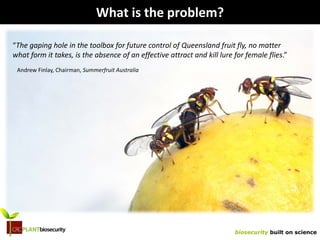
“The gaping hole in the toolbox for future control of Queensland fruit fly, no matter
what form it takes, is the absence of an effective attract and kill lure for female flies.”
Andrew Finlay, Chairman, Summerfruit Australia
biosecurity built on science
What are we doing about it?
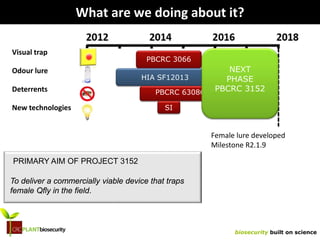
PBCRC 3066
HIA SF12013
PBCRC 63086 (PhD)
SI
Visual trap
Odour lure
Deterrents
New technologies
Female lure developed
Milestone R2.1.9
NEXT
PHASE
PBCRC 3152
To deliver a commercially viable device that traps
female Qfly in the field.
PRIMARY AIM OF PROJECT 3152
biosecurity built on science
What are we doing about it?
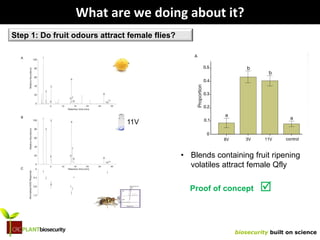
Step 1: Do fruit odours attract female flies?
• Blends containing fruit ripening
volatiles attract female Qfly
Proof of concept 
11V
biosecurity built on science
What are we doing about it?
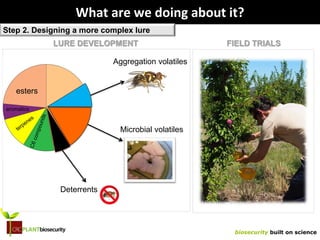
Step 2. Designing a more complex lure
?
Aggregation volatiles
Microbial volatiles
Deterrents
aromatics
esters
LURE DEVELOPMENT FIELD TRIALS
biosecurity built on science
What are we doing about it?
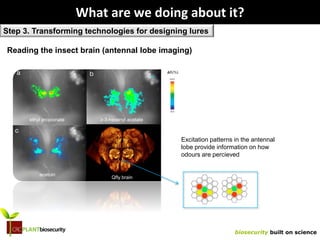
Step 3. Transforming technologies for designing lures
Excitation patterns in the antennal
lobe provide information on how
odours are percieved
ethyl propionate z-3-hexenyl acetate
acetoin
Qfly brain
Reading the insect brain (antennal lobe imaging)
biosecurity built on science
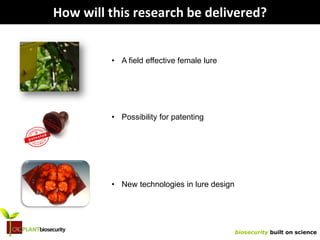
How will this research be delivered?
• A field effective female lure
• Possibility for patenting
• New technologies in lure design
biosecurity built on science
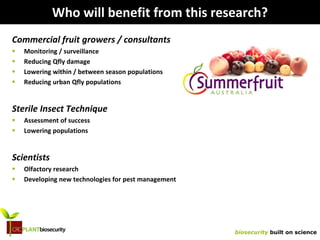
Who will benefit from this research?
Commercial fruit growers / consultants
 Monitoring / surveillance
 Reducing Qfly damage
 Lowering within / between season populations
 Reducing urban Qfly populations
Sterile Insect Technique
 Assessment of success
 Lowering populations
Scientists
 Olfactory research
 Developing new technologies for pest management
biosecurity built on science
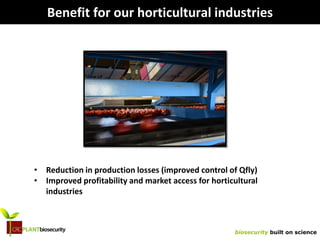
Benefit for our horticultural industries
• Reduction in production losses (improved control of Qfly)
• Improved profitability and market access for horticultural
industries
biosecurity built on science
Future
A field effective female lure is the starting point
… integration into Qfly control practices
… more powerful attractants
… better traps
biosecurity built on science
Thank you
Project Team
Jane Royer (QDAF)
Pawel Sadowski (QUT/CARF)
Mikael Carlsson (Stockholm University, AL imaging)
Tony Clarke (QUT)
Technical Assistance
Tommaso Villa
David Hodkinson
Brett Lewis
Lona van Delden
Summerfruit Australia
Andrew Finlay (Chairman)
Rowan Berecry
paul.cunningham@ecodev.vic.gov.auPBCRC is established and supported under
the Australian Government Cooperative
Research Centres Programme

New lure and kill technologies (Queensland fruit fly)

  • 1.
    biosecurity built onscience New Lure & Kill Technologies PBCRC3152 Paul Cunningham Research Leader, AgriBio, DEDJTR, VIC. Plant Biosecurity Cooperative Research Centre
  • 2.
    biosecurity built onscience What is the problem? “The gaping hole in the toolbox for future control of Queensland fruit fly, no matter what form it takes, is the absence of an effective attract and kill lure for female flies.” Andrew Finlay, Chairman, Summerfruit Australia
  • 3.
    biosecurity built onscience What are we doing about it? PBCRC 3066 HIA SF12013 PBCRC 63086 (PhD) SI Visual trap Odour lure Deterrents New technologies Female lure developed Milestone R2.1.9 NEXT PHASE PBCRC 3152 To deliver a commercially viable device that traps female Qfly in the field. PRIMARY AIM OF PROJECT 3152
  • 4.
    biosecurity built onscience What are we doing about it? Step 1: Do fruit odours attract female flies? • Blends containing fruit ripening volatiles attract female Qfly Proof of concept  11V
  • 5.
    biosecurity built onscience What are we doing about it? Step 2. Designing a more complex lure ? Aggregation volatiles Microbial volatiles Deterrents aromatics esters LURE DEVELOPMENT FIELD TRIALS
  • 6.
    biosecurity built onscience What are we doing about it? Step 3. Transforming technologies for designing lures Excitation patterns in the antennal lobe provide information on how odours are percieved ethyl propionate z-3-hexenyl acetate acetoin Qfly brain Reading the insect brain (antennal lobe imaging)
  • 7.
    biosecurity built onscience How will this research be delivered? • A field effective female lure • Possibility for patenting • New technologies in lure design
  • 8.
    biosecurity built onscience Who will benefit from this research? Commercial fruit growers / consultants  Monitoring / surveillance  Reducing Qfly damage  Lowering within / between season populations  Reducing urban Qfly populations Sterile Insect Technique  Assessment of success  Lowering populations Scientists  Olfactory research  Developing new technologies for pest management
  • 9.
    biosecurity built onscience Benefit for our horticultural industries • Reduction in production losses (improved control of Qfly) • Improved profitability and market access for horticultural industries
  • 10.
    biosecurity built onscience Future A field effective female lure is the starting point … integration into Qfly control practices … more powerful attractants … better traps
  • 11.
    biosecurity built onscience Thank you Project Team Jane Royer (QDAF) Pawel Sadowski (QUT/CARF) Mikael Carlsson (Stockholm University, AL imaging) Tony Clarke (QUT) Technical Assistance Tommaso Villa David Hodkinson Brett Lewis Lona van Delden Summerfruit Australia Andrew Finlay (Chairman) Rowan Berecry paul.cunningham@ecodev.vic.gov.auPBCRC is established and supported under the Australian Government Cooperative Research Centres Programme